
What the Data Says: The Most Profitable Time to Gamble Online
It’s late at night, and everyone is in bed (maybe you should be too, but that’s none of our business), and you’re on your fav gambling site and about ready to place a bet on a casino game. Why are you playing after you’re usually lights out? Did you hear somewhere that late at night or early hours in the morning is the most profitable time to gamble, or is that an old gambler’s tale? We can’t tell you for sure, but the data might have some insight into the murmurs that timing can impact your winnings!
The saying is that “timing is everything,” so maybe there is more to online gambling than just luck and strategy. If you are a late-night player who is chasing jackpots or a weekend warrior who doubles down on a Saturday, the patterns in player behavior and platform activity actually tell of interesting trends. And that’s where our friendly data analytics come in handy!
Does timing matter when you’re gambling online? We aim to find out! We’ll unpack the numbers to see if your winnings could depend on when you play, with a deep dive into player habits, platform algorithms, and all of the stats available so we can find out if your betting clock needs to be reset.
Understanding Online Gambling Platforms
Online gambling is a well-oiled machine that’s a combo of tech, player behavior, and well-timed promotions. If you’ve ever pondered over what’s actually happening behind the screen, here’s a little secret: timing, both yours and the casino’s, could have more of an impact on your gameplay than you think!
How Online Casinos Work
Here’s the deal: every legit online casino relies on Random Number Generators (RNGs) to guarantee that the outcomes are fair. These little digital babies verify that every single spin, card draw, or dice roll is totally random—there are no hidden tricks and no discernible patterns. But that’s only one part of the story. The algorithms running the platform also decide things like when jackpots are triggered or how games are queued up during the busiest times. While your timing doesn’t influence the RNG itself, it can change how you experience multiplayer games, pooled jackpots, or limited-time features.
Player Behavior Patterns
If you’ve ever logged in on a Friday night, then you know that the virtual casino floor is packed with players. This is peak gambling time—lots of players, big jackpots, and a race to grab bonuses before they disappear. And on early weekday mornings, it’s like a ghost town—quieter, less competition, and sometimes players have better odds of snagging smaller prizes. Knowing when most players are active can help you decide if you want to join the crowd or try your luck during the slower hours.
Bonuses and Promotions
Casinos don’t roll out promotions randomly—they’re planned to get your attention at exactly the right moment. Online casinos strategically time their bonuses and promotions in order to maximize player engagement. While specific schedules vary by platform, there are several patterns that are common:
- Weekends: Online casinos always try to boost activity during weekends by offering special promotions. They can range from free spins on popular slots to deposit bonuses that are designed to draw in more players during peak leisure times.
- Holidays and Special Events: Major holidays and events are prime opportunities for casinos to roll out themed bonuses and promotions. Whether it’s extra rewards for festive seasons or deals that are tied to sporting events, the time-sensitive offers are meant to keep players engaged during high-interest periods.
- Weekly Promotions: Most platforms stick to a predictable rhythm, like running weekly bonuses or recurring deals. Players might see offers like cashback opportunities, reload bonuses, or free spins that are tied to a specific day of the week, which encourages consistent play.
- Game-Specific Promotions: Some casinos create promotions that are tied to individual games. For example, wagering a certain amount on a specific slot or table game could unlock bonus funds or additional rewards, which gives players an incentive to check out any new titles.
Below are specific examples of how a few mainstream gambling sites roll out their bonuses and promotions:

BetMGM: BetMGM likes to keep things interesting with a steady stream of weekly offers. For example, you might find a promotion like “Bet & Get,” where playing a specific slot game could land you some bonus funds. They also roll out seasonal offers that are tied to big events, like the Super Bowl, to keep players playing when excitement is up.

DraftKings: DraftKings keeps players on their toes with daily odds boosts and weekly bonuses across sports and casino games. They’re also big on timing promotions around major events. If there’s a big game or holiday coming up, chances are they’ll have a deal to match.

Caesars: Caesars goes all out during the holidays with festive-themed promotions that are hard to say no to. They also have weekly deals, like profit boosts or parlay insurance, that make playing a little more rewarding—especially for regulars who know when to look.
Analyzing the Data
Online gambling sites are designed to deliver a random outcome every time, thanks to sophisticated Random Number Generators (RNGs). But the experience around those results—whether it’s player competition, jackpot sizes, or bonus availability—can vary wildly, and it all depends on when you log in. Let’s see what the data says about it!
Study Findings and Reports
Research into online gambling trends has given us a lot of insights into when players are most active and how the timing could affect their overall experience.
- Peak Hours and Jackpot Growth: A report by H2 Gambling Capital found that player activity peaks during evenings and weekends, with the heaviest traffic occurring between 7 pm and midnight. An increase in activity directly correlates with larger progressive jackpots, as more players are contributing to prize pools during these hours. So, while your odds of hitting a jackpot are the same, the potential payout can be way higher during this time period.
- Seasonal Patterns: Studies also indicate a spike in online gambling during the holiday seasons. Platforms report higher engagement during events like New Year’s Eve or major sports events, which is why there are themed promotions and social excitement to get players to participate.
- Late-Night Gambling Trends: Research published in the Journal of Gambling Studies highlights the late-night hours as a period of heightened gambling activity. Players tend to engage more during these hours for fun or escapism. It’s a trend that is most common with younger players who are looking for some entertainment after work or social activities.
Real-Life Data Insights
The best insights always come from analyzing real-world cases, and that means online gambling, too!
- New Jersey’s Online Gambling Market: In October, New Jersey’s internet gambling revenue reached an all-time high of $213.6 million, surpassing the previous month’s $208 million. Experts attribute this surge to weekend and evening traffic, particularly as colder weather and special promotions encouraged more people to stay home and gamble online.
- Platform-Specific Trends: Some gambling platforms report that their largest jackpot wins often occur during weekends, not because of a hidden strategy but due to the sheer number of active players increasing the jackpot size. For instance, progressive slot games with pooled prizes see rapid growth during these peak periods, and that builds to create larger payouts.
- Timing and Bonus Releases: Casino platforms frequently match their bonus schedules with high-traffic times. Weekend reload bonuses, holiday-themed rewards, and limited-time tournaments will pop up to get peak player interest. By contrast, quieter weekday mornings may see smaller, targeted bonuses to attract the off-peak traffic crowd.
Variables to Consider
There are several factors that can actually shape your experience, and it all revolves around timing! The type of game you’re playing can influence how timing impacts your experience, like the following examples:
- Progressive Slots: Jackpot sizes grow faster during peak hours as more players contribute to them.
- Poker Tournaments: These are usually scheduled for evenings or weekends to match player availability, so it makes the competition tougher during these times.
- Table Games: Playing blackjack or roulette in the quieter hours will give you a more relaxed experience, especially if live dealers are involved.
- Location and Time Zones: The global nature of online gambling means time zones do matter. A player in Europe might hit peak traffic at 8 pm their time, while a player in the U.S. could be gambling during off-peak hours on the same platform.
Most Profitable Times to Gamble
Timing in gambling isn’t just some trivial detail—it’s a strategic factor that can make or break your gameplay! Even though every spin, card deal, or dice roll all depends on luck and RNGs, the surrounding dynamics, like player traffic and jackpot growth, will differ depending on when you play. Below, we break down how weekdays compare to weekends, the differences in morning and late-night gambling sessions, and how seasonal trends could impact your whole strategy!
Weekdays vs. Weekends
The ebb and flow of player activity throughout the week plays a huge part in how online gambling platforms operate. Weekdays and weekends both have their own specific rhythms and knowing what to expect can help you plan your sessions better.
Weekends are obviously peak hours for online casinos. Because more people have free time, player traffic surges from Friday evening through Sunday night. The influx adds to faster-growing progressive jackpots and a bigger variety of active games. But slow your roll—more players means stiffer competition, particularly in skill-based games like poker, where you’re up against real opponents.
The heightened activity also comes with more promotions, and most platforms use weekends to introduce sweet bonuses or host high-stakes tournaments to bring in a larger crowd.
As for weekdays—especially mornings and early afternoons—they are quieter. There are way less players online, so the competition for bonuses and in-game rewards is less intense. Progressive jackpots will grow more slowly, but this can be an advantage if you’re looking for a more chill and focused gaming experience. Weekdays also give players a chance to snag mid-week promotions that are aimed at luring players during slower periods.
Time of Day
The time of day you pick to gamble can also influence your experience, from the pace of play to the types of promotions you get!
- The morning hours are usually the calmest—most players are either asleep or busy with their day-to-day activities, so online casinos are less crowded. This is a great time to enjoy slower-paced games like slots or live dealer tables without feeling rushed. Some platforms also use this quieter period to promote time-limited bonuses or free spins to attract early risers or players in different time zones.
- By mid-afternoon, activity starts to pick up again—people are logging in during meal breaks or after finishing work, so this time of day usually sees a mid-level jackpot bump and moderate competition. It’s a balanced window—active enough to feel competitive but definitely not as overwhelming as during the peak evening hours.
- During late-night sessions, you’ll see a mix of players from different time zones. Players in the U.S. will be wrapping up their day while European or Asian players are just getting going. This means there is an interesting blend of global traffic, which can lead to fast jackpot growth in pooled games. However, the late hours can also mean you’re more likely to bet impulsively, so hang on to your discipline if you’re still at it!
Seasonal Trends
The calendar year also influences online gambling activity. Special occasions and holidays can offer up some unique opportunities—or more challenges, depending on where you are.
The holiday season is an absolute goldmine for online casinos. Events like Christmas, New Year’s, and even Halloween come with themed promotions, free spins, and deposit bonuses. The limited-time offers are designed to bring in more players, and they always succeed in creating a surge of activity. If you want to capitalize on these opportunities, acting early before competition spikes is the best strategy.
Big global events like the Super Bowl, World Cup, or the Olympics aren’t just for sports betting. Most mainstream online casinos tie promotions to these occasions, offering players everything from themed slot games to bigger bonuses for event-related bets. These times can be really lucrative if you’re looking to mix gambling with event excitement.
Specific Times to Avoid Due to High Competition
While the allure of crowded platforms can be tempting—big jackpots and active tournaments—it’s not always the best time to gamble, especially if you’re looking for a strategic edge. Below are the times when high competition could work against you:
- Weekend Evenings: Friday and Saturday nights are the busiest times for online casinos. Players from all over log in for leisure after a long week, leading to packed tables and skyrocketing activity on popular games. While jackpot sizes grow fast, the sheer number of competitors lowers your chances of claiming bonuses, seats at tables, or tournament wins.
- Holiday Peak Hours: Major holidays like Christmas, New Year’s, and Thanksgiving bring in casual gamblers, usually during the evening hours. Casinos capitalize on this by launching attractive promotions, drawing even more traffic. If you want a less crowded environment or don’t want to compete against a flood of players for rewards, consider logging in before or after the peak festive days.
- Right After Bonus Announcements: When platforms announce new bonuses or promotions, especially highly advertised ones, expect a surge in traffic. Everyone wants to take advantage of limited-time offers, so if you can, wait for the rush to subside or go for promotions that will work during off-peak hours.
- Global Tournament Finals: Events like major poker tournaments or international betting competitions draw players in droves. If the platform is running a marquee event, non-tournament games like slots or table games might get spillover traffic from players who are waiting for their matches, meaning a busier and more competitive environment.
- End-of-Month Rush: Some players will try to finish loyalty points or bonus wagering requirements near the end of the month, causing a higher-than-usual number of users online. This will crowd popular games and impact the availability of live dealer tables or slots with lower betting minimums.
Strategies to Maximize Your Gambling Success
Gambling success isn’t solely reliant on chance—when you play at the right times, use bonuses effectively, and keep track of your activity, you can make the most out of your experience! Below are the best strategies for timing, resourcefulness, and consistency so you can elevate your approach.

Choosing the Right Time
As we’ve established, when you gamble can influence your experience in interesting ways!
- Play During Quiet Hours: Sessions during weekday mornings or late nights tend to have fewer players. This means less competition for bonuses, easier access to popular games, and a more relaxed environment. For games with live dealers, quieter times can even create a more personalized and less rushed experience.
- Capitalize on Scheduled Promotions: Certain casinos will release special bonuses on set days or times, like midweek deposit matches or weekend free spins. Tracking the patterns means you can match your gameplay with promotions that give you extra value. Platforms usually promote these types of offers in advance so you can plan ahead.
Leveraging Bonuses
Bonuses are a tried and true way to extend your bankroll and improve your gameplay when you use them wisely!
- Stay Ahead of Seasonal Offers: Holiday-themed promotions and bonuses tied to major events are some of the most generous. Make a habit of checking promotional calendars or subscribing to notifications so you don’t miss out on deals that can boost your gameplay.
- Structure Your Deposits Around Bonuses: Some casinos offer bonuses only on specific days or at certain times. For instance, reload bonuses or cashback deals follow predictable schedules. Matching up your deposits with the offers can help you get the most out of your budget without overextending yourself.
- Understand the Fine Print: Not all bonuses are the same—some come with higher wagering requirements or are restricted to certain games. Knowing what the terms are in advance means you can make the most of them without being blindsided.
Tracking Your Performance
Paying attention to your gambling activity can make you a more strategic—and safer—player.
- Maintain a Log: Jotting down your wins, losses, and play times helps you recognize trends—you might notice certain games or times of day work better for you, and knowing this can help refine your approach over time.
Tracking tools like apps or browser extensions can help you streamline the whole process, like the following platforms:
- Slot Tracker: This monitors your slot sessions, giving real-time feedback on spins, payouts, and bonus activations.
- Custom Casino Logs: Some platforms will let you manually log playtime and results, which can help analyze patterns across different games.
Tracking isn’t just about noticing trends—it’s a way to keep yourself on track as well. Budgeting tools and limit-setting features that casinos provide will help you not to overspend or chase losses.
Limitations of Timing Your Gambling
All in all, gambling is always a game of chance, and concentrating too much on when to play will probably just overcomplicate something that is meant to be fun! Why? Because timing has its limits and luck, strategy, and responsible gambling habits should always be front and center.
No matter how well you time your sessions, luck is still the one and only factor in gambling outcomes.
– Random Number Generators (RNGs): Every online casino game relies on RNGs to verify fairness. The technology makes every spin, roll, or card draw entirely independent of timing. Whether you’re playing at 12 pm on a quiet Thursday or midnight on a Saturday, the odds of winning are exactly the same.
– It’s Not an Investment: Gambling is designed for entertainment, not as a way toward financial growth. Sure, timing might improve your overall experience—like weeding out competition for bonuses—but it’s not a surefire way to influence outcomes. Approaching it with a healthy and balanced mindset will mean that you are playing for fun instead of just chasing elusive wins.
Placing too much emphasis on finding the “perfect time” to gamble could distract you from the most important aspects of responsible play—don’t do that!
– Decision Paralysis: Overanalyzing when to play can result in hesitation or missing out on enjoying the games themselves! Constantly debating whether it’s the right moment takes the spontaneity and fun out of the experience.
– Risky Behaviors: Concentrating only on timing could encourage poor gambling habits, like extending sessions unnecessarily in the hopes of hitting a jackpot during peak times. This can cause you to overspend or chase losses.
– Responsible Gambling Always Comes First: A healthy gambling mindset prioritizes fun, limits, and control over external factors like timing. Setting a budget, knowing when to walk away, and not taking unnecessary risks are way more valuable (and safer) strategies than banking on the “perfect” moment to play.
Conclusion: Is Timing Everything?
Timing can shift the odds in a few subtle ways, but it’s not the be-all and end-all of gambling success—that’s the job of luck and luck alone.
Keep reading for a snapshot of what we found about the most profitable times to gamble online:
- Busy vs. Quiet Times: Weekends bring jackpot fever, but with that comes heavy competition, while the weekdays cater to a more chill and focused crowd.
- Day vs. Night: Morning sessions always are calmer, and late-night gambling is a global melting pot of players.
- Seasonal Trends: Holidays and events bring amazing promotions, but they also attract everyone and their cousin to gambling sites—it’s busy as heck.
Final Thoughts
Look, gambling is unpredictable by design. Sure, strategic timing can change how it goes, but no amount of planning can change the fact that luck is running the game. Rather than bending over backward to find a “perfect” time to play, just use the strategies that work for you! Have fun, set a clear budget, and gamble responsibly. Timing is just a tool, and it’s not a particularly useful one!
If you are an online gambler, have you noticed that there are certain times that feel luckier or more fun for you? Tell us in the comments below! And remember: gambling should always be fun and never a source of stress. Stick with what works for you, and gamble responsibly!
Instant vs. Delayed Payouts: What Really Affects Withdrawal Speed?
Why exactly is it that sometimes your casino winnings show up in your account like that (picture us snapping), but other times you’re left in waiting limbo, hitting that refresh button, and wondering when you’re finally going to get access to your payout? We have an answer for you—withdrawal speeds in online gambling can vary wildly, and understanding how and why is super important to choose a platform that meets your expectations for getting your winnings.
The faster the payout? The more people who use that particular gambling site. It’s become a huge selling point for online casinos—delays cause a lot of frustration, mistrust, or worse, the loss of players. It matters to users, so we want to make sure you know exactly what affects withdrawal speeds how to compare the pros and cons of instant vs. delayed payouts; and we’ll give you some great tips so you can choose the right platform!
Why Withdrawal Speeds Matter
Withdrawal speeds aren’t just about getting your money quickly—they’re also tied to player satisfaction, trust, and even your financial planning. Below is why they’re so important:
Impact on Player Experience
Fast withdrawals make the whole gambling experience smoother—when a casino pays out quickly, it sends the message that they appreciate and value their players’ time. Slow payouts, on the other hand, tend to leave players feeling frustrated or suspicious about the casino’s trustworthiness; they may even think the platform is shady for holding onto their winnings.
Competitive Edge for Casinos
Casinos that offer instant payouts stand out like beacons in an oversaturated market. Players are much more likely to pick a platform with a rep for quick and reliable withdrawals, which gives those casinos a solid competitive advantage.
Financial Planning for Players
For most casino players, gambling isn’t just entertainment—it’s a vital part of their financial habits. If you’re setting aside winnings for future bets or cashing out to pay bills, knowing when you’ll get your money will allow you to plan better!
Key Factors Affecting Withdrawal Speeds
There are factors that can influence how quickly your winnings make their way into your account. Here’s what’s happening behind the screens:
1- Verification Processes
Online casinos are required to follow KYC (Know Your Customer) regulations to prevent fraud, money laundering, and underage gambling. This process involves verifying your identity by requesting documents such as the following:
- A valid government-issued ID.
- Proof of address (like a utility bill).
- Payment method ownership (e.g., a credit card photo or a screenshot of your e-wallet).
Delays usually happen when players don’t submit these documents promptly or if the casino takes longer to review them.
KYC Documents: What You Need to Know
If you’ve ever tried to withdraw from an online casino and been asked for “KYC documents,” you might’ve wondered what it’s all about. KYC, or “Know Your Customer,” is a standard process that casinos use to verify your identity. It’s a way to ensure the platform stays secure and complies with legal rules. While it might seem like an extra hurdle, it’s there to protect you and the casino.
So, what do they need from you? Let’s break it down:
What Are KYC Documents?
KYC is just a way for online casinos and gambling sites to confirm the following:
- That you are who you say you are.
- That you’re old enough to gamble.
- That the money you’re depositing or withdrawing is legitimate.
Casinos are legally required to do this to prevent fraud, money laundering, and underage gambling. Think of it as a way to keep the whole system fair and secure.
Most casinos will ask for some or all of the following documents:
- Proof of Identity: This is typically a government-issued ID, like a passport, driver’s license, or national ID card. They’ll want to clearly see your name, photo, and date of birth. A quick snapshot or scan of the document usually does the trick—just make sure it’s not blurry.
- Proof of Address: This is to confirm where you live. A recent utility bill, bank statement, or official letter (dated within the last three months) works here. Just make sure your name and address are visible.
- Payment Verification: If you’re withdrawing money, they might want to confirm that your payment method is yours. For example:
- If you’re using a credit or debit card, they might ask for a photo showing the first and last four digits (you can cover the rest for security).
- For e-wallets, a screenshot of your account showing your name and email address might be required.
- If you’re using cryptocurrency, a wallet transaction receipt may do the job.
Additional Requests
- Sometimes, casinos might ask for extra proof, like a selfie holding your ID, especially if you’re withdrawing a large amount or if something unusual pops up in your account activity.
- At Signup: Some casinos require KYC documents as soon as you register, but this isn’t super common.
- Before Your First Withdrawal: Most casinos won’t process your first withdrawal until your account is verified. That’s why getting this out of the way early is a smart move.
- For Big Wins: If you’re withdrawing a large sum, additional checks could kick in to make sure that everything’s legit and on the up and up.
Once you submit your documents, most casinos take about 24 to 72 hours to review them. The process will be faster if you send in clear and accurate files upfront.
- Send Clear Photos or Scans: Blurry or incomplete documents are the number one reason for delays.
- Be Proactive: Don’t wait until you’re withdrawing to send in your KYC docs—do it early so you’re ready when the time comes.
- Double-Check Requirements: Each casino has its own policies, so check what they ask for before submitting.
2- Payment Method Chosen
Not all payment methods are the same! Below is how the most common options stack up against one another in terms of faster payouts:
- E-wallets (e.g., PayPal, Skrill): Usually among the fastest, with payouts processed within hours or even minutes.
- Cryptocurrency: Has near-instant transfers, but the availability does vary by casino.
- Bank Transfers: Secure but definitely slow, as it usually takes about 3-5 business days.
The speed you experience largely depends on the method you choose and the casino’s payment infrastructure.
3- Casino Policies
Each and every online casino has its own rules for processing withdrawals. These can include the following:
- Minimum and maximum withdrawal limits: Some casinos only process amounts within a certain range.
- Pending periods: A common practice where withdrawals are “held” for a set period before being approved.
- Internal processing times: Casinos with fewer staff members or working on older systems may take longer to review and release funds.
4- Regulatory Requirements
Where a casino is licensed plays a pretty big part in how payouts are handled. Casinos regulated by jurisdictions like the UK or Malta are held to stricter standards, which will sometimes slow down the process. But the less regulated jurisdictions may prioritize speed but sacrifice oversight—and that’s not necessarily a good thing.
5- Player Status

Being part of a VIP or loyalty program always comes with lots of perks, and that includes faster payouts. If you’re not a VIP and just a regular player, you could find that you’ll be made to wait longer, especially during any busy periods.
6- Technical Limitations
Outdated payment infrastructure, system errors, or even scheduled maintenance will always slow things down. The newer online casino apps utilize much faster, tech-driven systems, but the older platforms will have a hard time keeping up.
Pros and Cons of Instant Payouts
Instant payouts sound great, right? They are, but they do come with a few trade-offs. Below is a closer look at the good and the not-so-great:
Pros:
- Immediate Access: Your winnings are in your hands right away. Yay!
- Better Experience: We don’t think you’ll find a player who doesn’t feel more satisfied and loyal to online gambling sites with fast payouts.
Cons:
- Limited Availability: Instant payouts are usually tied to specific payment methods like e-wallets or cryptocurrency.
- Higher Fees: Casinos may charge extra for expedited withdrawals.
- Verification Dependency: Instant payouts are only possible if your verification process is already complete.
Why Some Casinos Have Delayed Payouts
Look, not every payout delay is due to platform inefficiency—there are legit reasons why some casinos take longer to process withdrawals, like the ones below!
Delayed payouts usually mean that casinos are taking the extra time to verify player accounts and verify the legitimacy of transactions. This protects both the casino and its players from fraud or unauthorized withdrawals.
Casinos have to manage their cash flow carefully, and this means balancing incoming deposits with outgoing payouts. Processing delays might happen if a casino is trying to maintain liquidity, especially during peak times like big jackpot wins.
Staffing issues, holidays, or even those wonky technical glitches can cause bottlenecks in the payout process. Smaller casinos may be especially vulnerable to these types of issues.
Strict licensing regulations always require additional checks before payments can be released, particularly for larger withdrawal amounts.
How to Ensure Faster Withdrawals
Want your winnings faster? Of course, you do! The tips below can help you out:
- Choose the Right Casino – Only play at licensed, reputable casinos with a proven track record of fast payouts. Read player reviews—they are the best way to gauge how quickly a platform processes withdrawals.
- Optimize Your Payment Method – Go for the options that are known for their speed, like e-wallets or cryptocurrency. Stay away from the slower methods like bank transfers unless it is absolutely necessary.
- Prepare for Verification – Submit all of your KYC documents early to avoid last-minute delays–being proactive can save you from waiting days or even weeks for approval!
- Read the Terms and Conditions – Take the time to understand a casino’s withdrawal policies before you start playing. This helps you avoid any not-so-nice surprises when it’s time to cash out.
- Leverage Loyalty Programs – If you’re a regular player, look into VIP or loyalty programs that prioritize faster payouts.
Comparing Instant vs. Delayed Payouts: Which Is Better?
The choice between instant and delayed payouts depends on your priorities. Below is a quick comparison table:
| Feature | Instant Payouts | Delayed Payouts |
|---|---|---|
Speed | Typically processed within minutes to a few hours | Depending on casino policies and payment methods, it can take anywhere from a few hours to several days. |
Payment Methods | Limited to faster methods such as e-wallets (e.g., PayPal, Skrill) or cryptocurrencies like Bitcoin | Available for a wider range of methods, including bank transfers and credit/debit cards. |
Verification | Requires verification to be completed in advance; accounts must be fully verified. | May delay the process further if verification hasn’t been completed. |
Fees | Often incurs higher fees for quicker processing | Lower or no fees in most cases, though this depends on the casino and payment method. |
Convenience | Offers immediate access to winnings, ideal for players who need funds quickly. | Less convenient but may be acceptable for players who value other factors, like lower fees. |
Availability | Only offered by select casinos or tied to VIP programs. | Widely available across all casinos and payment methods. |
Security | It can be secure if tied to reliable payment methods, but there’s a risk of less thorough fraud checks. | Usually involves additional fraud and compliance checks, adding an extra layer of security. |
Player Satisfaction | High satisfaction due to quick access, but may leave players frustrated if high fees are involved. | It can cause frustration due to waiting periods but offers peace of mind for cautious players. |
Impact on Planning | Allows for immediate financial planning, especially for reinvesting winnings or covering expenses | Delays can make planning more difficult, particularly for time-sensitive needs. |
Casino Operations | Requires advanced infrastructure to support instant transactions; may not always be reliable. | Easier for casinos to manage as it allows for liquidity balancing and thorough reviews. |
Concluding Thoughts
Withdrawal speed is more than just a convenience—it’s a big part of what makes or breaks your experience with online gambling. Instant payouts feel great when they happen, giving you quick access to your winnings, while delayed payouts might seem frustrating but often have logical reasons behind them, like extra security or compliance checks.
Here’s a brief recap of the main points to keep in mind when choosing between instant vs. delayed payouts:
- Instant payouts give you quicker access to your money, but it usually depends on the specific payment methods or any VIP perks.
- Delayed payouts are obviously slower, but they do show the casino’s commitment to security, regulation, and managing their operations.
- Factors like the payment method you choose, your account’s verification status, and the casino’s policies all impact just how quickly you’ll get your funds.
The best approach is to pick a casino platform that lines up with your priorities. If speed is super important to you, look for platforms with a solid reputation for fast payouts and streamlined processes. If you don’t mind waiting a little bit longer so you can steer clear of the higher fees, delayed payouts will work just fine for you!
Above all, remember that gambling should always be about fun. Sure, payout speed can improve your experience, but the most important thing is finding and playing at a casino that’s trustworthy, fair, and meets whatever your needs may be. Take your time to research, weigh your options, and set realistic expectations so you can enjoy playing without any unnecessary stress.
We want to hear how your experience has been with instant vs. delayed payouts. Was there a time when payout speed made a huge difference? Tell us your thoughts and experiences in the comments below! And if you’re looking for the top-rated casinos with reliable payouts, check out our picks on GamblingSite.com.
FAQs
We went over a lot of info, so look below for some of the most frequently asked questions that we get from our readers about gambling site winning withdrawals!
Why Do Some Casinos Require Kyc for Every Withdrawal?
Casinos have to follow strict regulations to verify player identities, prevent fraud, and comply with anti-money laundering laws.
What Is the Fastest Withdrawal Method Available?
E-wallets and cryptocurrency are always the quickest—the processing times usually range from minutes to a few hours.
Can I Speed Up the Withdrawal Process at Any Casino?
You can! If you submit KYC documents promptly, choose the faster payment methods, and only play at licensed platforms that have a good reputation among players.
Do Cryptocurrencies Have Instant Withdrawals at All Casinos?
Not always—it all depends on the casino’s payment infrastructure and policies! If an online casino does accept crypto, it does translate into faster transfers than the more conventional payment methods.
Exploring Subscription-Based Models in Online Gambling
Subscription services are now a way of life. If you don’t get confused about how many you have and what you’re paying for them, are you even living?
From Netflix to Hulu to Amazon Prime to Spotify to Apple Music to about 50 others, subscription-based models are convenient, valuable, and dependable. They’ve completely changed how we consume entertainment, shop, and even our fitness habits. Did you think the online gambling industry wasn’t going to get in on this? LOL, think again!
Gambling platforms have always been a one-off industry—deposits, bonuses, and loyalty programs that will attract and retain players. But subscription-based models could change all of that! Instead of one-time transactions, players could pay a recurring fee for access to perks like exclusive games, cashback offers, and bonus premium features. Operators, in turn, would benefit from a steadier income and the chance to give players more tailored experiences.
The shift does raise some intriguing questions, though: What exactly are subscription-based gambling models and how would they work? How would they stack up against the conventional way of operating? What advantages and downsides come with them? And most importantly, would they be here to stay or is it just an experiment? We are going to answer these burning questions and find out all about this trend in online gambling!
What Are Subscription-Based Models in Online Gambling?
Subscription-based gambling is pretty much like upgrading your plan to a streaming service like Peacock, so you don’t have to sit through commercials. They take their cues from other industries like entertainment and fitness but apply them in a way that suits the online gambling arena. To understand why someone would want to subscribe, we have to look at what the models are, how they differ from regular setups, and the different formats that they take!
Basically, a subscription-based gambling model lets players pay a recurring fee—whether it’s monthly, weekly, or annually—to unlock specific benefits. You can view it as a sort of VIP pass to an online casino, with regular rewards and improved access.
As a hypothetical, a gambling platform could offer a $30 monthly plan that would include free spins every week, exclusive game access, faster payouts, and maybe even invitations to private tournaments. Unlike traditional pay-as-you-go gambling, subscriptions concentrate on constant, expected value.
Operators can take advantage of the models to build long-term relationships with players while also guaranteeing ongoing engagement—and building a reliable revenue stream. For the players, it simplifies the gambling experience by bundling all of the perks into one payment.
Comparison to Traditional Models
To appreciate the scope that the subscription-based gambling introduces, it’s helpful to compare it to the usual pay-as-you-go model:
- Traditional Model: Players deposit funds, wager on games, and possibly receive bonuses tied to loyalty programs or specific spending milestones.
- Subscription Model: Players pay a set fee to unlock ongoing benefits, like exclusive games, weekly bonuses, or personalized perks.
The main difference? Conventional gambling relies on occasional transactions, which is inconsistent, at least for businesses. But with subscriptions, both casino apps and players will benefit—it’s a more rewarding experience for users and a steadier income for operators.
Types of Subscriptions
As for the types of plans, subscription-based gambling models won’t be a one-size-fits-all kind of deal. Operators are now experimenting with different formats that would cater to various player preferences and habits, like the following:
- Flat-Fee Access to Premium Games: A simple monthly payment would unlock a collection of exclusive games or features, like better odds or high-stakes tables.
- Bonus-Focused Plans: Subscribers would get guaranteed perks, like weekly cashback, free spins, or bonus credits.
- Tiered VIP Memberships: These plans would give players escalating benefits depending on the subscription level. Lower tiers will probably include modest rewards, and the higher tiers will get them personalized support, faster withdrawals, or invitations to exclusive events.

If gambling sites tailor the subscription models, the platforms would appeal to both casual players and high rollers, and that means a broader market appeal!
Advantages of Subscription-Based Gambling Models
Subscription-based gambling doesn’t just change how players pay—it also reworks their relationship with the platform. Below is why this model is generating excitement among both operators and players.
Reliable Revenue for Operators
For gambling operators, one of the obvious draws of subscriptions is predictability—conventional revenue streams are inherently volatile, as they fluctuate based on player activity, seasonal trends, or even the game outcomes themselves. Subscriptions, by contrast, would give them a dependable and foreseeable income stream.
A steady cash flow would allow operators to:
- Plan More Effectively: Platforms can budget for long-term projects, like developing exclusive games or upgrading their user interface.
- Invest in Innovation: Steady income makes room for experimentation, whether that’s integrating cutting-edge technology or offering new types of games.
- Build Resilience: Subscriptions cushion operators during slower periods, like when the holidays hit or there are economic downturns.
Better Player Experience
Subscriptions simplify the gambling experience for players. Why? Well, they know the exact costs and ongoing perks, and that can make gambling feel less transactional and more rewarding.
Subscribers could look forward to benefits like the following:
- Exclusive Access: Entry to games or tournaments that are not available to the general user base.
- Convenience: A single recurring payment eliminates the need for constant deposits.
- Personalized Features: Tailored recommendations or bonuses that are based on individual preferences.
When the perks are bundled, subscription models will make it a more fun and less stressful experience for players!
Encouraging Player Loyalty
Subscription-based models naturally encourage long-term engagement. When players commit to a plan, they’re less likely to switch platforms, especially if they feel they’re getting good value for their money!
Operators can use subscriptions to:
- Build Stronger Connections: Personalized services, like curated offers or targeted bonuses, make players feel appreciated.
- Gather Insights: Subscription data provides a clearer picture of player preferences, enabling a more effective marketing and development strategy.
The approach won’t just boost player satisfaction—it’ll also increase their overall lifetime value to the platform.
Challenges and Risks
As promising as subscription-based gambling does sound, it’s not all fun and games. There are big legal complexities and there will be player skepticism, so operators will have to work around these hurdles in order to make this model work.
Regulatory Complexity
The gambling industry is and will always be subject to super strict regulations, and introducing subscriptions will only add to this scrutiny. The main concerns include:
- Compliance with Local Laws: Different jurisdictions have different rules about recurring payments, gambling promotions, and player protections. Operators need to verify that their subscription plans meet these standards.
- Transparency Requirements: Players have to clearly understand what they’re paying for, including costs, benefits, and cancellation policies. Ambiguity could lead to disputes—or worse, legal penalties.
To address the above challenges, operators should work closely with regulators and make transparency the most important thing in their plans.
Player Concerns
Some players won’t warm to the idea of a subscription model right away—or ever. There are people who sit through ads on streaming services just so they don’t have to pay, so that might be a big issue! Others could not want to commit, especially if they’re used to pay-as-you-go systems. Common concerns include the following:
- Feeling “locked in” to a plan.
- Doubts about whether the perks justify the cost.
- Forgetting to cancel the plan before it renews and then having to pay for another term.
To ease these concerns, platforms should give players flexible options, like month-to-month plans or trial periods that let players explore the benefits before they have to commit.
Market Competition
The online gambling market is already super crowded, and a lot of platforms have free-to-play options or traditional deposit-based systems. For subscriptions to be attractive to users, they have to give clear and compelling advantages. This could look like unique perks or exclusive features that players can’t find anywhere else.
Examples of Subscription Models in Action
To understand the practical application of subscription-based models in online gambling, we have to look at the current implementations and draw parallels from other industries that have successfully adopted similar strategies!
Current Implementations in Gambling
There aren’t any current implementations…yet. But there are a few online gambling sites that have started to experiment with subscription-based models:
- VIP Memberships: Most online casinos offer tiered VIP programs where players, often based on their wagering activity, receive benefits like higher withdrawal limits, personalized customer support, and exclusive game access. The programs are pretty close to subscriptions, as they reward ongoing engagement with premium perks.
- Seasonal Passes: Some sports betting platforms have seasonal passes, which give subscribers access to exclusive betting markets, improved odds, or in-depth analytical tools during specific sports seasons. The model encourages sustained engagement throughout the season.
- Game-Specific Subscriptions: Certain poker sites have monthly subscriptions that grant players access to exclusive tournaments, training materials, and advanced tracking software, which improves their entire gaming experience.
Lessons from Other Industries
The success of subscription models in other sectors can give the online gambling industry a wealth of valuable insights!
- Streaming Services: Platforms like Netflix and Spotify have shown that when you offer exclusive, high-quality content, it can and does justify a recurring fee. By continuously updating their libraries and personalizing user experiences, they’ve maintained subscriber loyalty.
- Software as a Service (SaaS): Companies like Adobe transitioned from one-time software purchases to subscription-based access, providing regular updates and cloud storage. The shift guaranteed a steady revenue stream and kept users involved and interested in the latest features.
- Fitness Apps: Applications like Peloton combine hardware sales with subscription-based access to live and on-demand classes, which creates a community-driven experience that encourages regular participation.
By analyzing these models, online gambling sites will be able to see strategies that will improve player engagement and retention through the implementation of subscriptions!
Potential for Growth and Innovation
The integration of subscription models into online gambling opens up new avenues for technological advancements and innovative player experiences.
– Artificial Intelligence (AI): AI can analyze player behavior and then use that to offer personalized game recommendations, tailored bonuses, and adaptive difficulty levels, which will improve user satisfaction.
– Blockchain Technology: Implementing blockchain can verify transparent and secure transactions, and that builds trust among players. Smart contracts could also automate bonus distributions and enforce fair play.
– Virtual Reality (VR) and Augmented Reality (AR): These technologies can create more immersive gambling environments where subscribers are able to experience virtual casinos or live sports betting in a more engaging manner.
– Gamification: Incorporating game-like elements, such as leaderboards, achievements, and challenges, can make the gambling experience more interactive and rewarding for subscribers.
– Cross-Platform Integration: Offering subscriptions that provide benefits across multiple platforms—like online casinos, sports betting, and eSports—would fashion a unified and versatile gambling experience.
– Social Features: Integrating social elements, like community chats, friend leaderboards, and collaborative betting pools, can level up the communal aspect of gambling, making it ever more fun.
As technology evolves, subscription-based gambling models are poised to give players increasingly personalized and immersive experiences. Operators that leverage the innovations will be able to differentiate themselves in a competitive market, and that means attracting and retaining a loyal player base.
Ethical Considerations
The adoption of subscription models in online gambling necessitates a really careful examination of ethical implications to guarantee responsible gaming practices.
Player Protection
- Transparent Communication: Operators must clearly outline the terms of subscriptions, including costs, benefits, and cancellation policies, to prevent any and all misunderstandings.
- Affordability Checks: Implementing measures to assess a player’s financial capacity can prevent overcommitment to subscription plans.
- Self-Exclusion Options: Providing easy access to self-exclusion tools will mean that players can take breaks or limit their gambling activities as needed.
Fairness and Accountability
- Equitable Access: Making sure that subscription benefits do not create an unfair advantage over non-subscribers will keep an even playing field.
- Data Privacy: Operators have to handle player data responsibly, only using it to better the gaming experience and not to compromise people’s privacy.
- Regulatory Compliance: Adhering to local and international gambling regulations is a must to maintain the integrity of subscription models.
By addressing all of the ethical considerations, operators will be able to create a safe and trustworthy environment for all players!
Final Thoughts
Subscription-based models are definitely a transformative opportunity for the online gambling industry! It would give the operators more steady revenue streams and better gameplay for players. But successfully implementing them will take a careful consideration of the regulatory landscape, technological advancements, and ethical responsibilities.
As the industry keeps changing, welcoming and taking advantage of innovations while also prioritizing player well-being will be the key to the sustainable growth of subscription-based gambling models!
Look below for a quick summary of what we went over:
- Why Operators Are Excited: Subscriptions create a reliable cash flow so gambling platforms can innovate more confidently. A steady revenue stream makes it way easier to focus on better games, customer service, and advanced tech like AI or VR.
- What’s In It for Players: Subscribers will get perks like special games, faster payouts, and ease of budgeting. Instead of having to juggle multiple deposits, everything is streamlined into one concise payment plan.
- Potential Hazards: Convincing players to adopt a new system won’t be an easy task, especially in regions where traditional gambling models dominate the biz. Legal challenges around transparency and fair play add extra complications.
- The Bigger Picture: With advances in technology and cross-industry inspiration, subscription-based gambling could bring with it more immersive, personalized, and engaging options to the table—if it’s done right.
Would you sign up for a subscription gambling service, or does the pay-as-you-go model work just fine for you? We want to know what you think, so tell us in the comments!
Gambletainment: The Future of Gambling and Entertainment Fusion
If you have ever thought about why your favorite games or shows seem to be way more fun and immersive as of late? There’s a pretty good chance it’s thanks to ‘Gambletainment’—a trend that’s mixing gambling with entertainment in new and unexpected ways!
What exactly is ‘Gambletainment’? It’s an innovative fusion of engaging interactive entertainment and gambling—it merges the thrill of betting with engaging content, and the result is a novel way to play!
We are going to see how (and why) ‘Gambletainment’ is changing up the gambling and entertainment industries by creating super immersive content that is calling out to and drawing in the younger generation of consumers.
Understanding ‘Gambletainment’
The term ‘Gambletainment’ (it’s certainly a mouthful) fuses gambling and entertainment into one word, and it’s meant to convey how the two worlds are teaming up!
What exactly is it? Well, even though it’s a four-syllable word, it’s pretty simple. Gambletainment is where gaming, betting, and entertainment meet. It is intended to blur the usual boundaries between the genres, making it a fun mix of gambling with the added bonus of entertainment. It can come in the form of game shows with betting elements to live-streamed casino events, and it is already starting to change how audiences partake (and enjoy) both hobbies!
Historical Context
Gambling has been a part of human culture for millennia, and it has existed as a distinctly separate activity from all other forms of entertainment. In ancient civilizations like Mesopotamia and China, people played games of chance using dice and rudimentary betting systems, and these activities were usually confined to specific venues or occasions, like festivals or dedicated gambling houses.
Fun fact: The Ridotto in Venice, which was established in 1638, is considered one of the earliest government-sanctioned gambling houses!
In the United States, gambling went from informal betting among early settlers to more organized forms, and this encompassed lotteries and horse racing. And by the turn of the 19th century, gambling went mainstream, which resulted in the establishment of casinos and other gambling places. Despite its soaring popularity, gambling usually faced a ton of legal and moral opposition—there were periods of prohibition and strict regulation.
Entertainment Evolution
As for the entertainment side of things, mediums have constantly been adapting to enthrall their audiences. The 20th century witnessed huge changes—there was the advent of radio, television, and video games that totally changed how and when people consumed entertainment.
- Radio brought serialized dramas and live music into homes, and television introduced visual storytelling that ranged from sitcoms to news broadcasts.
- The surge of video games in the late 20th century included interactive experiences, and users were able to engage directly with content.
Both mediums sought to engage audiences with compelling content and innovative formats. Television evolved from black-and-white broadcasts to color programming and eventually to high-def and streaming services, continually improving the viewer experience. Similarly, video games progressed from basic pixelated graphics to complex, immersive worlds, and players were treated to a much more engaging and interactive form of entertainment.
Past Crossovers
The melding of gambling elements into entertainment is not exactly a new thing—game shows like The Price Is Right, which debuted in 1956, incorporated elements of chance and reward, and contestants could win cash and prizes that were based on their ability to guess prices accurately. Similarly, Wheel of Fortune, which premiered in 1975, combined word puzzles with a spinning wheel that determined contestants’ cash prizes, putting a gambling-like spin on the show.
Both of these TV programs absolutely hooked audiences—there was the excitement of possible rewards, plus the combo of conventional entertainment with the thrill of chance. The formats laid the groundwork for the modern fusion of gambling and entertainment, as it showed the broad popularity of integrating elements of risk and reward into mainstream media.
Gambling and entertainment have historically existed as separate entities, but there have been a few notable instances where the two have intersected, and the predecessor crossovers were a preview of the contemporary trend of gambletainment!
Drivers of the Merge
Technology has been a big reason gambling and entertainment have started to blend in new ways. High-speed internet has taken gambling out of casinos and brought it straight to people’s homes. Add smartphones to the mix, and now anyone can gamble or play games whenever and wherever they want. Mobile gambling apps have capitalized on this, offering everything from poker to slot games at the tap of a screen.
Streaming platforms like Twitch and YouTube have also become major hubs for what some call “gambletainment.” Watching live poker tournaments or even casino games has turned into an interactive experience where viewers can chat, share tips, or even place their own bets—all in real-time.
Changing Consumer Preferences
Millennials and Gen Z grew up online, with content that’s constantly asking for their attention. Static experiences don’t quite do it for these generations. Instead, they’re drawn to experiences that are interactive and social. To keep up, the gambling world has added things like leaderboards, in-game achievements, and real-time interaction to make games more lively and appealing.
Virtual and augmented reality are also bringing a new layer to the scene, creating spaces that feel more immersive. Add social features like multiplayer options or live chat, and gambling becomes more of a shared experience that fits into the digital habits of younger users.
Global Connectivity
Thanks to the glorious internet, gambling, and entertainment content can reach audiences across the world in seconds. This global reach has turned trends from one region into influences for others, with online poker or live-streamed casino games popular in one country finding fans across continents.
Collaborations between international entertainment brands and gambling platforms are creating shows, tournaments, and events that can appeal to audiences everywhere. This blending of ideas and styles from different parts of the world has added a fresh, cross-cultural dimension to gambling content, transforming it into a form of entertainment that feels new and connected across borders.
The Role of Live Streaming and Online Platforms
Live streaming has turned gambling into a whole new kind of entertainment, making it more social, interactive, and accessible than ever. Platforms like Twitch and YouTube Gaming are at the heart of this shift, giving viewers a front-row seat to gambling action—and the chance to connect with streamers and other fans along the way.
The Rise of Streaming Services
Streaming services have completely reshaped how people watch and interact with content, moving away from passive viewing to something that feels much more engaging. With gambling, this shift has been a game-changer, turning a traditionally solo activity into something you can experience with a crowd. Through live chats, reactions, and real-time play, gambling on these platforms feels almost like a digital casino where the audience can cheer each other on, share tips, and bond over wins and losses.
Platforms Overview
Twitch and YouTube Gaming are where the lion’s share of this kinda action takes place.
- Twitch, which is a hub of live-streaming, hosts an ever-growing number of gambling channels that feature everything from high-stakes poker to wild slot machine runs. The streamers often chat directly with viewers, making jokes, celebrating wins, and even sharing strategies. It feels less like watching a game and more like being at a lively table with friends.
- YouTube Gaming has also become a go-to place for gambling content, with creators uploading everything from tutorial-style videos to full-blown gambling shows. Both platforms make gambling content more approachable and create communities where people with shared interests can connect, talk strategy, or just have a laugh over a big win.
Streamer Influence
Some streamers have taken gambling content to an entirely new level–they showcase a triple threat of skill, humor, and personality that draws in huge audiences. Here are a few who are especially known for this style:
- Roshtein: Known for his animated personality, Roshtein’s streams are full of excitement and big reactions. He plays a range of casino games and constantly interacts with his audience, making the whole thing feel like a shared experience rather than just a broadcast.
- Trainwreckstv: A multi-content creator, Trainwreckstv has built a strong following through a mix of gambling and general entertainment. His streams bring a mix of suspense and camaraderie, with plenty of spontaneous moments that keep viewers coming back.
- ClassyBeef: This isn’t just one person but a group of friends who team up to stream together, often with a playful, light-hearted approach. They’ll switch off, cheer each other on, and engage viewers in a way that feels like a big digital hangout.
Each of these streamers brings something unique to the table, but what they all have in common is an ability to make gambling entertaining for a broad audience. They create a space where viewers feel like part of the action, turning the idea of gambling from a solo pastime into a social experience that everyone can enjoy together.
Interactive Audiences
Audiences aren’t just watching the content—they’re joining in! This makes live streams feel like they are shared events instead of merely gaming for one.
Real-Time Engagement
Features like chat, polls, and direct audience participation let viewers connect in real-time. During gambling streams, fans chat with streamers, react to every win and loss, and even weigh in on moves or strategies. Polls give them a chance to shape the action, adding to the thrill by letting viewers have a say in what happens next.
Community Building
These interactions go beyond the stream itself, building strong online communities. Fans gather in chats, forums, and social media groups to discuss strategies, celebrate wins, and share experiences. These spaces become more than just fan groups—they’re communities where people with shared interests come together, bond over their favorite content, and support each other, making online gambling feel less like a solo pursuit and more like a team sport.
Case Studies
Looking at how certain streamers combine gambling with entertainment and how some brands collaborate with them can give us a better handle on the growing medium of online content and marketing!
Notable Streamers
There are several influencers who have found ways to mix gambling with engaging, interactive entertainment, drawing big audiences and building loyal fan bases, like the following:
- Xposed: Known for his high-energy streams, Xposed combines casino gaming with engaging commentary, attracting a substantial following on platforms like Twitch and YouTube. His dynamic personality and interactive approach make his content appealing to a broad audience.
- DeuceAce: This streamer offers a gripping and dynamic experience with his gameplay, focusing on casino content. His engaging style and consistent streaming schedule have garnered a dedicated viewer base.
- LetsGiveItASpin: A fast-growing Twitch streamer who loves playing slots and other games, LetsGiveItASpin provides entertaining and informative content, making complex gambling concepts accessible to his audience.
Successful Campaigns
The brands that have waded into this medium and teamed up with popular streamers to reach new audiences are taking advantage of live content as a powerful way to market their platforms and services.
- Stake.com and Streamer Partnerships: Stake.com has collaborated with various streamers, including those mentioned above, to promote their platform. These partnerships often involve streamers showcasing Stake.com’s games during their live sessions, providing viewers with firsthand experiences of the platform’s offerings.
- Roobet’s Sponsorship of Streamers: Roobet, an online casino, has sponsored streamers to feature their games during live streams. This strategy not only increases Roobet’s visibility but also allows viewers to see the platform in action, potentially attracting new users.
The above examples illustrate just how streamers and brands collab in order to put out engaging content that benefits both parties—streamers get lucrative sponsorships and content material, while the brands can reach wider audiences via authentic and entertaining presentations!
Technological Innovations Driving ‘Gambletainment’
As technology advances almost daily l, ‘Gambletainment’ has taken on all kinds of new dimensions, which means more engrossing and secure experiences to users everywhere. Below is a glance into how certain innovations are driving the medium!
Virtual Reality (VR) and Augmented Reality (AR)
The introduction of VR and AR has made it possible to recreate the excitement of a real casino, bringing players closer to the experience without leaving home.
- Immersive Experiences: VR and AR create realistic gambling environments that closely replicate the ambiance of a physical casino. Through VR headsets or AR features on mobile devices, players can interact with virtual dealers, explore casino floors, and engage with other users, all in a lifelike setting.
- Accessibility: These technologies make casino-like experiences available to anyone with a compatible device, eliminating the need to travel while still offering the excitement and atmosphere of a real gaming environment.
Mobile Gaming and Apps
Smartphones have totally reimagined how people gamble—mobile platforms make gambling accessible no matter where you are and no matter what time zone you’re in!
- On-the-Go Access: Mobile gaming has allowed users to bring their favorite gambling activities wherever they go. With apps designed specifically for gambling, users have everything they need at their fingertips, from poker to slots, ready to play at a moment’s notice.
- Gamification Elements: Almost all gambling sites are incorporating game mechanics, like levels, rewards, and leaderboards, to keep users playing. The elements build on excitement, and that changes gambling into an interactive and social experience.
Blockchain and Cryptocurrencies
Blockchain technology has brought new levels of security and transparency to online gambling, and this speaks to users who are looking for the most secure and reliable options.
- Secure Transactions: Blockchain guarantees secure and transparent transactions, which is really important in real-money gambling—users have to trust that their bets and winnings are safe! Using cryptocurrency translates into transactions becoming faster and anonymous, and that means users can cross that off of their “things to worry about” list.
- NFTs and Digital Assets: Gambling platforms are also starting to experiment with NFTs and digital collectibles—users have the opportunity to own virtual items or assets that can be used in games or traded. The digital assets introduce bonuses to the gambling experience in terms of fusing the world of collectibles with online gaming.
Integration with Mainstream Entertainment
Because gambling has crossed the Rubicon into different entertainment platforms, it’s generating novel and fun experiences that bring in all kinds of demographics and audiences!
Television and Film
With interactive features and gambling-themed stories, TV and film have found ways to bring audiences closer to the thrill of betting.

- Interactive Shows: Platforms like Netflix have experimented with shows like Black Mirror: Bandersnatch, where viewers can choose different plot outcomes–it’s like the Choose Your Own Adventure book series. Although it’s not directly betting-related, the format does hint at a future where audiences could potentially wager on story directions in real time.
- Gambling-Themed Content: Movies like Casino Royale and Ocean’s Eleven show both the glamour and tension of high-stakes gambling, which just goes to show what kind of an impact casino culture has had on the entertainment industry. These films don’t just entertain—they portray the suspense, tension, and sometimes elicit side of the gambling world, and that makes people more interested in gaming culture.
Music and Events
From live concerts to celebrity partnerships, gambling is increasingly present in the music and events space, adding new dimensions to the fan experience.

- Live Concerts with Betting Elements: The Frick Frack Blackjack experience, a traveling gambling setup, has appeared at music festivals, letting fans enjoy live betting games in between performances. This mix of music and interactive gaming creates an event atmosphere that’s both lively and unique.
- Celebrity Partnerships: High-profile artists like Drake have partnered with gambling brands like Stake.com. Drake has streamed his gameplay live, bringing fans along as he plays, which links his brand with the gambling world and authentically introduces gambling platforms to his fanbase.
Esports and Competitive Gaming
Esports has become a primo area for gambling integration, turning competitive gaming into an experience where fans can bet and interact as they watch.

- Betting on Esports: Esports platforms like Betway have expanded into gambling, letting fans place bets on popular games like CS:GO and Dota 2. This service provides a fresh way for fans to connect with their favorite esports teams and competitions through betting.
- Hybrid Events: Some events, like the Esports & Casino Resorts conference, bring together casino gambling and live esports competitions. By offering a mix of gaming and traditional casino activities, these events appeal to both gamers and gamblers, creating a hybrid experience that feels new and engaging.
Impact on the Gambling Industry
The fusion of gambling and entertainment is reshaping how the industry connects with audiences, markets itself, and generates revenue.
Attracting New Demographics
As gambling integrates with entertainment, it’s starting to appeal to a wider and more varied audience.
- Younger Audiences: ‘Gambletainment’ appeals strongly to younger, tech-savvy audiences who enjoy interactive, fast-paced content. This shift draws in millennials and Gen Z, who might not be as interested in traditional forms of gambling but are attracted to the gamified social experience of these new platforms.
- Diverse Participation: The blending of gambling and entertainment has also expanded participation among different demographic groups, creating more inclusive spaces where people from various backgrounds feel welcome to join the fun. These new formats break down some of the barriers that previously limited gambling’s appeal.
Marketing and Branding Strategies
The gambling industry is moving away from straightforward ads and finding success with marketing approaches that engage audiences on a deeper level.
- Content Marketing: Rather than relying solely on traditional advertising, gambling brands are focusing on content that entertains and informs. Creating engaging videos, live streams, and interactive campaigns helps them attract viewers who appreciate authentic, entertaining content.
- Influencer Collaborations: Many brands are teaming up with influencers to broaden their reach, tapping into the personalities who already have strong fanbases. By partnering with content creators who resonate with their audience, gambling brands reach new users in a genuine and relatable way.
Revenue Streams and Business Models
New business models and revenue streams are emerging as the gambling industry merges with entertainment.
- In-App Purchases and Microtransactions: Many ‘Gambletainment’ platforms now offer in-app purchases, where users can buy extra features, virtual items, or upgrades. These small, frequent transactions add up and have become a core part of revenue for online gambling sites.
- Subscription Services: Some platforms offer premium content or special features for subscribers. By offering a monthly or annual subscription, platforms give users exclusive experiences or perks, adding a steady income stream to support ongoing development and content creation.
Regulatory and Ethical Considerations
Because ‘Gambletainment’ mixes gambling with entertainment, it does come with a few distinct concerns regarding regulations, responsibility, and ethical standards to make sure that audiences stay safe and know what they’re getting into.
Legal Frameworks
With gambling laws varying across the globe, staying compliant can be a real challenge, especially in the following areas:
- Jurisdictional Challenges: Each region has its own gambling rules, making it harder for Gambletainment platforms to operate seamlessly across borders. Adapting to these different laws means constantly fine-tuning content to meet local regulations.
- Compliance Requirements: Platforms need to follow specific rules to keep everything above board, from fair play standards to user protection policies. This isn’t a one-size-fits-all situation; each region’s laws add more rules to what platforms need to check off.
Responsible Gambling
The accessibility and appeal of ‘Gambletainment’ mean that platforms have a responsibility to do all that they can to make sure that users gamble safely!
- Addiction Risks: With interactive, engaging content, the risk of addiction can increase. Addressing this, platforms are putting more emphasis on support resources to help players recognize and manage potential issues early.
- Protective Measures: Many platforms now feature age checks, spending limits, and self-exclusion tools that encourage players to keep things fun and under control. These tools offer players a way to enjoy responsibly, with boundaries that help prevent overspending.
Ethical Advertising
Ethical advertising is essential to ensure people know what they’re getting into, especially as gambling content reaches wider and more far-reaching audiences.
- Transparency: Platforms are working on clear messaging around the odds, risks, and outcomes involved. Communicating openly gives users a better sense of what to expect.
- Protecting Vulnerable Audiences: Ethical advertising includes keeping gambling content away from minors and at-risk groups. Ad placements and targeted content are handled carefully to avoid reaching those who shouldn’t see it.
The Future of ‘Gambletainment’
There are a few trends that are shaping gambletainment’s future trajectory, and it’s being fueld by technological advancements, global market dynamics, and cross-industry collaborations.
Emerging Technologies
Advancements in technology are set to redefine the ‘Gambletainment’ experience, making it more personalized and interactive.
- Artificial Intelligence (AI): AI enables personalized user experiences by analyzing player behavior to offer tailored game recommendations and promotions. Predictive analytics help platforms anticipate user preferences, enhancing engagement and satisfaction.
- 5G Connectivity: The rollout of 5G networks is enhancing real-time interactions and streaming quality, allowing for seamless live gaming experiences with minimal latency. This improvement supports more immersive and responsive ‘Gambletainment’ platforms.
Global Expansion
‘Gambletainment’ is poised for growth in new markets, necessitating cultural sensitivity and adaptation.
- New Markets: Regions like Asia and Africa present big growth opportunities due to the increasing internet penetration and a growing middle class. But, entering these markets requires a comprehensive understanding of local regulations and consumer behaviors.
- Cultural Adaptations: Tailoring content to follow and adhere to local preferences and cultural norms is a necessity for success. This means adapting certain themes, narratives, and user interfaces to appeal to different demos and audiences.
Cross-Industry Collaborations
Partnerships between gambling and entertainment firms lead to innovative formats and expanded reach.
- Entertainment Giants: Collaborations such as BetMGM’s partnership with X (formerly Twitter) exemplify how gambling companies are teaming up with major entertainment platforms to enhance user engagement and broaden their audience base.
- Innovative Formats: Exploring new mediums like interactive storytelling and episodic gaming means creators and platforms can produce engaging narratives that integrate gambling elements, offering users a more immersive experience.
Why Gambletainment Is Here to Stay
The ‘gambletainment’ is a movement that will undoubtedly change gambling for some—it will become something else entirely, a medium that feels extra connected and social! The elements involved will bring gaming closer than ever to mainstream entertainment, and we are on board!
Below is a brief recap of what we covered:
- ‘Gambletainment’ is redefining gambling by incorporating live streams, interactive chats, and community involvement.
- It’s leveraging VR, AI, and 5G to make gaming smoother, personalized, and way more immersive.
- It will expand into new regions and tailor content to appeal to diverse audiences and demographics.
- Partnering with entertainment brands means better experiences that will bring in audiences from all kinds of backgrounds.
As the space grows, so does the responsibility to make sure that things remain fair, clear, and fun for everyone who’s involved. The industry needs to find ways to build safety rails and transparency so that ‘Gambletainment’ will be interesting and enjoyable for everyone!
Final Thoughts
We think that this is just the start—there are amazing ideas constantly hitting the scene, so there’s a wealth of things to look forward to as ‘Gambletainment’ develops and connects with more people!
What are your thoughts on the ‘Gambletainment’ trend? Have you been a part of any streams yet? And if you didn’t know about it, are you curious to check it out? Tell us in the comments!
Countries with the Best Responsible Gambling Frameworks
Responsible gambling has become a critical focus for countries worldwide—governments, regulators, and industry players are all working together to create safer gambling environments. And because of the abundance of online gambling sites and the ease of access to all kinds of betting activities, the need for strong frameworks has never been more urgent. The frameworks are designed not only to protect players but also to uphold ethical standards within the gambling industry.
We are going to unpack the main elements that define effective, responsible gambling frameworks and take a look at the countries that are leading the way. From the established regulatory systems in the United Kingdom to some innovative policies in Singapore, let’s find out what exactly makes some nations ahead of the curve and what lessons other countries can learn from them!
What Makes a Strong Responsible Gambling Framework?
Gambling will continue to grow in popularity—that’s not up for debate—and having a strong and responsible gambling framework is a much-needed safety net for players and a guide for operators. But what does it actually take to make sure gambling remains an enjoyable pastime and not a harmful one? Below are the core elements that set the basis for a responsible gambling system.
Definition and Purpose
At its essence, a responsible gambling framework is a structured approach to ensuring that gambling activities are conducted in a way that protects players, supports vulnerable people, and promotes ethical practices.
The primary goal is to balance the excitement of gambling with safeguards that minimize potential harm. Think of it as a set of guardrails designed to keep players on a safe path while allowing the industry to flourish.
The framework isn’t just about laws and policies—it’s also about shaping a culture where gambling is treated as entertainment, not a means of escaping financial or emotional difficulties. The main principles include the following:
- Preventing Harm: This means putting measures in place that will identify at-risk players early and give them the tools to regain control over their gambling habits.
- Protecting Minors and Vulnerable Groups: Effective frameworks enforce strict age limits and prevent marketing practices that could exploit those who are more susceptible to addiction.
- Encouraging Ethical Behavior Among Operators: Licensed operators are expected to act with integrity, which means prioritizing player safety over profits.
- Promoting Awareness: By educating players about risks, frameworks empower individuals to make informed decisions.
Core Features of Effective Frameworks
A strong framework is like a puzzle where every piece plays an important role. Below is a comprehensive list of the features that define an effective system:
The cornerstone of any responsible gambling framework is player protection. When players feel supported, they’re less likely to fall into patterns of harmful behavior. Effective measures include:
– Self-Exclusion Programs: These let players voluntarily block themselves from gambling for a specific period. Programs like GamStop in the UK have nationwide exclusion across multiple operators, and that gives players a simple and effective tool to take control.
– Spending and Time Limits: Most gambling platforms have options to set daily, weekly, or monthly spending caps. Similarly, time reminders or session limits encourage players to take breaks and think about their gaming habits.
– Reality Checks: Notifications that pop up during play remind users how long they’ve been gambling, which means they are aware of their behavior.
Behind every strong framework is a regulatory body that holds operators accountable. The authorities aren’t just the enforcers of the rules—they’re the architects of a fair and safe gambling ecosystem!
– Licensing Requirements: Operators must meet strict criteria to obtain and maintain their licenses, ensuring they prioritize player safety.
– Audits and Compliance Checks: Regular monitoring guarantees that operators continue to follow the rules. Non-compliance results in hefty fines or license suspensions, which sends a loud and clear message that cutting corners isn’t an option.
– Anti-Money Laundering Measures: Regulators help prevent criminal activity in the gambling industry by monitoring suspicious transactions.
Advertising is both a good and a not-so-good aspect in the gambling world. Obviously, it’s a must for businesses so that they can attract customers, but it can also inadvertently and unintentionally encourage unhealthy habits where gambling is concerned.
– No Targeting Vulnerable Audiences: Responsible advertising avoids exploiting vulnerable groups, like minors or those who are recovering from gambling addiction.
– Balanced Messaging: Campaigns should stress moderation and include responsible gambling warnings. For instance, phrases like “Set your limits” will remind players that they should gamble mindfully.
– Clear Bonus Terms: Misleading promotions are a huge red flag. A strong framework verifies that any offers or bonuses are transparent and don’t have any hidden conditions.
No responsible gambling framework is complete without a safety net for those who need it. The systems make sure that help is always within reach for the players who are facing challenges.
– Hotlines and Counseling Services: Players can reach out to trained professionals for guidance and support.
– Partnerships with Health Organizations: By collaborating with addiction experts, regulatory bodies can offer well-rounded resources for recovery.
– Community Education Programs: Outreach initiatives lessen the stigma and encourage more open conversations about gambling addiction, and that makes it easier for players to get help.
Weak vs. Strong Frameworks
Think that all frameworks are built the same? Think again! In regions with weaker systems, gambling operators can exploit loopholes, which means more players are vulnerable to harm. Let’s compare:
- Weak Frameworks: Typically lack enforcement, fail to penalize non-compliant operators, or have limited tools for player protection. Advertising can also be super misleading and encourage players to gamble excessively.
- Strong Frameworks: Combine preventative tools, strict regulations, and public education to build a safer gambling environment. They also adapt to any and all emerging challenges, like the surge of online gambling, which means a guarantee of continued relevance and effectiveness.
By comparing these two extremes, it is obvious that a strong framework is proactive, player-centered, and adaptable!
Top Countries With Exemplary Responsible Gambling Frameworks
Now that we’ve established what defines a strong framework let’s take a look at the countries that are showing up! The nations below have implemented systems that not only safeguard players but also demonstrate how regulation can coexist with industry growth.
1- United Kingdom
The United Kingdom has always been recognized as a global leader in responsible gambling due to the following measures:
- Regulatory Body: The UK Gambling Commission (UKGC) oversees all licensed operators, ensuring they adhere to rigorous standards. The UKGC also constantly updates its policies to address emerging challenges, such as the rise of online gambling.
- Player Protection Initiatives: The UK is home to GamStop, a free self-exclusion service that allows players to block themselves from all online gambling sites licensed in the UK. Additionally, operators are required to conduct affordability checks to prevent players from spending beyond their means.

- Advertising Restrictions: The UK’s approach to advertising is super strict. Operators must avoid glamorizing gambling or targeting vulnerable populations. Campaigns are required to include messages promoting moderation, such as “When the fun stops, stop.”
- Accountability Measures: Operators face big financial penalties for non-compliance. In 2023 alone, the UKGC imposed millions of pounds in fines for breaches related to player safety and advertising violations.
2- Australia
Australia’s gambling regulation is different from others—each state is responsible for its own framework.
- Regulatory Bodies: Authorities like the Victorian Commission for Gambling and Liquor Regulation (VCGLR) verify that operators comply with state-specific rules. The decentralized approach allows for tailored strategies.
- Harm Minimization Tools: Australia is a pioneer in tools like pre-commitment systems, which allow players to set spending limits before starting to gamble. Self-exclusion options are also widely available across venues and online platforms.

- Public Awareness Campaigns: Slogans like “Gamble Responsibly” are more than just copywriter catchphrases—they’re part of a national effort to normalize conversations about responsible gambling. The campaigns are supported by scientific research into gambling behavior, and that helps their effectiveness.
3- Sweden
Sweden’s responsible gambling framework is both centralized and comprehensive.
- Regulatory Body: Spelinspektionen, Sweden’s gambling authority, oversees the licensing and operation of all gambling activities within the country.
- Self-Exclusion System: Sweden’s Spelpaus program is a standout feature. It allows players to self-exclude from all licensed operators through a single platform, which is convenient and effective.

- Licensing Standards: Operators must meet strict requirements, including offering responsible gambling tools and refraining from aggressive marketing practices. The measures all promote a safer gambling environment.
4- Canada
Canada’s approach to responsible gambling highlights the importance of collaboration between regulators and health organizations.
- Provincial Frameworks: Each province has its own system, with Ontario setting a strong example through iGaming Ontario, a regulatory body that integrates player protections directly into its licensing framework.
- Health Organization Partnerships: Groups like the Responsible Gambling Council (RGC) work closely with provincial regulators to provide resources, conduct research, and develop targeted interventions for at-risk populations.

- Education and Awareness: Canada invests heavily in public awareness campaigns that focus on prevention and early intervention. By educating players about the dangers of gambling, the campaigns help to reduce the stigma and encourage help-seeking behaviors.
5- Singapore
Singapore’s approach to gambling regulation is both innovative and culturally sensitive!
- Regulatory Body: The Casino Regulatory Authority (CRA) ensures operators comply with strict licensing conditions that are designed to prioritize player safety.
- Entry Levies: Locals have to pay an entry fee to access casinos, which in turn discourages frequent visits and impulsive gambling. The policy has been credited with decreasing problem gambling rates among Singaporean residents.

- Support Services: Singapore collaborates with organizations like the National Addictions Management Service (NAMS) to provide counseling and support for those who are or have been affected by gambling addiction.
6- New Zealand
New Zealand takes a community-focused approach to responsible gambling—it stresses harm minimization at all levels.
- Regulatory Body: The Department of Internal Affairs (DIA) monitors gambling operators and ensures they comply with harm minimization policies.
- Community Outreach: Public education campaigns focus on reducing stigma and encouraging open conversations about gambling addiction. These initiatives are tailored to reach diverse populations, including indigenous communities.

- Operator Contributions: Licensed operators are required to allocate a portion of their revenue to funding problem gambling services, which makes sure there is ongoing support for affected people.
Emerging Countries Making Strides in Responsible Gambling
As far as the global conversation about responsible gambling goes, smaller or emerging markets often don’t get the same level of attention as established leaders like the UK or Australia. Yet, these countries are demonstrating that innovation and progress aren’t limited to well-resourced markets. With growing awareness of gambling-related harm and a push for ethical industry standards, several less-developed gambling markets are making big strides.
From regulatory overhauls to community-driven initiatives, these emerging nations are setting examples of how even resource-limited environments can prioritize player safety. Below, we’ll explore some of these efforts, concentrating on South Africa and Malta as prime examples of countries that are showing up to support players!
South Africa: Strengthening Online Oversight
South Africa’s gambling industry has historically been focused on land-based casinos and lottery systems, but the rise of online gambling has posed new challenges. While online gambling remains illegal for unlicensed operators, many offshore platforms still attract South African players, creating regulatory gaps that expose users to risks.
Recent developments, however, signal a shift toward more comprehensive oversight:
- Introduction of Self-Exclusion Tools: South Africa’s National Gambling Board has started exploring tools that allow players to exclude themselves from gambling platforms. The initiatives want to protect vulnerable individuals while also addressing the growing popularity of online gambling.
- Tighter Licensing Requirements: The government has introduced stricter licensing criteria, ensuring operators meet higher standards for player protection. This includes providing clearer information about risks, offering spending limits, and promoting responsible gambling practices.
- Public Awareness Campaigns: Educational programs are being rolled out to inform South Africans about the dangers of unregulated gambling and the resources available to those struggling with addiction.
South Africa’s proactive approach, despite its limited resources, shows a strong commitment to lessening gambling-related harm while supporting a safer gambling culture.
Malta: Leading in Online Gambling Regulation
Although Malta is one of the smallest countries in Europe, it has emerged as a hub for online gambling. The Malta Gaming Authority (MGA) oversees one of the most active online gambling markets in the world, licensing hundreds of operators who serve players across the globe.
However, with great market influence comes great responsibility. Malta has been working to verify that its regulatory framework lines up with the growing focus on player safety by doing the following:
- Mandatory Risk Assessments for Operators: Operators licensed by the MGA are now required to conduct regular risk assessments to identify vulnerabilities in their platforms. These assessments focus on detecting problematic gambling behaviors early and implementing measures to mitigate harm.
- Focus on Transparency: The MGA has introduced guidelines that require operators to clearly outline their responsible gambling tools, such as self-exclusion options, deposit limits, and time tracking. Players must also have access to detailed terms and conditions that don’t have misleading language.
- Collaboration with International Bodies: Malta has partnered with international organizations to share best practices and enhance its regulatory approach. This ensures that its policies remain relevant and effective in a rapidly evolving market.
By leveraging its influence as a global online gambling hub, Malta shows that even small countries can set the highest standards for responsible gambling!
Honorable Mentions: Noteworthy Developments
While South Africa and Malta are shining examples, there are a few other countries that are also making meaningful progress:
- Colombia: As the first Latin American country to regulate online gambling, Colombia has introduced strict player protection measures, including mandatory responsible gambling messaging and monitoring systems to detect dangerous behavior.
- Kenya: After facing criticism for lax regulation, Kenya has introduced higher taxes on gambling operators and launched initiatives to educate players on responsible gambling.
- Philippines: The Philippines is focusing on harm reduction in its rapidly growing online gaming market, with new regulations requiring operators to fund problem gambling services.
Why Emerging Markets Matter
The progress made by these countries shows the universal importance of responsible gambling. Emerging markets face challenges, like limited resources and regulatory loopholes, but their efforts demonstrate that meaningful change is possible. By implementing innovative solutions and learning from global leaders, these countries are proving that size and resources don’t matter or define the quality of a gambling framework—commitment and adaptability do.
Challenges in Implementing Responsible Gambling Frameworks
It is no small feat to build and maintain responsible gambling frameworks! The systems are there to protect players and promote ethical industry standards, but their implementation is a different story that can encounter real-world obstacles that can slow progress or limit their effectiveness. From balancing economic priorities to navigating cultural sensitivities, each country faces its own hurdles in trying to build a safer gambling ecosystem.
Three critical challenges exist: finding equilibrium between industry growth and player safety, addressing cultural attitudes that can complicate regulation, and tackling the enforcement issues posed by online gambling.
One of the most complex challenges is managing the tension between growing the gambling industry and safeguarding players. Gambling is a significant economic driver in many regions, generating billions in revenue, creating jobs, and contributing to government budgets through taxes. However, these financial incentives tend to overshadow the importance of player safety.
– Economic Reliance on Gambling Revenue
– Governments often rely heavily on gambling revenues to fund public services, making introducing strict regulations politically and economically challenging. For instance, measures like advertising bans or caps on betting amounts could result in short-term revenue losses, which will cause pushback from industry stakeholders.
– Operator Resistance: Operators usually resist stricter rules, like mandatory affordability checks or reduced maximum stakes. Businesses argue that measures like these would deter casual gamblers and harm their bottom line. Balancing these concerns with the need to protect vulnerable players takes some thoughtful negotiation and enforcement.
– Navigating Growth in Emerging Markets: In newer gambling markets, governments may prioritize rapid growth over responsible practices, leaving frameworks underdeveloped. Striking a balance between fostering economic opportunity and establishing player protection will remain a pressing challenge in these regions.
Cultural norms and societal views on gambling can greatly influence the success of responsible gambling frameworks. In some countries, gambling is deeply ingrained in traditions, while in others, it carries a stigma that can hinder or outright discourage conversations about problem gambling.
– Normalization of Gambling in Certain Cultures: In countries where gambling is a longstanding tradition, such as Macau or parts of Southeast Asia, introducing tighter restrictions can be perceived as infringing on cultural practices. This makes it harder to gain public support for responsible gambling initiatives.
– Stigma Surrounding Gambling Addiction: In regions where addiction is seen as a personal failing and not as a disease, people will probably think twice about getting help or taking part in harm-reduction programs. Without cultural shifts that lessen this stigma, frameworks are at risk of underutilization.
– Resistance to Foreign-Influenced Policies: Some nations view global responsible gambling standards as imposing Western values, which can lead to resistance against adopting best practices. Tailoring frameworks to local contexts while maintaining international benchmarks is a delicate balancing act.
The surge of online gambling platforms has revolutionized the industry for sure, but it has also created massive enforcement challenges for regulators. Unlike physical casinos, online platforms can operate across borders, making monitoring and controlling their activities difficult.
– Jurisdictional Issues: A lot of online operators are based in countries with lax regulations, meaning they are able to serve players in regions where they are technically unlicensed. A lack of jurisdictional authority undermines local responsible gambling efforts and leaves players vulnerable.
– Unregulated Offshore Platforms: Offshore gambling sites often bypass local regulations entirely, operating in a legal gray area. Players drawn to these platforms will probably not have access to the protections given by licensed operators, like self-exclusion tools or spending limits.
– Technology Gaps in Regulation: Some countries lack the technological infrastructure to monitor and enforce rules online. This can result in weak oversight, allowing operators to exploit loopholes.
– Emerging Risks With Crypto Gambling: The emergence and popularity of cryptocurrency-based gambling platforms have added even more complexity. The sites are harder to trace, usually operate anonymously, and are rarely subject to traditional regulatory frameworks.
Key Lessons and Takeaways From Leading Countries
Countries with exemplary responsible gambling frameworks have several things in common that serve as valuable lessons for others. Their success isn’t solely rooted in regulations—it’s also in the collaborative efforts that bring various stakeholders together and the stress placed on public education.
The main lessons and takeaways are as follows:
- Government Support and Strong Regulations: Effective frameworks rely on firm government backing. Clear laws, strict enforcement, and well-funded regulatory bodies guarantee that operators prioritize player protection and ethical practices.
- Collaboration Among Stakeholders: Partnerships between gambling operators, health organizations, and regulators improve the overall system. By working together, the groups create comprehensive safety nets that address prevention and intervention.
- Public Awareness and Education: Public campaigns are super important in creating a culture of responsible gambling. Educating players about the dangers and available tools not only decreases the stigma–it also empowers people to gamble responsibly.
Conclusion
What do countries with the best responsible gambling frameworks have in common? They all take a multi-faceted approach where regulation, collaboration, and education intersect to create the safest gambling environments possible!
Look below for a quick recap of the leading countries and why they’re in front:
- United Kingdom: GamStop self-exclusion program, affordability checks, and strict advertising standards.
- Australia: State-specific harm minimization tools like pre-commitment systems and public awareness campaigns.
- Sweden: Centralized Spelpaus self-exclusion system and stringent licensing requirements.
- Canada: Collaboration between provincial regulators and health organizations, with a focus on education and awareness.
- Singapore: Entry levies for locals, partnerships with health services, and strong regulatory oversight.
- New Zealand: Community-focused outreach, mandatory operator contributions to support gambling harm services, and culturally tailored initiatives.
A truly sustainable gambling industry hinges on the ability to protect players while also maintaining trust and integrity. When operators prioritize safety and governments enforce meaningful regulations, the industry can thrive—without causing widespread harm. Responsible gambling is not just a moral obligation—it’s a necessity for long-term viability and public support!
As players, regulators, and industry stakeholders, we all play a pivotal role in supporting responsible gambling practices. Always choose gambling platforms that show they are committed to safety, advocate for stronger protections, and encourage conversations about gambling-related harm. When we do this, we can make sure that gambling stays what it is meant to be—entertainment.
FAQs
Understanding responsible gambling and how it’s implemented worldwide can be hard to get your head around! Below are the most common questions about the main concepts and how you can access the tools.
What Is Responsible Gambling?
Responsible gambling refers to practices and policies designed to ensure that gambling remains a safe and enjoyable activity. It involves measures that protect players from harm, promote fair play, and provide support for those struggling with gambling-related issues. Examples include self-exclusion tools, spending limits, and responsible advertising.
Why Is Responsible Gambling Important?
Responsible gambling is so important in regard to protecting people from the financial, emotional, and social harm that is associated with problem gambling. It builds trust in the industry by holding operators accountable and helps to create a balanced environment where entertainment doesn’t come at the expense of player well-being.
Which Country Has the Best Gambling Regulations?
The United Kingdom and Sweden are regarded as the leaders in responsible gambling. The UK’s Gambling Commission sets a high standard with tools like GamStop and strict advertising guidelines, while Sweden’s Spelpaus system has centralized self-exclusion for players. Both countries show a dedicated commitment to player safety and ethical practices.
How Can Players Access Responsible Gambling Tools?
Players can access tools through licensed operators and regulatory bodies. Common options include the following:
– Self-exclusion programs, such as GamStop or Spelpaus.
– Spending limits, which are available through all reputable online gambling sites.
– Support hotlines and counseling services provided by organizations like GamCare or local health agencies.
To find these resources, check your country’s gambling regulatory body or the responsible gambling section on your preferred platform!
The Relationship Between Gambling and Charity Events: A Growing Trend?
It’s always been a thing, but you might not have noticed—gambling for good. Gambling-themed charity events have always been around, but what started out as basic fundraisers have turned into some of the hottest tickets around! There are casino nights, poker tournaments, raffles, and more. And they aren’t solely about raising money (although that’s the main point); they’re a super fun social night out with friends, colleagues, luck, and it’s all for a good cause!
What exactly is driving the growing popularity of gambling for good, and why are charities going all-in on gambling events to fundraise? Keep reading to find out!
History of Gambling in Charity Events
Gambling for charity has been around a lot longer than most of us realize—it’s gone from small, close-knit gatherings to some of today’s most popular fundraising events!
Early Beginnings
It all began with smaller community-focused events like a bingo night at the local church or neighborhood raffles. The gatherings brought people together, put the “fun” in fundraising, and supported everything from community projects to school programs. Bingo pretty much became an obsession in the U.S. in the early 20th century, and the game helped churches and local organizations rally their communities and raise much-needed funds.
Evolution Over Time
As time went on, events like these grew, and by the 1980s, some states started to allow more structured gambling for charity purposes. In Illinois, poker was approved for charity use in 1984, which gave rise to groups like Rockford Charitable Games. Now, poker nights weren’t just a chance to play cards—they supported local causes and gave poker fans a way to do some good while enjoying the game!
Significant Milestones
The events gained in popularity, so they started attracting bigger names and even more money to charitable endeavors.
- In the UK, the launch of the National Lottery in 1994 marked a major moment, as a portion of lottery revenue went directly to charitable projects.
- In the U.S., the World Series of Poker (WSOP) began incorporating charity tournaments, which drew in celebrities and big donors who were eager to support a cause while also chasing a jackpot.
Charity gambling got even more popular because of the internet—platforms like Extra Life, which was launched in 2008, turned gaming marathons into a way to raise money for children’s hospitals across North America. By 2024, Extra Life has become a fundraising powerhouse, and that shows just how much impact a mix of games, technology, and a good cause can have!
How Gambling Events Work as Fundraisers
What makes gambling-themed charity events tick? How can you plan a good one, what games should you choose, and how do they bring in funds? And how can you make sure you stay on the right side of the law and the IRS?
Almost every gambling-themed charity event has a setup that fully engages guests. You’ll usually see poker tournaments, blackjack tables, roulette wheels, and maybe even slot machines—it all depends on the venue and the budget!
Poker tournaments are a huge hit at these types of events. Guests will pay an entry fee, which goes right to the charity, and then compete for prizes that add a little friendly competition to the night. Casino nights, on the other hand, work with a “fun money” model: guests will make a donation and get a set amount of chips to use at the tables. The setup lets everyone have fun without needing real cash to keep the games running, and at the end of the night, events will most likely award prizes based on chip totals.
Raffles are another popular feature, as they’re simple yet effective: guests buy tickets for a chance to win prizes, with all ticket sales supporting the cause. Plus, raffles don’t need much of a setup or a lot of expertise, so they’re an easy addition to an event. The games give a nice balance of structured activities and casual play, and guests have various ways to participate, even if they’re not experienced players.
The most important part of a gambling fundraiser lies in the variety of revenue streams it brings in. The events don’t only rely on one way to get donations; they’re pulling in funds from different angles, and that helps them maximize the money going to the cause! Here’s how they do it:
– Ticket Sales: Charging an entry fee helps cover the basics and gives it a feeling of exclusivity, which gets people invested in the event.
– Game Participation Fees: Tournaments usually have buy-ins, and casino games work with a chip-buying model. Both approaches give people a way to engage directly with the games, so they aren’t merely passive observers. It’s hands-on fun with a purpose.
– Sponsorships: Partnering with local businesses can really help push a fundraiser’s profits. Sponsors will usually contribute funds or donate prizes, and in return, they get brand exposure and the goodwill that comes from supporting a charitable event.
– Donations from Winners: Some events encourage winners to give a portion of their prize back to the charity. This gives winners a chance to enjoy their victory but stay true to the event’s purpose. For the charity, it’s a great way to stretch funds a little further.
As fun as gambling-based charity events can be, they do come with some legal and tax requirements, especially in the U.S.
– Licensing Requirements: Organizers typically need specific licenses to hold gambling activities, even for charity. The rules vary by state, so it’s important to understand all local laws beforehand. Some states are relatively flexible about charitable gambling, but others require extensive paperwork and permits.
– Tax Reporting: Charities need to report any significant winnings to the IRS. In the U.S., if a participant wins above a certain threshold, the charity will have to file a Form W-2G, and winners could have tax withholdings. Getting this right means avoiding any surprises for both the charity and the winner.
– Unrelated Business Income Tax (UBIT): Charities in the U.S. need to watch out for this tax, which can apply if the event doesn’t directly relate to their core mission. However, events run by volunteers or those fitting other specific criteria can be exempt from UBIT, so understanding the nuances here can help keep the event tax-efficient.
– State Regulations: Each state has its own rules around charitable gambling. Some states allow a range of activities, while others have strict limits on what’s permitted, especially when money changes hands. It’s super important for organizers to be aware of the regulations to keep everything above board.
If you are planning a gambling fundraiser, you can work with a legal advisor or a professional with experience in charity events who can help you keep things on the up and up in the tax and legal departments!
The Appeal of Gambling for Charity
There is obviously a special appeal for gambling events for charity—they mix fun with a real purpose, and that makes for an atmosphere where the attendees feel like a part of something exciting that gives back to a worthy cause!
Social and Entertainment Value
People love events that are a combo of social connection and entertainment, and gambling nights hit the bullseye in both categories. Casino tables, raffles, and poker tournaments bring an interactive element so that the gatherings feel more like a night out with friends than a stiff and upper-crust formal fundraiser. It’s a setting where people can socialize, enjoy games, and kick back—all while knowing their participation makes a difference. It attracts guests who will skip a traditional black tie gala but are all in for a fun night that supports a good cause!
Unique Donor Engagement
Interactive events bring in donors in a way that more formal fundraisers can’t always match.
Why? Well, an informal gambling night feels way more approachable and inclusive; it encourages people to get involved—even if they’re not normally big donors.
There’s something so inviting about a night where people can play games, win prizes, and hang out with others without that fundraising pressure accompanying hoity-toity events. The format breaks the ice, and that can result in way more relaxed and open-handed contributions—there’s no sense of obligation.
Increased Media Coverage and Sponsorships
Want attention? Throw a gambling-themed event! Sponsors know the appeal of having their brand associated with an engaging, well-attended event that’s more than just a fundraiser. Media outlets, for the most part, will view these events as worth covering, too, since they offer something different from the more standard charity functions. Extra exposure doesn’t just boost attendance—it also helps spread awareness for the cause itself, and that benefits the charity well past the night of the event.
Impact of Gambling on Charity Fundraising Success
Gambling events have proven to be really effective fundraisers—they bring in high returns, encourage long-term support, and attract a lot of attention to the causes that they support. Below is a look at the impact of gambling-based fundraisers through data, loyalty-building, and some successful examples!
Higher Fundraising Averages
Research has shown that charity events with gambling elements frequently achieve strong fundraising results. With ticket sales, game buy-ins, and sponsorship opportunities, it’s possible for these events to generate more funds than most traditional fundraisers. Events with poker, blackjack, and similar games tend to outperform traditional galas because of their interactive nature—it’s so much more fun than standing around in formal attire drinking champagne!
Casino nights and poker tournaments that are hosted by groups like the American Cancer Society and the Red Cross consistently attract larger crowds and encourage generous giving. Guests love the engaging setting and the chance to give in a relaxed environment. With an immersive experience, charities usually see increased average donation amounts, especially when guests are inspired to donate back their winnings or buy extra chips.
Recurring Events and Donor Loyalty
Gambling events bring in dedicated supporters who come back year after year, and that establishes a loyal donor base. Annual casino nights or poker tournaments foster a sense of tradition among the attendees, many of whom will bring friends or family, building a community around the event. The recurring engagement strengthens the relationship between the charity and its supporters, making it easier to reach their fundraising goals each year.
An example is the Poker for Puppies event hosted by animal shelters across the U.S. Participants return annually, not only for the poker but for the social connections (and puppies!) and a common mission of supporting animal welfare. The loyalty developed through these events turns attendees into lifelong supporters who look forward to each new installment, so there is a high likelihood of giving back in other ways, like volunteering or donating outside of event times.
Case Studies
High-profile charity gambling events serve as powerful examples of the success these fundraisers can bring.
- The Ante Up for Africa poker tournament, held annually in Las Vegas, has raised millions to support humanitarian work in Africa. Founded by Don Cheadle and Annie Duke, the event combines celebrity appeal with serious fundraising, and it attracts major poker players and fans from across the country.
- In Canada, the Heart and Stroke Foundation’s Red Ball Gala, which features casino tables, auctions, and live music, has become a celebrated annual event in Toronto. The gala attracts hundreds of attendees, from business leaders to local influencers, each year, with all proceeds supporting heart disease and stroke research.
- Another example is the All-In for Kids Poker Tournament organized by the Children’s Hospital of Philadelphia. This yearly event brings in local business leaders and celebrity players, generating substantial funds to support children’s healthcare initiatives. Combining high-stakes poker with charitable giving is a huge fundraiser and a gathering that strengthens the community around the cause.
- And then there’s the annual Celebrity Poker Tournament, which has become a favorite among Hollywood stars. The event raises hundreds of thousands of dollars and brings in celebrities and high rollers who generate publicity and attract more attendees. The star power gets massive media coverage, and that means more donations!
In smaller communities, events like Local Casino Nights have also proven to be super successful. Community organizations in cities like Chicago and Miami host casino nights that incorporate poker tables, blackjack, and live auctions. The events are hosted in partnership with local businesses, creating a fun environment that pulls in substantial funds through both participation and sponsorship. Charities involved usually report a strong turnout from both new guests and longtime supporters, with all proceeds benefiting local causes!
Potential Challenges and Criticisms
Gambling-themed charity events are obviously popular, but they come with a few challenges—and criticisms. Charities have to think the following through carefully; there are some ethical debates, regulatory hoops, and, of course, the public perception aspect!
Ethical Considerations
For some people, the idea of using gambling to raise money for a good cause feels a little contradictory. Yes, gambling events rake in significant funds, but they also come with a stigma. Critics argue that hosting casino nights or poker tournaments sends the wrong message, especially if the charity’s mission seems to be at odds with gambling. Organizations promoting healthy lifestyles or financial literacy, for instance, could risk appearing that they are inconsistent by encouraging gambling—even if it’s just for a single night.

There’s also concern about the broader impact of normalizing gambling, even in a charitable context. Some worry it may encourage unhealthy behaviors or cause gambling problems down the road. In fact, a study by the Canada West Foundation found that 63% of charities who avoid gambling events cite ethical concerns as a main reason for doing so. Even though gambling-themed fundraisers are lucrative, there’s always a fine line to walk between raising funds and staying true to the organization’s values.
Regulatory Hurdles
Organizing a gambling event isn’t as easy as just renting a space, some poker tables, and inviting people to play. In the U.S., nonprofit gambling events are subject to strict regulations that vary from state to state, and charities have to adhere to multiple legal requirements to operate within the law, like the following:
- Licensing: In most states, charities have to secure a gambling license before they can host events that have poker, blackjack, or other casino games. The process involves paperwork, fees, and specific compliance steps that could take weeks or months to get done. Depending on the state, organizations might even need different licenses for different types of games.
- Age Restrictions: It’s a must for charities to follow the legal age restrictions for gambling. An event has to make sure that only those of legal age are able to participate in casino-style games. Failing to enforce this can result in penalties and reputational damage, especially for charities whose work involves younger audiences. Volunteers and staff need to be ready to check IDs and monitor the crowd, and this takes more logistical planning.
- Tax Implications: Nonprofits also have to negotiate the tax side of gambling events. Income from gaming activities may be subject to unrelated business income tax (UBIT) if it’s not directly related to the organization’s exempt purpose. However, some exceptions exist—like for bingo, which often has a different tax status than other gambling activities. Charities need to understand the distinctions in order to steer clear of unexpected tax bills and to verify they they’re following IRS guidelines.
- State-Specific Laws: In addition to the general rules, each state has its own gambling laws, and some are more flexible than others. A state like Nevada, with its already-established gaming industry, will have different requirements for charity events than a state where gambling is more restricted. Nonprofits have to tailor their events to fit local regulations, which may involve additional costs or limitations on the types of games they are able to offer attendees.
Impact on Perception of the Charity
Public perception is another big hurdle that charities have to consider! Because gambling events are usually high-energy and attract a sizable crowd, they may not be a natural fit for every cause.
Some organizations get criticism that a casino night or poker tournament doesn’t match up with their mission or values, particularly if their work is related to youth, addiction recovery, or poverty alleviation.
A youth-focused nonprofit will worry about sending mixed messages if they host a casino night fundraiser. Even if there are age restrictions and a clear mission statement, the optics of promoting gambling could cause tension with supporters or parents. The organization is then in danger of alienating a segment of its audience who view gambling as an activity that shouldn’t be associated with young people, even in an indirect way.
Some charities manage this challenge by carefully framing the event—they’ll focus on the social or community aspect instead of the gaming itself or include language highlighting the entertainment and charity elements. Others will choose to pivot to events that feel more aligned with their core mission to avoid any possible backlash.
The Growing Popularity of Online Gambling Events for Charity
Since the COVID-19 pandemic, online gambling events have become a popular way for charities to raise funds! Let’s take a look at how the shift to virtual fundraisers came about, the benefits it has, and the challenges that could come with it.
Shift to Virtual Fundraisers
The COVID-19 pandemic forced most organizations to rethink their fundraising strategies. Because traditional in-person events were no longer feasible, a lot of charities began to explore virtual alternatives. Online poker tournaments, raffles, and casino-style games emerged as solid options that could be held safely from a distance. Events like the American Cancer Society’s annual poker night transitioned to online, which meant sustained support and keeping donors engaged even during the pandemic lockdowns.
Advantages of Online Events
The growth of online gambling events has brought with it new advantages that conventional in-person events can’t always compete with, like the following:
- Accessibility: Virtual events break down geographical barriers—people are able to join from anywhere. The expanded reach brings in more donations and connects charities with a bigger donor base
- Cost-Effectiveness: Hosting events online cuts out the need for expenses like venue rentals, catering, and other in-person logistics. With lower costs, charities can direct a larger portion of the funds raised to their programs.
- Convenience: Being able to join from home means that more people can attend, which, in turn, makes the event accessible to a much broader audience. The comfort factor boosts turnout!
Challenges of Virtual Gambling Events
Obviously, online events come with certain advantages, but they also have a few challenges that charities have to consider, like the following:
- Security: Protecting participants’ personal and financial information online is a must. Charities have to secure platforms and should educate all participants on online safety best practices.
- Payment Processing: Reliable payment processing is really important for transactions—charities have to choose secure, user-friendly payment platforms to facilitate easy and safe donations.
- Engagement: It can be really hard to replicate the fun atmosphere of an in-person event virtually. But, using live hosts, interactive features, and networking options does help to bring a more social, engaging feel to the online format.
- Regulatory Compliance: Gambling laws for virtual events vary wildly, so charities have to negotiate them carefully. Consult with legal experts to make sure you’re in compliance with regional laws and to secure the necessary licenses.
Future Trends in Gambling-Themed Charity Events
What does the future look like for gambling-themed charity events? For starters, they’ll find new ways to keep people engaged, and they’ll use cutting-edge technology to do it! And there could be hybrid event formats that will make it easier for anyone to get involved!
Integration of Technology
Technology will undoubtedly be a conduit for new kinds of possibilities for gambling fundraisers:
- Live-Streaming Events: Some charities are now streaming their events, which lets supporters tune in and join from anywhere. This is a way to reach more people and keep things interactive, even for those who aren’t there in person.
- Virtual Reality (VR) Casino Experiences: You might be able to pop on a VR headset and “walk” right into a VR casino environment. Virtual reality makes this a reality, and it brings the casino to you. The setup has an immersive feel that appeals to tech-savvy supporters who want to experience something fun while also contributing to a good cause.
- Mobile Participation: Smartphones are a mainstay, and more and more charities are setting up mobile-friendly platforms. Supporters are able to join in, make donations, and play games directly from their phones, and that makes participation easier than ever.
More Cause-Specific Events
Charities are tailoring events to speak directly to their mission and supporters’ interests by utilizing the following tactics:
- Themed Events: Organizations are getting super creative with themes that reflect their work, like eco-conscious casino nights for environmental groups or medical-themed events for health research. Adding a specific theme to a gambling night means supporters will feel a stronger connection to a cause.
- Engagement with Targeted Audiences: Knowing what makes their audience tick helps charities make it a memorable experience. By concentrating on what speaks to l their supporters, they’re able to have events that draw people in and encourage them to give generously.
Potential for Hybrid Events
With both in-person and online elements, hybrid events could be a boon for gambling-themed fundraisers:
- Expanded Participation: Hybrid setups mean people can take part no matter where they are, which will mean higher attendance and, in turn, more funds raised. Those who can’t make it in person can still join in on the fun.
- Flexibility for All Attendees: Hybrid events cater to a host of preferences—it blends the traditional event feel with the convenience of joining from home, and the approach means that the event is accessible to even more supporters.
- Enhanced Interaction: Adding interactive online components, like live chats or virtual networking, always makes the event engaging for everyone, no matter if they’re there in person or virtually!
Conclusion: Gambling for Good
If you love to try your luck and want to do it while giving back to a good cause, gambling-themed charity events are the perfect way to multitask!
Here’s a quick wrap-up on why gambling-themed charity events are so popular:
- Gambling-themed charity events are growing in popularity because they combine two of the best things: fun and giving back to a cause you care about.
- Events like poker nights, raffles, and casino nights give charities the opportunity to reach more people and increase their fundraising via multiple ways to donate.
- With both in-person and online options, gambling fundraisers make it easier than ever for supporters to join in—it doesn’t matter where they are.
As more and more charities are exploring different fundraising methods, we expect gambling events will only become more popular as a great tool for both raising funds and building community!
If you’re feeling inspired, you can always support local or national gambling-themed charity events! Just pick a cause, any cause! Or, if you’re feeling really inspired, you could host your own casino night! It’s a great way to get everyone together and support a cause you’re passionate about.
Why Las Vegas Weddings Are a Cultural Phenomenon
Viva Las Vegas isn’t just a movie that happened to star Elvis Presley, although some would argue that the film’s title and accompanying song spurred the iconic phrase.
No, Viva Las Vegas is a state of mind that sprung forth from the 1964 flick—and Elvis was the driving force. If you have ever wondered why there are so many Elvis-themed things in Sin City, it’s because the King of Rock ‘n’ Roll loved it so much that he made it his home. And one of the most beloved things in Vegas? The weddings that Elvis impersonators officiate.
Las Vegas weddings are indeed a cultural phenomenon—around 100,000 weddings happen there every year. Your love can be cemented at a drive-thru church! But why are these quick hitch options so popular? For starters, the convenience is a big draw. Couples in the city can walk into one of its famed chapels and say ‘I do’ within minutes, and they only need a little cash.
It all began back when liberal marriage laws and a dash of Hollywood glitz and glamour turned Sin City into a hotspot for romance that has made it a pop culture mainstay, from the big screen to songs and reality TV. Impulsively eloping or standing up before complete strangers to say” I do” is part of the appeal for couples that don’t want a big to-do. So break out your best “thank you, thank you very much” Elvis impression and read all about why Vegas weddings are a cultural phenomenon that is the heart of Sin City!
A Brief History of Las Vegas Weddings
The glittering oasis of the Nevada desert is synonymous with nightlife, casinos, and whirlwind weddings. Las Vegas’s journey as a wedding destination started in the 1930s and has evolved into a cherished tradition for couples from all over the globe. Ready for a quick tour through the milestones in the history of Las Vegas weddings?
Origins
Back in the 1930s, Nevada made a literal game-changing move when it legalized quick marriages so couples could bypass any waiting periods. This move attracted couples who were looking to tie the knot with zero hassle, and that made Vegas the go-to place for those who wanted to exchange spontaneous vows.
Growth Over Time
As the years went by, Las Vegas changed from a niche option for couples looking for quick weddings into an iconic hotspot. We saw the growth of chapels, themed weddings, and all-inclusive packages; the city became synonymous with matrimonial bliss that catered to all styles, from the ultra-romantic to the whimsically outrageous.
Celebrities and Notable Weddings
Las Vegas has long been the backdrop for a ton of celebrity weddings, which only adds to the city’s rep as a premier wedding destination. Below are some of the most notable unions that have taken place in Sin City!
- Elvis Presley and Priscilla Beaulieu (1967): The King of Rock ‘n’ Roll married Priscilla Beaulieu on May 1, 1967, at the Aladdin Hotel in Las Vegas. Their ceremony was a private affair, attended by a select group of family and friends, and was followed by a press conference and a lavish reception. The high-profile wedding significantly boosted Las Vegas’s chic destination image.
- Frank Sinatra and Mia Farrow (1966): On July 19, 1966, legendary singer Frank Sinatra wed actress Mia Farrow at the Sands Hotel in Las Vegas. Their marriage, which had a 30-year age difference between the couple, drew a lot of media attention.
- Bruce Willis and Demi Moore (1987): Actors Bruce Willis and Demi Moore tied the knot on November 21, 1987, at the Golden Nugget Hotel. Their fast romance and subsequent marriage in Las Vegas charmed fans and the media and reinforced the city’s reputation for quick celebrity weddings.
- Britney Spears and Jason Alexander (2004): Pop star Britney Spears married her childhood friend Jason Alexander on January 3, 2004, at A Little White Wedding Chapel. The spontaneous ceremony was famously annulled just 55 hours later, but it is still one of the most talked-about celebrity weddings in Las Vegas history.
- Joe Jonas and Sophie Turner (2019): Musician Joe Jonas and actress Sophie Turner surprised fans by getting married on May 1, 2019, at A Little White Wedding Chapel, immediately following the Billboard Music Awards. An Elvis impersonator officiated their ceremony, which was live-streamed by their friends, and it epitomized the fun and spontaneous spirit of Las Vegas weddings.
- Ben Affleck and Jennifer Lopez (2022): After rekindling their romance, Ben Affleck and Jennifer Lopez tied the knot on July 17, 2022, at A Little White Wedding Chapel. The intimate ceremony nearly missed the midnight deadline and spoke to the enduring appeal of Las Vegas as a wedding spot for even the most high-profile couples.
- Usher and Jennifer Goicoechea (2024): Singer Usher married his longtime girlfriend, Jennifer Goicoechea, in a surprise Las Vegas wedding on Super Bowl weekend in 2024. The ceremony, featuring an Elvis impersonator, surprised fans and their entire family, including their children from previous relationships!
What Makes Las Vegas Weddings So Appealing?
Since Las Vegas is known as the “Entertainment Capital of the World,” don’t mistake it as just a place to gamble! It’s a beloved destination for couples who are ready to tie the knot! From its ease and convenience to the 24/7, 365 availability of wedding chapels, Vegas has something for everyone.
One of the biggest reasons people get married in Las Vegas is the simplicity of the whole process. There’s a super quick turnaround from decision to “I do,” thanks to minimal paperwork. Most chapels don’t even require you to have witnesses, although there are always strangers around who are more than happy to volunteer to be witnesses! It’s a perfect perk for couples who just want things to be low-key. With a marriage license (which you can get the same day, BTW), you can make your dreams come true without any elaborate planning—or in-laws.
Las Vegas wedding chapels are open around the clock! That’s right, you can say your vows at 4 a.m. or at noon. The flexibility accommodates spur-of-the-moment elopements or last-minute plans. If you and your romantic partner find your forever inspiration after a night out on the Strip—and what better place to find it—you can find a chapel that’s ready and waiting to host your nuptials. In Vegas, love doesn’t sleep!
Weddings can get super pricey, what with the catering and everything else, but Vegas has options to fit almost all budgets. You can get cheap, quick, no-frills ceremonies or more elaborate packages that are complete with flowers, photographers, and live streaming—you can curate the experience that suits your style and bank account. If you’re looking to have an intimate ceremony or go all out with a big blowout, there’s no shortage of choices! You can have your dream wedding without going broke.
Las Vegas is the ultimate destination for love—period. The wedding circuit welcomes and embraces couples from all backgrounds and orientations, making it a beacon of inclusivity. It doesn’t matter if you’re straight, LGBTQIA+, or from any cultural background—you’ll find lovely chapels that will cater to your love story. Vegas’s kind and accepting atmosphere creates a wonderful backdrop for anyone looking to celebrate their love story.
Las Vegas Weddings and Pop Culture
The city’s distinct charm has made it an iconic destination for couples who are looking to tie the knot, and its influence on pop culture is undeniable. Las Vegas weddings are a staple in pop culture, as they appear in movies, TV shows, and social media. Look below for how Sin City’s matrimonial scene has embedded itself into the very fabric of entertainment and online trends!
Influence in Movies and TV
Las Vegas weddings have graced our screens in so many films and TV shows, solidifying the city’s reputation as a haven for quick and quirky nuptials. One of the most famous examples has to be The Hangover, where a group of friends embarks on a wild adventure following a night of debauchery that includes a surprise wedding in a tacky chapel. And
who could forget the iconic Friends episode where Ross impulsively marries Rachel (for the second time) in Vegas? Their late-night wedding captured the spontaneity that’s synonymous with getting hitched in Vegas. Here are a few more films and shows that featured Vegas nuptials:
- What Happens in Vegas (2008): Starring Cameron Diaz and Ashton Kutcher, this romantic comedy centers on two strangers who marry in Las Vegas after a night of debauchery and then must navigate the complications that follow their impulsive vows.
- Saved by the Bell: Wedding in Las Vegas (1994): The TV movie wraps up the popular series with characters Zack and Kelly traveling to Las Vegas to get married.
- Fools Rush In (1997): A classic rom-com that stars Matthew Perry and Salma Hayek follows a one-night stand turned wedding. Their Vegas wedding sets off a whole mess of culture clashes and laughs—all of which were kicked off by a spontaneous, late-night decision.
- Honeymoon in Vegas (1992): This movie really plays up the classic Elvis Vegas wedding theme. Nicolas Cage’s character promises to marry Sarah Jessica Parker, but things go left when he loses a big bet, and she gets “loaned” out to another man. It’s over-the-top, full of Elvis impersonators, and oh-so-perfectly Vegas.
- Vegas Vacation (1997): A part of the “National Lampoon” series, the film sees Chevy Chase and family tackling Vegas-style “family bonding.” Clark and Ellen Griswold renew their vows in Vegas—the city’s wedding appeal isn’t just for young couples and wild weekends!
Role of Elvis and Theme Weddings
No discussion of Las Vegas weddings would be complete without mentioning the King himself: Elvis Presley! The legendary star continues to play a prominent role in the city’s wedding culture, thanks to the many Elvis impersonators who roam the chapels and are ready to officiate your wedding in a sequined jumpsuit. Whether you want a full-on Elvis extravaganza or a more subdued ceremony with a touch of rock ‘n’ roll, Vegas caters to both.
This trend traces back to Elvis’s deep connection with the city, where he performed 646 shows and was a symbol of its entertainment nightlife.
Themed weddings in Las Vegas go further than an Elvis officiant—couples can choose from a ton of different experiences, like fairy-tale settings and sci-fi adventures so that they can tailor their nuptials to their personalities and interests. There are everything from pirate-themed ceremonies to elegant garden parties in the themed chapels dotting the Strip!
Social Media Impact
Over on social media platforms, Vegas weddings are kind of a sensation. Influencers and celebrities alike flaunt their quickie weddings online, and that contributes to the city’s allure and inspires fans to follow suit. Taking a pic with Elvis, live-streaming a drive-thru wedding, or showing off an elaborate themed celebration—these tend to go viral, as Vegas nuptials are a super Instagrammable highlight.
According to pop culture, the spontaneity of a Vegas wedding has grown only more appealing as couples look for different ways to make ceremonies their own. The hashtags #VegasWedding and #ElvisWedding can trend, and that kicks off curiosity about what it’s like to say “I do” under the bright neon lights.
The Iconic Venues and Themes of Vegas Weddings
Sin City has a host of different venues and themes for couples looking to tie the knot—below are some of the most famous chapels in Las Vegas, the popular wedding themes that attract couples, and bring in couples who want to renew their vows.
Famous Chapels
Several famous chapels immediately come to mind when you picture weddings in Vegas. The charming, usually kitschy locations have hosted thousands of nuptials—they’ve cemented their status as wedding icons.
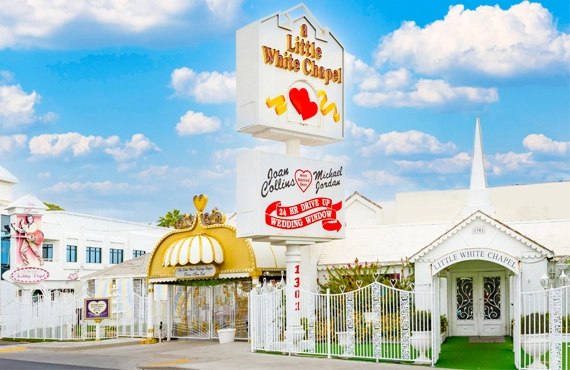
- The Little White Wedding Chapel: Perhaps the most recognizable chapel in Vegas is the Little White Wedding Chapel. The romantic spot has been a favorite for couples since it opened in 1951. It’s especially famous for its drive-thru option! You’ll find that this chapel is one of the top spots for quick, spur of the moment ceremonies and celebrity weddings.
- Graceland Chapel: If you want to channel your inner Elvis, look no further than the Graceland Chapel. Known as the first chapel to offer Elvis-themed weddings, it’s perfect for die-hard fans of the King. With the option to have an Elvis impersonator perform your ceremony or serenade you with classics like “Can’t Help Falling in Love,” the chapel has a little bit Vegas and a little bit rock and roll.
- Chapel of the Flowers: Another gem is the Chapel of the Flowers, and it’s loved for its elegant décor and exceptional service. The chapel has various wedding packages, and their beautiful flower arrangements and professional photographers make it a fav among couples who want a classic, yet chic ceremony.
Popular Themes
Don’t want a conventional wedding ceremony? Not a problem in Vegas, baby! There are themes galore!
- Casino Weddings: When in Vegas, it only makes sense to tie the knot in a casino! Some resorts have wedding packages that include ceremonies with a backdrop of glittering lights and extravagant decor. You could be saying your vows with the sound of slot machines in the background and the stacking of poker chips nearby. It’s an energetic, fun setting that perfectly captures the vibe of Vegas.
- Roller Coaster Weddings: For the thrill-seekers out there, a wedding on a roller coaster might just be the ultimate rush. The Stratosphere Tower and the New York-New York Hotel have couple’s packages that let you exchange vows way up in the air while riding the roller coasters. Make sure you have a strong stomach and aren’t afraid of heights if you go this route!
- Zombie-Themed Weddings: And for those who want something weird and slightly off-putting, there are zombie-themed weddings! Several chapels in Vegas, like the Las Vegas Zombie Apocalypse Wedding Chapel, give couples the chance to get married in a frightfully fun way—complete with props and “zombies!”
- Unique Venues: Vegas also boasts novel venues like aquariums, botanical gardens, and helicopter tours over the Grand Canyon. Whatever your preferred vibe—be it elegant, adventurous, or whimsical—there’s a perfect backdrop in Vegas that is waiting for you and your significant other.
Renewal of Vows
Las Vegas reignites love for couples long after their wedding day. The bright lights and bustling atmosphere compel so many couples to take a trip to the city for a vow renewal ceremony. The tradition not only reaffirms commitment but is also a fun getaway!
The attraction of renewing your wedding vows in Vegas lies in the combo of nostalgia and fun. Couples could go back to the same chapel where they first tied the knot, or opt for a totally new adventure that reflects their journey together.
Some couples will go all out for vow renewals, incorporating wacky themes and fun elements. Whether it’s a classic ceremony or something more playful, Vegas gives people a chance to honor their love story. Revisiting Sin City for a vow renewal encapsulates everything Vegas stands for—celebration, joy, and adventure. It’s a reminder that love can be as exciting and unexpected as the city itself!
The Economic Impact of Las Vegas Weddings
Las Vegas is a wedding mecca, and that means that the weddings generate a ton of economic activity that reverberates throughout the city. But what are the actual numbers for the annual revenue generated by weddings? How does wedding tourism boost associated industries? And what’s the impact on local employment?
Love isn’t the only thing in the air—the Vegas wedding circuit brings in some serious cash! The wedding industry in Las Vegas is a potent financial force, contributing billions of dollars to the local economy each year. While hard numbers do fluctuate, estimates indicate that the wedding business in Nevada rakes in over $2 billion annually. Every ceremony brings in revenue not just for the venue but for a host of local businesses.
Couples flock from around the globe, drawn by the attraction of quick, affordable ceremonies and scenic locations—be it the iconic Las Vegas Strip, breathtaking gardens, or the aforementioned helicopter tour over the Grand Canyon. The process is streamlined, so it’s easy for couples to say “I do” without the months of planning that conventional weddings usually call for. This means that Las Vegas effectively capitalizes on the wedding boom, resulting in a constant flow of cash into the city’s economy. It’s not just a quick romance—these weddings are a full-fledged financial affair!
Wedding tourism doesn’t operate in a vacuum; it creates a ripple effect that boosts a number of other associated industries. Hotel and resort bookings surge—couples and their guests need places to stay, and transportation services—like taxis, limousines, and rideshare companies—experience a nice uptick in demand. And let’s not forget the casinos! While guests may come for the wedding, they want to partake in all of the different entertainment options that Las Vegas has before and after the big day.
Catering businesses, florists, photographers, and bakeries all see increased activity around the wedding season, too. Couples are not just ordering cakes; they’re planning receptions, paying for luxurious floral arrangements, and hiring photographers to capture the special moment. The boost in different sectors does a lot for sustaining the local economy. And as they say in Las Vegas, the more, the merrier!
The wedding industry doesn’t just fill the city’s coffers either; it creates a lot of jobs! From officiants and wedding planners to hospitality workers and event coordinators, the employment spectrum is broad and diverse. Think about it: if you’re getting married in Las Vegas, you’re most likely going to need a range of services, which translates to job opportunities at every level of the industry.
These roles are important for making each and every wedding a success. Couples enlist the help of florists, book photographers, and hire DJs to keep the dance floor jumping. Additionally, hotels need cleaning staff, chefs for catering, and front-desk workers to assist guests. The demand generated by wedding tourism supports thousands of jobs, making it a busy ecosystem of employment options in the process.
And many of the jobs are flexible and cater to those who want part-time or seasonal work. The flexibility is especially valuable in a city that is known for its transient population and thriving tourism industry.
Unique Wedding Traditions and Rituals in Las Vegas
The “Wedding Capital of the World,” has a lot of unique wedding traditions that show off its colorful and unconventional spirit! From exchanging vows at drive-thru chapels to being serenaded by Elvis impersonators, and even tying the knot in a midnight ceremony, the practices are the epitome of Vegas’s “anything goes” culture. Below, we look at the iconic traditions that make Las Vegas weddings one-of-a-kind!
Drive-Thru Weddings
Drive-thrus aren’t just for fast food, and Las Vegas is known for its drive-thru wedding chapels—couples can get married without getting out of their cars! This particular tradition began in 1991 when “Tunnel of Love” opened at A Little White Wedding Chapel—couples are able to say “I do” in 15 minutes or less. The popularity of drive-thru weddings stems from their efficiency and the novelty of the experience.
The Elvis Officiant
Elvis-themed weddings are a staple of Las Vegas’s wedding industry. The tradition dates back to the 1970s when Elvis impersonators began officiating ceremonies, adding a fun and nostalgic element to the nuptials. Couples can choose from different packages that include Elvis walking the bride down the aisle, performing classic hits, and conducting the ceremony. It pays homage to Elvis Presley’s deep connection with Las Vegas and continues to be a super popular choice for those who are looking to infuse their wedding with a touch of rock ‘n’ roll.

Midnight Marriages
The pull of spontaneous, late-night weddings is a hallmark of Las Vegas’s “anything goes” culture. Most chapels operate 24/7, catering to couples who decide to marry in the early hours of the morning. The impromptu ceremonies symbolize the city’s nature of spontaneity and adventure, and lovebirds can seize the moment and make their commitment legal under the bright lights of the Strip.
Challenges and Criticisms of Las Vegas Weddings
Okay, so while we know that Las Vegas weddings are iconic, they aren’t without their fair share of challenges, criticisms, and common concerns, like the following:
Negative Stereotypes
Las Vegas weddings can come with a certain stigma that they’re “cheap” or “frivolous.” The perception stems from the city’s reputation for quick, impulsive ceremonies with the themed chapels or Elvis impersonators. Yes, these are all options, but they don’t represent the full spectrum of wedding experiences available in Vegas! Most venues host really elegant and personalized ceremonies that cater to couples who want a more traditional or upscale celebration. The diversity of options means that a Vegas wedding can be as simple or as elaborate as you want, and that challenges the notion that every wedding is not well-thought-out or insincere.
Short-Lived Marriages
The lore of Las Vegas is full of tales of impulsive weddings that quickly end in annulment or divorce (sorry, Britney). The ease of getting a marriage license and the abundance of 24-hour chapels contribute to spur-of-the-moment decisions that some couples may regret later on. While these stories are part of Vegas’s colorful history, they don’t account for the many couples who plan their weddings thoughtfully and have lasting marriages. After all, the outcome of a marriage depends more on the people involved than the location of the ceremony.
Local Laws and Controversies
Nevada’s marriage laws are designed to be accommodating, as there are no waiting periods and minimal requirements—this is why Las Vegas is such an attractive destination for couples. However, this kind of accessibility has caused concerns about the seriousness with which some couples approach marriage. To maintain the integrity of the institution, local authorities have implemented measures to make sure that ceremonies are conducted legally and respectfully. Officiants must be licensed, and marriages have to be registered with the county clerk’s office. The regulations uphold a balance of the city’s bustling wedding industry with the need to respect the sanctity of marriage.
Concluding Thoughts
Look, Las Vegas weddings are a good time, end of story. Don’t let anyone tell you that saying your vows in front of Elvis isn’t a fun way to seal the deal—they’re either boring or jealous that they had to pay a mint for their nuptials, and it took over a year to plan!
Look below for a quick recap of all things Vegas weddings:
- Vegas didn’t just put a ring on weddings—it turned them into an entire experience. From drive-thru vows to Elvis serenades, it’s a place where anything goes.
- With options that go from classic to outrageous, Vegas lets couples create a wedding that’s as weird or as heartfelt as they want it to be.
- Las Vegas has made weddings fun, flexible, unforgettable, and a cultural staple—saying “I do” doesn’t have to follow the usual rules.
Las Vegas weddings put their money where their mouth is—it’s a place that says, “Love how you want, when you want,” whether it’s a 4:15 a.m. chapel dash or a planned celebration. Vegas welcomes everyone, no matter the style or story, and that’s what makes it an iconic cultural phenomenon. Love, laughter, and some of that Las Vegas magic—is there anything better?
How do you feel about Las Vegas weddings? Have you ever been to one, or did you get married in Sin City? Tell us in the comments! If you enjoyed this article, be sure to check out others on our blog.
The 20 Weirdest Things Ever Witnessed in a Casino
Casinos have never been accused of being boring, that’s for sure. There is always something happening at these entertainment hubs, including entertainment, conventions, dining for days, conventions, and, of course, gambling.
If you’ve ever been, you’ve probably seen some, um, weird stuff. The stories are posted all over the internet for everyone to read if you haven’t witnessed them with your own eyes. Although we have seen some things, we thought we’d gather first-hand accounts of people who have observed the oddest behaviors and reported back to the masses.
Don’t worry; we are gonna keep it PG-ish—we don’t want to scare you from visiting a casino! But if any of the weirdest things ever witnessed at a casino spook you, you can always play from home on a gambling site.
Look, things tend to get a little wilder when you add booze into the mix, and at casinos, if you’re gambling, the booze is free and keeps coming (unless you get cut off by the pit boss or security). Throw money on the line into the equation, and you’ve got a perfect storm for not just weird but crazy behavior. We’re going to start off with something that I personally witnessed in good ol’ Las Vegas and then go from there!
The Cowboy Convention Crasher
My first time in Vegas, our trip just happened to coincide with a cowboy convention. And hoo boy, there were a lot of git-along buckaroos in attendance. The presence of them didn’t seem to bother anyone—except for a group of what I can only assume were Wall Street bros.
On our second night there, these dudes were with us at the roulette table and drinking double whiskeys or double anythings—they were soused. And the decorations that were put in place for the cowboy event were visible from the casino floor. One of the dudes kept staring at a giant cowboy boot that was made out of intricate LED lights and muttering obscenities. A few losses and several double whatever’s later, he stands up, pushes his perfectly ironed pinpoint Oxford sleeves to his elbows, and takes off running.

His friends were calling him, and a foot chase ensued, but this man was charging at the big cowboy boot like a bull toward a matador. Of course, we followed—we’re nosy! And the Wall Street bro did NOT disappoint. He took a running leap and tried to tackle the big boot while my friends and his friends watched. Did he beat the boot? Nope. Did he manage to get tangled up in the strings of LED lights and cause a ruckus? Yep. It was honestly one of the funnier things I have ever seen in my life—what was even funnier is that he was frogmarched out by security while his friends tried to plead with them to let it slide. One security guard said, “You’re lucky we’re just bouncing him and not calling the cops,” which shut the bros up pretty quickly. The moral of the story is this: he fought the boot, and the boot won.
The Abandoned Car
This was posted on Listverse by a casino employee:
“One aspect of my job was bicycle patrol of the three-level parking garage. All things considered, I enjoyed patrol days because it got me out of the stuffy, smoke-filled casino and gave me a chance to exercise. It also meant, most of the time, that I didn’t have to deal with bothersome guests. But that isn’t to say that it didn’t present other, more interesting situations.
“I remember being on patrol one day and coming across a vehicle in the garage that I could have sworn was in the process of being stripped. All four doors were wide open, and no one was about. I observed the scene for a few moments, then called it in to dispatch. They had me remain on the scene while they tried to locate the owner of the vehicle.
“After several minutes, they radioed to tell me to go ahead and close and lock the doors. Apparently, a guest had forgotten to close up the car. How can you be in such a hurry to gamble that you forget even to close your doors, never mind lock them?”
The Little Man in the Slot Machine
Some gamblers are super superstitious, always relying on rituals, lucky charms, and all sorts of odd habits to try and win over Lady Luck. A casino worker said he has seen “People drape amulets over machines, rub garlic on them, or even stuff it inside.”
Others have tried rubbing money on women’s chests or behinds—basically, if it might work, someone’s tried it. His wife, who’s Asian and used to work as a cashier at the casino, was constantly asked to rub bills on her shirt to “give them Asian luck.” And people would get downright furious if housekeeping cleaned a machine they’d been playing for a while, claiming it would “wipe off the luck.”
There was one woman who he’ll never forget.
He was walking through the slots area when she grabbed my arm and said, “Can you tell this machine to let me win?”
He was caught off guard, but he told her, “Ma’am, the machine doesn’t take orders. It’s just a machine, and there’s no magic button we can press to make it pay out.”
She looked at him, completely serious, and said, “I know that. I want you to tell the little man inside the machine to pay me.”
He was floored, trying to make sense of what she’d just said.
She went on, “I know there’s a little man inside who can see me, and he’s not letting it pay off because I’m black! But I’ve been playing this machine all day, and it owes me some money.”She was so convinced, and even after he got a slot tech to open up the machine and show her there was no one inside, he didn’t think she believed it.
The Peeing Bandit
This next one is gross, so skip it if you don’t want to be traumatized:
“A well-heeled woman about 40 years of age who would come into the casino on a regular basis each week. We don’t know if her problem was incontinence or stupidity, but she would sit at a slot machine until she urinated on the seat and would then move to the next one in the row. I recall one day, she soiled no less than six seats.
We weren’t permitted to confront her on the issue, as she spent a considerable amount of money in the casino. Instead, as soon as she left for the day, housekeeping would run over and retrieve the soiled seats, replacing them with fresh ones.”
A Goat in a Pink Tutu
We don’t know how to explain this, and neither did the person who saw it. But they did have the presence of mind to snap a pic of the pink tutu-wearing goat, which we thank them for.
The Runners
It was 4 a.m. in Vegas. The guy next to me loses his last $5 bet, then suddenly reaches across the table, grabs two handfuls of $500 chips, and bolts. Security was everywhere in seconds. I looked over at this older guy and said, “Did you just see that?” He just nodded and said, “Yup, that’s Vegas for you.” It was insane.
When I came back the next day, all the $500 chips were gone, swapped out for $100 ones. It was my first time in Vegas, and I couldn’t believe what I’d just witnessed.
That night, there were two friends playing at the same table. They both handed over their IDs to get players’ cards. One guy loses his money, snatches a bunch of $500 chips, and takes off running. His friend, who had the car keys, just sat there, waiting for security. Now, they’ve got those plastic shields over the purple, black, and green chips because of stuff like this.
I remember thinking, “Did that really just happen, and did anyone else catch that?” The way everyone just froze actually shocked me more than the guy stealing the chips.
Another Runner
We have yet another runner! On Quora, someone posted that they once saw a guy grab a handful of cash chips from a table that was closing and take off running. He sprinted right into a mirror—despite clearly seeing his own reflection—and bounced off, completely dazed. As he tried to catch the chips that went flying out of his hands, he hit the ground, and security tackled him like a linebacker.
The Unlucky 7 Mascot
“A few years back, while waiting for a seat, I was watching a craps game on a blazing hot table. The shooter was on fire and it was one of the most pumped up craps tables I’ve ever seen. It was packed and everyone was loud, having a great time,” said a poster on Reddit.
The casino was running some promotion for a lottery or slot game, and they had a group of people wandering around handing out freebies, along with a guy in a mascot costume—a giant Number 7.
They made their way over to the craps table, and I still crack up when I think about how everyone completely lost it, from the players to the dealers, supervisor, and pit boss. This giant Number 7 stood about four feet away from the hot shooter, and the costume was massive—the top of the 7 had to be eight or nine feet tall.

The poor guy inside had no clue why everyone suddenly started hating on him. Of course, the table 7 outs right away, and all heck breaks loose.
“I’ll never forget this little old man screaming at the 7, ‘I hope you get syphilis, syphilis, SYPHILIS!’
“It’s hard to convey how much pandemonium broke out, though; I’ve never experienced the mood of a large group of people shifting so suddenly or dramatically.”
The Trash Can Borrower
Years ago, two buddies and I headed to our local casino, about an hour and a half away, to play some poker. We got pretty hammered and ended up on a 12-hour session.
By 8 a.m., the free donuts were out for the poker players, and one of my friends says he’s going to the car to do a couple of shots and smoke a cigarette. By this point, the other friend and I had sobered up.
About 45 minutes later, the friend who went to the car comes back wheeling a dolly marked “property of the casino.” On the dolly, he’s got one of those big metal bar trash cans with the wide rim—the kind that makes you want to “Kobe” your trash from 15 feet away because you just can’t miss it.
The floor staff immediately confronts him, asking what he’s doing. His explanation? He wanted to tell another poker player that they were trash.
He got kicked out, and we all ended up leaving. We still crack up about it to this day.
The Senior Citizen Throwdown
On Reddit, a person recalled that while “Dealing a seniors poker event about 10 years ago; we’ve got a bunch of temp tables set up and they’re kind of close together, well the old guy in my 8 seat sits down in his chair and bumps the old guy behind him who turns around and starts b*tching at him about it and they start arguing back and forth, they get scooted around a little so they’re sitting down but kind of side facing each other- shouting -pushing and eventually sort of slow punching each other then… they started cane fighting 🤣. I was asked by a guest if I was going to break it up.. ‘nope’🤣.”
The Table Flop
A gambler was playing on one of those casino boats in Louisiana when a guy completely lost his mind after a huge bad beat. He dove onto the table, flailing around and sending chips flying in every direction. Security jumped on him right away, but it took them hours to go through the camera footage and try to put all the chips back where they belonged.
I’ve always had my doubts about how accurate that chip count was afterward. But having worked at another casino for a few years, I’ve seen their surveillance room, and let me tell you, the clarity and coverage they have is unreal.
Caribbean Cruise Stud
“On a cruise ship; we’re playing Caribbean Stud (I know, I know; it’s all they had.) Anyhow, I’m sitting next to this big burly Irish lad (I’m 6’1″; he was at least 6’6″), and he was just getting his a** kicked.
“Like LARGE; he couldn’t win one bloody hand. The dealer is this little German kid that he was calling Hans (not the kid’s name). And he is just berating this kid about all of his losses. So at one point he asks for a marker to go to the bathroom; when he comes back he maxes his bets. Once he gets his cards, he’s yelling at the dealer ‘You better open, Hans. I mean it. I know there’s security here but I will be over this table WAY before they could come and help you.’ Dealer says ‘I am so sorry, sir; I have a full house.’”
“The Irishman yells ‘One, two, three four bullets!!!’ He had four aces, and that was one of the huge multiplier hands, and he was maxed. I think it was like $17K (and this was in the 80’s). He gave Hans a hug (and a couple hundred) and bought champagne for the table…”
No, Thank You, Carrot Top
“Carrot Top walked up to me and my friends and offered us free tickets to his show that night and my buddy said, ‘No thanks man, we got sh*t to do.’ Good times.” Guess they weren’t fans of the ginger-haired comedian.
The Oopsie
This one made me laugh so hard that coffee came out of my nose:
“My wife unknowingly picked up a ‘lady of the night’ thinking she was just super cool and friendly lmao. Went back to the casino hotel room and had a good time and when the topic of payment came up my wife flipped out like what? I thought we were friends, what’s going on here. Been laughing at that since that happened lol.”
I Do, Nope, I Don’t
On Quora, a commenter recounted, “A couple held their wedding in a banquet room of the casino. Towards the end after they were married and drinking a little he stopped the band for a cheers. He said the misses and I have saved for over 2 years and were getting this marriage off to a $200k start. (probably not the best thing to shout in a casino).”
They hugged, then headed to the casino floor—she joined the ladies, while he went with the guys to the high roller poker room.
Around 3am, the loudest scream I’ve ever heard echoed across the casino floor. A woman was all over a man, and the guards were struggling to pull her away. She said, “You son of a b*tch you blew not only the $200k we had saved but also took out a marker for $20k????”
She demanded an annulment on the spot. There happened to be a justice of the peace nearby, who may or may not have had the authority to end a marriage, but he went ahead and did it. She left with her friends, and I don’t know where he went.
“That was crazy.”
Eminem/M&M
“At a blackjack table in Tunica in the early 2000s Eminem walked up and sat down next to me. My buddy on the other end of the table kept surreptitiously pointing at him with wide eyes. I had no idea who he was but when I looked behind him he had a bodyguard standing behind him watching the passersby so I knew he was some kind of big deal. Finally it came out somehow that this was Eminem (maybe because my buddy was all ga-ga about it but I’m not sure.)”
“So leaned over and mentioned his bodyguard and that he must be somebody because most people don’t have a bodyguard.
“Yeah, I’m Eminem.”
“M… and M?”
“Eminem.”
“M & M? LIKE THE CANDY?”
“My buddy turned white and red all at the same time out of embarrassment for me. Everyone at the table laughed, and Eminem laughed.
“And then he relaxed and we chatted for a bit and I said I’d let him play because he was starting to attract attention. So we got up from the table and he invited us to some party. I remember the invite like it happened yesterday. (“8th floor at the Gold Strike, C’mon up.”)
“We thanked him and left. We didn’t go to the party despite my buddy’s pleas. I didn’t believe Eminem was serious, that he was just being nice.”
Casino Cat
A couple was staying at the Excalibur resort in Vegas when they started noticing some odd things in their room—objects in the bathroom were mysteriously knocked over, there were strange noises coming from the walls, and they even discovered what looked like urine in the shower.
The mystery was solved when they woke up at 4:00 A.M. one morning to find a cat staring at them in their room. They later learned that the previous guest had reported their cat missing, thinking it had slipped out. It turns out the cat had been hiding in the room for six days, with the couple unknowingly sharing their space with it for three days. The resourceful cat had survived by coming out at night and drinking toilet water.
Fortunately, the cat was OK and was reunited with its owner. And here’s the kicker: the couple who discovered the cat were both veterinarians and in town for a conference!
God, Is That You?
Another poster on Quora said they “Once watched this guy, completely wasted, somehow stumble into a disabled refuge area and was way too drunk to figure out how to get out. Just to clarify, a disabled refuge is a safe space with an intercom meant for emergencies where someone with a disability can wait for help. This guy, though, was crawling around on the floor, backward, like he thought the room might be bigger on the inside—kind of like the Tardis.
Security decided to reach out through the intercom. They said something pretty basic like, “Are you okay? Need some help?” What came next had us all dying laughing:
“God? Is that YOU, God?” he slurred, with this mix of drunken awe and confusion.
Without missing a beat, the security guy responded, “YES! This is God!”
And there he was, on his knees, babbling away, caught somewhere between religious ecstasy and total panic. It was honestly one of the wildest things I’ve ever witnessed.
The Wrong Button
We thought we’d end with a few feel-good “weird” stories as palate cleansers!
A gentleman was playing blackjack on one of the computer blackjack games in a casino, and the max bet was 3000. The man sitting next to him makes a max bet and is dealt 19 against a 6–he means to click stay but accidentally clicks double and ends up pulling a 2 for 21, and he made 6k off of clicking the wrong button.
The people who witnessed it said, “The whole table and a crowd of people were watching and we celebrated like we won the World Cup!”
The Lucky Lad
On Reddit, a commenter said, “I remember seeing a guy looking shocked, sitting talking to a security guard and nursing a cocktail at the Hippodrome in London. He couldn’t have been older than 25.
“Basically it transpired that he’d just won the jackpot at 3-card poker, which is usually only about £2k. However, he’d won £30,000 and had got a security guy to come sit with him to calm him down. It was essentially life-changing money for him. Those awesome moments just make casinos unlike anywhere else on earth.”
Final Thoughts
People have seen some truly wild stuff when they were just trying to have a good time at a casino! We hope you aren’t too freaked out by the stories—most of them are rarities, and casino security is always quick to jump into action.
What’s the weirdest thing you’ve ever witnessed at a gambling establishment? Tell us in the comments below!
The Influence of UX/UI Design in Making Online Casinos More Addictive
Gambling has gotten a serious upgrade in the last 10 years! It’s gone from the once smoke-filled physical casinos to our personal devices. You don’t have to do anything more than pick up your phone and log on to get your gambling fix—who would’ve imagined you’d be able to do that? But you can! And online casinos have changed gambling into a super accessible and visually appealing pastime. It has all of the colors of the rainbow, fun sounds, and seamless navigation. Gambling sites and apps draw players in, kind of like a virtual oasis of fun.
What might surprise you is just how much thought goes into the designs—online casinos aren’t only built to look pretty; they’re meticulously crafted to make gambling a continuous loop of endless possibilities. The user experience (UX) and user interface (UI) elements are anything but random—they are all carefully chosen to keep players playing. The point? To give users a nudge to make “just one more” bet.
We are gonna pull back the digital curtain to see exactly how the design choices impact player habits, influencing how people interact with online casinos and making it, frankly, addictive. To the way the colors and sounds prey on our emotions to the super subtle prods that encourage players to stay, let’s find out how what appear to be simple choices are actually keeping players coming again and again!
Understanding UX/UI in Online Casinos
Online casino apps have taken gambling off of the casino floor and right to our screens, and design has a major in how it keeps players engaged. Two big elements in this digital design are User Experience (UX) and User Interface (UI). The two concepts work in tandem to make a player’s time on the platform fun, and they each bring their own strengths with them.
User Experience, or UX, revolves around how a player interacts with a gambling site or app. In online casinos, UX design is used to make things easy to navigate so players can find games, understand the layout, and manage their accounts easily. The goal is intuitive navigation, quick load times, and clear instructions—platforms want to make a player’s journey through the platform feel effortless and enjoyable.
User Interface, or UI, is the visual side of an online casino experience. It’s what players see and interact with directly—the buttons, icons, colors, animations, and sounds that make the site or app come to life. UI design is optimally an inviting look and feel that holds a player’s attention and makes all interactions seamless. In online casinos, UI isn’t just about appearances; it’s made to keep players engaged with a visually appealing setup that’s simple to use.
In an online casino, UX and UI go hand in glove! UX keeps the platform simple to navigate so that nothing interrupts the player’s flow, while UI brings the excitement factor via visuals and sounds that grab attention. Together, they create an environment that means players come back with a setup that’s not only easy to use but also fun to explore!
Main UX/UI Elements That Improve Player Engagement
Online casinos have absolutely redefined gambling, taking the traditional casino experience and reworking it for the screen, all while keeping it accessible, engaging, and visually inviting. But what really hooks people? Behind the games and graphics are intentional design choices that make the experience both enjoyable and hard to leave. Below are the main UX/UI elements that all contribute to making that engaging environment!
Visual Design
A really central part of an online casino’s appeal is visual, and designers rely on stimulating colors, dynamic animations, and enticing graphics to create an atmosphere that feels both exciting and welcoming. Colors like red and green aren’t just chosen randomly—they’re actually rooted in color psychology, which shows how specific shades can influence emotions and decisions. Red, for example, is proven to evoke energy and excitement, and green is seen as a positive hue.

Animations add another element in terms of making games feel lively. Spinning reels, flashing icons, and subtle movements draw the eye, so the screen is active and engaging. Every tiny detail, down to a glowing button or a moving icon, is thoughtfully designed to hold a player’s attention. By tapping into color and motion, visual design creates a space that’s not only attractive but also energizing.
Reward Feedback Loops
Every single win, bonus, or spin comes with sounds and animations that make for a quick, satisfying “wheeeee!” And this feedback system isn’t just for decorative purposes; it triggers a feeling of reward by tapping into the brain’s natural reward cycle and releasing a hit of dopamine with each “win.” Moments of gratification build up, and that reinforces a player’s connection to the game.
The feedback loop doesn’t rely solely on big wins to make gameplay exciting—the smaller victories also play into it. All of the little celebrations keep players connected to the experience, building a steady rhythm that makes ordinary, non-winning spins seem like an accomplishment. Eventually, even little hits of excitement make gameplay more fun and fulfilling, and that encourages players to continue exploring.
Straightforward Navigation and Accessibility
Online casinos know some things and one of them is that a confusing layout or hard-to-navigate site will turn players off—and away from the platform. That’s why simplicity is so important. When there are well-organized menus, clear icons, and intuitive categories, it makes it easy for players to find their way around. It doesn’t matter if they’re looking for a specific game or just browsing—a good online gambling site knows this.
Navigation tools like filters, search bars, and favorites lists make it even easier to find exactly what users want. A straightforward platform guarantees that players will spend more time enjoying the games and less time trying to wrap their heads around how to use the platform.
As mobile gaming continues to get bigger, the accessibility across different devices is absolutely necessary. The experience on a phone or tablet should feel just as smooth as it does on a desktop. A responsive design lets players switch between devices, taking their favorite games with them without any snafus or interruptions. And flexibility means players can play anytime, wherever they happen to be, without any loss in quality!
Personalization Features
A personalized experience goes far in making players feel appreciated, and online casinos will remember previous game choices, suggest new ones based on playing habits, and hand out loyalty rewards like candy on Halloween. Profiles, loyalty programs, and tailored game recommendations build up a sense of familiarity and can make each player’s experience feel like it was made for them.
For example, most casinos have loyalty systems where players can earn points or rewards based on their activity. Logging in to see a set of game suggestions that match a player’s preferences or a reward that recognizes their playtime adds to the feeling of connection. Personalization can turn what could be a generic site into a much more engaging and customized space.
Loading Speed and Performance
There are very ew things that are as disruptive to gameplay as a dreaded lag or slow-ish load times, especially in high-energy games. Online casinos focus on delivering the fastest load speeds and smooth animations to avoid these issues. By optimizing performance, casinos provide an experience that is polished and uninterrupted.
Players benefit from a responsive platform that keeps up with them so that their focus remains on the game in front of them instead of being interrupted by technical glitches. Platforms are fine-tuned to run well across a range of different devices and internet speeds, so that players will have a reliable, high-quality experience.
Psychological Tricks in UX/UI Design to Increase Play Time
Online casinos are way past just offering players games—they’re crafting an entire experience that is specifically designed to keep players playing. With clever design elements that leverage human psychology, the platforms can draw out playtime, reeling players in and getting them to stick around for longer. How do they do it? With features like infinite scrolling, progress bars, and gamification—all of which exist to gently nudge players to stay logged in for longer periods of time.
Infinite Scrolling and Endless Games
Infinite scrolling is a super common design feature, nowhere more than on social media platforms, where the content continues to load as you scroll, so you never quite reach the “end.” The concept, which can be really addictive, has obviously found its way into gambling sites. It shows up in the form of an extensive and seemingly never-ending library of games, with new options being just one click away. There’s always another game to try, and players usually find themselves checking out the selection for way longer than they might have planned.

The approach taps into what’s known as the Zeigarnik effect—a phenomenon where people tend to remember unfinished tasks better than finished ones. When a player has so many options, there’s a lingering sense that they haven’t tried everything, and that makes them curious, so they come back to look again. In a way, the abundance of choices makes the platform feel like it’s always full of new things to uncover, and this can be a big motivator for players to stay logged in.
Another subtle aspect of infinite options is the low commitment. Players can hop from game to game without pausing, moving through options with the same fluidity they would if they were scrolling on social media. It’s effortless to keep trying new games, especially if the casino interface is designed with clear categories, suggestions, or a “for you” section that makes browsing seem like it was tailored to you.
Progress Bars and Leveling Up
Progress indicators, like bars, levels, or badges, are some of the most powerful motivators in UX/UI design. When players are able to see their advancement—via levels, points, or loyalty statuses—they’re given a concrete sense of progression, and that can be super engaging. Online casinos lean on this concept heavily in programs or achievement systems, and every completed level or milestone feels like a step toward a reward.
Psychologically, “leveling up” taps into our desire for growth and mastery. Seeing a progress bar fill up or unlocking a new status, gives players a little dopamine boost, much like achieving a goal in real life. This feeling of progression is highly satisfying and keeps players coming back to see how far they can go. It’s a subtle nudge that tells players, “You’re close—just a little more time, and you’ll get to that next level!”
For players, these progress indicators make the platform feel like more than just a series of games; it becomes a journey with milestones and achievements. Players might initially sign up to play a game or two but find themselves motivated to play longer, aiming for the next status level or reward. The platform will even add countdowns or reminders, highlighting how close players are to their next reward. This adds a sense of urgency, prompting them to spend more time reaching their goals.
Gamification
Gamification brings in game-like features—missions, tasks, badges, and rewards—that can add a whole new layer to the experience. Rather than just playing games, players are given challenges or “missions” that reward them for specific actions, like playing certain games, achieving a winning streak, or hitting milestones. This strategy keeps things fresh, adding little twists that give players more reasons to stay active on the platform.
Basically, gamification exploits our innate drive for accomplishment—completing tasks or earning rewards satisfies the basic human desire for achievement, so players have a sense of purpose along with the immediate thrill of gambling. The approach also creates a cycle where players feel like they’re working toward something, even if it’s only a virtual badge or a small bonus. By gamifying certain elements, online casinos make the experience feel more dynamic and goal-oriented.
Rewards are a huge part of gamification. For instance, players might earn virtual coins, bonus rounds, or loyalty points, which they can collect over time.
These rewards don’t just add an extra layer of enjoyment; they also serve as mini-achievements that keep players coming back. When players feel like they’re accumulating something, they’re more inclined to keep playing, building a sense of loyalty to the platform.
Some platforms take gamification even further–there are time-limited challenges or daily missions, and this builds a sense of urgency. If you know that a reward or task will expire soon, you’re going to spend extra time trying to get there, right? You don’t want to miss out on the opportunity to complete it, which is where the psychological FOMO (fear of missing out) comes into the equation, and it usually means players will engage more often and consistently.
Social Interaction Features and Their Role in Addictiveness
The modern casino landscape has turned gaming from solo play to one that’s full of social interactions. They’ve integrated features that let players chat, compete, and track their progress against others, thus making an environment that feels lively and connected. Let’s see how elements like in-game chat, multiplayer options, leaderboards, and tournaments contribute to an immersive—and, at times, addictive—gameplay.
In-Game Chat and Multiplayer Options
In-game chat and multiplayer functions introduce a social layer to online casino games that haven’t always been present. Players can now interact with others in real-time, sharing reactions, swapping tips, and celebrating wins together. The chat function allows players to feel part of a broader community, turning a solitary game into a shared experience.
The social features capitalize on another powerful aspect of human psychology: social reinforcement. When players share their wins or engage in conversations during gameplay, they get a sense of validation from others. This social reinforcement can enhance the enjoyment of each game, as players feel both individually successful and collectively connected. There’s also a bit of Fear of Missing Out (FOMO) at play. Knowing others are actively participating can encourage players to stay engaged so they don’t miss out on shared experiences or special moments within the community.
Multiplayer games add an extra layer of connection by enabling direct competition or collaboration with other players. Players can join tables together, team up, or compete head-to-head, adding to the excitement. The ability to play with or against friends or other online users makes each game feel more engaging, creating a social loop that brings players back again and again.
Leaderboards and Tournaments
Leaderboards and tournaments introduce an entirely different level of competition, transforming the casino experience from casual play into a race for the top. Leaderboards display where players rank compared to others, motivating them to improve their position. This simple element taps into the desire to achieve and excel, prompting players to keep going as they climb the ranks.
The competitive spirit fostered by leaderboards can lead players to push their limits, sometimes staying longer than they intended just to see their name higher on the list. For many, it’s not just about winning in a single game—it’s about achieving a spot in the top rankings, which brings a sense of accomplishment and recognition.
Tournaments build on this competitive energy by offering structured events with prizes and special rewards for top performers. These events, which are often time-limited, encourage players to participate more frequently to improve their chances of winning. The time limit on tournaments creates a sense of urgency, which can prompt players to play more intensively, revisiting the game throughout the day or week.

Tournaments add another layer to the gaming experience by giving players something to work toward. Competing for a spot at the top, particularly when prizes or prestige are involved, keeps players coming back and makes the overall gaming experience more dynamic.
The Ethics of UX/UI in Online Casinos
Online casinos have gotten scarily good at crafting designs that lure people in—every button, color, and animation is placed where it is with intention. But there’s a bigger question here—how far is too far? As all digital spaces use increasingly engaging design techniques, they also raise some ethical questions. At what point does encouraging play cross into promoting addiction? Below, we break down some of the more controversial design choices, look at transparency efforts, and examine how the industry is straddling the fine line between engagement and responsible gambling.
Questionable Design Choices
Some design choices in online casinos are obviously made to keep players immersed. For instance, the combination of colorful graphics, sound effects, and easy-to-navigate menus creates an experience that feels pretty much seamless. Features like endless scrolling through games, flashy animations after every win, and constant notifications can make it tempting to keep playing “just a little bit longer.”
This raises some ethical concerns—design choices such as these draw upon psychological triggers, and that encourages players to spend more time and money on the platform. In the design world, tactics that push users toward more screen time are sometimes called “dark patterns.” They’re not inherently bad, but when used in an environment like online gambling, they can exploit vulnerabilities. Designers face a dilemma—how to make an engaging platform without creating something that might be addictive.
Many argue that designers and casino operators should share responsibility for player well-being. While their goal is to create a fun and engaging experience, they also need to consider how certain design elements may impact users who are prone to gambling addiction. Striking this balance isn’t easy, especially in a competitive industry where engagement is key to business.
Transparency and User Awareness
One way online casinos can address these ethical concerns is through transparency. When players can clearly see information like account balances, time spent playing, and betting histories, they’re more equipped to make informed choices. Features like balance trackers and session timers can give players a sense of control, making it easier to recognize when it might be time to take a break.
Adding in “reality checks”—alerts that pop up to remind players of their playtime or betting habits—can further promote self-awareness. These gentle nudges remind users of their activity and can encourage reflection.
For example, a simple notification saying, “You’ve been playing for an hour,” can prompt players to take stock of their time and spending.
Giving players tools to set limits is another step toward responsible design. Self-exclusion options, deposit limits, and bet caps are features that let players define their boundaries. When easily accessible, these tools empower users to make mindful choices. Transparency, when woven into the UI, gives players the information they need to stay in control of their gambling habits without feeling pressured.
Industry Regulations
In recent years, regulatory bodies have begun to take a closer look at how UX/UI design in online casinos affects player behavior. Some regions have introduced guidelines requiring casinos to implement responsible gambling features. For instance, the UK Gambling Commission mandates that online casinos include tools like time limits, financial limits, and reality checks, so players have options to manage their gameplay responsibly.
Some online casinos have responded by adding self-exclusion features, allowing players to block themselves from accessing their accounts if they feel their gambling is getting out of hand. Deposit limits are another option, letting players set the maximum amount they can spend in a certain period. These moves reflect a shift toward a more responsible gaming environment.
However, there’s still a lot of debate over how far regulations should go. Some argue that casinos should do more to help players manage their gambling habits, while others believe that too many restrictions could hinder the user experience. Finding a middle ground that balances player safety with an enjoyable gaming experience remains a challenge for the industry as a whole.
How Users Can Recognize and Manage Addictive UX/UI Designs
Online casino platforms are designed with features that are meant to engross players, but it’s helpful to be able to recognize the design choices that make gameplay feel more intense or harder to walk away from. By understanding common UX/UI elements that are made to amplify engagement and knowing the ways you can manage your playtime, you will be able to have fun and be mindful of your gaming habits!
Awareness of UX/UI Triggers
Online casinos usually use subtle design techniques to make the experience feel seamless and immersive. Visual and auditory cues, for instance, are particularly effective. Bright flashing lights after a win or the constant appearance of buttons that encourage more play can reinforce the desire to continue. Sound effects, like celebratory jingles that play with each spin or win, create small bursts of reward, making actions feel more satisfying and giving the impression of “mini-victories.”
Notifications and time-sensitive prompts can also play a role. Pop-ups reminding users of bonuses about to expire or highlighting limited-time events can create a sense of urgency, making it harder to pause. Recognizing these patterns and understanding how they affect your own play habits can help you make more mindful choices.
Tips for Managing Play Time
Once you’re aware of what tends to engage you more intensely, setting clear boundaries can help.
- One approach is to create personal time or spending limits before even logging in. This might mean deciding in advance how much time you want to spend or setting a budget that you’ll stick to no matter what. Knowing your boundaries upfront can make it easier to stop once you reach them.
- Using time-tracking apps or built-in reminders is also useful for staying mindful of how long you’ve been playing. Some online casino platforms include session timers or reality checks that pop up after a certain period, encouraging players to take breaks and assess their time spent. When available, these tools can be beneficial for staying in control.
- Another option is to opt for games that offer a slower pace or don’t rely as heavily on stimulating visuals and sounds. Games that feel more relaxed or have natural stopping points can make it simpler to pause when you’re ready. Exploring games that align more with a calm experience can help maintain a sense of balance during play.
Resources for Help
For those who are finding it hard to maintain limits on time or spending, there are so many helpful resources dedicated to supporting responsible gambling! Most countries have helplines and websites focused on providing guidance and assistance for anyone who might be struggling.
For example, the National Problem Gambling Helpline in the U.S. (1-800-522-4700) and BeGambleAware in the U.K. (0808 8020 133) offer confidential support.
Some online casinos also collaborate with organizations that support responsible gaming practices, and these sites often offer information on self-exclusion programs. These tools give players a way to temporarily block themselves from accessing their accounts, providing a practical option for anyone who feels they need a break.
Support groups, both online and in-person, can also be valuable resources. Programs like Gamblers Anonymous create spaces where individuals can connect with others facing similar challenges. These groups often provide resources, meetings, and online forums where players can find guidance and community support.
Conclusion
Alrighty, let’s put a pin in this for now. We covered a lot of ground about how online casinos use cool designs so that things stay interesting—and, in doing so, make it harder to stop playing!
Here’s a quick rundown of what’s going on behind your device screen:
- Flashing Lights and Fun Sounds: The celebratory sounds and colorful graphics aren’t just for show—they exist so that every spin feels like a win.
- Infinite Games and Scrolling: With endless games and seamless scrolling, there’s always “just one more” to try.
- Levels, Points, and Progress Bars: Small achievements, badges, and progress bars give us that adrenaline rush, which prods you to keep on going.
- Social Features and Leaderboards: Chats, tournaments, and rankings give players a sense of community—and some competition that can be super hard to resist.
Final Thoughts
Here’s the plain truth: knowing what the design tricks are doesn’t mean that you can’t still play them and have fun! If anything, it puts you in control. When you are clued into what’s happening, you’re able to keep it fun and not let it rule over your gaming habits.
The next time you log in, keep an eye out for the tactics we went over. Set boundaries that work for you and play on your own terms. Online casinos are meant to be entertaining, and awareness will help you enjoy them without feeling like they’re the ones running the show.
Microbetting Explained: The Next Big Thing in Sports Betting?
Everyone is always blathering on about “the next big thing” in different industries. Sometimes, it’s actually a big thing, and others, it’s a big ol’ nothing burger. Well, we are pleased to report that there is a “next big thing” in sports betting, and it’s called microbetting.
What is this trend that sounds like it’s part of an Introduction to Econ class that’s got the sports betting world so excited? Well, instead of the usual bets on a game’s final score or winner, microbetting is for real-time moments—like betting on the next play in a football game or the outcome of a single pitch or hit in baseball. It’s quick, it’s immersive, and it keeps fans glued to all of the action.
But what exactly is fueling the new trend? Is it merely the rush of constant action, or could it become a staple of sports betting? We’ll unpack how microbetting is different from traditional betting, why it’s bringing in so many fans, and some of the obstacles it might bump into!
What Is Microbetting?
Microbetting is a newer take on sports wagering that zeroes in on the instant, bite-sized moments within a game. You aren’t placing bets on the final score or overall winner—microbetting lets you wager on specific events as they are happening! It’s a different and fun way to wager that keeps fans connected to every part of the action.
Types of Microbets
Microbetting opens up a whole new world of possibilities for bettors—they’re able to bet on all kinds of in-game events, like the following:
- Next Player to Score: Predict which player will put points on the board next.
- The outcome of the Next Pitch (Baseball): Bet on whether the upcoming pitch will be a strike, ball, or hit.
- Result of a Specific Drive (Football): Wager on the outcome of the current offensive drive—will it end in a touchdown, field goal, or turnover?
- Next Play Type (Football): Guess if the next play will be a run or a pass.

- Next Point Winner (Tennis): Predict which player will win the upcoming point.
- Next Free Throw Outcome (Basketball): Bet on whether the next free throw will be made or missed.
- Basketball Rebounds: Wager on which player will grab the next rebound.
- Football First-Down Outcome: Predict if the next first down will be converted or stopped by the defense.
- Soccer Throw-In Location: Bet on where the ball will re-enter the field after a throw-in.
- Next Serve Outcome (Tennis): Will the next serve be an ace, a double fault, or returnable?
- Basketball Three-Point Attempt: Guess if the next shot attempt will be a three-pointer or a standard field goal.
- Penalty Outcome (Soccer): When a penalty is awarded, predict if it will result in a goal, a miss, or a save.
- Hockey Shot Outcome: Bet on whether the next shot will score, be saved, or miss the net.
- Golf Shot Landing: Predict if the golfer’s shot will land on the green, in the rough, or somewhere else.
- Next Yellow Card (Soccer): Place a bet on who will get the next yellow card.
How Microbetting Works
How does it all work? Good question! Next up, we’ll unpack how it all works—from the fast decisions made during each bet to the technology that keeps everything running like a well-oiled machine. We’ll also explore the role of live data feeds, odds, and the platforms that are designed to handle the pace of microbetting.
Real-Time Betting Process
In conventional sports betting, wagers are always placed before a game starts, and they are focused on outcomes like the final score or the overall winner. Microbetting changes that and focuses on the immediate, in-game events. Bettors can place wagers on things like the result of the next play in basketball, the outcome of a single serve in tennis, or the next goal in ice hockey. The bets are over within seconds or minutes, so that means instant feedback and gratification!
The whole process is pretty straightforward:
- Selection of Event: Bettors choose a specific in-game event to wager on, such as the next play type in a football game.
- Placement of Bet: Using a sportsbook’s platform, the bettor places a wager on the selected event. Given the rapid nature of microbetting, decisions have to be made very quickly.
- Outcome Resolution: The bet is settled almost immediately after the event happens, so the bettor knows the outcome without having to wait until the game ends.
The Role Technology Plays
The feasibility of microbetting all hinges on advanced technology and real-time data processing, and several main components make it all possible:
- Live Data Feeds: Accurate and instantaneous data feeds are essential. Companies like Sportradar provide real-time information on game events, which is crucial for updating odds and settling bets promptly.
- Machine Learning and AI: Sophisticated algorithms analyze live data to generate odds for various micro-events. For instance, Simplebet utilizes machine learning models to create play-by-play odds in Major League Baseball, processing historical data and real-time inputs to offer precise betting opportunities.
- Responsive Platforms: Sportsbooks have to have platforms that are capable of handling the quick-paced nature of microbetting. This means user-friendly interfaces that allow for quick bet placement and real-time updates. Companies like nVenue provide enterprise platforms that are powered by machine learning and artificial intelligence, processing massive amounts of data to deliver new live betting markets with sub-second latency.
- Low-Latency Streaming: Low-latency streaming services are a must to guarantee bettors are viewing all events in real time. Delays can cause discrepancies between the actual game and the betting platform, affecting the betting process’s integrity.
Why Microbetting Is Gaining Popularity
Why is microbetting getting so much love? There are a lot of reasons! One is that it suits different types of bettors, which is a big reason. It’s gaining momentum for the following reasons as well!
Instant Gratification Appeal
One of the biggest draws of microbetting is how it satisfies the basic human desire for immediate results. Traditional bets are made on an entire game or season and won’t suit those who want instant feedback. But microbetting is built for quick returns—wagering on the next pitch, one single play, or a short sequence in real-time. Bettors don’t have to sit through the whole thing to see how they did, and that quick payoff keeps the hype high. It’s super appealing to those who like action that doesn’t drag out, so the betting experience is as fast as what’s happening in the game.
More Game Engagement
Microbetting also changes up how fans interact with a game—instead of putting one bet down and waiting for the results, they can now make predictions on different real-time events, so they are locked into the action as it is happening right in front of them. Every second becomes more exciting because there’s something at stake in each play, shot, or drive. The level of interaction tends to make viewers feel more connected to the game, especially during what would normally be the slower parts. Bettors are active participants, not just spectators, making games feel jam-packed with mini-events and chances to win.
Appeal to Younger Audiences
Microbetting matches up well with the preferences of the younger gens, as they are used to digital interactions that happen in real-time. Younger bettors who have grown up with social media updates, notifications, and instant responses see microbetting as a great way to bet. They don’t have to commit to a full game or season—they can place quick, situational bets that play out in seconds. And because microbetting is integrated into mobile platforms and apps, it fits seamlessly into their everyday lives. The design of the platforms, with their ease of use and fast response times, further amplifies the appeal for younger fans who are looking for entertainment that’s both interactive and instantly gratifying.
Comparison: Microbetting vs. Traditional Betting
Sports betting has evolved into an entity that gives fans all kinds of ways to engage with their favorite games. Two of the most popular options are traditional betting and the new-ish microbetting. Below, we’ll break down how they differ in bet types, result timing, and risk versus reward.
Microbetting and traditional betting each cater to different betting styles. Traditional bets concentrate on the big-picture outcomes, and microbetting hones in on the instantaneous moments happening within a game. The following is how each style defines the types of wagers that are available.
Traditional Betting
Traditional betting zeroes in on bigger results, such as:
– Match Result: Predicting the winner or if the game will end in a draw.
– Point Spread: Betting on the margin of victory.
– Over/Under: Wagering on the total points scored by both teams.
– Futures: Long-term bets, like predicting the season’s champion.
In this style, bettors typically analyze team performance, player statistics, and other factors at play in order to make the most strategic choices.
Microbetting
Microbetting is for real-time events as they occur, such as:
– Next Play Outcome: Will the next football play be a run or pass?
– Next Point Scorer: Which basketball player will score next?
– Pitch Result: In baseball, will the next pitch be a strike, ball, or hit?
This style is a fast-paced experience that keeps bettors engaged in the game’s minute-to-minute developments.
Timing is one of the biggest contrasts between traditional betting and microbetting. Traditional bets keep fans waiting for hours or even months, whereas microbetting brings results in a matter of seconds. Below is how each approach handles the timing of results:
– Traditional Betting: Results are determined at the end of the game or season, with bettors potentially waiting hours, days, or even months to know the outcome. This longer timeframe appeals to those who prefer a strategic, long-term perspective.
– Microbetting: Here, outcomes are resolved almost instantly, delivering quick feedback and letting fans engage with the game as it progresses. The immediacy suits those who like a faster pace and continuous interaction.
Each type of betting has its own risks and rewards, which impact the way fans manage their strategies. Traditional betting is usually seen as the steadier option, and microbetting involves more frequent, smaller bets.
– Traditional Betting: With larger stakes and potentially much higher payouts, traditional bets allow for a more extensive analysis, which can help decrease the risk. However, because of the higher stakes, losses can also have a bigger financial impact.
– Microbetting: In contrast, microbets are typically smaller with quicker outcomes. This rapid style can encourage impulsive choices, raising the chance of losses if not managed well. Though individual payouts may be lower, the cumulative effect of multiple microbets can really add up, which is why bankroll management is so important.
Traditional betting appeals to those who like to analyze games and place long-term wagers, while microbetting is more for fans who are looking for immediate involvement and fast results.
Potential Challenges with Microbetting
Microbetting has brought with it a new dimension to sports betting, but it does come with some baggage. From managing responsible gambling to negotiating possible technology and data delays, there are several important things to consider if you are looking to get in on this action!
Managing Responsible Gambling
Microbetting’s super fast format makes it almost effortless for bettors to put down bets quickly, sometimes without spending any time to think them through. Because the outcomes are instant, bettors might be tempted to keep going, chasing small wins or trying to chase any quick losses. The excitement of placing bets on so many real-time events in a single game can result in a pattern of impulsive betting, and people may not realize how quickly their wagers are adding up. Addressing this challenge requires sportsbooks to promote responsible gambling tools (all reputable gambling sites do, BTW), like self-imposed betting limits or reminders so that users are able to stay in control.
Technology Dependence
A smooth microbetting experience depends on stable technology and internet access. Real-time betting necessitates high-speed connections and platforms that are able to process data immediately. If the technology lags or the internet connection is unstable, the experience will be really frustrating—bets might not go through in time, or updates will arrive with delays. A dependence on fast and reliable tech means that microbetting platforms have to invest in an infrastructure that can keep up with the pace of the bets. Interruptions or downtime will disrupt the flow and could discourage users from engaging, especially if they will miss out on important moments because of tech issues!
Data Lag and Fairness
Even the tiniest delays in data can affect the fairness of microbetting—in a situation where bettors receive updates just seconds after the actual event, there’s a risk of discrepancies in outcomes. For example, if a bettor receives live data a second or two ahead of another, they could possibly use that to their advantage, and that makes it an unfair playing field. The challenge with this lies in providing data to all users in as close to real-time as possible so everyone has an equal shot. Addressing this takes collaboration between tech providers and betting platforms so they can minimize any lag and sustain a fair experience for everyone who is involved.
The Future of Microbetting in the Sports Betting Industry
Microbetting has caught on like a house on fire, and it’s only expected to get more popular! What does the future look like? Below are the trends and considerations that are fueling what’s next for this style of wagering.
Increased Adoption by Sportsbooks
More sportsbooks are integrating microbetting options into their platforms to attract new users and keep existing bettors engaged throughout the game. By allowing wagers on specific events—like predicting the outcome of the next pitch or the next play in a football game—these platforms are tapping into the excitement of real-time betting. Some mainstream sportsbooks have adopted microbetting options, including the following:
DraftKings: Has a variety of microbetting options, such as predicting the outcome of the next play in football or the result of the next pitch in baseball.

FanDuel: Provides microbetting markets that enable users to bet on immediate in-game events, enhancing the live betting experience.

Caesars Sportsbook: Features microbetting opportunities, so bettors are able to engage with specific moments during live games.

Bet365: Known for its extensive live betting options, including microbetting on various sports events.
Companies specializing in microbetting technology, like Simplebet, have made it so much easier for major platforms to adopt this betting style for real-time betting that goes head to head with the speed of live games. Adding these options not only draws in newcomers—it also gives experienced bettors a new way to interact with games!
Potential Growth with Major Sporting Events
Large-scale sporting events, like the Super Bowl or World Cup, would be perfect for microbetting to get more visibility and popularity. The events draw massive audiences and keep fans intensely focused, making them a great fit for the play-by-play nature of microbetting. During high-stakes games, bettors want to interact with each moment, and microbetting matches this excitement. If sportsbooks offer users bets on specific plays or quick outcomes, they can amplify the viewing experience, thus keeping fans engaged during the whole event, and microbetting could reach a bigger audience and encourage more fans to get in on the action.
Regulatory Considerations
As microbetting becomes more popular, it’s likely to draw a little extra attention from regulators. The fast nature could call for new guidelines around responsible gambling practices. Regulators may look into setting limits on how often bets can be placed or the amounts allowed per game to make sure that the quick pace doesn’t encourage impulsive betting. Additionally, with its reliance on real-time data and tech, there could be new standards introduced that guarantee fair play and accuracy.
Tips for Betting on Microbets
A fast bet can be fun and rewarding! And although it definitely ramps up the adrenaline, you need to know what you are doing. Below are a few practical tips that’ll get you on your way.
Start with Small Bets
For those of you who are trying microbetting for the first time, starting with small wagers is the best way to ease into it. Microbetting moves super fast, so smaller bets let new bettors get a feel for the timing and rhythm without risking too much money upfront. It’s a great way to learn how your quick decisions play out before you up the ante.
Focus on Sports You Know Well
When you are betting on the fly, familiarity with the game will make a world of difference. Sticking to sports you know inside and out means making faster, smarter calls as the plays unfold. Knowing the flow, common strategies, and even particular player tendencies in a sport can be a pretty big advantage when you are trying to predict what might happen next!
Use Reliable Platforms
There are no ifs, ands, or buts when it comes to where you place your bets. You have to pick a reputable sportsbook with a solid track record in microbetting features. The platforms that have stable, real-time data and responsive live odds will improve the experience and make bettors feel secure and in control. Well-established sportsbooks like DraftKings, FanDuel, and Bet365 are known for their reliable microbetting options—all bets, no matter what type, are processed smoothly, and there aren’t any unexpected delays or surprises.
Last Thoughts
Microbetting has opened up a whole new chapter in sports betting, and we’re reading with gusto! We love that every play, pitch, or point is keeping bettors on their toes and glued to the on-screen actions.
Here’s a quick refresher on why we think it’s such a great option for sports betting fans:
- Microbetting gives bettors instantaneous results, so fans have the ability to wager on moments as they happen.
- It creates a way more interactive experience by turning every moment into a chance to bet.
- Mainstream sportsbooks are integrating microbetting and rolling out more options for fans.
The appeal is undeniable, but you should approach and handle microbetting with care. Quick wagers definitely ramp up the excitement, but that same appeal means you have to watch out for how often and how much you’re betting, so always gamble responsibly.
Because microbetting is gaining traction, we are pretty sure there is more to come, so stay tuned! And while you’re at it, keep on top of the emerging trends and features—don’t get left behind.