


Why DraftKings and FanDuel Are Suddenly Taking Prediction Markets Seriously
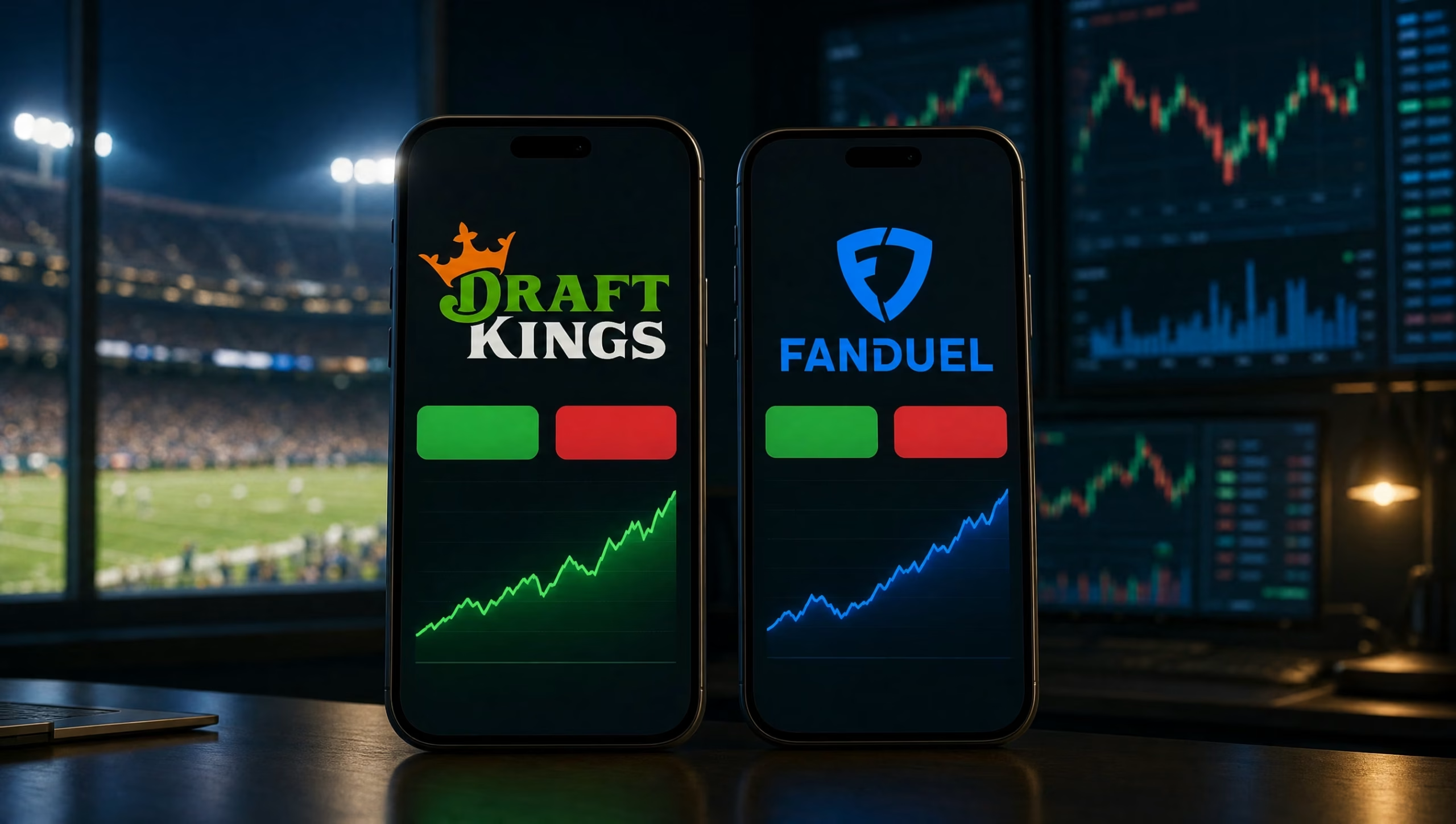
Less than a year ago, DraftKings and FanDuel still belonged to the trade group leading the fight against prediction markets. Today they run their own. DraftKings and FanDuel are taking prediction markets seriously because event contracts reach customers in states with no legal sportsbook, the NFL season is pushing exchange volume to records, and their core sportsbook growth has flattened. DraftKings now operates its own CFTC-licensed exchange and is spending an extra $200 million to $300 million on the product this year, while FanDuel has rebuilt its setup and turned market making into a new revenue line.
Neither company is walking away from its sportsbook. But the last ten months show a clear change in how both treat event contracts: less as an experiment, more as a second front. That bet now rides on a legal question headed for the Supreme Court. Here is what changed, why the timing makes sense for them, and where the risks sit.
What Changed for DraftKings and FanDuel in 2026?
Both companies went from launching small prediction apps in December 2025 to building event contracts into their main products by the start of the 2026 NFL season. DraftKings bought the plumbing and put Predictions inside its flagship app. FanDuel reworked its partnership structure so it could list more sports contracts, and both became market makers on other exchanges.
The timeline shows how quickly it moved:
| Date | Company | Move |
|---|---|---|
| Nov. 2025 | Both | Exit Nevada sports betting and leave the American Gaming Association over prediction markets |
| Dec. 2025 | DraftKings | Launches DraftKings Predictions |
| Dec. 22, 2025 | FanDuel | Launches FanDuel Predicts with CME Group in five states |
| May 2026 | Both | Confirm market-making operations on prediction exchanges |
| June 26, 2026 | DraftKings | Launches its own CFTC-licensed exchange, DKeX |
| Aug. 5, 2026 | FanDuel | Moves sports and novelty contracts from CME to Crypto.com; plans one app for betting and predictions |
| Aug. 6, 2026 | DraftKings | Says Predictions is growing faster than expected; commits $200M to $300M more this year |
Why Are They Pushing Into Prediction Markets Now?
Four pressures landed at once: a map problem, a football calendar, a slowing core business, and a new way to make money without taking bets. Each one on its own would justify a test. Together they explain why both companies stopped testing.
Prediction Markets Reach States Sportsbooks Can’t
The biggest draw is geography. Legal sports betting exists in 39 states plus Washington, D.C., but California, Texas, and Georgia still have no legal sportsbooks, and all three are large, sports-crazy states. Event contracts run under federal oversight from the Commodity Futures Trading Commission, so they can reach places a state license never will.
Both companies built their sports contracts around that gap. FanDuel’s December 2025 launch announcement said sports contracts would be offered in states where online sports betting is not yet legal. DraftKings says its sports event contracts are available in 18 states. For a company whose sportsbook is already live in most states that allow it, the untapped customers are almost all on the other side of that line.
The NFL Is Driving Record Exchange Volume
Football turned the category from interesting to impossible to ignore. Across NFL Week 1, Jefferies counted $3.12 billion in prediction-market volume on Sunday, September 13, across eight exchanges and every category, not just football. Aldrin Research, as reported by Covers, put Kalshi’s Sunday NFL trading alone at $388.1 million, excluding combos.
DraftKings got its own milestone out of that weekend. According to the same Aldrin data, its DKeX exchange crossed $100 million in daily trading volume for the first time on Saturday, then set an all-time high of $139.8 million on Sunday, with $98 million of that from sports and combos.
The company says the season has kept that going. At a Wells Fargo fireside chat on September 23, CEO Jason Robins said more than 1 million customers have used the Predictions product, that prediction-market volume had climbed to nearly 2.5 times its July level, and that DraftKings holds a double-digit share of the markets where it operates. Those are company figures rather than audited data, and investors were not uniformly impressed: DraftKings shares fell about 4% that day, with coverage tying the drop to how much the company plans to spend.
ℹ️
Volume Is Not Revenue
Trading volume counts every contract that changes hands, including trades that close out earlier positions. A customer who buys and sells the same contract twice adds to volume four times. These figures show activity, not how much money customers deposited or how much the exchanges earned.
Sportsbook Growth Has Flattened
The core business is not collapsing, but it is not growing the way it used to. The American Gaming Association forecast on September 4 that legal NFL wagering will reach $29.5 billion this season, against $29.4 billion last season. We covered the broader slowdown in sports betting handle earlier this year, and the football forecast fits that pattern.
Second-quarter results made the pressure concrete:
- DraftKings: sports revenue fell 10.6% to $891.9 million, which the company tied to customer-friendly results and higher promotional spending on both its sportsbook and Predictions. Its Sports Consumer Volume rose 15% to $13.1 billion, but that number combines sportsbook wagers and prediction-market trades, so it does not isolate either product.
- Flutter (FanDuel’s parent): posted a $296 million net loss, cut its adjusted EBITDA guidance by $210 million, and reported U.S. revenue down 6% from a year earlier.
When the main product stalls, a new product with a bigger addressable map gets a lot more attention from the boardroom.
Market Making Is a New Way to Get Paid
Both companies found a second way to profit from prediction markets: supplying the prices other people trade against. Setting lines and managing risk is what sportsbooks already do well, and exchanges need liquidity to function.
- DraftKings announced its market-making operation on its May earnings call. CEO Jason Robins called it “one of our fastest to profitability business lines.”
- Flutter said it began making markets for a major third-party prediction platform in April. Its market-making unit produced $6 million of revenue in the second quarter, and the company expects about $50 million in both revenue and adjusted EBITDA from it in 2026.
That second point matters. A sportsbook operator can now earn from prediction-market growth even when the trade happens on someone else’s exchange.
How Are DraftKings and FanDuel Approaching It Differently?
DraftKings is building the whole stack itself, while FanDuel is leaning on partners and its trading expertise. DraftKings launched its own exchange, DKeX, in June using the technology and CFTC license it gained from buying Railbird Technologies, and completed its futures commission merchant registration in July. FanDuel kept CME Group as its partner for financial contracts but moved sports and novelty contracts to Crypto.com.
| DraftKings Predictions | FanDuel Predicts | |
|---|---|---|
| Launched | December 2025 | December 22, 2025 |
| Exchange | DKeX, owned by DraftKings | Crypto.com for sports and novelty; CME Group for financial contracts |
| App setup | Inside the DraftKings Sports & Casino app | Combined betting and predictions app planned for the NFL season |
| Market making | Announced May 2026 | Since April 2026; ~$50M expected in 2026 |
| 2026 spending signal | $200M to $300M incremental investment | Accepting lower 2026 profit guidance to keep investing |
Owning the exchange gives DraftKings more control over which contracts it lists and how the economics work. DraftKings’ launch announcement quoted Robins calling DKeX “a vertically integrated foundation” for the product. FanDuel’s route is less capital-heavy, but its plans depend on partners’ choices, as the CME change showed.
That change came after CME chairman and CEO Terry Duffy publicly separated his exchange from sportsbook-style products in July. Flutter then shifted sports and novelty listings to Crypto.com, while CME kept its 51% stake in the FanDuel Predicts joint venture and its financial contracts. Outgoing Flutter CEO Peter Jackson framed the switch as “a step change” in the product catalog. Jackson is stepping down this fall, with Dan Taylor taking over.
If you already use either brand for sports betting, our DraftKings Sportsbook review and FanDuel Sportsbook review cover how their licensed betting products compare.
What Are the Risks for DraftKings and FanDuel?
The main risk is that courts decide sports event contracts are simply gambling under state law. On August 28, the Ninth Circuit ruled in KalshiEX v. Assad that Nevada’s gaming rules are not preempted by federal commodities law, holding that sports contracts amount to gaming. That conflicts with the Third Circuit’s ruling in KalshiEX v. Flaherty, and New Jersey has petitioned the Supreme Court. A ruling against the category would not hit DraftKings and FanDuel the way it hits their rivals, because both still hold the state sportsbook licenses the exchanges do not.
Robins addressed that directly at the September 23 fireside chat, saying he would rather the contracts stay, but that “if they got shut down by the Supreme Court tomorrow, our share prices would pop.” The rest of the risk list is more immediate, and our state-by-state prediction market tracker shows how differently states are responding.
- Lost market access: In November 2025, FanDuel surrendered its Nevada sportsbook registration and DraftKings withdrew its pending Nevada application. Nevada Gaming Control Board chairman Mike Dreitzer said the board had been told the companies “intend to engage in unlawful activities related to sports event contracts.”
- Lost allies: Both companies left the American Gaming Association that same month over the issue, giving up the industry’s main lobbying voice.
- State enforcement: On September 10, Connecticut announced cease-and-desist orders against nine prediction-market companies, and Missouri’s attorney general ordered six to stop in September. DraftKings and FanDuel were not named in either action; both hold Connecticut sports-wagering partnerships, which is exactly the kind of license a misstep could put at risk.
- Cannibalization: Every dollar that moves from a sportsbook to an exchange earns a different, usually thinner margin. Flutter has described the effect on its existing sportsbook customers as “low-single-digit cannibalization,” but outside analysts are still debating the real number.
The spending is a risk too. DraftKings kept its full-year guidance of $6.5 billion to $6.9 billion in revenue and $700 million to $900 million in adjusted EBITDA, and management said the core business is on track for roughly $1 billion in adjusted EBITDA, with the Predictions investment accounting for the difference. If the product does not keep growing, that money is gone.
What Does This Mean for Bettors?
For bettors, it means more familiar brands offering prediction-market contracts, but the product is not the same as a sportsbook bet. You buy and sell contracts priced between $0.01 and $0.99 against other traders, costs work differently from a sportsbook’s built-in margin, and you can often sell before the game ends. The rules, tax treatment, and consumer protections are also different, which we break down in prediction markets vs. sportsbooks.
A few practical points follow from how the two companies have set things up:
- Your state decides what you see. Sports contracts are aimed at states without legal online sportsbooks, so what appears in the app depends on where you are.
- A contract price is not a probability guarantee. A 60-cent price reflects what traders are willing to pay at that moment, including any spread and fees.
- Tax treatment is unsettled. The IRS has not issued guidance specific to prediction-market winnings, so keep your own records.
- Promotions change quickly. Welcome offers on both apps change often, so read the terms; T&Cs apply.
⚠️
Same Brand, Different Protections
A state-licensed sportsbook comes with state-mandated tools such as self-exclusion programs. A federally regulated prediction market sets its own responsible-gambling controls, and your state’s self-exclusion list may not apply to it. Check the limit and budget settings in the app before you trade.
The Bottom Line
DraftKings and FanDuel are not abandoning sports betting. They are hedging it. Event contracts give them a legal path into California, Texas, and other states they could not otherwise serve, a product that grows during football season, and a trading business that pays whether or not the customer is theirs.
The open questions are legal and financial. The Supreme Court may end up settling how far federal rules reach, and the next few earnings reports will show whether the extra spending pays off. For now, the two biggest names in U.S. sports betting have made their choice clear: they would rather compete in prediction markets than watch Kalshi and Polymarket take the category without them. Holding sportsbook licenses in most legal states is what lets them say they are comfortable either way.
Play Safe: Gambling should be fun, not stressful. Set limits, stick to your budget, and never chase losses. If you or someone you know has a gambling problem, call 1-800-MY-RESET or visit ncpgambling.org. For more resources, see our Responsible Gambling page.
Frequently Asked Questions
These are the questions we hear most about the DraftKings and FanDuel prediction apps.
Why Did DraftKings and FanDuel Start Offering Prediction Markets?
Mainly to reach customers they cannot serve with a sportsbook. Event contracts are regulated federally by the CFTC, so they can be offered in states such as California and Texas that have no legal sports betting. Flat sportsbook growth and record NFL trading volume added to the push.
Can I Use DraftKings Predictions or FanDuel Predicts in a State Where Sports Betting Is Already Legal?
Usually not for sports contracts. Both companies have aimed their sports event contracts at states without legal online sportsbooks, and DraftKings says its sports contracts are available in 18 states. Non-sports contracts, such as economic or financial markets, have wider availability.
Is a Prediction Market Trade on DraftKings the Same as a Sportsbook Bet?
No. On a sportsbook you bet against the house at its odds. On DraftKings Predictions you buy and sell contracts priced between $0.01 and $0.99 against other traders, and you can often sell before the event ends.
Could the Courts Shut Down Sports Prediction Markets?
It is possible, and the question is headed for the Supreme Court. The Ninth Circuit ruled on August 28, 2026 that Nevada’s gaming law is not preempted by federal commodities law, which conflicts with an earlier Third Circuit ruling, and New Jersey has petitioned the Supreme Court. Until that is resolved, sports event contracts stay live in most places while the cases proceed.
Why Did FanDuel Move Its Sports Contracts From CME to Crypto.com?
To list a wider range of sports and novelty contracts. Flutter announced the change on August 5, 2026, after CME’s leadership distanced the exchange from sportsbook-style products. CME still owns 51% of the FanDuel Predicts joint venture and supplies its financial contracts.