
Understanding Sports Betting Odds and Lines
Sports betting odds tell you how much you can win relative to your stake and reflect the probability the sportsbook assigns to each outcome. They show up in three formats — American, decimal, and fractional — that all describe the exact same price, and a minus sign marks the favorite while a plus sign marks the underdog. The betting line is the closely related number that frames the matchup, and once you can read both, you can size up any wager at a glance. Let’s break down how it all works, from reading a board for the first time to spotting where the real value hides.
What Are Sports Betting Odds?
Sports betting odds are numbers that express two things at once: how much a winning bet pays relative to your stake, and the implied probability the sportsbook gives each outcome. Read the odds and you instantly know which side is favored, how risky the bet is, and what you stand to collect if it lands. That is why they sit at the center of every wager you will ever place.
A minus price (like -150) marks the favorite and shows what you risk to win $100 — stake $150 to profit $100. A plus price (like +150) marks the underdog and shows what $100 wins — a $100 bet profits $150. The bigger the number, the wider the gap the sportsbook sees between the two sides.
Bookmakers do their best to price each team or competitor at its true likelihood of winning. They get it wrong sometimes, though — overvaluing a popular favorite here, sleeping on a live underdog there. Your job as a bettor is to shop the numbers and pounce when a price looks better than the real chance of the result. That edge, small as it often is, is where long-term winning bettors actually make their money.
One thing worth getting comfortable with early: the favorite is not always the smart bet, and the underdog is not always the long shot to avoid. The odds simply tell you what the sportsbook thinks and what you will be paid — they say nothing about whether that price is good. A -700 favorite might be a terrible bet if the real chance of winning is closer to 80% than the 87.5% the price implies, while a +250 underdog can be a steal if you believe it wins more than 28.6% of the time. Reading odds is the skill; judging whether they are fair is the edge.
Odds vs. the Betting Line: What’s the Difference?
The odds tell you the payout and implied probability of a single outcome, while the line is the number that frames the whole matchup — the point spread, the total, or the price gap separating favorite from underdog. People use the two words almost interchangeably, and that is fine in casual talk, but they describe different things. Think of the line as the headline number a sportsbook hangs on a game, and the odds as the price tag attached to each way you can bet it.
Here is the practical version. When you see “Chiefs -6.5 (-110),” the -6.5 is the line — the margin the Chiefs are expected to cover — and the -110 is the odds, the price you pay to back that side. Move the line and the matchup changes; move the odds and only the payout changes. Keeping the two straight makes every betting board easier to read, because you stop treating one big blur of numbers as if it all means the same thing.
| The Odds | The Line | |
|---|---|---|
| What it tells you | The payout and implied probability of one outcome | The number that frames the matchup — spread, total, or favorite-dog gap |
| In “Chiefs -6.5 (-110)” | -110 — the price to back that side | -6.5 — the margin the Chiefs must cover |
| Move it and… | Only your payout changes | The matchup you are betting changes |
The Three Odds Formats (American, Decimal, Fractional)
American, decimal, and fractional odds are three ways of writing the exact same price, and most U.S. sportsbooks let you switch between them in the settings with one tap. None is more “correct” than the others — they are just regional dialects for the same idea. American odds rule U.S. books, decimal odds dominate Europe, Australia, and Canada, and fractional odds are the traditional choice in the United Kingdom and at horse tracks worldwide.
American Odds
American odds use a minus sign for the favorite and a plus sign for the underdog, with the number showing the relationship to a $100 bet. A minus price tells you how much you must risk to win $100, so -150 means you stake $150 to profit $100. A plus price tells you how much you win on a $100 stake, so +150 means a $100 bet profits $150. Say a board lists the Falcons at -500 and the Eagles at +700: backing Atlanta means risking $500 to win $100, while backing Philadelphia means risking $100 to win $700 if they pull the upset.
Decimal Odds
Decimal odds show your total return per $1 staked, with your original bet already included in the number. To find your payout, multiply your stake by the decimal: a $100 bet at 2.50 returns $250 total, which is $150 profit plus your $100 back. The favorite always carries the lower decimal and the underdog the higher one, so 1.50 is a clear favorite and 3.00 is a clear dog. Plenty of bettors find this the easiest format to read precisely because there are no plus or minus signs to interpret — bigger number, bigger payout, full stop.
Fractional Odds
Fractional odds show your profit relative to your stake as a fraction, written with a slash or a hyphen like 4/1 or 4-1 (“four to one”). The first number is the profit, the second is the stake required to earn it, so 4/1 means you win $4 for every $1 you bet. Back the Eagles at 4/1 with a $20 wager and a win returns $100 total — $80 profit ($20 x 4) plus your original $20. Fractions where the first number is smaller, like 1/3, mark a heavy favorite: you risk $3 to win $1.
Odds Conversion Reference Table
Every American price has an exact decimal, fractional, and implied-probability equivalent, so once you memorize a few common ones the rest start to feel familiar. The table below lines up the prices you will see most often on a U.S. board. Notice how the favorites (minus prices) carry implied probabilities above 50% and the underdogs (plus prices) sit below it.
| American | Decimal | Fractional | Implied Probability |
|---|---|---|---|
| -200 | 1.50 | 1/2 | 66.67% |
| -150 | 1.67 | 2/3 | 60.00% |
| -110 | 1.91 | 10/11 | 52.38% |
| +100 (even) | 2.00 | 1/1 | 50.00% |
| +150 | 2.50 | 3/2 | 40.00% |
| +200 | 3.00 | 2/1 | 33.33% |
You do not have to do any of this math by hand. Punch any price and your stake into our odds calculator and it returns the payout, profit, and implied probability instantly, plus the equivalent in all three formats. It is the fastest way to confirm you are reading a board correctly while you are still learning the patterns.
When two sportsbooks list the same bet in different formats, convert both to decimal first. The higher decimal number always pays more, which turns line shopping into a five-second check instead of a guessing game.
A Worked Example: Reading a Real Betting Board
A typical NFL board shows three lines side by side — the moneyline, the spread, and the total — and reading it top to bottom tells you who is favored, by how much, and how the payouts change across each bet. Picture a Chiefs-Raiders game to see how the three fit together. Here is how that matchup might look at a U.S. sportsbook. For a football-specific walkthrough built on a real board, with an interactive price reader, see our guide to reading NFL odds.
- Moneyline: Chiefs -250, Raiders +200 — Kansas City is the clear favorite to win outright.
- Spread: Chiefs -6.5 (-110), Raiders +6.5 (-110) — the Chiefs are expected to win by about a touchdown.
- Total: Over 47.5 (-110), Under 47.5 (-110) — oddsmakers expect a moderately high-scoring game.
Now walk through the math. Backing the Chiefs on the moneyline at -250 means risking $250 to win $100, because they are heavily favored and the payout is small. Prefer a bigger return? Bet the Raiders’ moneyline at +200 and a $100 stake profits $200 if they pull the upset, or take the Raiders +6.5 spread at -110, where they only need to lose by six or fewer for the bet to cash. The total has nothing to do with who wins — bet the over if you expect a shootout and the under if you expect a defensive grind. One board, three completely different ways to have action, each with its own price.
This is also where line shopping pays off. The Chiefs might be -250 at one book and -230 at another, and that gap is real money over hundreds of bets. The same logic applies to the spread and total, where a half-point or a few cents of price can decide a winning bet from a push. Reading the board fluently is step one; comparing it across books is step two.
What Implied Probability Means (and Why Odds Don’t Add Up to 100%)
Implied probability is the win percentage baked into the odds, and the two sides of any market always add up to more than 100% because the sportsbook builds in a margin. Convert -150 and you get a 60% implied chance; convert +150 and you get 40%. Those line up to a tidy 100% only in theory. In the real world, a book might price both sides of a coin-flip game at -110, and each -110 converts to 52.38% — add them together and you get 104.76%.
That extra 4.76% is the sportsbook’s built-in cut, known as the vig, juice, or overround. It is how books stay profitable no matter who wins — they take a small slice from both sides of every bet. A typical point-spread or total market runs a 5% to 10% overround, and markets with more possible outcomes (think a 10-horse race) carry a bigger one. If you want the deeper math behind how probability and odds relate, Wikipedia’s overview of odds and probability lays it out clearly.
The vig is exactly why “buying” both sides of a game at most books loses money over time even when you go 50-50. Beating it is the whole game: you find value when you believe the true probability of an outcome is higher than the implied number the odds are charging you.
The Main Types of Betting Lines
The three most common betting lines are the moneyline, the point spread, and the total (over/under), and they are the first three options you will see when you tap into any game. Each one frames the same matchup a different way — who wins, by how much, and how many points get scored — so the right line to bet depends on what you actually have an opinion about.
Moneyline
A moneyline bet is the simplest wager there is: you pick the outright winner, and the margin of victory does not matter. Win by one or win by fifty, a win is a win. The catch is that backing a heavy favorite pays very little, while a successful underdog moneyline can pay handsomely — so the skill is judging whether a dog has a real shot at the upset. Our moneyline betting guide digs into when this bet is worth taking and when the favorite’s price is simply too steep.
Point Spread
A point spread is a margin oddsmakers set to level the playing field between two mismatched teams. A -3 favorite must win by more than three points for that bet to cash, while the +3 underdog covers by winning outright or losing by fewer than three. Because the spread evens out the matchup, both sides usually carry a similar price (often -110), which is why spreads are the bread and butter of football and basketball betting. For the full mechanics, including what “covering” and the hook mean, see our point spread guide.
Totals (Over/Under)
A total, or over/under, asks whether the combined score of both teams will land above or below a number the book sets. It does not matter who wins — you are betting on the pace and scoring of the game itself. If the line is 47.5, the over needs 48 or more combined points and the under needs 47 or fewer. Totals shift with weather, injuries, and lopsided betting, and our over/under guide walks through how to read those moves before you bet.
How Sportsbooks Set and Move Odds
Sportsbooks set an opening line using team and player data, matchup history, and what rival books are posting, then move it as money comes in to keep both sides roughly balanced. The opening number is a starting point, not a final verdict — books want even action so they collect the vig no matter who wins. When too much money piles on one side, they nudge the line or the price to make the other side more tempting and rebalance the book.
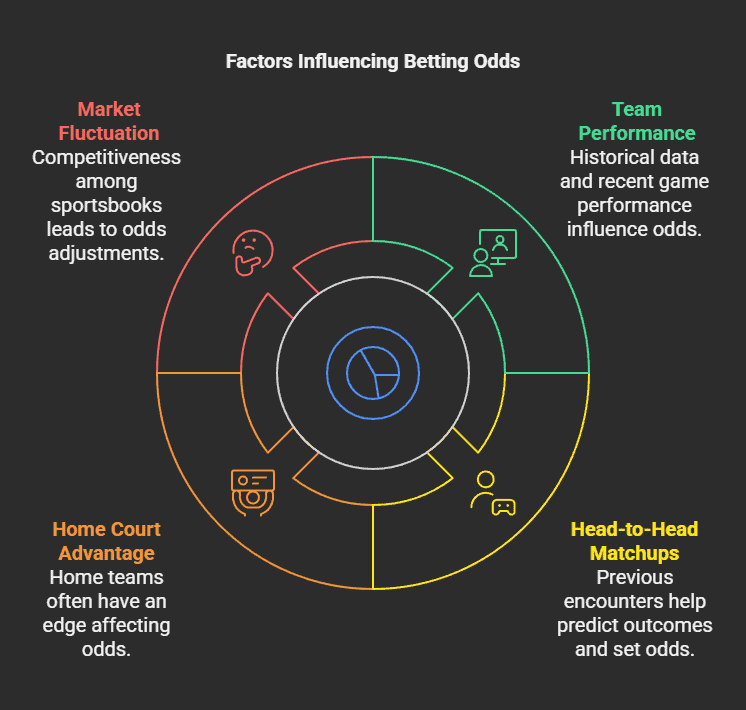
A handful of factors do most of the work when oddsmakers build that first number:
- Team and player performance — recent form, momentum, and historical results signal who deserves to be the favorite.
- Head-to-head history — past matchups surface patterns and style mismatches between two teams.
- Home-field advantage — playing at home is worth points, and books bake that into the line.
- Market fluctuation — books watch rival sportsbooks and adjust to stay competitive on price.
Once a line is live, fresh information keeps moving it. A key injury or suspension can swing a number hard, especially when the missing player is hard to replace. Weather shifts the calculus for outdoor sports — wind and rain tend to drag totals down. Lopsided public money pushes the line as books court the other side, and sharp bettors often wait until just before kickoff to grab the value that last-minute moves create. The number you bet is rarely the number the game opened at, which is exactly why timing and line shopping matter.
It helps to know who is moving the line, too. Some moves come from the public piling onto a popular team, and those can actually create value on the unpopular side, since the book may shade the number further than the matchup deserves. Other moves come from respected, high-limit bettors — the sharps — and books take those far more seriously, often shifting the line on a single well-sized wager. You will not always know which is which, but watching how a number drifts from open to close, and where it settles, tells you a lot about where the smart money landed.
Common Odds Mistakes Beginners Make
The most common beginner mistakes are blindly backing favorites, misreading the plus or minus sign, and ignoring the vig when judging value. Each one quietly drains a bankroll, and each one is easy to sidestep once you know to watch for it. Building good habits early is far easier than unlearning bad ones after a few painful weeks.

Leaning on favorites every time feels safe, but the middling payouts rarely outrun the losses when a chalky pick goes down. There is a time to back the favorite and a time to take a value-priced dog — the discipline is in telling them apart instead of defaulting to the “safe” side. Underdogs are not automatic losses; priced right, they are often where the best value lives, which is the whole reason books offer them in the first place.
The other quiet killer is staking too much on any single bet because a number looked good. Reading odds well is only half the battle; sizing your bets sensibly is the other half. New bettors should pair this guide with our walkthrough on types of bets to see how each wager behaves, and our bankroll management guide to keep one bad night from wiping out a month of smart plays.
Play Safe: Gambling should be fun, not stressful. Set limits, stick to your budget, and never chase losses. If you or someone you know has a gambling problem, call 1-800-MY-RESET or visit ncpgambling.org. For more resources, see our Responsible Gambling page.
Frequently Asked Questions
New to reading a betting board? Here are the questions beginners ask most about odds and lines before they place a wager.
What do the plus and minus signs mean in sports betting odds?
The minus sign marks the favorite and the plus sign marks the underdog in American odds. A minus price like -150 tells you how much you must risk to win $100, so you stake $150 to profit $100. A plus price like +150 tells you how much you win on a $100 stake, so a $100 bet profits $150.
Which odds format is easiest to read if I’m just starting out?
Most beginners find decimal odds the easiest because there are no plus or minus signs to interpret. You simply multiply your stake by the decimal to get your total payout, and the bigger number always pays more. Every U.S. sportsbook lets you switch to decimal in the settings if American odds feel confusing at first.
How do I figure out the implied probability from American odds?
For a positive price, divide 100 by the odds plus 100, so +150 becomes 100 / 250 = 40%. For a negative price, divide the odds by the odds plus 100, so -150 becomes 150 / 250 = 60%. Our odds calculator does this instantly, but the formula is handy to recognize a fair price.
What’s the difference between the odds and the betting line?
The line is the headline number a sportsbook hangs on a game — the point spread, the total, or the gap between favorite and underdog — while the odds are the price you pay to bet a given side. In ‘Chiefs -6.5 (-110),’ the -6.5 is the line and the -110 is the odds. Move the line and the matchup changes; move the odds and only the payout changes.
Why do the odds on both teams add up to more than 100%?
They add up to more than 100% because the sportsbook builds a margin into every market, known as the vig, juice, or overround. For example, both sides of a coin-flip game priced at -110 each imply 52.38%, which totals 104.76%. That extra slice is the book’s built-in profit and the reason you have to find genuine value to beat it over time.