Why Casino Innovation Often Makes Games Worse

Casinos talk about innovation the same way tech companies do—like it’s automatically good. Faster games. Flashier graphics. More features. More ways to “engage.”
And on the surface, it all looks like progress.
But if you’ve been playing long enough, you may have noticed something strange: the games feel busier, louder, and quicker—yet somehow less enjoyable. Sessions end faster. Bankrolls disappear sooner. Wins feel smaller, even when they’re frequent. And the excitement fades quicker than it used to.
That’s not an accident.
Most casino innovation isn’t built to make games better for players. It’s built to make games more efficient for casinos—more spins per hour, more bets per session, more predictable losses over time. The fun is still there, but it’s been carefully engineered to move you along faster, with fewer pauses to think, stop, or reassess.
This article isn’t anti-technology. Casinos need to evolve.
But not all innovation is created for your benefit—and some of it quietly works against you in ways most players never spot until it’s too late.
Let’s break down how that happens—and how to recognize it before the next “upgrade” costs you more than you expect.
What Casinos Mean by “Innovation” (vs. What Players Expect)
When casinos roll out something new, the messaging is almost always the same. Smarter gameplay. More excitement. Better experience.
Players hear that and naturally assume innovation means the game is improving for them. Inside a casino, though, innovation has a very different definition.
Casinos don’t start with the question, “How do we make this more fun?” They start with, “How do we make this more efficient?”
Efficiency, in casino terms, means:
- More bets per hour
- More predictable outcomes
- Better control over volatility
- Higher average hold across all players
Those goals don’t require worse games—but they often produce them.
Here’s the core disconnect:
What players expect innovation to deliver
- Better odds or fairer math
- More strategic choice
- Greater transparency
- A sense of control over outcomes
What casinos actually optimize for
- Faster decision cycles
- Reduced downtime between bets
- Behavioral nudges that keep players clicking
- Consistent revenue regardless of player skill
This gap is why new games often feel exciting at first, then quietly exhausting over time.
The innovation wasn’t designed to help you win more—or even enjoy the game longer. It was designed to keep the system running smoothly, with fewer pauses, fewer questions, and fewer chances for players to slow down and reassess.
Once you understand that, modern casino design starts to make a lot more sense—and a lot less appealing.
Faster Isn’t Better: The Speed Trap

Speed is one of the most celebrated forms of casino “innovation.” Faster spins. Faster hands. Faster re-bets. Fewer pauses between decisions.
On the surface, it feels like a win for players. No waiting. No downtime. Just action. But speed is one of the most effective tools casinos have for increasing losses without changing the odds at all.
Every bet you place carries a built-in house edge. When games move faster, that edge doesn’t get bigger—but it gets applied more often. You’re exposed to it again and again, with less time to think, adjust, or stop.
Casinos benefit from speed because it:
- Increases the number of bets per hour
- Raises theoretical loss without raising bet size
- Reduces moments where players reconsider or cash out
- Compresses bankroll swings into shorter sessions
Players, on the other hand, experience speed very differently:
- Sessions end sooner than expected
- Decision quality drops as fatigue sets in
- Losses feel “sudden” rather than gradual
- Wins feel less meaningful because they vanish quickly
The real danger of speed isn’t that it feels risky—it’s that it doesn’t. Everything moves so smoothly that players mistake momentum for control.
In reality, speed doesn’t make games better. It just makes the math work faster against you.
When “More Features” Quietly Make Games Worse
Modern casino games love features. The more moving parts, the better—at least according to the marketing. You’ll see layered bonus rounds, cascading symbols, progress meters, mystery prizes, side missions, and pop-up mini-games stacked on top of the base game. It feels rich. Dynamic. Like you’re getting more for your money.
But features don’t come free.
Every added mechanic has to be funded somewhere, and it’s almost never the casino paying for it. Value is usually taken from the core game and redistributed into rare, flashy events that look exciting but happen far less often than players expect.
That’s why feature-heavy games often share the same hidden downsides:
- Lower base payouts to offset bonus potential
- More value locked behind extremely rare triggers
- Increased volatility that’s poorly explained (or not explained at all)
- Harder-to-track odds that feel intuitive but aren’t
Features also change how players behave. Instead of evaluating the actual math, players start chasing moments—waiting for the next unlock, the next multiplier, the next animation that might make the session feel worthwhile.
Casinos understand this psychology perfectly. Complexity keeps players engaged, even when the underlying value has quietly eroded.
The result? Games that look more advanced, feel more interactive, and promise more excitement—while delivering less clarity, less control, and often, less enjoyment over time.
More features don’t make a game better. They just make it harder to see what you’re really playing.
Side Bets: Innovation’s Favorite Trojan Horse
If casinos had a favorite type of innovation, it would be the side bet.
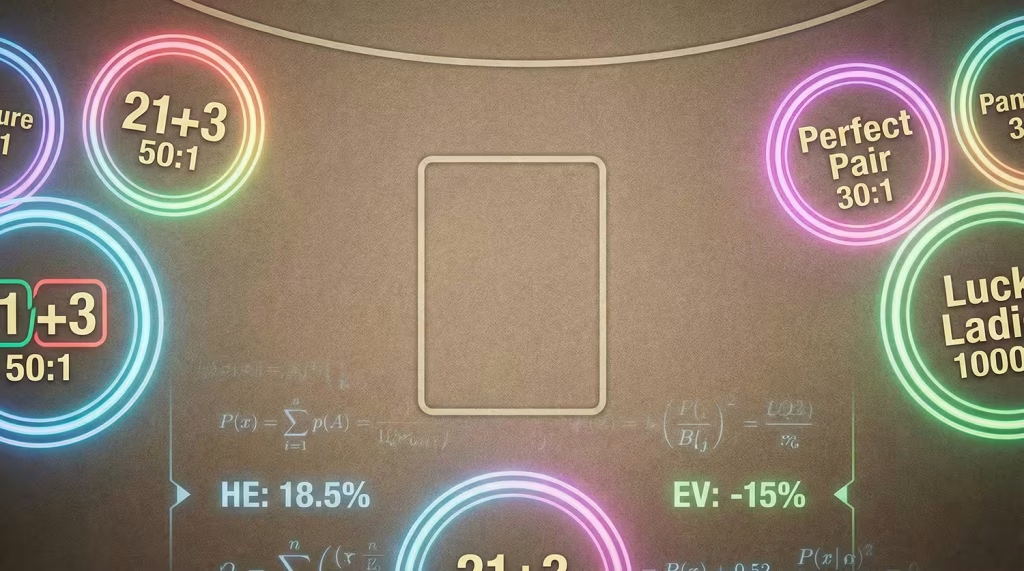
Side bets are presented as harmless extras—small wagers layered on top of a main game, promising big payouts and “just a little more action.” They’re framed as optional, exciting, and low-commitment. That framing is exactly why they work so well.
Behind the scenes, side bets are some of the most profitable bets in the entire casino. They don’t change the main game, so players don’t feel like they’re taking on more risk. But mathematically, side bets almost always carry a much higher house edge than the core wager.
Casinos love side bets because they:
- Are optional, avoiding player resistance
- Add revenue without altering base game odds
- Appeal to emotion rather than strategy
- Generate massive profit relative to bet size
From the player’s perspective, side bets tend to share a few warning signs:
- Eye-catching payouts with vague probabilities
- High volatility masked as “fun”
- Marketing language that emphasizes excitement over math
The most dangerous thing about side bets isn’t that they’re bad—it’s that they don’t feel bad. They feel like a bonus. A chance. A free shot at something big.
In reality, they’re a carefully engineered add-on designed to siphon extra value from players who think they’re just enhancing the experience.
That’s why side bets remain one of casino innovation’s most effective—and expensive—Trojan horses.
UI Tricks That Nudge You to Lose More
Some of the most impactful casino innovations have nothing to do with the games themselves. They’re baked into the interface—the buttons you click, the colors you see, and the way outcomes are presented.
This is where the idea of choice architecture comes into play. Choice architecture refers to how decisions are shaped by the way options are presented—not by removing choice, but by quietly steering behavior. In casinos, this shows up in small, intentional design decisions: which buttons are largest, which actions are default, which outcomes are celebrated, and which are visually minimized.
Nothing is technically hidden, but some paths are made frictionless while others require effort. Over time, players don’t feel forced—they feel guided. And that guidance almost always nudges toward continued play rather than thoughtful stopping.
Modern casino UI is not neutral. It’s designed.
Every layout choice is tested to influence behavior in subtle ways that most players never consciously notice, but almost always respond to.
Common design nudges include:
- Oversized, brightly colored Rebet or Spin buttons
- Smaller, muted Cash Out or Exit options
- Default bet sizes that slowly increase over time
- Win animations that feel dramatic—even for tiny payouts
These choices push players toward momentum. The easier it is to continue playing, the less likely players are to pause and reassess.
One of the most effective tricks is disguising losses. Many games celebrate outcomes where you technically win something—but still lose money overall. Flashing lights, upbeat sounds, and congratulatory messages turn negative results into emotional “wins,” keeping players engaged far longer than they otherwise would be.
Casinos often label this as user experience optimization. In practice, it’s behavioral engineering.
Over time, these interfaces create a sense of blur. Sessions feel shorter. Bets feel automatic. Stopping feels awkward or interruptive. The game didn’t get more aggressive. The interface just made it harder to notice what was happening.
That’s why modern casino play often feels exhausting rather than exciting—and why understanding the design is just as important as understanding the odds.
Removing Skill—On Purpose

One of the quietest trends in casino innovation is also one of the most revealing: skill is being designed out of games on purpose.
That might sound counterintuitive. After all, casinos still talk about “player choice,” “interactive gameplay,” and “engagement.” But look closer and you’ll notice that most modern games are structured to feel skill-based without allowing skill to meaningfully affect outcomes.
Why? Because skill introduces uncertainty—for the casino.
From a business perspective, skilled players are harder to model, harder to predict, and harder to monetize consistently. So innovation increasingly moves toward systems that minimize decision impact while preserving the illusion of control.
You see this in:
- Automated betting options and default strategies
- Simplified choices that don’t materially change expected value
- RNG-heavy mechanics disguised as “decision points”
- Features that reward timing or participation, not judgment
The result is a strange middle ground. Players feel involved, but their decisions rarely move the needle in a meaningful way. Strategy becomes cosmetic. Outcomes become smoother, more predictable, and safer for the house.
This isn’t about eliminating thinking players—it’s about reducing their influence.
And over time, that’s why experienced players often feel pushed away from newer games. The challenge isn’t higher. It’s thinner. The game isn’t harder to beat—it’s harder to engage with honestly.
When Innovation Actually Helps Players (Yes, It Happens)
Not all casino innovation works against players. The problem is that player-friendly innovation doesn’t get the same spotlight.
When innovation genuinely helps players, it usually does one thing: it gives them clarity or control. And those features tend to spread slowly because they don’t directly increase revenue.
Examples of innovation that actually benefits players include:
- Clear RTP and volatility disclosures
- Session tracking, loss limits, and cooling-off tools
- Transparent payout structures without hidden mechanics
- Slower game formats that encourage deliberate play
These changes don’t make casinos less profitable overnight—but they do change how players interact with games. They reduce impulse. They encourage awareness. And they help players make informed decisions instead of emotional ones.
That’s why these features are often optional, buried in settings, or quietly implemented without marketing hype. They’re protective, not promotional.
The key distinction is simple:
- Good innovation empowers the player
- Bad innovation accelerates the system
Once you learn to spot which is which, casino innovation stops feeling mysterious. It becomes readable. And that awareness alone can dramatically change how—and how long—you play.
How Smart Players Should Evaluate “New” Games

You don’t need to avoid new casino games. You just need to stop taking them at face value. Smart players don’t ask whether a game looks exciting. They ask whether the innovation actually changes the math—or just disguises it.
Before spending real money on any new game, experienced players mentally run through a short filter:
- Is the game faster than older versions of the same format?
- Are there optional bets or features with unclear odds?
- Do wins happen often but feel small and temporary?
- Is volatility explained clearly—or buried under buzzwords and animations?
Then come the red flags that rarely lie:
- Heavy emphasis on visuals instead of information
- Multiple bonus paths without transparent probabilities
- Features that trigger frequently but pay very little
- Design that encourages automatic re-betting
Smart players understand something casual players don’t: novelty is not value.
A new game can be fun, but fun doesn’t mean fair—and fair doesn’t mean profitable. The goal isn’t to avoid innovation altogether. It’s to recognize when innovation exists to keep you playing longer, faster, and with less awareness.
Once you adopt that mindset, “new” stops being persuasive. It becomes something to evaluate—not chase.
Why This Trend Isn’t Going Away
If anything, casino innovation is accelerating—and not in the direction most players hope.
Casinos today aren’t competing on odds or generosity. They’re competing for attention. Shorter sessions. More distractions. More players cycling through more games, more quickly.
That pressure pushes innovation toward:
- Speed over depth
- Simplicity over strategy
- Psychology over transparency
Slower, skill-driven games don’t fit that model. They encourage pauses. Questions. Comparisons. And those things interrupt momentum.
As margins tighten and competition increases, casinos will continue optimizing games to feel smoother, faster, and easier—while quietly removing friction that once gave players time to think. The result isn’t worse games in an obvious way. It’s games that feel more polished, more engaging, and more draining over time.
Players who understand this won’t necessarily win more. But they’ll last longer. They’ll make fewer emotional decisions. And they’ll avoid the traps that modern innovation is designed to normalize.
In today’s casino landscape, awareness isn’t just helpful—it’s the closest thing players have to an edge.
Innovation Isn’t the Enemy—Blind Acceptance Is
Casino innovation isn’t going to slow down. If anything, it’s accelerating—becoming sleeker, faster, and harder to question. And that’s exactly why players need to think more critically, not less.
New games aren’t automatically better. More features don’t mean more value. And smoother design doesn’t mean fairer outcomes. Most modern innovation is about efficiency—moving players through decisions quickly, quietly, and emotionally, with fewer pauses to reflect or stop.
That doesn’t mean you shouldn’t enjoy new games. It means you shouldn’t trust them just because they’re new.
The smartest players today aren’t chasing the flashiest releases or the most complex mechanics. They’re slowing down. They’re asking where the value actually lives. They’re paying attention to speed, transparency, and how much control they truly have over outcomes.
In a casino world built on momentum, the most powerful move is interruption—pausing long enough to understand what the game is designed to do.
Because in modern gambling, the edge isn’t finding the newest game. It’s recognizing when innovation is quietly working against you—and choosing not to play along.