Sports Betting Is Making Young Men Drink More — And the Data Is Alarming
The legalization of online sports betting was sold to the public as a harmless way to bring a black market into the light and generate tax revenue. But as the industry has exploded across 31 states and Washington D.C., public health researchers are uncovering a darker reality that nobody in the industry wants to talk about.
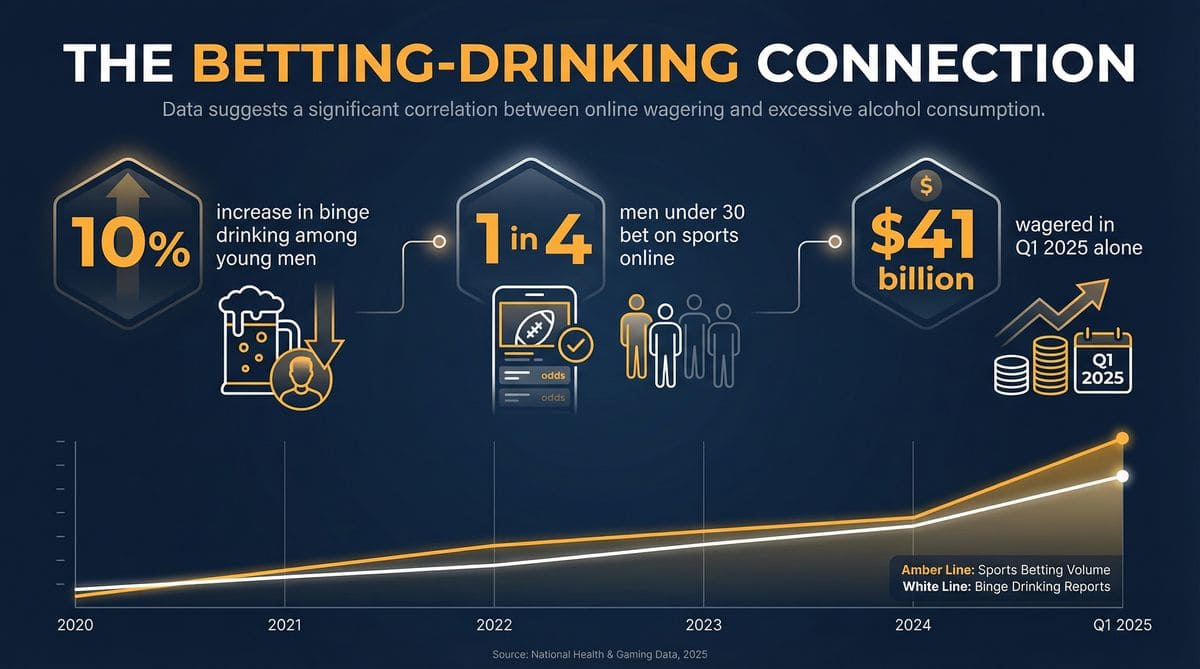
A new study published in *Health Economics*, as reported by Scientific American, reveals a troubling connection between the rise of mobile sportsbooks and an increase in substance abuse. According to the research, the legalization of online sports betting has led to a 10% increase in binge drinking among young men who already engage in heavy alcohol consumption. That figure represents thousands of additional episodes of dangerous drinking behavior directly correlated with the arrival of legal sports wagering.
As the industry generated a staggering $41 billion in wagers in just the first quarter of 2025, the spillover effects of having a casino in your pocket are becoming impossible to ignore.
The Study: What the Numbers Actually Show
The study, led by University of Cincinnati economist Keshar Ghimire, focused on what researchers call the “intensive margin” of drinking behavior. This distinction is important. The general population did not suddenly start drinking more after sports betting became legal. Instead, men aged 35 and under who already had a history of binge drinking — defined as consuming five or more drinks in a single sitting — saw their consumption spike by approximately 10%.
This is a critical finding because it reveals that legalized sports betting is not creating new drinkers. It is making existing problem drinkers worse. The mechanism, according to Ghimire, is environmental. “Online sports betting differs from traditional gambling because it is immediate, continuous, and easily accessible through smartphones,” he explained. “That accessibility may make it easier for gambling to occur in settings where alcohol consumption is already common, such as watching live sports.”
A 2024 survey found that one in four men aged 30 or younger gamble on sports online. When you overlay that demographic with the population of young men who already binge drink, the intersection is enormous. These are not two separate groups of people. They are overwhelmingly the same people, engaging in both behaviors simultaneously.
The study relied on self-reported data, which means the actual increase in consumption could be even higher. People tend to underreport both their drinking and their gambling habits, particularly when those habits are becoming problematic.
The Perfect Storm: Smartphones, Sports, and Alcohol
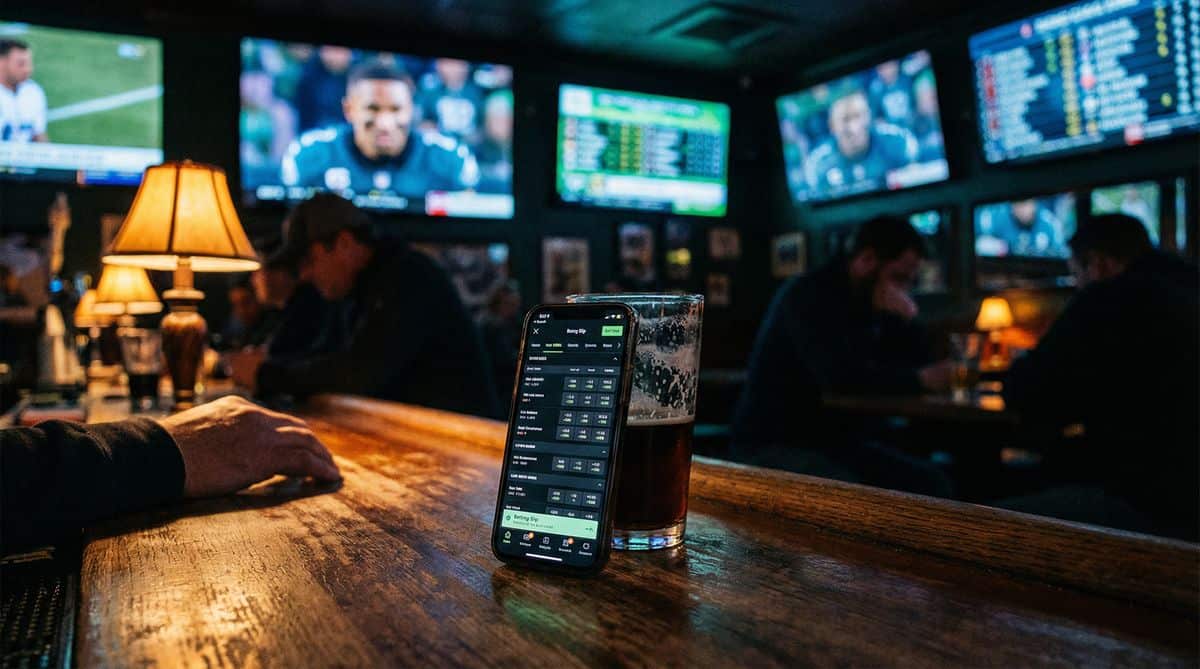
Unlike traditional casino gambling, which requires travel, planning, and a degree of intentionality, online sports betting is immediate and continuous. A bettor can place a wager from the couch, at the office, during a commute, or — crucially — while sitting at a bar watching a game. The accessibility of mobile betting means that gambling now frequently occurs in environments where alcohol consumption is already encouraged and normalized.
This creates what addiction researchers describe as a “compounding risk loop.” The bettor drinks while watching a game. The alcohol lowers inhibition. The lowered inhibition leads to riskier bets. The riskier bets create emotional volatility — the highs of a win, the lows of a loss. That emotional volatility drives more drinking to cope. The cycle feeds itself.
The physical setting matters more than most people realize. A 2025 study published in *ScienceDirect* found that alcohol use frequency is directly related to elevated sports betting behaviors. The two activities are not just correlated — they actively reinforce each other. When someone is already three drinks deep and their team is losing, the impulse to chase a loss with a bigger bet becomes significantly harder to resist.
Recovery Answers, a research initiative from Massachusetts General Hospital, published findings in May 2025 confirming strong within-person associations between sports gambling and heavy drinking. The relationship is not just statistical. It is behavioral. The same person drinks more on days they gamble more, and gambles more on days they drink more.
How Advertising Fuels the Fire
The sports betting industry has spent hundreds of millions of dollars on aggressive marketing campaigns designed to acquire new customers. These advertisements are ubiquitous during live sports broadcasts, on social media platforms, embedded in podcasts, and even integrated directly into sports commentary itself.
For young men, the constant bombardment of betting promotions can create a feeling of suffocation. As one 26-year-old recovering gambling addict told NPR in a February 2026 report, “Their whole goal is to flood you with it so that you feel kind of suffocated and you’re constantly thinking about it.”
That same young man, identified only as Jason, described making up to 50 wagers per day at the peak of his addiction. He described feeling “trapped in my phone,” unable to stop checking odds and placing bets even when he knew he was losing money he could not afford to lose.
Lia Nower, director of the Center for Gambling Studies at Rutgers University, drew a stark comparison in the same NPR report: “Gambling is where cigarettes were in the ’40s when we had the Marlboro Man and every actress with a cigarette on one of those extenders.”
The comparison is not hyperbolic. The tobacco industry spent decades marketing an addictive product as glamorous and harmless before regulators intervened. The sports betting industry is following the same playbook — sign-up bonuses, “risk-free” bet promotions, celebrity endorsements, and partnerships with the leagues themselves. When this constant engagement with sports betting apps is paired with alcohol, impulse control drops, leading to riskier wagers and heavier drinking.
The Mental Health Toll of Mobile Betting
The financial consequences of gambling addiction are well-documented, but the mental health impacts are just as severe. A 2026 study published in *JAMA Health Forum* found that problem gambling is strongly associated with elevated levels of depression, mood disorders, and anxiety. These are not minor correlations. They are clinically significant relationships that addiction specialists see playing out in their offices every day.
In Massachusetts, which legalized sports betting in 2023, the number of residents in their 20s and 30s referred to gambling treatment programs has more than doubled. Nearly 400 young adults sought help through the state’s gambling hotline in the 2024 fiscal year alone. A Gamblers Anonymous meeting leader in the state reported gaining 17 new members in just five months, with two-thirds of them in their 20s and 30s.
Kyle Faust, who directs the Digital Addiction and Gambling Treatment Program at Massachusetts General Hospital, noted that the vast majority of his patients struggling with gambling addiction are tied specifically to online sports betting — not casino games, not poker, not horse racing.
“Somebody is going to be more susceptible to depression, different types of anxiety disorders,” Faust explained. “And if somebody is significantly in debt, they are going to feel trapped and helpless and feel like there’s no way out.”
One of his patients, a 33-year-old identified as Adam, gambled away his entire savings on a single Bruins game. Stories like his are becoming disturbingly common as online gambling proves more addictive than its in-person counterpart.
The National Council on Problem Gambling reported in March 2026 that 33% of adults aged 21 to 44 placed their first sports bet before they were legally old enough to do so. The pipeline from underage exposure to adult addiction is shorter than anyone in the industry wants to admit.
The Underage Exposure Problem
The NCPG statistic about underage betting deserves its own examination. One-third of young adult sports bettors started before they turned 21. This is not a minor data point. It suggests that the marketing saturation of sports betting is reaching minors at scale, normalizing the behavior years before they can legally participate.
Sports betting advertisements do not exist in a vacuum. They appear during NFL games that teenagers watch with their parents. They appear on social media feeds that no age-verification system can meaningfully filter. They appear in the podcasts and YouTube channels that young men consume for hours every week.
By the time these young men turn 21 and can legally place a bet, many of them have already internalized the idea that betting on sports is a normal, expected part of being a fan. The transition from watching a game to wagering on it feels seamless — because the industry has spent years making it feel that way.
What Can Be Done to Protect Young Bettors?
As the data mounts, pressure is building on lawmakers and regulators to implement stricter controls on the sports betting industry.
Some proposed solutions include banning sports betting advertisements during televised games, similar to restrictions placed on tobacco advertising decades ago. Others advocate for mandatory affordability checks, stricter limits on deposit amounts, and more robust funding for addiction treatment programs. Several states are already exploring legislation that would require sportsbooks to fund responsible gambling programs proportional to their revenue.
Sportsbook operators point to their existing responsible gambling tools, such as self-imposed deposit limits and self-exclusion programs. However, critics argue that these tools place the burden entirely on the user, while the apps themselves are meticulously designed to maximize engagement and time-on-device. The same behavioral psychology that makes these apps addictive is the same psychology that makes voluntary self-regulation ineffective for the people who need it most.
Australia offers a potential model. The country recently implemented sweeping bans on gambling advertisements during live sports broadcasts, a move that was fiercely opposed by the industry but supported by an overwhelming majority of the public. Whether the United States will follow a similar path remains to be seen, but the political momentum is building.
Until more comprehensive regulations are put in place, the responsibility falls largely on individuals to recognize the risks. Understanding the strong correlation between sports betting and increased alcohol consumption is a crucial first step in recognizing when a harmless hobby might be turning into a destructive habit. If you find yourself betting more when you drink, or drinking more when you bet, that pattern is not a coincidence. It is a warning sign.
FAQ
How much did binge drinking increase after sports betting legalization?
A 2026 study published in Health Economics found a 10% increase in binge drinking among young men who already had a history of heavy alcohol consumption following the legalization of online sports betting.
Who is most at risk for gambling and drinking issues?
The research indicates that men aged 35 and under are the highest risk demographic. This group also represents the core user base for online sportsbooks, with one in four men under 30 participating in online sports betting.
Why does mobile betting lead to more drinking?
Researchers believe the accessibility of smartphone betting apps means gambling now frequently occurs in settings where alcohol is already present, such as sports bars or while watching games at home, lowering impulse control for both activities.
Are sports betting apps causing mental health problems?
Yes. Treatment professionals report that problem gambling tied to sports betting apps is strongly associated with increased rates of depression, severe anxiety, and feelings of helplessness, often exacerbated by mounting financial debt.
What responsible gambling tools do sportsbooks offer?
Most regulated sportsbooks offer tools like self-imposed deposit limits, time limits, and voluntary self-exclusion programs. However, addiction specialists argue these tools are often insufficient for users already struggling with compulsive behavior.
Responsible Gambling: If you or someone you know is struggling with a gambling problem, help is available. Call 1-800-GAMBLER or visit the National Council on Problem Gambling for free, confidential support 24/7.