
The Near-Miss Is Not an Accident: How Slot Machines Are Engineered to Feel Like Almost-Wins
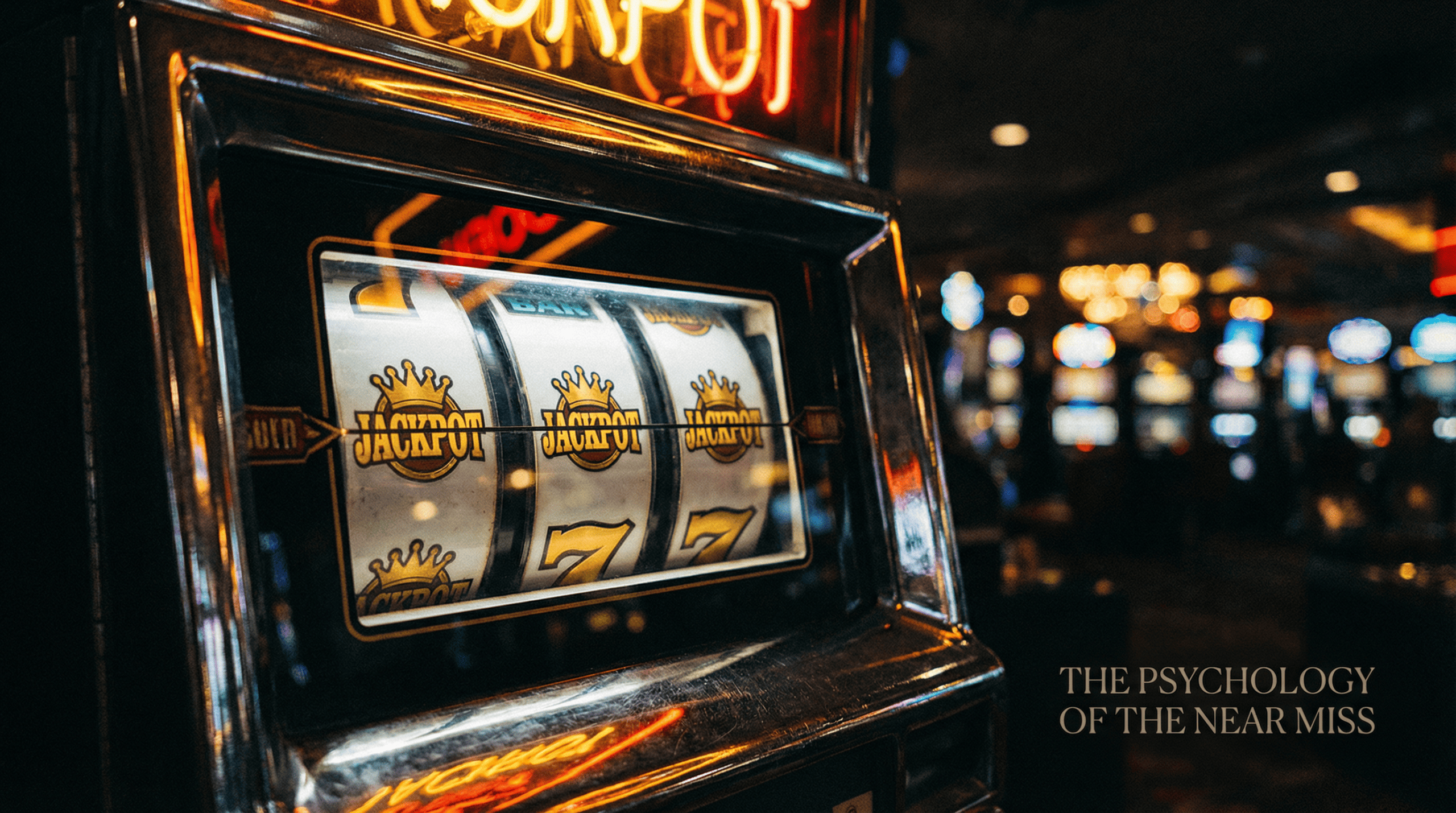
If you have ever played a slot machine, you know the feeling. The first reel lands on the jackpot symbol. The second reel lands on the jackpot symbol. Your heart rate spikes as the third reel spins, only for it to stop exactly one click past the final jackpot symbol. You didn’t win, but it felt like you were incredibly close.
That “so close” feeling is not a coincidence, and it is not a sign that the machine is about to pay out. It is a highly engineered psychological trigger known as the near-miss effect. Modern slot machines are deliberately programmed to show you these near-misses far more often than they would occur by pure chance.
The goal is simple: to make losing feel just enough like winning to keep you spinning. By understanding how the math and the psychology behind these machines work, you can recognize the manipulation and make smarter decisions about your bankroll.
What Is the Near-Miss Effect?
The near-miss effect is a psychological phenomenon where a failure that closely resembles a success triggers the same brain reward pathways as an actual win. When you experience a near-miss on a slot machine, your brain releases dopamine, creating a rush of excitement despite the fact that you just lost money.
A landmark 2009 study published in the journal Neuron by Dr. Luke Clark mapped exactly what happens in the brain during these events. The researchers found that near-misses recruited the striatum and insula—the exact same brain regions activated by actual monetary wins. The study also revealed that near-misses increased a player’s desire to continue gambling, even though the players consciously rated the near-misses as highly unpleasant.
For the casino, this is the holy grail of game design. They get to deliver the neurological reward of a jackpot without actually having to pay you a dime. According to behavioral research, optimal gambling persistence occurs when a machine delivers near-misses on roughly 30% of all spins.
How Casinos Engineer the Almost-Win
To understand how casinos manufacture these near-misses, you have to understand that modern slot machines do not operate like the mechanical games of the past. Today, the physical spinning reels (or the digital animations of them) are completely disconnected from the actual outcome of the game.
Every modern slot machine runs on a pseudo-random number generator (RNG). This software cycles through billions of numbers every second. The exact millisecond you press the spin button, the RNG locks in a number that determines whether you win or lose. The spinning reels you see are just a theatrical presentation of that already-decided outcome.
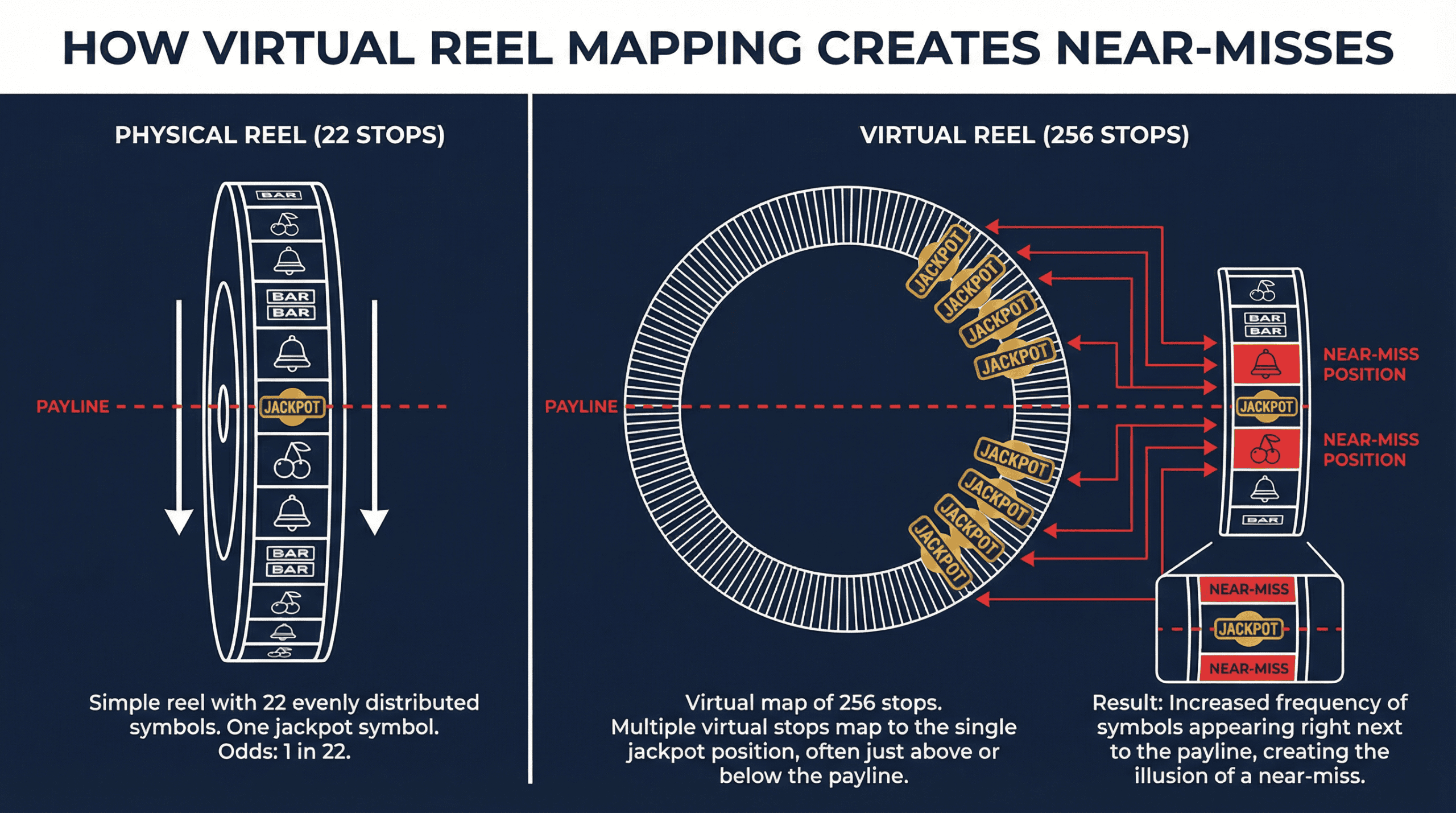
This separation between the math and the display allows game developers to use a technique called “virtual reel mapping.” On a physical or animated reel, there might be 22 visible stops. But in the machine’s programming, the virtual reel might have hundreds of stops. Developers map multiple virtual stops to the blank spaces immediately above or below the jackpot symbol.
This technique, sometimes referred to as clustering or using a high award symbol ratio, guarantees that the jackpot symbol will frequently land just out of reach on the payline. The machine isn’t almost hitting the jackpot; it is mathematically programmed to show you a near-miss.
The Legal Loophole in Slot Design
You might be wondering how it is legal for a machine to misrepresent the true odds of the symbols landing on the screen. The answer lies in how gaming regulators define fairness and randomness.
In major jurisdictions like Nevada, gaming regulations require that the outcome of a spin be determined entirely by the RNG. The machine cannot decide you are going to lose and then run a secondary program to intentionally generate a near-miss. However, because the virtual reel mapping is baked into the primary math model of the game, it is entirely legal.
The RNG randomly selects a number, and that number corresponds to a specific stop on the virtual reel. Because the virtual reel is heavily weighted with stops right next to the jackpot symbol, the “random” result will naturally produce a disproportionate number of near-misses. Some jurisdictions, like Ontario, have no specific regulations against these asymmetric or “starved” reels, giving manufacturers broad leeway to engineer the player experience.
Why This Matters for Your Bankroll
Understanding the near-miss effect is one of the most powerful tools you can have when playing slots. The flashing lights and near-jackpots are designed to bypass your logical brain and tap directly into your reward circuitry.
When you see two jackpot symbols and a blank, remind yourself that the machine did not “almost” pay out. Every spin is an independent event, and a near-miss is mathematically identical to a complete miss. It does not mean the machine is “hot” or that a win is coming soon.
By recognizing the near-miss for what it is—a programmed illusion—you can maintain better control over your play. Set strict limits on your time and budget, and never chase a jackpot just because it looked like it was one inch away.
Frequently Asked Questions
Here are the most common questions players have about the near-miss effect and slot machine programming.
What is a near-miss on a slot machine?
A near-miss occurs when the symbols on a slot machine land in a configuration that looks very close to a major payout, such as getting two jackpot symbols on the payline and the third symbol stopping just one space away.
Do near-misses mean a slot machine is about to pay out?
No. Every spin on a modern slot machine is an independent event determined by a random number generator. A near-miss has absolutely no predictive value for future spins.
Are casinos legally allowed to program near-misses?
Yes. While machines cannot use secondary programming to fake a near-miss after determining a loss, game developers can legally use virtual reel mapping to make near-miss outcomes statistically more common than actual wins.
Why do near-misses make me want to keep playing?
Neuroscience research shows that near-misses activate the same dopamine-driven reward pathways in the brain as actual wins. This chemical rush increases your motivation to keep gambling, even though you are losing money.
How often do near-misses happen on modern slots?
While it varies by game design, behavioral research suggests that slot machines are often optimized to deliver near-misses on roughly 30% of spins, as this frequency has been shown to maximize player persistence.