Polymarket Pulled a Bet on Nuclear War — Here’s What That Says About Prediction Markets

Prediction markets have built their reputation on a simple, ruthless premise: if something can happen, you should be able to bet on it. The entire value proposition rests on the idea that crowds with money on the line produce better forecasts than pundits, polls, or government agencies. But in early 2026, the industry found a line it was not willing to cross.
Following the escalation of military conflict in the Middle East, Polymarket — the world’s largest crypto prediction market — quietly removed its markets allowing users to bet on whether a nuclear weapon would be detonated by the end of the year. The decision came after massive public backlash and highlights a growing existential crisis for the industry: where is the ethical boundary for betting on real-world events?
As these platforms fight for mainstream legitimacy and U.S. regulatory approval, the nuclear war controversy proves that the “Wild West” era of prediction markets is coming to a forced end.
The Market That Went Too Far
The controversy began when users noticed several active markets on Polymarket with titles like “Nuclear weapon detonation by…?” which allowed traders to buy “Yes” or “No” shares on the likelihood of a nuclear strike by specific dates throughout 2026.
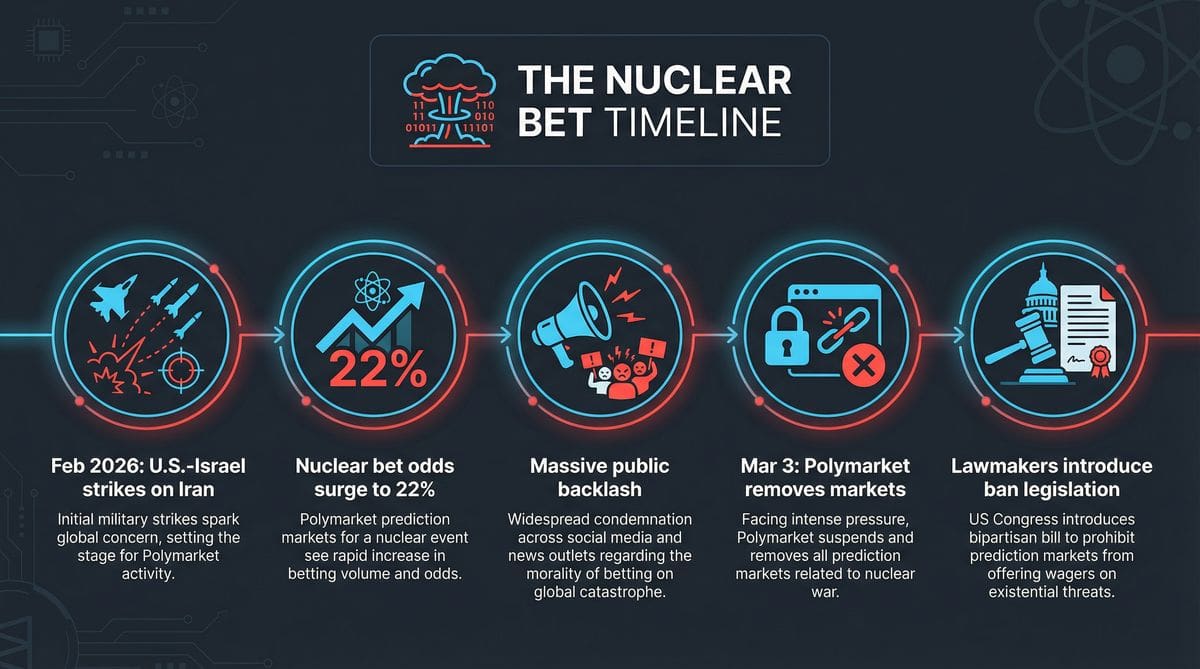
These markets had existed for months in relative obscurity, attracting modest trading volume from the niche community of prediction market enthusiasts who treat geopolitical risk like any other tradeable asset. That changed dramatically on February 28, 2026, when the United States and Israel launched coordinated airstrikes on Iran, killing Supreme Leader Ali Khamenei. Overnight, the nuclear detonation markets went from academic curiosities to front-page news.
Trading volume surged as speculators rushed to price in the possibility of Iranian retaliation. At one point, Polymarket’s own social media accounts posted odds showing a roughly 22% probability of a nuclear detonation by year-end. The post went viral, sparking immediate and intense outrage across social media and mainstream news outlets.
The backlash was swift and bipartisan. Critics argued that creating financial incentives around global annihilation was not just distasteful but deeply cynical. Some pointed out that a market predicting nuclear war could theoretically incentivize bad actors to make the prediction come true — a moral hazard that no amount of market efficiency can justify.
By March 3, Polymarket had archived and removed all nuclear detonation markets from its platform without issuing a formal public statement. The markets simply disappeared, as if they had never existed.
Their primary competitor, Kalshi, faced separate but related scrutiny over a market regarding whether Iran’s Supreme Leader would be ousted. Kalshi ultimately issued refunds for that market, citing internal rules that bar wagers directly tied to death or assassination. The distinction between predicting a political outcome and profiting from someone’s death proved too thin for even the most libertarian-minded platform to defend.
The Scale of the Money Involved
The nuclear detonation markets were not trivial side bets. The broader ecosystem of prediction markets like Polymarket and Kalshi had attracted enormous capital to Middle East conflict wagers. A single multi-outcome prediction market on the timing of the strikes accumulated over $500 million in bets on Polymarket alone.
To put that in perspective, $500 million wagered on a single geopolitical event exceeds the total handle of many state-regulated sportsbooks during an entire NFL season. These are not small-stakes hobbyists making $10 bets for fun. These are sophisticated traders, crypto whales, and — as subsequent investigations would reveal — potentially people with access to nonpublic information.
The sheer volume of money flowing into these markets is what transformed them from an interesting experiment in crowdsourced forecasting into a political and ethical lightning rod. When millions of dollars are riding on whether a country gets bombed, the line between “prediction” and “profiteering” becomes uncomfortably thin.
The “More Money, More Problems” Defense
Prediction market executives have historically defended controversial markets by arguing that they provide a valuable public service: unbiased, crowdsourced forecasting that cuts through the noise of partisan media and government spin.
Polymarket CEO Shayne Coplan, speaking at the MIT Sloan Sports Analytics Conference shortly after the backlash, acknowledged that the nuclear markets were a “complicated question.” However, he maintained that prediction markets remain “innovative and disruptive” tools for discovering the truth. Coplan summarized the growing scrutiny with a dismissive shrug: “More money, more problems.”
The defense has a certain internal logic. If prediction markets accurately forecast election outcomes better than polls — which Polymarket demonstrably did during the 2024 U.S. presidential race — then perhaps they also provide valuable signal about geopolitical risk. A 22% probability of nuclear detonation is, in theory, useful information for policymakers, journalists, and the public.
But for regulators and the general public, the problem is not the information. It is the underlying morality of the contracts being traded. There is a fundamental difference between predicting an election outcome and creating a financial instrument that pays out when a nuclear weapon kills people. The former is a forecasting tool. The latter feels like something much darker.
The Insider Trading Threat
Beyond the ethical concerns of betting on war, the nuclear market controversy has exposed a critical vulnerability in the prediction market model: the threat of insider trading.
Crypto-analytics firm Bubblemaps recently identified six suspected insider accounts that made a combined $1.2 million wagering that the U.S. would strike Iran, placing the bets shortly before the military action occurred. The timing of these trades was suspicious enough to attract the attention of both journalists and federal investigators.
According to CNBC’s investigation into prediction market war bets, another single account — operating under the username “Magamyman” — made over $500,000 betting on the death of the Iranian Supreme Leader. The New York Times separately reported that hundreds of bets of at least $1,000 predicting an imminent American strike were placed in the hours before the operation began.
In traditional financial markets, trading on nonpublic material information is a federal crime prosecuted aggressively by the SEC and DOJ. But because Polymarket operates offshore and deals in event contracts rather than securities, the legal framework is murky at best. The Department of Justice has already begun investigating the prediction market industry, signaling that federal prosecutors are no longer willing to let these platforms police themselves.
The insider trading problem is not just a legal issue. It is an existential threat to the entire prediction market thesis. If markets are being manipulated by people with advance knowledge of military operations, then the prices are not reflecting genuine crowd wisdom. They are reflecting information asymmetry — which is the opposite of what these platforms claim to offer.
Lawmakers Push for Sweeping Bans
The nuclear bet controversy has provided fresh ammunition for lawmakers who have long viewed prediction markets with suspicion.
In Washington, Democratic lawmakers have introduced legislation specifically targeting these types of wagers. Senator Chris Murphy of Connecticut and Representative Mike Levin of California proposed a bill that would strictly prohibit prediction markets from offering contracts that resolve on military actions, regime change, or deaths. The bill would apply to both domestic and offshore platforms serving U.S. users.
Separately, Senators Jeff Merkley and Amy Klobuchar introduced the End Prediction Market Corruption Act, which seeks to bar the president, vice president, members of Congress, and their families from trading event contracts entirely. One lawmaker bluntly characterized the trading on military outcomes as “worse than insider trading.”
The urgency from lawmakers is driven by both the ethical concerns and the scale of the money involved. When half a billion dollars is wagered on a single military operation, the potential for corruption and manipulation becomes a national security concern, not just a financial regulation question.
Neither bill has attracted Republican co-sponsors, reflecting the partisan divide on prediction market regulation. Many conservatives view these platforms as free-market innovations that should be left alone, while progressives see them as unregulated gambling operations that exploit human suffering for profit. The regulatory fear surrounding prediction markets is not new, but the nuclear war controversy has given it a concrete, visceral focal point.
The Path to Mainstream Acceptance
For prediction markets to survive and thrive in the United States, they must transition from offshore crypto experiments to regulated financial entities. The nuclear war debacle has made that transition both more urgent and more difficult.
Kalshi has already taken this route, operating under the oversight of the Commodity Futures Trading Commission (CFTC) and maintaining stricter compliance standards than its offshore competitors. Kalshi’s decision to issue refunds on the Khamenei market — while painful financially — was a calculated move to demonstrate that a regulated prediction market can exercise ethical judgment without destroying its core product.
Polymarket, while currently restricting U.S. users from its main platform, is reportedly planning a CFTC-regulated U.S. version. But gaining that regulatory approval will require the platform to prove it can enforce ethical boundaries, prevent insider trading, and implement the kind of compliance infrastructure that its crypto-native user base has historically resisted.
The industry also faces a more fundamental question: can you build a profitable prediction market business while excluding the most controversial — and therefore most heavily traded — contracts? The nuclear war markets attracted enormous volume precisely because they were shocking and high-stakes. If regulators force platforms to exclude contracts on war, death, and catastrophe, will enough trading volume remain to sustain the business model?
What This Means for Bettors
If you currently use prediction markets, the nuclear war controversy should prompt some serious reflection about the platforms you are trusting with your money.
Offshore platforms like Polymarket operate outside the reach of U.S. consumer protection laws. If the platform makes a unilateral decision to archive a market — as it did with the nuclear detonation contracts — you may have limited recourse to recover your position. The lack of regulatory oversight means that disputes are resolved by the platform, not by an independent authority.
For bettors who want to participate in prediction markets with some degree of consumer protection, CFTC-regulated platforms like Kalshi offer a safer alternative. The tradeoff is a narrower selection of markets and stricter compliance requirements, but the benefit is operating within a legal framework that provides actual recourse if something goes wrong.
The question is no longer whether prediction markets work — they clearly do. The question is what kind of world we are willing to let people bet on. And as the industry learned in early 2026, even the most permissive platforms have limits they did not know they had until the world forced them to find out.
FAQ
Why did Polymarket remove the nuclear war betting market?
Polymarket removed markets allowing users to bet on a nuclear detonation following massive public backlash. The outrage peaked after the platform posted odds showing a 22% chance of a nuclear strike by the end of 2026, shortly after U.S. and Israeli airstrikes on Iran.
Are prediction markets legal in the United States?
It depends on the platform. Kalshi operates legally within the U.S. under the regulation of the CFTC. Polymarket operates offshore and technically restricts U.S. users, though it is reportedly seeking to launch a regulated U.S. version.
What did Kalshi do regarding bets on the Middle East conflict?
Kalshi faced scrutiny over a market predicting whether Iran’s Supreme Leader would be ousted. The platform ultimately closed the market and issued refunds, citing internal policies that prohibit wagers directly tied to death or assassination.
Is it illegal to use insider information on prediction markets?
While insider trading is strictly illegal in traditional stock markets, applying those laws to event contracts on offshore platforms is a legal gray area. However, the Department of Justice has recently opened probes into suspected insider trading on prediction markets.
How much money was wagered on Middle East conflict prediction markets?
A single multi-outcome prediction market on the timing of the strikes accumulated over $500 million in bets on Polymarket alone. Individual accounts were identified making trades worth hundreds of thousands of dollars shortly before the military action occurred.
Responsible Gambling: If you or someone you know is struggling with a gambling problem, help is available. Call 1-800-GAMBLER or visit the National Council on Problem Gambling for free, confidential support 24/7.