
New York Knicks vs. Indiana Pacers Game 6 Prediction (May 31, 2025)
It ain’t over until the you-know-who-sings, and she did NOT sing–the Knicks are still in it.
NY was down 3-1 in the series against the Pacers, but they pulled off a Game 5 win, bringing it to 3-2. It’s a comeback that we honestly didn’t see coming, but here we are!
Indiana thought it was a wrap, but the Knicks had other ideas and won 111-94 on Thursday night. Jalen Brunson scored 32 points, had 13 rebounds, and three assists.
Game 6 will be in Indiana on Saturday, as the Thunder play a wait-and-see game to see who they’ll face in the Finals on June 5.
Will it be the Pacers or the Knicks? Is it anybody’s game, or does one have an advantage? Let’s find out!
Game Details
- Matchup: New York Knicks @ Indiana Pacers
- Series Status: IND lead 3-2
- Date & Time: Saturday, May 31, 8 pm ET
- Location: Gainsbridge Fieldhouse
- Broadcast: TNT/MAX
Prediction Breakdown
 43.3%
43.3%
 56.7%
56.7%
According to GamblingSite.com
Series Recap
The Pacers won the first three games of the series before the Knicks won Game 5 to stay in it. Below is how it’s played out so far:
- Game 1: Pacers 138, Knicks 135 (OT)
- Game 2: Pacers 114, Knicks 109
- Game 3: Pacers 106, Knicks 100
- Game 4: Pacers 130, Knicks 121
- Game 5: Knicks 111, Pacers 94
Indiana leads the series 3–2 heading into Game 6.
Betting Odds
Betting on this one? Here are the latest odds and lines according to FanDuel Sportsbook:
| Team | Spread | Moneyline | Total |
|---|---|---|---|
Knicks | +3.5 (-106) | +150 | Over 218 (-112) |
Pacers | -3.5 (-114) | -178 | Under 218 (-108) |
Prop Bets
If you’re looking for some side action, here are three props we think are worth it!
Jalen Brunson (Knicks)
- Over 2.5 Made Three-Pointers: -102
- Under 2.5 Made Three-Pointers: -130
Karl-Anthony Towns (Knicks)
- Over 1.5 Made Three-Pointers: +260
- Under 1.5 Made Three-Pointers: -360
Pascal Siakam (Pacers)
- Over 2.5 Made Three-Pointers: +430
- Under 2.5 Made Three-Pointers: -750
Don’t forget to check the sportsbooks for the latest odds, as they can (and do) change leading up to the game!
Players to Watch
And here is who everyone will have their eyes on in Game 6:
- Jalen Brunson (Knicks): Brunson is New York’s primary ball-handler and scoring option. He had 32 points in Game 5 and kept initiating most of the offense. Indiana will try to trap or hedge harder in pick-and-roll situations so they can limit his shot creation.
- Karl-Anthony Towns (Knicks): Towns finished with 24 points and 13 rebounds in Game 5, and gives New York a frontcourt scoring option that can go beyond the arc or operate in the post. Indiana could be looking to lure him away from the rim defensively.
- Tyrese Haliburton (Pacers): Haliburton is the Pacers’ main facilitator. He had a triple-double in Game 4 and controls Indiana’s half-court sets. His off-ball movement and passing make him really hard to contain when the defense relaxes.
- Pascal Siakam (Pacers): Siakam scores from all over the court—face-ups, cuts, and transitions. He’s averaging 25+ points this series and usually draws secondary defenders. New York will most likely rotate help early when he attacks from the wing.
- Myles Turner (Pacers): Turner anchors Indiana’s defense and spaces the floor on the other end. He protects the paint and can switch onto perimeter players when he needs to. Offensively, he stretches opposing bigs with his shooting.
- Josh Hart (Knicks): Hart gives New York rebounding and defensive coverage across positions. He isn’t a primary scorer, but he does do his part in switching schemes and keeping possessions going.
Best Bets
What do we (and FanDuel) think are the best bets for Game 6? The following:
- Pacers Team Total Over 110.5 (-115): Indiana is averaging 116 points at home in this series. Their half-court sets have been solid, and they’ve pushed the pace off misses. New York has allowed 114+ in all three road games so far.
- Jalen Brunson Over 2.5 Threes (-102): Brunson is seeing a lot of volume from beyond the arc—off screens and late-clock isolations. He’s hit at least 3 threes in 3 of the 5 games in this series.
- Pascal Siakam Over 2.5 Threes (+430): Siakam has taken more spot-up attempts in this series than he usually does. The volume isn’t high, but the number and price have some value in a game where spacing could matter way more if New York collapses inside.
- Karl-Anthony Towns Over 1.5 Threes (+260): Towns has attempted 4+ threes in the last two games. Indiana is sagging off early to help on drives, and that gives him clean looks from the top of the key.
Get your bets in early for Game 6 between the Knicks and the Pacers at one of the top-rated betting apps. You’ll find the best odds and bonuses for getting the most out of your wagers.
Game 6 Prediction
The Pacers are back on home court, ahead 3–2, and have a chance to finish it in front of their fans. They’ve created good looks through consistent spacing and smart decision-making, and their bench has held up in important stretches. Haliburton is directing the offense, and Siakam’s scoring versatility has forced New York into tough matchups.
The Knicks need to put in another big night from Brunson to push it to Game 7. If he doesn’t get some help from Towns or support from their reserves, they’re gonna have a hard time keeping up. Defensive breakdowns and heavy minutes have been issues on the road, and Indiana has taken advantage of both.
Final Prediction: Pacers 117, Knicks 108
Indiana ends it at home by keeping pressure on New York’s defense and not giving them any second chances.
Los Angeles Sparks vs. Las Vegas Aces Picks & Prediction (May 30, 2025)
The WNBA is finally getting the attention it deserves! Ok, so this game doesn’t have Caitlin Clark or Angel Reese, but they aren’t the only two stars in the league. The Sparks vs. Aces a big draw for fans, and Las Vegas is back at home after a surprising loss, and they’ll try to reset without some of their important names in the lineup. The Sparks are also coming a rough one and haven’t really found their feet when they’re on the road.
Injuries are a big factor on both teams, and that makes this matchup harder to call than it would be under normal circumstances. Las Vegas is still favored, but they have some missing pieces, and the gap isn’t as wide as it looks on paper. Can the Aces cover the spread with a short bench, or is this a chance for L.A. to win one?
Game Details
- Matchup: Los Angeles Sparks (2–4) vs. Las Vegas Aces (2–2)
- Date & Time: Friday, May 30, at 10:00 ET
- Venue: Michelob ULTRA Arena, Las Vegas, NV
- Broadcast: ION
Team Comparison
The Sparks and Aces both are coming off losses and missing important players, but their situations aren’t the same. Below is how they compare going into the game.
Los Angeles Sparks
- Record: 2–4 (1–1 away)
- Last Game: Lost to Atlanta Dream 88–82
- Key Player: Kelsey Plum – 25.2 PPG, 5.5 APG

Plum has been their most reliable option, handling scoring and distribution through the early part of the season.
Injuries
- Rae Burrell (G) – Out
- Cameron Brink (F) – Out
Las Vegas Aces
- Record: 2–2 (1–0 home)
- Last Game: Lost to Seattle Storm 102–82
- Key Player: A’ja Wilson – 20.8 PPG, 10.8 RPG

Wilson leads by example; she puts up points, cleans the glass, and holds it down with the defense.
Injuries
- Megan Gustafson (C) – Out
- Cheyenne Parker-Tyus (F) – Out
Betting Odds
Here’s what the latest odds and lines are according to DraftKings:
- Spread: Aces -9.5
- Total Points (O/U): 164.5
- Moneyline: Aces -500, Sparks +360
Analysis & Insights
Las Vegas is still up as the favorite, and predictive models are giving them a 77% chance to win. But with players out on both sides, there’s more uncertainty than the number suggests.
The Sparks are putting up 81.8 points per game, slightly ahead of the Aces, who are averaging 80.5. Both teams can score, but defense and depth could be tested because of the injured main players.
How well each team adjusts, like with shorter rotations, will decide how close this one is. The Aces have the advantage from a numbers standpoint, but that margin gets smaller without a full lineup.
Best Bets
Plenty of unknowns with the injuries, but there are still a few angles worth targeting if you’re betting this one. Here’s what we like in terms of best bets!
- Aces -9.5 Spread – Las Vegas has played really well at home and still has enough depth to create separation. The Sparks are thin up front, and if the Aces get out in front early, a double-digit win is not out of reach.
- Under 164.5 Total Points There are scorers on both teams, but with rotations shortened and less reliable options off the bench, it could be a lower-tempo game. The number’s pretty high for a matchup that’s missing key players.
- First Half: Aces -5 – Vegas busts out of the gate when they’re on home court after a loss. Backing them to cover the early line makes a lot of sense with how the Sparks have looked in the opening quarters on the road.
Bottom Line: Sparks vs. Aces Best Bet Recap
Our Final Score Prediction: Las Vegas Aces 86, Los Angeles Sparks 74
The Aces are back at home and want to get back on track after a hard loss. They’ve been solid on their own floor and still have the parts to handle a short-handed Sparks squad. L.A. hasn’t shown a lot of stability yet when they’re away from home, and they’re missing important contributors again heading into this game.
Injuries are affecting both sides, which makes betting angles a little less clear-cut. But based on how each roster has handled their recent setbacks, we think that Vegas is in a better spot to come out on top.
Yankees vs. Dodgers – May 30, 2025: Game Preview & Best Bets
On Friday night in LA, there’s a baseball game with a little more oomph to it. The Yankees are at the top of the American League and playing good baseball. The Dodgers are near the top of the NL West, and this is their first time playing each other since the Dodgers knocked them off in last year’s World Series.
Max Fried is on the mound for the Yankees and has been dealing sick pitches all season. Tony Gonsolin will try to hold things down for a Dodgers rotation that’s been stretched really thin. At the plate, Aaron Judge is ripping the cover off the ball, and Shohei Ohtani is putting up power numbers that lead the league.
Both teams have lineups that can do a lot of damage, so if you’re looking for a game with playoff-level energy before summer? This is the one to watch! Look below for the stats, best bets, and who we think will knock it out of the ballpark.
Game Details
- Matchup: New York Yankees vs. Los Angeles Dodgers
- Date & Time: Friday, May 30, at 10:10 ET
- Venue: Dodger Stadium, Los Angeles, CA
- Broadcast: Apple TV+
- Weather: Clear skies, 77°F at first pitch
Storylines to Watch
There’s unfinished business and two really different pitching trends, so here’s what we are watching when the Yankees and Dodgers take the field.
1. World Series Rematch
They’re facing off for the first time since the Dodgers took out the Yankees in last year’s World Series. That six-game result still hangs over New York, and you can bet they’re treating this series as a chance for payback. Both clubs are on top of their divisions, so there’s more tension because of how it ended last year.
2. Pitching Duel: Max Fried vs. Tony Gonsolin
- Max Fried (NYY): 7-0, 1.29 ERA, 0.93 WHIP
- Tony Gonsolin (LAD): 2-1, 4.68 ERA: Gonsolin’s had some problems settling in. His last couple of starts have been short, and he’s been working from behind in too many counts. The Dodgers need more from home if they’re piecing together innings from their bullpen.
3. Offensive Powerhouses

Aaron Judge (NYY): .391 AVG, 18 HR, 47 RBI. Judge is squaring up just about everything that’s thrown his way. He’s hitting for average, crushing mistakes, and making pitchers work for every out. His plate discipline and power give the Yankees a nice boose in almost every game.
Shohei Ohtani (LAD): .292 AVG, 20 HR, 35 RBI. Ohtani’s been steady and dangerous. He’s not chasing, he’s working deep into counts, and when he gets something to drive? He sends it. He already has 20 homers, and he’s doing what the Dodgers brought him in to do.
Team Comparisons
Ok, let’s take a look at how the Dodgers and the Yanks look when compared side-by-side!
| Category | Yankees | Dodgers |
|---|---|---|
Record | 35-20 | 34-22 |
Recent Performance | Won 5 in a row | Lost their most recent game |
Home/Away Record | 17-11 on the road | 19-8 at home |
Team ERA | 3.34 | 3.91 |
Bullpen Strength | Reliable, with Mark Leiter Jr. handling late innings | Still trying to find consistency through injuries |
Betting Odds
Betting on this ballgame? Here are the latest odds and lines via FanDuel:
| Team | Spread | Moneyline | Total |
|---|---|---|---|
Yankees | -1.5 (-170) | -108 | Over 8 (-118) |
Dodgers | +1.5 (-185) | -112 | Under 8 (-102) |
Best Bets
Ready for our best bets? Below are the three that we think make the most sense!
- Yankees Moneyline (-108) – Fried has been on top of his game all season long; he makes hitters off balance and gives the Yankees a good chance of winning when he’s out there. Combine that with New York’s recent streak of wins? You’ve got a number that’s worth getting in on.
- Over 8 Total Runs (-118) – The Dodgers have been bringing in runs, but they’ve also had some problems getting consistent innings from their pitching staff. The Yankees also put up runs, so this total isn’t too high for two bada** bullpens.
- Aaron Judge to Hit a Homer – Judge is making that thwack sound almost every night he steps up to the plate. He’s seeing the ball really well, his swing looks beautiful, and he’s already got 18 homers in his back pocket. In a park like Dodger Stadium? An error from Gonsolin could end up in the nosebleed seats.
Final Pick & Score Prediction
The Yankees will be at Dodger Stadium and looking to get their lick back after last year’s World Series loss. Max Fried is pitching, and the lineup is producing, so we think that they’re in a good position to open the series with a win.
The Dodgers have lots of hitters who can do some damage, and Ohtani is always a threat, but Gonsolin hasn’t been as reliable. If New York can be patient at the plate and keep applying pressure, they should come out on top.
Our Recommended Bets:
- Yankees ML
- Over 8
- Judge hits a home run
Final Score Prediction: Yankees 6, Dodgers 4
Fried goes six solid innings, Judge homers, and the Yankees hang onto their winning streak.
FYI: All stats and odds are current as of publishing, but always check the top online sportsbooks for the latest lines and info before you make your bets!
How to Spot and Exploit Overreactions in Betting Markets
Anyone who has ever bet on sports has fallen into the recency trap at one point or another—no exceptions.
Recency bias (also called the availability heuristic) is the tendency to overweight recent events when judging probability. In sports betting? That means if Team A just thumped its last three opponents, we might assume that they’ll keep winning, even if the long-term data suggests otherwise.
Media coverage often highlights the latest big win or upset, making it easy for us not to be swayed by the memory of recent dominance. This can lead to big mistakes, as bettors will push a hot team’s lineup or dump a team after one bad game, distorting the odds.
A good example of this is when the NFL’s Pittsburgh beat Houston, Indianapolis, and Baltimore, so the public bet them up as 4.5-point favorites against the 1–8 New York Jets. It was pretty hard to think that the Steelers would lose, but the Jets pulled off an upset and beat them 20–13.
That’s recency bias in action; one string of wins made everyone flat-out ignore the longer-term trends. In betting markets, these kinds of overreactions create solid opportunities for patient, analytical bettors. By understanding how recent events can mislead the crowd? You can spot when lines are too high or too low.
We are gonna explore what causes those overreactions, how sportsbooks exploit them, and how you can use them to your advantage. We’ll cover real-world examples from the NFL, NBA, and March Madness, explain some good betting strategies, and point out the most common psychological traps to sidestep. You’ll be honing your contrarian instincts: when the public goes all-in on the latest narrative, you’ll know better and pause to look for hidden value!
What Causes Overreactions in Betting Markets?
Betting markets can blow hot and cold for a lot of reasons. The main drivers of overreaction? Psychological and informational. Below are the most common culprits:
Recency Bias / Availability Heuristic
People naturally put more weight on recent results. A big win last week or a star player’s hot streak can seem more predictive than it really is. Sportswriters and broadcasts also feed into this: studies show that media coverage only focuses on the most recent games, player performances, or incidents, which then causes bettors to overemphasize recent events and ignore broader trends. In practice, this means a team that just crushed an opponent might see its odds shorten drastically, even if nothing fundamentally changed about their matchup.

Media Hype and Narratives
The press adores a good storyline—a young phenom, a veteran on a roll, or a QB comeback. Dramatic headlines and social media chatter inflate a team’s perceived chances. According to betting analysts, vivid or over-covered media stories become more accessible in memory and can disproportionately influence betting decisions.
For instance, if a star player’s turnaround passes get 24/7 coverage, bettors might rush to back that team. This hype-driven demand shifts the line, often beyond what stats justify.
Injury and Personnel News
News about injuries or lineup changes can trigger knee-jerk reactions. If a star quarterback is ruled out on game day, the public often jams bets on the other team. Research confirms this: bettors were found to back the visiting team 3.1% more when the home team’s starter was injured.
Conversely, if the home team loses its QB, bettors back them 2.1% less, even though teams playing without their star often still cover a reasonable part of the spread. In other words, bettors tend to overreact to an injury and abandon a team that might still be decent. Sharp bettors, aware of this bias, are able to exploit the inflated line on the opponents.
Gambler’s Fallacy and Hot-Hand Bias
People look for streaks or reversals in ways that don’t make sense statistically. If a team just won five in a row, fans might think “they won’t lose the sixth” (gambler’s fallacy) or that they’re “on fire” and will just keep winning (hot-hand fallacy). Neither is guaranteed. Sports outcomes aren’t strictly random, but treating each game as dependent on a previous win or loss is usually dead wrong.
A classic example is a baseball team that has a long losing streak; they aren’t due for a win; every game still has its own probability. Yet many bettors make decisions as if “momentum” alone predicts the next result.
Confirmation and Emotional Biases

Once a fan believes something, they tend to cherry-pick info. If you love Team X, you might notice all the glowing stats and ignore warning signs about them. This confirmation bias causes bettors to remember or seek data that supports a hypothesis and disregard contradictions. Emotions also play a big part, as it’s easier to back a beloved underdog or “script” than to take a look at the math. Fan loyalty and wishful thinking can drive support (and line shifts) for a team that isn’t objectively strong.
Herd Mentality
When a lot of bettors jump on the same side, more will follow (“everyone else is doing it”). Bookmakers call this the “mob” effect. A public herd will back the popular team or a big favorite, even at poor odds, simply because it feels like a sensible move. And piling on can push the line well past fair value.
Betting Promotions
Lines can be skewed by promotions or parlays, too! If a sportsbook has a special offer that encourages one side, it can distort the market temporarily.
Any time the crowd gets swayed by recent memory, hype, or emotion, odds can overshoot. Overreactions are usually the strongest right after a big headline event, like a shocking upset, a major trade or signing, or a record performance. Smart bettors recognize that these are the moments when lines move the most and where the value is hiding.
How Sportsbooks Take Advantage of Overreactions
Bookmakers are fully aware of these biases and will often exploit them for profit. They don’t just set lines to split bets 50/50 (the old myth of “balancing the book”). In fact, research shows that bookmakers are using recency bias to encourage bets on what they perceive will be the “losing’ side.” That is, the line might be tweaked so that the “smart” or less popular side becomes the more attractive value play, while the majority backs the other team at worse odds.
For example, imagine Team Y has been on a heater and is a 10-point favorite by true power rankings. Because of the hype, the public overwhelms the books with bets on Team Y anyway. A smart sportsbook could move that spread to 13 or 15 points, knowing full well that recency bias is going to push bettors to the hot team. In one reported case, researchers saw a line where the true spread was about 10, but the sportsbook posted -15 because they expected heavy betting on the favorite.
When bettors blindly took that extra 3 points of (illusory) cushion, the underdog actually covered more often than bettors expected. The sportsbook ends up profiting not just from its built-in vig (house commission) but from the extra amount of action it lured on the favorite side.
Legendary odds-maker Gerry Goldstein once said, “They [sportsbooks] always try to push you in one direction…They’re trying to maximize their profit.” In practice, this means that lines are not neutral. A line may already incorporate the sharp (informed) money and then further adjust for expected public money. If Big Team Z just got a franchise quarterback, the opening line may shorten before even a single public bet is placed, anticipating the hype. Then, as casual bettors pile on, books might pivot the other way to get action on the dog.
A real scenario looks like when, early in a season, the Browns were 10-point home favorites over a Dallas team missing its star QB. As expected, the public bet on Cleveland heavily because they were on a winning streak. The sportsbooks then jacked the spread up to 15 points, knowing full well that recency bias is going to push bettors to the Browns.
A lot of bettors took Cleveland at –15, convinced the streak would continue. But if you looked at the bigger picture, Dallas, without their quarterback, still had a shot to keep it close. The books basically made the line bigger to guarantee a profit. Even a little shift like that can turn a modest favorite into a trap.
Oddsmakers often inflate favorites and deflate underdogs when they expect the public to overreact. This goes beyond merely getting equal money on each side. Famous statistician Nate Silver noted that the idea “that sportsbooks seek to balance their books” is mostly a myth.” Instead, they craft lines to exploit bettor mistakes. If a majority is leaning one way, the “other” side might carry hidden value.
In effect, sportsbooks are betting against the overreactions of the crowd. They know that bettors as a group will pay the vig and more by chasing hype. The lines will reflect that, so watch for lopsided lines or spreads that move counterintuitively!
How to Spot Overreactions in Real Time
Knowing why overreactions happen is, of course, useful, but how do you catch them as they happen? The following are some practical tactics for getting a good read on the market:
Significant line shifts can be a red flag. If the spread or moneyline moves sharply in one direction without a clear fundamental reason (no injury news, no weather change, etc.), it likely reflects an emotional reaction. Look for odds that shift dramatically due to public betting rather than fundamental changes in team strength. Like if a team suddenly opens as a 10-point favorite and by midweek it’s –14 with no new injury reports, ask “why?” In most cases, the public has jumped on board, forcing the line. An unexplained big move often means value has popped up on the other side.
Most sportsbooks and gambling sites now report two metrics: the percentage of bets (public%) and the percentage of money (money%). Sharp bettors generally bet bigger amounts, while casual “square” bettors make smaller wagers. If 80% of tickets are on Team A but the bulk of the money is on Team B, that gap signals a contrarian play. In other words, if heavy favorites attract tons of small bets but pros are placing big bets on the dog, it’s worth considering taking the dog. Tools like Action Network or specialized apps will show you these splits in real time. Watching for a large discrepancy (e.g., 70–80% of bets on one side) can help you see where the crowd is overruling the wisdom of sharps.
Be very suspicious of super popular teams or players who are drawing overwhelming support. Some analysts note that high-profile teams often attract public money regardless of true probability. If the odds seem unusually short for a favorite (or long for an underdog) compared to statistical models, the public might be inflating them. For instance, a top NFL team on a hot streak might be bet down to an extreme line despite having only an average matchup. Likewise, an underdog getting near double-digit points could actually be a good bet if the public has dismissed them unfairly.
When everyone is talking up one team, saying “This is gonna be their year!” it can and does show up in the lines. Market pros strongly suggest avoiding bets based solely on hype. Instead, focus on objective factors: home field, pace of play, and defensive metrics. During Super Bowl XLVIII, the Denver Broncos were hyped up as historic offensive favorites. The public backed Denver so hard that the line moved way in their favor. Sharp bettors realized that the market was overconfident and bet on Seattle instead. The Seahawks won 43–8, proving that Seattle’s chances had been sorely underestimated. If you’d relied only on the Denver narrative, you’d have missed the value on Seattle. Trust the numbers and fundamentals over the headlines.
Not all books adjust lines equally or at the same time. One sportsbook might move a spread quickly, while another lags. It pays to shop around! For example, if Team X opened at +7 at -110 juice but one book offers +7 at -105, that slight discount is the better deal. Likewise, sometimes an overreaction subsides as the game nears kickoff. A smart bettor will wait out an early line spike and take a better price when it cools off. Always get the best available price before you place a bet.
By being aware of the signals—extreme moves, lopsided betting percentages, and narrative-driven lines—you can catch a market overreaction as it happens. The key is to look for dislocations between the line and the true probability of outcomes. Whenever the public seems to be steering the ship, stop and ask if the odds reflect reality. Often they don’t, and that’s where the edge is!
6 Betting Strategies to Exploit Overreactions
Once you’ve spotted an overreaction, the next step is to act on it in a smart way! Below are some tried and true strategies to capitalize on skewed lines:
- Fade the Public: Betting against heavily backed teams (fading the public) is a classic contrarian strategy. If the majority of casual bettors are on one side, the other side may be undervalued. If you see the public piling onto a popular team or a home favorite, consider betting the other side (especially with points). Sharp bettors follow this logic. One study of early NFL/NCAA games showed that underdogs won or covered 63.8% of the time when they received less than 40% of the public bets. In plain terms, when the crowd ignores an underdog, that dog tends to outperform expectations, which suggests that riding with the popular team can be a long-term loser.
- Spot Overpriced Favorites: Sometimes the best value is just to take points on an underdog that was hyped. A well-known example is research that was done on NFL games with backup quarterbacks, which concluded that underdogs get many of those points and cover far more often than most bettors realize. Analysts recommend always taking the points when a team is playing without its starting quarterback. Those teams rarely win outright, but they cover the inflated spread way more often than expected. The sportsbook knew this, but bettors were so scared of facing a backup that they gave away extra points. Betting the underdog in those cases turns that scenario into profit for you.
- Bet Early or Late as Needed: If you catch an overreaction early (before lines adjust back), you can lock in a favorable price. Conversely, if a line spikes too high to your taste, you could wait a bit. Say that news breaks that an injury might be worse than was first thought, the line might overshoot and then correct once more info is made public. Waiting for that correction can yield a much better price! The principle is to bet when your estimated probability exceeds the implied probability of the odds. If an overreaction makes the implied win chance of a team lower than what your analysis suggests, that’s your moment.
- Line Shopping: Always compare multiple books for the best odds, because even what seems like a tiny difference matters. A sportsbook might list a team at +7 (with -110 juice) while another offers +7 at -105. That half-point of “juice” is the difference between risking $110 to win $100 versus only $105. Over a lot of bets, saving a few cents per dollar wagered does add up. In the context of overreactions, line shopping can mean finding which book has taken more of the heat. If one book has moved a line out while another still shows the old number, the old line might offer hidden value before it catches up.
- Use Data-Driven Models: Keep your own power ratings or statistical models. If your model differs from the sportsbook line, bet where the model gives you an edge. If your ELO or predictive model says Team A is a 3-point favorite but the market lists them at 8, you have a potential +EV opportunity by betting Team B +8. The contrarian strategy here is to trust quantitative analysis over sentiment. It’s an approach that takes discipline and record-keeping, but it can systematically exploit crowds.
- Specialize in Niches: Overreactions tend to be more pronounced in high-profile games (Week 1 NFL primetime, March Madness, big rivalry matches). If you focus on a sport or situation where you’re especially knowledgeable, you can probably spot subtle context that the market misses. Early-season NFL games usually see a lot of overreactions to free-agent signings or rookie QBs. And March Madness, with its seed bias and insane bracket hypes, is infamous for lines that zig when public sentiment zags. By having solid knowledge of one area, you can see when the market has mispriced it based on incomplete analysis.
No strategy will ever win 100% of the time, and contrarian bets can and do lose. But the goal here is positive expected value (+EV) over time. That happens when your wins (when the market corrects) outweigh your losses. Taking advantage of overreactions means you are selectively picking spots where the math favors you, and not chasing every public line shift. The simplest strategy? Fade hype with reasonable caution, and bet the unheralded side when the favorite’s line is fueled by emotion.
Psychological Traps to Avoid
When you’re ferreting out those market missteps, watch that you don’t fall victim to other biases! Here are the psychological traps you need to watch out for:
- Recency Bias (Again): It’s easy to catch yourself falling into the same exact trap that you’re exploiting, so don’t overreact to recent games. If a team just gave up a big lead and lost last week, don’t automatically assume that they’ll continue the trend indefinitely. Treat each game on its own merits, not as a continuation of a short streak.
- Gambler’s Fallacy: Games are mostly independent, so don’t bet on a team just because you feel like it “deserves” a win after a string of losses or vice versa. A team losing five in a row isn’t any more or less likely to lose the sixth—past outcomes don’t change the fundamental odds. Likewise, if you’ve won a few bets in a row, don’t size up your wagers thinking you’re on a “hot streak.” The odds of your next pick are only tied to its own value, not to your recent run.
- Hot-Hand Fallacy: Don’t assume that a player will continue a scoring streak just because they’ve been “on fire” as of late. Similarly, don’t dip on a player because of a cold spell. Statistics, especially in large samples, show that long streaks tend to regress to the mean. Don’t give extra credit in your model to any short-term trends.
- Confirmation Bias: When the line moves away from your favorite side, don’t immediately assume that the market is right. Check all of the data! Conversely, if a line drifts in your favor, don’t let excitement carry you away. Always ask yourself this: “What info am I ignoring?” We all like to remember or look for the data that supports a hypothesis and forget the rest, so be your own devil’s advocate.
- Anchoring Bias: The first number you see can unduly influence you, which can anchor you to an opening line or a gut feeling. If a sportsbook posts certain odds, you might consider that to be gospel and not want to stray from it. But lines change for a reason. Even the most experienced bettors can be fooled by the bookmaker’s starting price: if a player’s chance is really 50/50 (true odds +100), a first posted line of +245 can make everyone think his chance is way lower. In practice, you should be reassessing a game on its own merits, not just by how you first saw it.
- Emotion/Fan Bias: Never let loyalty override logic. Betting on “my team” or hating the opponent can cause you to let value bets slip through your grasp. If your fav team is the one that just won big, be especially skeptical of the line—that’s when your own bias could be telling you that “they’ll win again.”
- Herd Mentality: Just because “everyone is on one side” doesn’t mean that they’re right. Sometimes the smartest move is the unpopular one. Ignore that temptation to join a public parlay or a trendy pick. Remind yourself that bookmakers usually set lines because they know that the herd will go that way.
- Outcome Bias (Hindsight): After a surprising result, it’s pretty common to say, “I knew that would happen” or “I should have seen it.” Hindsight is 20/20, and don’t get stuck on this. Learn from the error and move on. Focusing on what you could have done better (maybe you didn’t gather enough info) is more productive than telling yourself that the outcome was obvious.
- Chasing Losses: If a contrarian bet didn’t work out, don’t immediately double down on the next in the hopes of making up for it. Be disciplined—every situation is different, so look at every bet with fresh eyes and analysis!
Real Examples of Market Overreactions
It’s really helpful to see real examples of how market overreactions happen and the fallout. Below are where the betting market (and the public) overreacted, and what a smart bettor could have done differently!
Pittsburgh vs. New York Jets (NFL, 2014)
As mentioned, Pittsburgh had just crushed several opponents and was bet down to –4.5 against the 1–8 Jets. Public sentiment was that the Steelers would annihilate the Jets. Pittsburgh lost 20–13, and this was a textbook case of recency bias: bettors saw the previous blowouts and assumed another win was in the works.
A disciplined bettor might’ve taken the Jets with the points, recognizing that no team is unbeatable and that an 8–1 team losing big meant the Steelers were indeed vulnerable.
Buffalo vs. Jacksonville (NFL, 2021)
The Buffalo Bills schedule right now:
BYE
Dolphins
Jaguars
JetsEvery team has a BYE Week.
Buffalo has a BYE Month. pic.twitter.com/XjsjW2VjJl
— Kyle Brandt (@KyleBrandt) October 27, 2021
The Buffalo Bills were so hyped as Super Bowl contenders that oddsmakers made them 15-point home favorites against the Jaguars, which was the largest favorite in years. The public heavily backed Buffalo, but Jacksonville won the game. From 1996 through 2017, 15-point underdogs never won an NFL game, but in 2021? It happened. Bettors who assumed Buffalo’s high-powered offense guaranteed a blowout were snookered, and it showed that a seemingly “sure” outcome can be upended.
A better approach? Bet on the Jaguars +15 (or a low total) when the line shot up, instead of expecting the Bills to cover the huge spread.
Milwaukee Bucks vs. Miami Heat (NBA, 2020)
In the NBA playoff bubble, the 66-win Bucks were loaded with stars (plus a $10-plus average margin) and had both league MVP and Defensive Player of the Year. Vegas made them the heavy favorites over the Heat. The public assumed a Bucks series win was all but guaranteed, but Miami came out on top. It was a case of modern market efficiency failing under unique conditions (no home court, small sample).
Bettors who impulsively took the Bucks ignored all of the signs: Miami was a strong matchup even if they weren’t heavily favored. A contrarian bettor could have seized the value on Miami after the line went as low as it did. It’s a stark reminder that even statistically dominant teams can lose short series, especially when circumstances change.
Memphis vs. San Antonio (NBA, 2011)
This is a classic upset: the 8-seed Grizzlies beat 1-seed Spurs in the first round. The Spurs had a 99.4% calculated chance to win the series. If you’d bet San Antonio en route or during the game, you would have lost. Bettors who expected a sweep on paper were dead wrong, and the series showed that long odds favorites can fall.
If any smart money played it, it would have been on the Grizzlies, but most players and bettors look at an 8–1 matchup as a done deal. In retrospect, this was a mega-win for anyone who saw the mispriced market.
UMBC vs. Virginia (NCAA Tournament, 2018)
This was the penultimate March Madness shocker. Virginia was the No. 1 overall seed and was a 20.5-point favorite over 16-seed UMBC. Some sportsbooks didn’t even bother to list a moneyline for Virginia because the result was deemed nearly impossible. And then UMBC won by 20. Here’s how the betting market reflected bias: in one Vegas book, 25 people bet on Virginia at -10,000 odds (they risked $10,000 to win $1) because it was “safe.” Almost the entire betting public was expecting a blowout. A couple of bettors saw it differently: a gambler parlayed UMBC and another underdog (Marshall) for $40 and turned it into $7,280! Yes, that’s a rare bet, but it paid off in spades.
The lesson here? The market assigned virtually zero chance to UMBC, ignoring the unpredictable nature of the tournament. Betting on the dog (or on “under” with a prop bet) in giant mispricings was the right value play.
Baylor vs. Gonzaga (NCAA Championship, 2021)
Baylor was a 4.5-point underdog against unbeaten Gonzaga, with moneylines at +160 (Baylor) and -213 (Gonzaga). Everyone assumed that Gonzaga would finally finish the job. Baylor not only covered the spread but won handily. Bettors backing Gonzaga were rewarded poorly: a $1,294 wager on Gonzaga at -10000 would have netted only about $13, which is a comically small upside.
A smart gambler saw that +160 on Baylor was a huge overlay. Ignoring the hype on Gonzaga and taking Baylor (either on the line or moneyline) was the value move. The market had undervalued Baylor because it was biased by Gonzaga’s unbeaten narrative.
When Not to Bet Against the Market
Sure, contrarian betting can be profitable, but it’s not a guaranteed winning strategy. Sometimes the market is right, and fighting it is an uphill battle. Below are the examples of when you should hold back from betting against the public:
- Legit Info Surfaces: If a line moves on solid news? Trust that move. Like if a star player’s injury is confirmed or one unexpectedly returns from an injury, the odds will adjust for a real change in team strength. Overreacting to that move and betting the opposite would be unwise. If the market is shifting because the underlying probabilities have truly changed (not just hype), don’t ignore it.
- Heavy Sharp Money: Professional bettors (“sharps”) usually move lines by placing big bets, so if you notice a line shift by a lot, it was most likely driven by “steam” or sharp action, so be cautious about fading it. Sharps tend to uncover value; if they swarm a side, it usually means that they’ve found reasons others missed (like a hidden injury or matchup advantage). In these cases, the line move is not an overreaction to be exploited, but a correction that should be respected.
- Lack of an Edge: Only bet if you actually have an edge. If your analysis suggests that the market line is fair, like when your power ratings agree with the current point spread, it’s usually better to sit this one out. Not every game offers a mispricing. Sometimes the public and sharps align, and the line is basically efficient. Chasing action in those situations rarely, if ever, pays off.
- Low Information Games: If you don’t have time or data to analyze a particular matchup, don’t force a contrarian bet. Opportunistic bets should be based on info, not guesswork. It’s fine to skip a game if you’re unsure, rather than fade randomly.
- Thick vs Thin Markets: Be super careful in markets that have low liquidity (like minor league props or obscure bets). Overreactions can be really extreme in the smaller markets, and sometimes lines are incorrect due to bookmaker error or not a lot of action. Unless you have a very good reason to bet (and a good sportsbook), it’s probably not worth the risk.
- Emotional Decisions: Don’t go against the market just to be contrary. If your reasoning is driven by pride or “defying the crowd” rather than solid analysis, that’s a trap that you set for yourself. If you hate the narrative around a team and decide to bet against them just for that reason, you’re not betting smart, you’re betting emotionally!
Conclusion: Overreaction = Opportunity If You Know What to Look For
The crowd’s knee-jerk reactions create the chinks in the armor of otherwise efficient markets when it comes to sports betting. Recency bias and emotional betting can push odds way beyond what the actual probabilities justify. But guess what? For the informed bettors out there, this is great news: every overreaction is an opportunity hiding in plain sight.
By understanding the causes of these market swings, from hype cycles and media narratives to injury scares and cognitive biases, you’ll know how to spot when a line is inflated or deflated. Monitoring line movements, betting percentages, and sharp action helps pinpoint these moments in real time. Equally important? Having your own analysis ready and waiting with stats, power rankings, or modeling, so that you can easily and quickly evaluate if the market is in line with the facts or out of sync with them.
You don’t have to always bet against the public just because. The goal is to bet value, meaning you only act when the market’s price underestimates a team’s chances (and therefore offers positive expected value). When everyone else is hyper-fixated on the latest sensational headline, take a minute to check if the odds really reflect the situation. When you separate emotion from analysis, you can make bank off of what others miss.
The calm, cool, collected, and analytical bettor can thrive in markets that swing wildly. Overreactions are never guaranteed winners, but they do have some predictable oddities. If you patiently and thoughtfully identify them, you can turn public mistakes into your profit. And that is how an apparent overreaction becomes a real betting opportunity!
Indiana Pacers vs. New York Knicks Game 5 Prediction (May 29, 2025)
Tyrese Haliburton put on a historic performance in Game 4, finishing with 32 points, 15 assists, 12 rebounds, and zero turnovers in Indiana’s 130-121 win over New York. The Pacers are now up 3-1 in the series; they’re one win away from their first trip to the NBA Finals since 2000.
Haliburton’s second career playoff triple-double was the first in NBA postseason history with at least 30 points, 15 assists, and 10 boards without a turnover. Siakam added 30, and Obi Toppin hit a late three to seal it. Game 5 shifts back to Madison Square Garden on Thursday, where the Knicks will try to prolong their season.
New York did have some moments—Brunson scored 31, Towns added 24 and 12, and Anunoby chipped in 22—but they couldn’t erase a double-digit hole. Indiana hasn’t dropped two straight since early March, and they’ve now held serve at home for the first time in the series.
Will the Pacers get there? We have some thoughts!
Game Overview
- Matchup: Indiana Pacers @ New York Knicks
- Series Status: IND lead 3-1
- Date & Time: Thursday, May 29, at 8:00 pm ET
- Location: Madison Square Garden, New York, NY
- Broadcast: TNT, truTV, and MAX
Prediction Breakdown
51.1%
48.9%
According to GamblingSite.com
Team Performance Recap
The Pacers played like they had a purpose in Game 4. New York? They didn’t.
Indiana Pacers

Tyrese Haliburton was the star in Game 4. He ended up with 32 points, 15 assists, 10 rebounds, and no turnovers, a rare combo in a postseason game indeed. He picked his spots, moved the ball with purpose, and kept New York from ever getting settled defensively.
Pascal Siakam added 30 and gave the Pacers a steady scoring option in the half-court. He was decisive when he was matched up against slower defenders and stayed active off the ball while Haliburton was running the offense.
Indiana hasn’t strayed far from its identity: early offense, smart movement, and balanced shot selection. They’ve forced the Knicks into uncomfortable rotations and have taken full advantage when the defense gets out of position.
New York Knicks

Jalen Brunson scored 31, but the Knicks lacked any kind of rhythm; too much isolation, not enough movement, and long stretches without consistent shot quality. Indiana’s defense has been solid, but they’ve taken away New York’s first looks and disrupted their spacing.
Karl-Anthony Towns added 24 points and 12 rebounds. He’s continued to produce, but the offense hasn’t created a lot of space for him to work. Touches have been sporadic, and he’s had to generate way too much on his own.
Defensively, New York hasn’t rotated well. Miscommunication on switches and poor coverage at the point of attack have left shooters open and allowed the Pacers to stay in control. And that’s where the game slipped in the second half.
Matchups to Watch
Who are we watching in Game 5? Three battles: at the point, in the paint, and during second-unit stretches.
Point Guard Duel: Jalen Brunson vs. Tyrese Haliburton
Haliburton is coming off an insane Game 4 performance. He’s been in control, creating quality looks early in possessions and keeping New York in rotation. Brunson is still the Knicks’ primary scorer, but he’s under a ton of pressure and hasn’t gotten a lot of looks. If that trend holds? It limits New York’s options in late-game situations.
Frontcourt Matchup: Karl-Anthony Towns vs. Myles Turner
Towns keeps scoring, but Turner has made it tough for him to do it. He’s contested shots at the rim, held position in the post, and helped Indiana stay in control without extra help. Towns can still change a game when he’s getting touches, but Indiana pushing him out of his comfort spots is a good move.
Bench Factor: Benedict Mathurin
Mathurin showed what he can do in Game 4. His off-ball movement and energy opened up lanes, and he hit shots when the Pacers needed a bump. If he brings that energy in Game 5? It puts more pressure on a Knicks bench that hasn’t had much influence on the series up to this point.
Stats Insights
The stats so far say it all about the Games 1-4:
- Pace of Play: Indiana isn’t wasting any time. They’re averaging about 15 seconds per possession in the playoffs, and that tempo has forced New York into mismatches and late rotations. It also limits the Knicks’ ability to slow the game down and get control of the pace.
- Scoring Trends: Both have cleared 120 points more than once in the series; quick possessions and aggressive shot selection on both sides, and there has not been a lot of resistance when the offenses are clicking. It’s less about half-court sets and more about which team is creating the cleaner looks early in the shot clock.
- Turnover Battle: New York’s losses have followed a familiar pattern: too many empty possessions. Rushed entries, miscommunication, or over-dribbling have given Indiana extra chances, and the Pacers jumped on all of them. Cleaning that up has to be the priority going into Game 5.
Betting Odds & Lines
If you’re betting on Game 5, look below for the latest odds and lines via ESPN BET:
- Spread: Knicks favored by 4.5 points
- Total Points (Over/Under): 222.5
- Moneyline: Knicks -195, Pacers +165
Best Bets
Here’s where we think the value is in Game 4!
- Over 222.5 Total Points – The line’s gone up for a good reason! Neither team has shown very much resistance in transition, and both coaches have relied on quicker lineups. Unless one side runs cold from deep, this total is still a fair spot to hit the over.
- Tyrese Haliburton Over 9.5 Assists -He’s reading the floor almost too well, and New York has been really slow on help and recovery. Haliburton hasn’t forced anything; he’s just finding the open man when the defense shifts. With shooters spacing well and Siakam getting touches near the rim, this number is beatable.
- Karl-Anthony Towns Over 20.5 Points – The touches have been there, even when the Knicks’ offense stalls out. Towns has cleared this total in three out of four games, and because New York needs scoring from someone other than Brunson, he’ll probably get the volume again in the mid-post and on second chances.
Ready to lock in your picks? Check out our most trusted online betting apps!
Game 5 Wrap-Up & Prediction
If the Knicks want a fighting chance to extend the series, they need to be better defensively and take care of the ball. Indiana has turned all of their mistakes into points, and New York hasn’t found a way to slow the game down when it happens.
The Pacers don’t have to change anything at this point—they’re playing perfect bball. Haliburton has controlled the tempo, their spacing has held up, and their bench gave them a nice boost in Game 4. If they keep moving the ball and stay active off the dribble, they’ll have a lot of chances to close it out.
Final Score Prediction: Pacers 116, Knicks 111
Indiana finishes 4–1 and heads to the finals
Please gamble responsibly and be aware of the risks involved. Our bets and recs are all based on the current trends and statistics, but there’s no guarantee.
Edmonton Oilers vs. Dallas Stars Game 5 Prediction (May 29, 2025)
What a game! Tuesday night’s 4-1 win gave the Oilers their third win in a row, and they’re up 3-1 in the Western Conference Final. They’re only one win away from a spot in the Stanley Cup Final.
Corey Perry broke a 1-1 tie with a power-play goal in the second period, and Stuart Skinner stopped 28 shots.
Perry and Leon Draisaitl had one goal each and an assist on the power play; Connor McDavid and Ryan Nugent-Hopkins chipped in with two assists apiece.
That’s three straight losses for Dallas, and one game away from being eliminated. If they can’t turn it around, they’ll become the first team since the NHL’s current format began in 1994 to reach the conference final three years running without making it to the Cup Final.
Edmonton now has a chance to close out the series in Game 5 on Thursday in Dallas and battle it out for the Stanley Cup for the second straight year! Read on to find out who we’re backing and everything else that matters.
Game Details
- Matchup: Edmonton Oilers vs. Dallas Stars
- Series Status: EDM leads 3-1
- Date & Time: Thursday, May 29, at 8:00 pm ET
- Location: American Airlines Center, Dallas, TX
- Broadcast: ESPN, ESPN+, SN, TVAS, CBC
Prediction Breakdown
 51.8%
51.8%
 48.2%
48.2%
According to GamblingSite.com
Team Performance Overview
The Oilers are pushing toward a Stanley Cup Final berth, and the Stars are on the brink of falling apart. Edmonton has been the more composed squad, has been more opportunistic, and way better with execution. Dallas looks like they’re stuck in the offensive zone.
Edmonton Oilers
Recent Form: Three straight wins with a 13-2 scoring margin in Games 2 through 4. Edmonton has absolutely owned the middle of the ice and kept Dallas from generating anything sustainable.

Key Players
- Leon Draisaitl: Seven goals in the playoffs. He’s been super patient with the puck and keeps converting on the power play.
- Ryan Nugent-Hopkins: Nine points in the series! That’s the most by an Oiler during the first four games of a conference final since the legendary Wayne Gretzky.
Injuries
Zach Hyman left Game 4 after a savage hit to the upper body. His status for Game 5 is uncertain, and he did not return to practice on Wednesday.
Dallas Stars
Recent Form: Two goals across their last three games. Puck movement has looked disconnected, and their best skaters haven’t created much around the net.
Key Players
- Jason Robertson: Finally broke through with goals in back-to-back games; he’s now sitting on two for the postseason.
- Mikko Rantanen: Still leads the team in scoring but hasn’t produced much in this series. Zone entries have stalled, and his shot volume has dropped.
Injuries
- Roope Hintz was back in Game 4 after missing two games. He got decent ice time but didn’t have much of an impact with the puck.
Betting Odds & Trends
What do the odds say about Game 5? Here are the lines and latest trends, courtesy of BetMGM Sportsbook:
| Team | Spread | Moneyline | Total |
|---|---|---|---|
Oilers | +1.5 (-225) | +110 | Over 5.5 (-102) |
Stars | -1.5 (+185) | -130 | Under 5.5 (-118) |
Trends
- The Oilers are 10-2 SU in their last 12 games.
- Stars are 1-5 SU in their last six road games.
Best Bets
As for where the smartest money is, we think there are three that are your best bets!
- Pick 1: Oilers Moneyline (-135) – Edmonton has won the last three games by a combined score of 13-2. They’ve been cleaner with the puck, stronger on the forecheck, and more consistent across all four lines.
- Pick 2: Under 5.5 Goals (-130) – Dallas has only scored twice since Game 1. With their season being on the line, they’ll probably slow things down and try to limit any open looks. If that holds, the total stays under.
- Prop Bet: Ryan Nugent-Hopkins Over 0.5 Assists – He’s picked up seven assists in the series and is heavily involved in zone entries and puck movement on the man advantage. As long as the Oilers get on the board? He’s in play for a helper.
Our Prediction: Oilers to Close the Curtain in Game 5
Prediction: The Oilers win 3-2 and head to the Stanley Cup Final.
Edmonton has taken total control since Game 2, outscoring Dallas 13-2 and winning battles all over the ice. Their top line is producing, their special teams have been precise, and Skinner is handling the little traffic that comes his way.
Dallas is back on home ice, but they haven’t managed to get a grip on Edmonton’s structure. They’ve only gotten two goals in the last three games and haven’t been able to generate pressure at 5-on-5. Hintz was back for Game 4 but didn’t factor into the offense. Hyman’s status is still unclear, but the Oilers haven’t needed to adjust much in his absence.
- Our Pick: Oilers ML and Under 5.5
- Prop to Watch: Ryan Nugent-Hopkins Over 0.5 Assists
Looking for a trustworthy place to make your bets? Check out our recommended online betting sites for a safe and secure experience.
Timberwolves vs. Thunder Game 5 Preview & Best Bets (May 28, 2025)
The Thunder are only one win away from their first trip to the NBA Finals in over 10 years. They held off Minnesota in an insane finish in Game 4, and now they’re up 3–1, are on home court, and the Wolves HAVE to win Game 5 or it’s over for Minnesota.
Shai Gilgeous-Alexander had a ridiculous night with 40 points, 10 rebounds, and 9 assists. Jalen Williams? Also ridiculous with 34 points. OKC shot 54% from the field and made big plays in the fourth, but they also gave up 60 points in the paint, and the Wolves had hope until the final seconds.
Minnesota’s bench gave them life, but the turnovers (23 of them) and second-chance points they let happen were brutal. If they’re going to send this back to Minneapolis? The Wolves need more control, way less mistakes, and a huge night from Edwards, who had 29 last game but couldn’t finish at the rim.
The Thunder can close it out in front of a packed home crowd. The Wolves have no room for error. Read on to see the numbers, the matchups we have our eyes on, and the best bets for Game 5!
Game Details
- Matchup: Minnesota Timberwolves (#6) vs. Oklahoma City Thunder (#1)
- Series Status: OKC leads 3-1
- Date & Time: Wednesday, May 28, at 8:30 pm ET
- Location: Paycom Center, Oklahoma City
- Broadcast: ESPN
- Streaming Options: Available on ESPN via streaming services like Sling TV, DirecTV Stream, and FuboTV
Prediction Breakdown
 33.2%
33.2%
 66.8%
66.8%
According to GamblingSite.com
Injury Report
The Wolves and OKC have their main rotations intact. Minnesota has a healthy roster, and the Thunder are still missing rookie guard Nikola Topić.
- Minnesota Timberwolves: No reported injuries as of now.
- Oklahoma City Thunder: Nikola Topić (G) – Out for the season with a torn ACL.
Series Recap: Momentum Shifts
All four games have been really different! It’s been back and forth between the teams—look below for how each game went and how we got here:
- Game 1: Oklahoma City jumped out to a double-digit lead in the first quarter and never looked back. They held Anthony Edwards to only 18 points on 5-of-17 shooting and won 114–88 behind 29 from Shai Gilgeous-Alexander and a +14 rebounding margin.
- Game 2: The Thunder pushed the pace again, this time getting 27 from Jalen Williams and another solid night from SGA. Minnesota couldn’t keep up defensively, and despite Edwards getting 33, the Wolves lost 118–103.
- Game 3: Back in Minneapolis, the Wolves got it together. They scored 143 points—the most by any team this postseason—and shot 56% from the field. Edwards had 30, Randle added 24, and the bench poured in 45. OKC never got within 15 after halftime.
- Game 4: Easily the closest game of the series. SGA went for 40-10-9, Jalen Williams scored 34, and the Thunder made enough plays to hold off a fourth-quarter Wolves push. Minnesota had 23 turnovers, gave up 19 offensive boards, and almost stole it, but lost 128–126.
Players to Watch
This series has basically been all about a handful of players, and these are the ones who’ll have the most say in what happens next!
- Shai Gilgeous-Alexander (Thunder): SGA has scored 30+ in three of the four games so far, including 40 in Game 4. He’s been efficient, controlled the offense in the half court, and keeps getting to the line more than anyone on the court.

- Anthony Edwards (Timberwolves): Edwards is averaging 27.6 points in the postseason. He had 29 in Game 4 and has carried most of the scoring load for Minnesota. If they’re going to extend the series, he’ll need another big night from Edwards, and he needs help from his teammates.
- Julius Randle (Timberwolves): Randle had 24 in Game 3 but wasn’t as involved offensively during Game 4. But when he gets early touches and stays active in the paint? The Wolves play better basketball.
Betting Odds & Insights
Wanna throw some money on Game 5? Here are the current odds and lines via DraftKings:
- Spread: Thunder -8.5
- Total Points (O/U): 220.5
- Moneyline: Thunder -340 | Timberwolves +270
Best Bets for Game 5
Game 4 was the most exciting one yet, and the Thunder are back in OKC and Minnesota, trying to force a Game 6? We’ll probably see another high-scoring night. Below is what we think looks playable!
- Thunder -8.5 (-108) – Oklahoma City has covered in four of their last five at home. They were in control for the majority of Game 4 and looked super disciplined on both ends. If they bring the same effort? They are in a really good spot to cover this number.
- Over 220.5 Points (-110) – Game 4 hit 254, and both teams have been shooting well. Unless something goes wonky, the over is definitely in play again.
- Player Prop: Shai Gilgeous-Alexander Over 31.5 Points (-115) – SGA finished with 40 in Game 4 and has cleared this line in three of four games this series. He’s been accurate, aggressive, and the offense keeps running through him in every important possession.
Can the Timberwolves Survive? Our Final Take
Final Score Prediction: Thunder 118, Timberwolves 108
Oklahoma City has the advantage going into Game 5. They’ve been consistent at home, they’ve won the rebounding battle in three of the four games, and SGA has proven to be a weapon with steady scoring and solid decision-making—he doesn’t waste possessions and picks his spots really well.
Minnesota still has a chance to push this to a Game 6, but they’ll need way fewer turnovers, better shot selection, and a lot more impact from their frontcourt to get it done. Their bench did Yeoman’s work to keep the score close in Game 4, but they cannot afford to have another night where they give up 20 offensive rebounds.
Scoring has ramped up, and unless the pace slows down dramatically, the Over is a good option. As for the spread? If OKC limits second-chance looks and gets another strong night from Jalen Williams, they’re in a nice position to get the job done.
Check back soon! We aren’t done with the playoffs yet, and we’ll keep bringing you the best bets for the games.
Panthers vs. Hurricanes Game 5 Preview & Prediction (May 28, 2025)
If you’ve been watching this series, then you know that the Panthers have been bullying the Canes on the ice.
But if you only watched Game 4? You’d think that the Panthers choked. And they kinda did compared to their performance in the first three games. It was 3-0 going into Game 4 in what could’ve been a sweep, but the Hurricanes played like bosses and shut out the Panthers 3-0.
Can Carolina do it again? Why did they look like a totally different team? Will the Panthers be punishing them for getting a game and get the win so they’ll be in contention for the Stanley Cup?
Let’s find out what’s happening, who’s playing, and what your best bets are in our Game 5 preview!
Game Details
- Matchup: Florida Panthers vs. Carolina Hurricanes
- Series Status: FLA leads 3-1
- Date & Time: Wednesday, May 28, at 8:00 pm ET
- Location: Lenovo Center, Raleigh, NC
- Broadcast: TNT, truTV, Max; SN, TVAS
Prediction Breakdown
 52.3%
52.3%
 47.7%
47.7%
According to GamblingSite.com
Team Form & Key Storylines
Florida was in control for the first three, but Carolina said, “Not so fast” in Game 4–it’s not over yet. Carolina finally gave a complete effort, and Game 5 will be interesting for sure!
Florida Panthers

The first three games looked like the Panthers were playing a Junior League team. Florida imposed their style, buried their chances, and made Carolina chase the play. They had a 16-4 scoring advantage across those games and looked like it was pretty easy.
And then came Game 4, where it went sideways. The Panthers came out flat and never recovered. They had only 12 shots going into the third period and failed to generate quality looks. Zone exits were choppy; they weren’t getting to the middle of the ice, and second chances vanished.
They were also shorthanded. Sam Reinhart, Niko Mikkola, and A.J. Greer were all out, and it definitely showed. Reinhart’s absence took away an important front-of-net presence, especially on the power play. Mikkola’s size and reach were missed in defensive coverage during Carolina’s longer shifts in the Florida zone. All three skated during the optional practice before Game 5, but their availability hasn’t been confirmed.
The Panthers still have a nice 3-1 cushion, but the drop-off in energy and execution in Game 4 has us a little spooked. Their structure is built to close teams out, but that effort was nonexistent.
Carolina Hurricanes

Carolina finally put together the kind of game that’s been missing from them in the series. They tightened things up defensively, limited Florida’s zone time, and leaned into a more physical, north-south game.
Frederik Andersen was solid in the net, picking up a 20-save shutout without looking too stressed out. He controlled rebounds, tracked pucks well, and didn’t give Florida anything to build off.
Rookie Logan Stankoven opened the scoring with a slick finish off a heads-up pass from Alexander Nikishin, who had one of his best games of the postseason. Nikishin was physical in front of the net, quick on retrievals, and clean with his outlets, helping Carolina tilt possession back in their favor.
The Canes were so much cleaner across the board with shorter shifts, better puck support, and more engagement in 50-50 battles. If they can repeat that structure, especially on home ice, they’ve got a chance to push this to a sixth game.
Betting Odds & Trends
Are you backing Florida or Carolina? Look below for the latest odds and trends courtesy of FanDuel Sportsbook:
| Team | Spread | Moneyline | Total |
|---|---|---|---|
Panthers | -1.5 (+205) | -126 | Over 5.5 (+106) |
Hurricanes | +1.5 (-260) | +105 | Under 5.5 (-130) |
Don’t forget that odds can change as it gets closer to game time, so always check your fav sportsbook for the latest lines!
Best Bets
Ok, let’s talk value! Below are what we think are the best bets for Game 5:
- Panthers Moneyline (-126): Game 4 didn’t go their way, but Florida still has the advantage in almost every area that matters. They’ve been quicker to loose pucks, better on special teams, and more aggressive with their zone pressure. Assuming they clean up the neutral zone issues from Game 4 and possibly get Reinhart or Mikkola back, they’re in a good place to close the series. It’s not a cheap number, but it’s justified based on how they’ve played during all four games.
- Under 5.5 Goals (-130): Scoring chances were limited in Game 4, and both teams played tighter and more disciplined. Carolina slowed down the pace, Florida couldn’t generate much from the slot, and both goalies looked good. Bobrovsky has been dialed in for most of the playoffs, and Andersen was positionally strong and in control in Game 4. Unless special teams take over? Another low-scoring game makes a lot of sense.
- Evan Rodrigues to Score (+400): Rodrigues has been really active in transition and isn’t scared to shoot. With defenses honing in on Barkov’s line, Rodrigues has seen more open looks and keeps generating chances. He’s got four goals in the postseason and logged heavier minutes in Game 4 with Reinhart out. At 4-to-1, he’s a solid target for anyone who’s hunting value in the goal scorer market.
Ready to place a bet on Game 5? Be sure to check out the most trusted betting sites for the best bonuses and fast payouts.
Series Outlook & What’s Next
If the Panthers close this out on the road, they’re back in the Stanley Cup Final for the third year in a row—something no Eastern Conference team has done since the Penguins did it a decade ago.
No team has looked better in the East across that stretch, and they know how to finish a series. They’ve controlled the lion’s share of this matchup, but Game 4 showed a few cracks.
If Carolina strings two wins together, then it won’t be a one-sided series with a bump in the road. Game 6 would go back to Florida, and that’s where things could start to turn. The Hurricanes would have proof that Florida isn’t in full control anymore, and the Panthers would be facing pressure that they haven’t had so far.
The door is still ajar for Florida to wrap this up, but if we see a repeat of Game 4, everything changes.
All Eyes on Game 5: Closer or Comeback?
The Panthers are still out in front, but Game 4 threw a wrench in how this series was playing out.
Florida ran the show in the first three, but Carolina finally found their footing. If Reinhart or Mikkola sits again and Andersen turns in another solid performance, things could start tilting away from what looked like a done deal.
Chances are getting harder to come by, and both sides are clamping down defensively. This feels like another game where a single goal will carry a ton of weight.
Final Score Prediction: Florida Panthers 3, Carolina Hurricanes 2 (OT)
We predict that the Panthers end this series at 4-1 and send them to the NHL finals!
Remember: Please gamble responsibly! Our odds and predictions aren’t guaranteed and should be used for entertainment only, just like all betting should be.
5 Tells Unique to Online Poker – And How to Spot Them
If you think that poker tells only happen when you are sitting across the table from an opponent IRL, you are sorely mistaken.
Just because you can’t see anyone’s smirk through the screen doesn’t mean that online poker is a tell-free zone. As a matter of fact, in the digital realm? The clues just appear in different ways.
In the absence of physical ticks or behavioral giveaways, online poker tells take on the form of patterns and actions by players that inadvertently expose info about their hand.
Oopsies! If you can see a twitchy eyebrow giveaway, the info can manifest in how someone clicks or types.
There are five main online-only tells that we are going to explore, from reaction times to chat habits, and we’ll tell you how you can sniff them out. Get ready to read ’em without seeing ’em: Speed of play, bet sizing and chat behavior, multi-tabling slips, and even the quick-click buttons are all possible online tells!
What Is a ‘Tell’ in Online Poker?
A tell in poker is any change in a player’s behavior that gives clues to their hand. In a live game, it might be a nervous glance at the flop or a shaky breath after a bluff. Online, the facial tics are gone, but the principle is the same. You’re still reading behavior, just of the software kind. Online play strips away body language and replaces it with “betting patterns, timing, bet sizing, reaction speed, and chat behavior” as the windows into someone’s cards. In practice, that means a quick fold or a last-second call is the equivalent of a person fiddling with their chips or taking a deep breath.
For example, even with anonymous screen names and no facecam, you can often profile players by their habits: perhaps one player always waits the maximum time on every street (suggesting a distracted multitasker), whereas another clicks confidently within a second (suggesting they’re autopiloting or sure of their hand). As one strategy guide notes, online pros develop “much less behavior to study,” but the underlying dynamics are the same – you just have to look for the clock-tells instead of physical tells.
Definition of a ‘Tell’
Simply put, a tell is a habit or behavior – any involuntary (or voluntary) cue – that reveals information about a player’s hand. In live poker, that could be scratching an ear with pocket rockets. Online, it might be milliseconds: does someone always quick-fold garbage preflop? Do they often delay big raises? Every little pattern can count.
The Key Is Perspective
Any change from someone’s baseline play could be a tell. A serious player who never chats might be a grinding professional, while one who suddenly litters the table chat with emojis or trash talk might be on tilt (or very strong and relaxed). The digital cues aren’t as flashy as body language, but they can be powerful if you know what you’re looking for.
Clues Beyond the Face
In an online poker room, your “reads” come from the little things. Each click sends a message. For instance, one site explains that if a player tanks on every decision, it often means they’re either a clueless newbie or multi-tabling with too much on their screen. Conversely, an instant fold or check often means they have pre-set that action, usually because they have a terrible hand and couldn’t be bothered. The old live-school tells aren’t gone, they’re just hiding in your software.
As a PokerTube guide advises, you must “rely on betting patterns, timing… and chat behavior to gather clues” when you can’t see opponents’ faces. In short, a poker tell is anything unusual in someone’s play, and online, that often looks like the clock or the chat box rather than body language.
Tell #1 – Speed of Play
The first digital tell? How fast (or slow) someone acts. Timing is everything. In online poker, the clock is one of your main opponents, and players unconsciously use it to communicate. Quick moves usually mean something very different than lengthy pauses.
When a player snaps off a fold or call, they’re often “checking out” of the hand. Instant checks and folds almost always scream weakness. If someone clicks check at once (often via a pre-action setting), they probably had trash in the big blind and have written you off. Borgata’s online guide bluntly explains that a quick pre-flop check usually “indicates a weak hand and an impatient player.” Likewise, PokerTube warns that instant folds usually come from autopilot: the player has already decided to give up. In practice, if you see the clock barely tick before they click fold, you can often bluff more freely – their mind was already made up.
Interestingly, lightning-fast calls can also be telling. The poker author Zachary Elwood notes that very quick calls are typically medium-strength hands. The logic: with a monster, most people pause to consider a raise; with garbage, they’d usually fold (not call quickly). So a rapid call often means “this player isn’t folding or raising with confidence,” so they’re probably holding something like a mid-level pair or draw. In short, if a player acts as fast as possible to put chips in, assume they weren’t super happy about it – they just opted to take a cheap shot. The surprise is that very strong hands also sometimes snap-check (this is an exception, like check-raising traps), but generally, speed is a sign of relative disinterest.
On the flip side, the player who suddenly goes tank is often the scary one. In live poker, a long stare-down is obvious; online, it’s the on-screen timer that blinks. If someone thinks for a while before acting, they’re probably wrestling with a big decision, often one involving a good hand. Pokertube notes that “a long pause before betting may signal a player trying to appear weak or struggling with a decision when, in reality, they are holding a strong hand.” Similarly, the Borgata blog highlights that when a player tanks and then suddenly shoves, it usually means they had an extremely strong hand all along.
Sometimes, tricky players even tank on purpose to disguise strength, then shove at the last second. One 888Poker guide describes this: some pros intentionally let their time bank nearly run out before pushing all in, hoping their late shove looks weak and induces a call. Moral of the story: When an opponent pauses dramatically, be very careful. They may be methodically calculating a call with a monster or setting up a check-raise trap. By contrast, a pre-action check-or-fold that comes too quickly is almost certainly them surrendering. In short, hesitation often equals potency online, whereas instant actions often equal passivity.
Tell #2 – Bet Sizing Consistency
The next tell is how someone sizes their bets. Online players often inadvertently reveal what they have through bet patterns – and not just with how much they wager, but how consistently they do it.
Pay attention to “out-of-character” bets. If a player normally plays big and suddenly min-bets the flop, something is up. That small bet might be them fishing (marginal hand) or hoping to keep you in with a weak punt. Our strategy suggests asking yourself this: Has your opponent bet small when he usually bets large?” If so, it could be a sign of weakness, or perhaps an attempt to feel out the table.” In other words, a tiny bet from a typically aggressive player is fishy – maybe they have a dud and are just taking a flier.
Conversely, if someone who usually plays it safe starts plunking down $20 into a $5 pot, alarms should blare. PokerTube notes that a sudden oversized bet is often a scare tactic – “trying to scare opponents into folding,” i.e., a big bluff. As they explain, if a player suddenly makes a far larger wager than normal, they’re often barreling a bluff at you. (Of course, be wary of the very skilled who might flip that – some pros will use a mega-bet with a monster hand to look like they’re bluffing. But at the smaller stakes, big bets usually mean big lies.)
Even bizarre, odd-sized bets can be clues. For example, the Borgata guide mentions that if someone makes a funky all-in overbet (like shoving 80BB into a 30BB pot), it usually means a very strong hand – players rarely risk that much on a whim. And if you see someone consistently making the minimum bet, it’s a dead giveaway they’re likely on a draw, not slowing down the game. In practice, it pays to track each opponent’s “default” bet amounts with your HUD or notes: if they mostly shove or lead at 60% pot and then suddenly drop to 20%, you can bet that break in pattern is giving you information.
Inconsistent bet sizing is a huge red flag online. If a regular bluffs by overbetting, call it out. If a player underbets, suspect weakness. Tools like HUDs or plain-old table notes can help you remember these patterns. Watch for repeats: the next time they under-bet or over-bet, compare it to what you know. That size change is often where the secret is. As with all tells, don’t obsess over one occurrence, but keep an eye out for recurring sizing quirks. If it happens twice, you’re likely onto something.
Tell #3 – Chat Behavior (or Silence)
Even though chat boxes can be disabled, what players say (or don’t say) can be a tell. The online table chat is basically a digital version of trash talk or bragging at the table. Lean in when you see it.
Some players try to use the chat to throw opponents off balance, and that often reveals their mental state. Poker legend Zach Elwood observes: If a player is chatting while they have a big pot and are betting aggressively, it’s a sign that they feel comfortable, and are likely holding a strong hand. In his words, “if they’re betting and goading you in chat, that’s a pretty reliable sign of strength and relaxation.” If a player is typing in chat to taunt you while firing off raises, they are probably flexing a monster. And if someone is loudly trash-talking after flopping nuts, they might indeed have ’em. But be really careful: some pros will fake confidence to lure you in, so always combine chat with other reads.
The players who feel weak or tilt usually reveal it via chat. If someone suddenly goes on a soliloquy after losing a hand, venting frustrations, or predicting the deck’s next card – that’s a tilt dialed to 11. PokerNews notes serious players usually shut up, whereas recreational players “may engage in conversations or vent frustrations” during a session. So watch for that whiny “I’m too old for this” or “OMG what the heck,” they’re mad and likely not thinking straight. A braggadocious opponent might actually be hiding desperation, while the silent type might be a pro who keeps his mouth shut when he’s strong or weak. The key is this: if someone starts typing, ask yourself why.
What about over-friendliness? If a player starts chit-chatting like they’re at a friendly home game (“nice flop!” “glgl!”) when they’re out of position or not the bettor, Elwood points out that’s a tell of weakness. In short, non-aggressors who suddenly chat often have nothing. He notes, “Someone who chats when the pot is small, or when they’re the non-aggressor – waiting to act, or checking, or calling – will tend to be on the weaker side.” So, if while sitting next to you on the table, a player suddenly starts joking about their grocery list instead of focusing, treat it as a tip-off: they probably aren’t planning a big bet anytime soon.
The practical advice? Don’t let chat tilt you. You can mask frustration too (use the same “lol” and “nice try” if you bluff). And you might even bait them: feign confidence in chat to get a reaction. But mostly, the chat box is used as an extra sensor. The poker old-timer who says, “Everyone’s bluffing in chat,” isn’t quite true; it’s all in the type and timing of the messages.
Tell #4 – Multi-Tabling Slips
Here’s a really special online tell: the giveaway habits of multi-table players. Multi-tablers juggle several games, so their timing and attention can slip. “Clocks don’t lie,” as they say.
If you notice that a player is taking exactly the same amount of time on every street, often hitting auto-pilot buttons, they might be multitabling or distracted. The Borgata guide flags a dead giveaway: a player who “takes an inordinate amount of time on every decision” is often a novice or someone with too many tables open. In other words, their brain is just slow because it’s busy elsewhere. Watch for huge timers consistently; it usually isn’t contemplative thinking, but a lag due to juggling.
Another tip: auto-folds and auto-checks can signal a multitabler. Pokertube bluntly says an instant fold “suggests the player is multi-tabling or not paying close attention.” And 888Poker adds that someone who uses auto-call constantly “may not be thinking about their hands” and could be exploitable. In short, if you see someone folding or checking faster than it takes to blink, they probably gave up before their turn (maybe because they needed to answer that text).
Once you identify a multi-tabler, you can exploit it. If a player is auto-piloting (auto-calls or auto-folds) on every street, you can pump up pressure: make them think faster. For example, if you noticed them quickly calling any half-pot bet, try jamming an all-in against them – they might still click call without thinking. Conversely, if they tank every street, you might try tapping them with small bets to see if they eventually fold. The general rule is to adjust your aggression and timing: either speed up your game to test their commitment, or slow down to let them waste more clock. In all cases, be mindful: multi-tabler tells are tells, but they can also cause oddball mistakes. Watch for patterns in their play – if they always tank or always click one of the auto-buttons, that’s a reading in itself.
Tell #5 – Instant Check or Bet Buttons
Finally, there’s a subtle but potent tell buried in the interface: the quick-action buttons (like “Bet Max” or “Check/Fold”). How people use these can reveal their intentions.
Pay attention when players hit the quick-click options. If you see a player snap-check or snap-bet by a single mouse click, it often means they’re on autopilot (or very sure). Pokertube explains that an instant check usually means they had preselected that action – a classic sign of a weak hand. Similarly, an immediate bet via a “bet quick” button could mean they’re just clicking through a bluff or continuing a loose line. In essence, if someone is clicking faster than their connection speed, assume they’re not deliberating.
Of course, a snap bet might also mean a strong hand (they don’t need to think), so use caution. But the biggest culprit is the auto-check/fold. If you catch a player hitting “Check/Fold” without a pause (especially on the flop or turn), you can safely assume they’re folding to any real pressure. Essentially, the moment they press that button, they’ve already decided to move on. That gives you the license to fire at them, knowing they’ve mentally left the pot.
Be aware: players who rely on these quick buttons tend to have predictable patterns. Pokertube warns that “players who consistently use these automated features tend to follow predictable patterns.” This means you can sometimes decode their line of play. For example, if someone always clicks max-bet on all streets, they could be artificially polarizing their range. Or if they always quick-fold to min-raises, you know you can steal a blind from them. Essentially, treat excessive use of auto-actions as its own tell: a very weak or scripted game.
In short, don’t be lazy about the clock or the action buttons. If you see the dealer’s hand freeze for a long time and then poof an immediate click, you’ve got info. Likewise, if someone keeps clicking the same “Raise” button in a heartbeat, they might be bluff-happy. Use these gadget cues to tilt the odds in your favor.
How to Track and Use Online Tells Effectively
Spotting a tell is great, but tracking patterns over time is how you turn those observations into profit. You can’t trust a single data point – you need a history.
Keep Tabs Like a Pro
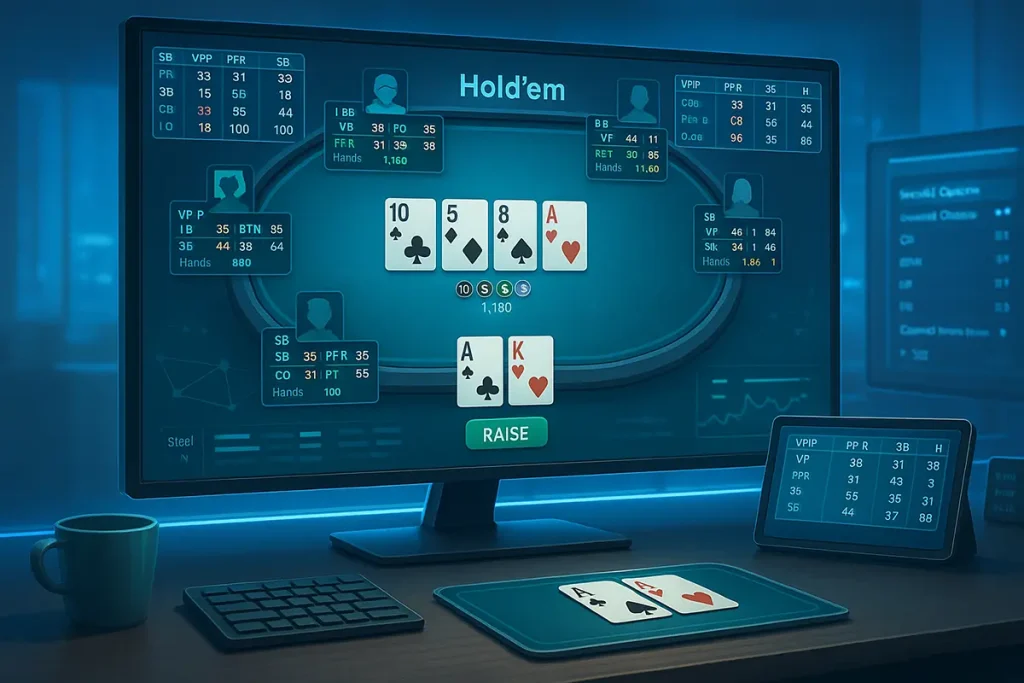
Use every tool you’ve got to keep notes on opponents. Most sites let you tag or note players; use it religiously. As one online strategy guide explains, keeping notes is key: “Using a site’s player notes or keeping them yourself can help track opponents’ play and idiosyncrasies. You can also make a note of timing and bet sizing tells or overall player tendency changes.”
In practice, maybe note that “BlueJoker9 tanks 15s every action, insta-folds to 3-bets.” Or “LadyLuck22 bets 50% pot with all pairs.” These little data points accumulate and give you a statistical edge later.
Heads-Up Displays (HUDs) are the ultimate form of this. HUD stats will tell you if someone fast-folds too much or overbets suspiciously often. But don’t be lazy: a HUD without interpretation is like a book you haven’t read. Use it to confirm what you see, not replace your eyes. If you see someone’s “Quick-Fold” stat is 80%, go in knowing that table chat will have even more opportunities to bluff them.
Patterns, Not Panic
The most important tip is not to overreact to a one-off. If someone pauses long only once, don’t call 911 on that. “Tells will be even rarer,” reminds Elwood, and they “should be a very small piece of your poker arsenal.” Don’t panic or tilt yourself because of it. Instead, stay calm and watch if the behavior repeats.
For example, one quick bet after folding your fishy bluff might mean nothing – maybe their cat jumped on the keyboard. But if they do it three times, you have a tell. Over time, build mini-profiles: “Oh, PokerMike always thinks 20+ seconds before river bets,” or “QueenOfHearts87 loves the chat when she’s bluffing.”
Always pair tells with a solid strategy. An identified tell alone isn’t a winning hand, but used correctly, it’s an extra chip. And remember, just as you watch them, some shark might be watching your timing too. So mix up your speed, use those mouse-click tools wisely, and keep some ambiguity. The moment you rely on reads alone and stop playing the cards, you’re giving them a tell on you.
Conclusion: Read ‘Em without Seeing ‘Em
Online poker tells can be hard to spot because they’re so subtle, but if you catch them? They can be powerful allies if you are able to notice them. Tracking timing patterns, bet sizes, the chat vibes, and how opponents use buttons will turn invisible clues into real edges. Even if you spot just a single predictable behavior from an opponent, like they always insta-fold to small raises, it can change your win rate in the long run.
Look below for a quick refresher on the five tells that are unique to online poker:
- Online tells are really subtle but can be powerful! They are usually hiding in the clock or chat, not in a mouth twitch.
- Tracking behavioral patterns can give you a real advantage. Notes and HUD stats will turn any fleeting observations into actionable reads.
- Mastering even one tell can change your win rate! If you know that a player is weak when they quick-fold, you can bluff way more profitably.
- Combine tells with a sound strategy, not in place of it. Tells are only one piece of your poker arsenal, not a decent strategy.
- Be observant: Why? Because just like you’re watching, someone is probably watching you, too! Online tables are fishbowls, so be as slick as possible with your playing style.
When you pay close attention to the unique online tells and stay level-headed, you’ll learn to read opponents without having to see their faces. In the virtual felt of the internet, you can’t see them sweat, but you can read the clicks. Stay sharp and use those tells to clean up the rake!
If you want additional help with your poker play or just want a simple way to find helpful information about playing, be sure to check out our Poker Cheat Sheet to get you started.
Knicks vs. Pacers – Game 4 Preview & Prediction (May 27, 2025)
Down 2–0 and trailing by 20 points in Game 3, the Knicks looked like they were calling it a night. But then came Karl-Anthony Towns! He took over in the fourth quarter, scoring 20 of his total 24 points, and that clocked it for New York for a 106–100 win, and it cut the series deficit to 2–1.
Jalen Brunson, despite some foul trouble, contributed 23 points and hit free throws in the final seconds. The Knicks’ bench made some moves, too—Miles McBride showed his prowess in the fourth.
The Pacers, who won the first two games in New York, had a really bad night of shooting in Game 3, going only 5-for-25 from beyond the arc. Tyrese Haliburton got Indiana 20 points, but acknowledged the team’s lack of pace in the final quarter.
Game 4 is on for Tuesday night at 8:00 pm ET at Gainbridge Fieldhouse in Indianapolis. The Pacers want to regain their footing at home, and the Knicks want to keep their Game 3 energy and tie up the series!
Game Snapshot
- Matchup: New York Knicks (51–31) vs. Indiana Pacers (50–32)
- Series Status: IND lead 2-1
- Date & Time: Tuesday, May 27, at 8:00 pm ET
- Location: Gainbridge Fieldhouse, Indianapolis, IN
- Broadcast: TNT, truTV, and MAX
What’s at Stake
What’s at stake? A lot! Look below for what’s on the line in Game 4:
- Knicks: Trying to tie the series at 2–2 before going back to MSG. A win keeps the pressure on Indiana and resets the series after a rocky start.
- Pacers: A chance to go up 3–1 with another win at home. That would put them one step closer to the Eastern Conference Finals and give them two chances to close it out.
Betting Odds & Lines
Want to put some cash on Game 4? Here are the latest odds courtesy of Caesars Sportsbook:
- Spread: Pacers -2.5
- Total Points (O/U): 221.5
- Moneyline: Pacers -135, Knicks +121
Key Stats & Trends
Look below for the important stats and trends to know before the ball goes up!
Knicks
- 7–1 against the spread in their last 8 road games.
- They’ve won 6 of their last 8 when they were listed as the underdogs.
Pacers
- Won 8 of their last 10 overall.
- 16–4 at home across their last 20 games in Indianapolis.
Matchup Breakdown
Who are we watching? Here are the main matchups you should keep in mind!
Knicks
- Jalen Brunson is still the heart and the engine of NY. He’s averaging over 35 points in this series and continues to shoulder the scoring load in the heaviest minutes.
- Mitchell Robinson moved into the starting five in Game 3 and instantly made a difference; he protected the rim and gave New York a presence on the boards that they’d been previously missing.
Pacers
- Tyrese Haliburton is driving the pace; he’s averaging over 9 assists per game. When he’s pushing in transition? Indiana’s offense is poetic.
- Pascal Siakam has been steady in knocking down midrange shots, finishing in traffic, and guarding multiple positions without needing touches called for him.
Best Bets
And here is what we think are the best bets for this game:
- Knicks +2.5 – New York has covered in 7 of their last 8 on the road, and they went into Indiana and won Game 3 outright. They’ve been better with Mitchell Robinson back in the starting five and have a real chance to even up this series.
- Over/Under: Over 221.5 – Game 2 hit 232, and Game 3 landed at 221. Both teams are playing through their stars and pushing the pace in transition, so this total is definitely in play again, especially if the fourth quarter is competitive.
- Player Prop: Jalen Brunson Over 29.5 Points – Brunson has scored 30+ in all three games this series. Even in Game 3, where he sat part of the third because of fouls, he still finished with 23. If he plays a full 35+ minutes, this number is very much within reach!
Final Take: Who Has the Edge in Game 4?
Final Score Prediction: Knicks 114, Pacers 110
The Knicks got what they needed (and more) in Game 3: a win on the road, more balance in the offense, and a much stronger effort on the boards with Robinson back in the starting five. They were more disciplined, more physical, and didn’t let Indiana dictate the tempo the way they did in the first two games.
The Pacers still have the advantage of playing at home, and they’ve been reliable there all season. If Haliburton finds his groove and their shooters come back from a tough night past the arc, they’ll be in a good position to take control once again.
This one has the feel of a close game deep into the fourth. Based on how Game 3 played out, the Knicks getting points holds some value, and the over is worth a look if both teams stay aggressive on offense!
Note: All betting odds and statistics are current as of May 27, 2025. Always gamble responsibly.