
Indy 500 2026 Betting Guide: Contenders, Odds, and Prop Bets Before Qualifying
The 110th running of the Indianapolis 500 is 35 days away — Sunday, May 24, 2026, green flag 12:45 p.m. ET — and the futures board has already sorted itself into a familiar three-way race.
Alex Palou is the +450 favorite as the defending 500 champion and three-time IndyCar Series champ. Josef Newgarden sits at +550 chasing a threepeat after his back-to-back 2023 and 2024 wins. Pato O’Ward is +650 and still chasing the first Indy 500 win of his career.
Here is where the real futures value sits on 2026 Indianapolis 500 odds, how dramatically the May 16-17 qualifying weekend will reshape every price on the board, and which Indy 500 prop markets have genuine edge versus which are juice traps.
Who Are the 2026 Indy 500 Favorites?
Three drivers sit at the top of the 2026 Indy 500 futures board: Alex Palou at +450, Josef Newgarden at +550, and Pato O’Ward at +650. Palou is the defending 500 champion and the Chip Ganassi Racing lead driver, sitting second in the 2026 IndyCar Series championship just two points behind Kyle Kirkwood after four races.
Newgarden, the Team Penske veteran, is the only active driver who has won back-to-back 500s (2023, 2024) and the threepeat story is the single biggest narrative arc of May. O’Ward, Arrow McLaren’s lead driver and the winningest active IndyCar driver without a 500 victory, has the oval pace and crew chief to break through but hasn’t closed the deal across five career attempts.
The entry list is locked at 32 of 33 spots through April 10, with A.J. Foyt Racing’s third seat the last TBD.
Championship points leader Kyle Kirkwood is nowhere near the top of Indy 500 futures despite leading the 2026 IndyCar Series — that mismatch is the oval-vs-street dynamic at work. Kirkwood is a confirmed road and street course specialist, and the 500 is a 2.5-mile oval where a different set of drivers historically hold serve. The futures market is pricing him correctly by ignoring the early-season points table and leaning on superspeedway history.
Is Alex Palou the Right Price at +450?
Palou at +450 is the defensible consensus favorite but almost certainly not a value bet at that price. The case for him is clean: he is the defending 500 champ, a three-time IndyCar Series champion, driving for Chip Ganassi — the team with the deepest Indianapolis institutional memory after Penske and the equipment to match.
He is second in the 2026 championship two points back of Kirkwood through four races, which means the car speed and team execution are already at series-leading level heading into May. Implied win probability at +450 is 18.2%, which sounds reasonable on paper for a defending champion.
The problem is historical base rates. Since 2000, the Indy 500 futures favorite priced inside +500 a month out has won the race roughly 12-15% of the time — below the break-even implied by +450.
The Indianapolis 500 is a race that rewards avoiding catastrophe across 500 miles (200 laps) in dirty air, traffic, and changing track conditions. Drivers who lead the most laps don’t always win; drivers who hit pit windows cleanly and avoid the big one do.
Palou has the profile to win, but at +450 you are paying a defending-champ premium on a race that historically spits out favorites more often than it anoints them. Better value generally sits in the +800 to +1400 range for proven superspeedway drivers on good equipment.
Across the last 25 Indy 500s, the pre-race futures favorite has won roughly 3 times. Compare that to road-course races where favorites win 25-30% of the time. The 500 is an attrition race with a larger field, more variance, and a much flatter probability distribution at the top. Spread your futures bets accordingly.
Can Josef Newgarden Actually Win a Threepeat?
Newgarden at +550 is the best combination of narrative and math on the top-of-board, and the threepeat story is real — no driver has ever won the Indy 500 three consecutive years. Helio Castroneves won in 2001, 2002, and 2009 (not consecutive). Only Rick Mears, A.J. Foyt, Al Unser, and Castroneves have four wins total, and none back-to-back-to-back.
Newgarden is chasing history in a way that guarantees Team Penske throws maximum engineering resource at his #2 car. Penske has won the 500 more times than any other team, and when they focus on a specific driver’s championship or historical moment, their equipment tends to deliver.
The statistical pushback: back-to-back Indy 500 winners trying to make it three have an abysmal conversion rate. Castroneves in 2003 (after 2001-2002) finished 10th. Unser in 1971 (after 1970) finished 9th.
The attempt is rare enough that the sample is tiny, but the historical suggestion is that trying to thread a third win is meaningfully harder than it looks. +550 (15.4% implied) is arguably short on a driver trying to make history against a field of 32 other professionals specifically gunning for him. For a Newgarden futures play, I’d rather be on the threepeat over/under prop if books offer it (typically No is plus-money) than on the +550 outright.
Why Pato O’Ward Is the Sharpest Play on the Top of the Board
O’Ward at +650 is the closest thing to real value among the top three favorites, and here’s why: he checks every box the 500 rewards except “has already won it.” Arrow McLaren has invested heavily in superspeedway development since McLaren Racing bought in, and O’Ward’s oval pace has been consistently strong across multiple qualifying weekends (he’s qualified on the front row at Indy before).
He’s the winningest active IndyCar driver without an Indy 500 win, a stat that’s been true for two seasons now — which means the futures market has had time to price his 500-specific hunger into the number, but the +650 price still treats him as the third choice rather than a coin-flip with the top two.
The implied probability at +650 is 13.3%. Given that Palou (+450, 18.2%) and Newgarden (+550, 15.4%) are the drivers priced ahead of him, and O’Ward has demonstrably equivalent superspeedway equipment plus the biggest “motivated to break through” narrative on the grid, the gap between him and Palou feels too wide.
If the three of them are functionally within 2-3 percentage points of each other in true win probability — which is my read of the data — then O’Ward at +650 is the bet that makes the math work. Books are selling you a 13.3% chance that I think is closer to 15-17%.
Which Mid-Tier Drivers Offer Real Futures Value?
The +800 to +1600 range is where most Indy 500 futures profit historically lives, because that’s the band where proven 500 contenders get priced as “also-rans.” Scott Dixon (Chip Ganassi) is six times a series champion and a 2008 500 winner — he will sit in this range pre-qualifying and every year produces a top-five 500 finish as a matter of routine.
Will Power, newly with Andretti Global for 2026, is a former 500 champion whose new-team transition may be slightly discounted by the market. Christian Lundgaard (Andretti Global) is third in the 2026 championship and drives for an organization that ran the fastest cars at Long Beach practice on April 19.
- Scott Dixon — The most reliable 500 finisher of the last 20 years; anything at +1400 or longer is a structural mispricing
- Christian Lundgaard — Top-3 in current championship with Andretti oval speed; price should sit +1600 range
- Will Power — Former 500 winner, new team penalty inflates his price; watch for +2000+ and pounce
- Robert Shwartzman — 2025 pole winner; if he qualifies front-row again, expect a 40-1 → 11-1 repeat
How Much Will Qualifying Weekend Reshape the Prices?
Qualifying weekend (May 16-17) will move every futures price on the board, and in some cases move them dramatically. The 2025 example is instructive: Robert Shwartzman entered qualifying at roughly 40-1 futures and left qualifying weekend at 11-1 after winning the pole. That’s a four-to-one compression on a single weekend.
The market respects pole position at Indy in a way it does not respect pole position at most other races, because starting at the front of the field on a 2.5-mile oval is worth multiple positions of track-position advantage on the first 50-lap stint — and track position on the 500 is the single biggest predictor of winning the race outside of raw car speed.
What this means for current futures betting: if you have conviction on a specific driver, bet now. If you’re agnostic between the top three, wait until after qualifying. Palou at +450 today could be +350 if he qualifies in the Fast Six and locks up the pole; he could also drift to +700 if he has a rough Time Trials and ends up in row 4.
The entire board moves on that one weekend more than on any other single event in the pre-race calendar. Practice opens Tuesday May 12; Time Trials run Saturday-Sunday May 16-17; Carb Day (final practice) is Friday May 22; the 500 itself is Sunday May 24. The Fast Six shootout Sunday afternoon of qualifying weekend is the single window that moves futures prices more than anything else.
Which Indy 500 Prop Bets Have Real Edge?
Five Indy 500 prop markets consistently offer informed bettors a real edge: pole-to-win parlays, front-row-to-win, total cautions over/under, first caution lap (under the traditional baseline), and leader-at-lap-100 to eventual winner.
The shared logic is that each of these markets is pricing a well-documented historical pattern that books often set at round-number lines rather than true statistical means. The underdog prop markets to avoid are first-lap winner, winning car number, specific lap leader, and any “fastest pit stop” prop — all noise with heavy juice.
- Pole-to-win: Since 2000, poles have converted to wins roughly 25% of the time at Indy — one of the highest pole-to-win rates of any major oval race. If a book offers pole-to-win at plus-money for Palou, Newgarden, or O’Ward after they qualify on pole, that’s a sharp bet.
- Front-row-to-win: Three front-row starters (pole, outside pole, middle of row 1) win the 500 close to 40% of the time. A “any-front-row-starter” win prop at better than -150 is usually plus-EV.
- Total cautions over/under: Modern Indy 500s have trended toward 5-7 cautions with the Aeroscreen era. If the line is set at 6.5, the over has been the marginally sharper bet in three of the last five years.
- First caution lap: Traditional line sits around lap 45-50. Historical average is closer to lap 35 when a caution occurs (and cautions occur in well over 90% of 500s). Under is usually the sharp side if you can find it under lap 50.
- Leader-at-lap-100 to winner: Roughly 30% conversion historically. If the book offers this at +200 or better for a top-three favorite, it’s a positive-EV side bet against the straight futures.
Which Prop Markets Are Juice Traps?
Avoid any prop where the underlying event is functionally random. First-lap leader, winning car number, “fastest pit stop time,” margin-of-victory-exact-to-the-second, and specific-lap-leader props all sit in this category.
The juice on these markets regularly runs 15-25%, sometimes higher for novelty lines, and the outcomes are close to unpredictable at the resolution the book is pricing. If the book is asking you to predict the race to the nearest tenth of a second, you’re almost always overpaying for volatility.
The specific-driver-to-lead-a-lap market is the most common trap. Over 200 laps in a 33-car field, the chance that any given top-10 driver leads at least one lap is quite high — often 60-70% for established front-runners — but books price these at -120 to -150, which bakes in full juice plus the normal market inefficiency on a prop most sharps don’t bother playing.
You’re getting 55-60% implied probability on a 65% true event. Marginal edge, at best, and usually negative.
How Should You Build an Indy 500 Futures Ticket?
Build the Indy 500 futures portfolio the way you build a horse-racing exotic: one top-of-board anchor, two mid-tier hedges, one longshot with a real superspeedway profile. The top-of-board pick should be the one you believe has true-probability edge over the price — my read is O’Ward at +650, but reasonable bettors land on Palou or Newgarden depending on their narrative priors.
The mid-tier hedges (Dixon, Lundgaard, Power) give you exposure to Penske/Ganassi/Andretti-level equipment at 15-1 or longer. The longshot is the “pole winner pops” bet — watch for a driver who shows unexpected speed in practice week and take the 40-1 before the Fast Six shootout prices him down.
A sample $100 futures allocation: $40 on your top-of-board conviction (I’d put it on O’Ward +650), $20 each on Dixon and Lundgaard in the 15-1 range, and $20 spread across two longshots priced 40-1 or better.
Expected payout distributions: the O’Ward ticket pays $260 on a win, each mid-tier ticket pays around $300 on a win, each longshot pays $800+ on a win. Total exposure $100, potential upside across all tickets $1,400+.
That’s the structure 500-futures bettors actually use — not blind 100-on-the-favorite plays that offer 4-to-1 upside against a 4-to-1 downside. For a deeper look at the sportsbooks best set up for motorsports futures markets, our DraftKings review covers the book that historically has the widest Indy 500 prop menu.
What About the New Entries — Schumacher, Grosjean, Hunter-Reay?
Three notable new or returning entries for 2026 give the 500 a different storyline layer than recent years. Mick Schumacher (Rahal Letterman Lanigan #47) is the F1-pedigree rookie — he’ll be priced at 100-1 or longer and has no oval résumé to speak of; skip the futures but watch him in qualifying speed traps.
Romain Grosjean (Dale Coyne) is making another Indy attempt and has one top-10 500 finish already; his Coyne equipment limits upside. Ryan Hunter-Reay is the one to watch — the 2014 Indy 500 champion back in an Arrow McLaren car is the kind of “forgotten former winner” futures play that occasionally hits.
If he’s priced 40-1 or longer after qualifying, the pedigree alone is worth a small longshot ticket.
The non-entry that matters: PREMA announced April 10 that it will not enter the 2026 Indy 500 after initially exploring a program. That decision removes one development-team storyline from the field and slightly tightens the starting grid — 32 confirmed entries plus A.J. Foyt Racing’s still-TBD third car make 33 total, meaning there’s almost no real “bump day” drama.
Every current entry that qualifies is in. That changes the pre-race betting feel compared to years with 35+ entries scrapping for the final grid slots.
The Bottom Line on 2026 Indy 500 Odds
Palou at +450 is the defensible favorite but overpriced for a race that historically spits out favorites. Newgarden at +550 is a narrative bet on the threepeat that fights steep historical pushback from back-to-back winners. O’Ward at +650 is the sharpest top-of-board value on pure implied-probability math.
The real profits in Indy 500 futures historically live in the +800 to +1600 range, where Scott Dixon, Christian Lundgaard, Will Power, and a post-qualifying pole winner tend to be priced. Wait on prop-market action until after the May 16-17 qualifying weekend; that’s the single event that reshapes every number on the board.
Skip the novelty props (first-lap leader, exact winning time) and hit the five markets with real historical edge: pole-to-win, front-row-to-win, total cautions O/U, first caution lap, and leader-at-lap-100.
Frequently Asked Questions
When is the 2026 Indianapolis 500?
The 110th Indianapolis 500 runs Sunday, May 24, 2026 at Indianapolis Motor Speedway with a 12:45 p.m. ET green flag. Practice opens Tuesday, May 12. Time Trials (qualifying) run Saturday-Sunday, May 16-17. Carb Day (final practice) is Friday, May 22.
Who is the favorite for the 2026 Indy 500?
Alex Palou is the +450 consensus futures favorite as the defending 2025 champion and three-time IndyCar Series champion for Chip Ganassi Racing. Josef Newgarden is +550 going for a historic threepeat after winning the 2023 and 2024 races, and Pato O’Ward is +650 chasing his first career Indy 500 win for Arrow McLaren.
How much do Indy 500 futures odds move after qualifying?
Futures odds move dramatically after the May 16-17 qualifying weekend. Robert Shwartzman went from 40-1 to 11-1 after winning the 2025 pole — a four-to-one compression on a single weekend. If you do not have strong conviction on a specific driver, waiting until after qualifying gives you much more information at the cost of slightly worse prices on any driver who performs well in Time Trials.
What is the best prop bet for the Indy 500?
Pole-to-win, front-row-to-win, and total cautions over/under are historically the sharpest Indy 500 prop markets for informed bettors. Pole winners convert to race wins roughly 25% of the time at Indy, and front-row starters (three cars) win the race close to 40% of the time. Avoid first-lap leader, winning car number, and fastest-pit-stop props — those stack heavy juice on near-random outcomes.
Play Safe: Gambling should be fun, not stressful. Set limits, stick to your budget, and never chase losses. If you or someone you know has a gambling problem, call 1-800-MY-RESET or visit ncpgambling.org. For more resources, see our Responsible Gambling page.
2026 NFL Mock Draft: Top 10 Picks Based on Betting Odds
Most NFL mock drafts are built on opinions. This one leans on betting odds.
Instead of just guessing the top 10 picks in the 2026 NFL Draft, I’m letting the betting market do the hard work. I’ll still provide insight and analysis for each pick – in particular, suggesting whether it’s a bad bet or not – but the idea is to see how this thing plays out purely based on odds.
Pricing for the NFL Draft is forever fluid. Media reports, rumors, injury news, team needs, sharp money hitting the board, and so much more work together to shift the betting landscape on a daily or even hourly basis.
Things can (and will) change probably before I even finish writing this, but we’re stripping out the noise and building a 2026 NFL mock draft based purely on what the odds are saying.
All pricing is from BetMGM and is subject to change.
How Betting Odds Shape NFL Mock Draft Predictions
Before we get to our 2026 NFL Draft mock picks for the top 10, let’s take a quick look at how the pricing and predictions change so much.
Every single shift in NFL Draft odds reflects new information, or at least the perception of it:
- Insider leaks
- Team visits & workouts
- Front office tendencies
- Team needs
- Sharp bettors attacking bad numbers
Those leaks can be hard-hitting reports about player injuries or even scandals, or they can be smoke screens or rumors created by players, agents, or even NFL teams.
More concrete shifts come from player interviews, the NFL combine, and individual workouts. It is at these types of events where everyone learns more about how teams view players and how those players can boost or hurt their draft stock beyond their college football game tape.
Front office tendencies and team needs can be either combative or work in union. This can be altered a bit with changing front office landscapes, with the 2026 New York Giants and their unique GM/Head Coach structure making things a little more difficult to gauge.
On top of all of this, sharp bettors will go after markets that are mispriced and, for better or worse, that can alter the odds and impact how the public feels about potential outcomes.
Key Trends from the 2026 NFL Draft Betting Markets
Before betting on the 2026 NFL Draft, make sure you know what the odds are actually saying to us right now.
- Quarterback landscape – This is a weak QB class. Fernando Mendoza is viewed as a lock to the Las Vegas Raiders at #1 overall, but there are no clear-cut hits at the position after that. Alabama’s Ty Simpson is your next best bet, but even he isn’t guaranteed to be taken in round one, and good luck guessing where he winds up.
- Top pick clarity – The one good thing about this draft class being weak at quarterback is that we know how the draft will start. It means the #1 pick is spoken for, but it also means we don’t need to worry about anyone taking a second passer very early.
- In the trenches – This class is very deep for offensive line and defensive line prospects. When trying to gauge who goes where and how many position players get drafted, keep this in mind.
- Volatility outside the top 5 – The main studs inside the top 5 seem predictable enough, but things could get rather volatile after that. Picks 5-10 are where the pricing can widen, and while it sets up a shaky market, it also creates major opportunities for sharp bettors.
2026 NFL Mock Draft – Predicting the Top 10 Picks
| Pick/Team | Player | Position | Odds |
|---|---|---|---|
1- Raiders | Fernando Mendoza | QB | -10000 |
2- Jets | Arvell Reese | EDGE | -300 |
3- Cardinals | David Bailey | EDGE | +145 |
4- Titans | Jeremiyah Love | RB | -125 |
5- Giants | Sonny Styles | LB | +200 |
6- Browns | Carnell Tate | WR | +275 |
7- Commanders | Mansoor Delane | CB | +550 |
8- Saints | Jordyn Tyson | WR | +250 |
9- Chiefs | Rueben Bain Jr. | EDGE | +375 |
10- Giants | Caleb Downs | S | +275 |
Here’s a quick snapshot of the latest odds for the top 10 picks over at BetMGM. They have NFL Draft prop bets for every position inside the top 10, among other wagers.
The pricing is not exact, to be clear. For instance, Jeremiyah Love is technically listed as the betting favorite at more than one prop. However, as this mock moves along, I am eliminating players already predicted to a particular spot and replacing them with the player that has the next best odds.
The table above shows everything in one truncated spot, but there’s context that is needed if you’re betting on these NFL Draft markets. Let’s dive into all 10 spots before placing any bets.
Pick #1: Las Vegas Raiders – Fernando Mendoza, QB, Indiana (-10000)
Mendoza to the Raiders at #1 overall is perhaps the worst-kept secret in professional sports right now. While not a flashy player, Mendoza brings size, accuracy, poise, and a championship pedigree to a franchise that sorely lacks all of that under center.
Las Vegas has been loosely talking as if Mendoza is already in the team facility, so this one is a true formality, and it’s priced as such. It’d be the mother of all NFL Draft upsets if this weren’t the pick.
Due to the odds and whispers around the league, this bet isn’t even available at most sportsbooks, and there isn’t a realistic second option worth betting on.
Pick #2: New York Jets – Arvelle Reese, EDGE, Ohio State (-300)
The New York Jets still don’t have their future franchise quarterback, but they acquired Geno Smith to upgrade the position temporarily and could always try to trade back into the first round to nab Ty Simpson.
Even if they are high on Simpson or another quarterback, none of them are good enough to warrant the #2 overall selection. Ohio State pass rusher Arvelle Reese is, while he fills a need for the defensive-minded Aaron Glenn’s rebuild.
The question isn’t really whether or not the Jets will go defense at the 2nd pick; it’s if there’s a chance they’d opt for safety over ceiling with fellow pass rusher David Bailey. The -300 price tag suggests Reese is the guy, but there’s enough uncertainty here to get me to bite on Bailey as a leverage bet.
Pick #3: Arizona Cardinals – David Bailey, EDGE, Texas Tech (+145)
This is where the 2026 NFL Draft could start getting interested. David Bailey is the favored pick at 3rd overall, but Arizona is in a bad way as a franchise, as they have a ton of holes to fill.
Those gaps include the quarterback position, while the team has been loosely linked to every top prospect in this slot at one point or another.
Their main guy under center is also weirdly trying to hold out, too.
The consensus does lean toward Bailey to boost Arizona’s mediocre at best defense, but his +145 odds give way to alternative picks. One such bet could be Francis Mauigoa, who stands out as quite the compelling pivot thanks to his +1200 odds.
Arizona doesn’t have a franchise passer yet – and they’ve been vocal about it – but when they do finally get one they probably want to make sure they can protect him. Bailey is the favored pick, but addressing the o-line with the best offensive lineman on the board is a pretty appealing bet for sharp bettors.
Pick #4: Tennessee Titans – Jeremiyah Love, RB, Notre Dame (-125)
There is immediate volatility when betting on the 2026 NFL Draft beyond the first two picks. It does correct itself slightly at the 4th overall pick, as the Tennessee Titans are heating up as the top landing spot for Notre Dame stud running back Jeremiyah Love.
Love has the talent to even go higher, but this is the first team that could really use the juice he’d provide, and they’re the current betting favorite to draft him. On top of that, they are the team that takes him in 65% of mock drafts across the industry.
I tend to agree with the logic here. Tennessee could definitely boost their defense, but they need to make life as easy as possible for young franchise passer Cam Ward. Adding a generational back to alleviate some pressure is a great way to do that.
Love is probably the correct pick, and Art -125, he’s a nice value. If the Titans go away from the consensus, though, I’d imagine Sonny Styles (+450) or Rueben Bain Jr. (+1500) would be the next best bets. There’s always a slim chance they go get Ward a different kind of weapon and target Carnell Tate (+3000) or Jordyn Tyson (+5000) here, too.
Pick #5: New York Giants – Sonny Styles, LB, Ohio State (+200)
New head coach John Harbaugh has a title-winning pedigree, and he’s always preached balanced, complementary football. He knows how to win, and it comes from within the trenches, from running the football, and from playing sound defense.
That is going to keep Jeremiyah Love in play if he slides here, but since this 2026 NFL Draft mock has him gone, the most logical play is to get his defense a quarterback.
Harbaugh’s best defenses have had stud linebackers running the show, and the odds favor him to go get one in Ohio State’s Sonny Styles. New York is set on the outside, but they need impact players on the defensive line, at linebacker, and in the secondary.
In terms of talent, need, odds, and mocks, Styles is shaping up something that looks a lot more like a lock than the latest NFL Draft betting odds would have you think.
Pick #6: Cleveland Browns – Carnell Tate, WR, Ohio State (+275)
Nobody knows for sure what the Cleveland Browns will do. They’re seriously considering letting Deshaun Watson compete to win the starting quarterback job over here, folks.
They also hired Todd Monken to run the show, and that move screams One Year Hire. But the franchise still needs to keep building, and whoever does end up throwing passes under center admittedly has precious little to work with.
That brings Ohio State wide receiver Carnell Tate to the front of the leaderboard for the 6th overall pick.
Cleveland does have some talent in place, but none of this caliber. Tate would give them an instant weapon to go to war with, and he’d surely start from day one.
Of course, as is the case with a perennial loser like the Browns, they have a lot of holes. The Browns could shock the world by reaching for a quarterback, trading down, or boosting their defense.
If Sonny Styles isn’t taken before this pick, he enters with the second-best odds behind Tate (+300), but then Spencer Fano (+450) becomes the next best bet. All signs lead me to believe Tate is a lock here, which makes him look rather inviting at a cool +275 price tag.
Pick #7: Washington Commanders – Mansoor Delane, CB, LSU (+550)
Ready for a pick out of left field? Let’s go with Mansoor Delane to the Washington Commanders. Don’t shoot the messenger, though, as it’s the latest NFL Draft odds that predict this pick, not me.
This is a default selection, too, seeing as the leading favorite to go to the Commanders at 7th overall is actually Love. Next up would be Styles and then Tate. Yes, that’s right, if you’ve made it this far in our 2026 NFL mock draft, you’re seeing a killer opportunity to make some serious coin.
If this mock stands the test of time, you’re looking at Delane at a sweet +550, or quite literally anything else at a better price.
We know the Commanders would fill a need with Love and would love guys like Styles or Tate, but with them gone, they’re suddenly eyeing the top corner in this draft or simply taking the best player available.
Is that Reuben Bain Jr. on the edge? Is that Jodyn Tyson for a passing game that has precious little after Scary Terry? Or is it simply the somewhat favored Delane to improve their secondary?
I’m okay with Delane, but I prefer aiming higher with Tyson (+800) due to Washington lacking weapons in the passing game at the moment.
Pick #8: New Orleans Saints – Jordyn Tyson, WR, Arizona State (+250)
There’s a growing trend here; the further we get from the first pick in the draft, the less safe our mock draft predictions are going to be.
To be fair, these mock picks are based solely on betting odds, but whether they’re informed by the betting public, teams, or concrete news, the reality is the same.
Tyson is still available in this mock draft, and with other options off the board, he’s a +250 favorite to be the guy the Saints go and get with the 8th pick. I can buy it, as the Saints traded away Rashid Shaheed last year and really don’t have much other than Chris Olave at receiver.
Investing in the position would go a long way in helping new franchise passer Tyler Shough, who seemed to prove a lot of his doubters wrong during an impressive rookie campaign.
Regardless, Tyson is a good bet at +250. If you don’t think the Saints go WR, they do have options, and for bettors, they’re pretty appealing. New Orleans could definitely stand to get younger on the defensive line, which instantly has Reuben Bain Jr. (+500) heating up as a fun pivot.
Pick #9: Kansas City Chiefs – Reuben Bain Jr., EDGE, MIAMI (+375)
If the Saints do go wide receiver, then Reuben Bain Jr. will slide at least one more spot, and the Chiefs could argue they got the steal of the 2026 NFL Draft.
Bain Jr. has the talent to come out of this class as the best pass rusher, and even if he doesn’t he’d bring a ton of production (9.5 sacks last year) and ferocity to the table. Off-field stuff and short arms have negatively impacted his draft stock, but it’d only be fitting for a yearly Super Bowl contender to have him fall into their lap.
The value is amazing with Bain at +375, but Kansas City is in a pretty nice spot where they can kind of do whatever they want. Short of drafting a replacement for Patrick Mahomes or taking a running back (they just signed Kenneth Walker), they could go in a number of different directions.
Simply taking the best player available is an educated guess, and that’d probably be Bain if he’s indeed still here. If not, Spencer Fano (+425) would own the next best odds, while safety Caleb Downs would be a distant third.
The true wild card and the pick I’d make after Bain? How about stud Oregon tight end Kenyon Sadiq (+1200)? How unfair would it be for the Chiefs to go from Travis Kelce to the fastest tight end in NFL Combine history?
Pick #10: New York Giants – Caleb Downs, S, Ohio State (+275)
The last pick of this 2026 NFL Draft mock is Caleb Downs, who will look to team up with Sonny Styles and form a pretty nasty defense for John Harbaugh’s New York Giants.
New York just jettisoned Dexter Lawrence to the Cincinnati Bengals for this pick, so it stands to reason that they’d use it on another impact defender. Perhaps they go position for position and reach for a replacement in the middle of their defense, but I like the idea of them just taking the best prospect on the board.
At this point, it figures to be Downs, who was a stud safety for the Buckeyes and would help New York’s secondary immediately. Olaiavega Ioane (+500) is gaining steam as the second-best bet – assuming the guys above are all off the board – while this could also be a realistic spot to target offensive lineman Francis Mauigoa if he hasn’t been selected yet.
Biggest Disagreements Between Betting Odds and NFL Mock Drafts
What do you put more stock in: NFL Draft pundits or the betting odds? That’s the big question, especially since there are some clear gaps created by this pricing.
Everyone agrees that Fernando Mendoza will be the top pick in the draft, and almost every mock draft I’ve seen has the Jets going with a defensive stud – usually Reese – at #2 overall.
But things get choppy from that point on. One issue up top is what Arizona will do. The current 2026 NFL Draft odds peg David Bailey as their pick, but the team has also been linked to Alabama passer Ty Simpson, as well as offensive lineman Francis Mauigoa.
The pricing on Mansoor Delane with the Commanders is interesting, too. In all fairness, he actually owns the third-best odds to be drafted by Washington. If guys like Love or Styles are there, BetMGM in particular would have them favored ahead of him.
Best NFL Draft Betting Angles Based on This Mock
If you’re betting on the 2026 NFL Draft, this is where the edge arrives:
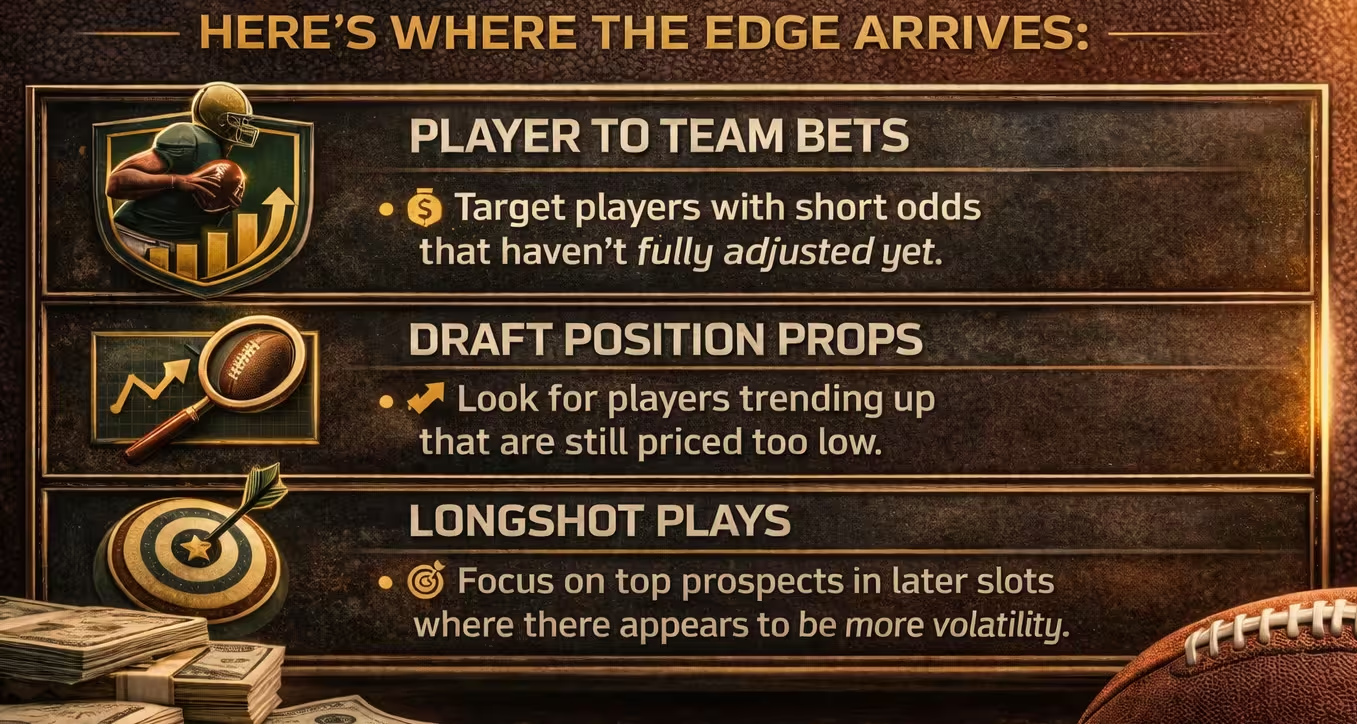
Right now, the best bets figure to deal with Arvell Reese and Jeremiyah Love. Reese to the Jets specifically stands out, but I’d also be very interested in bets dealing with him at #2 overall, or inside the top-3 and top-5.
Jeremiyah Love is an interesting case since not every team needs a running back – or will want to splurge to get one. The Titans stand out as the first team that makes sense, but even if they pass on him, two of the next three teams – Giants and Commanders – will have to think long and hard before passing.
Love to the Titans and/or Love to the #4 slot both stand out, but Love as a top-10 pick stands out as one of the better NFL Draft bets this year.
Based on this mock, I wouldn’t be aggressive with targeting Ty Simpson inside the top-10. However, due to the odds and team needs, it wouldn’t be all that shocking to see players like Francisc Mauigoa, Makai Lemon, Kenyon Sadiq, or Omar Cooper Jr. find their way into the top 10 selections.
Let the Market do the Predicting at the 2026 NFL Draft
Mock drafts are everywhere, and they’re inherently unreliable. Why? Because most writers piecing together a mock want to stand out.
This means they will propose made-up trades that probably won’t materialize, they’ll predict splashy outcomes that aren’t realistic, or they’ll entertain free falls for top talent just for more clicks.
That doesn’t mean we should ignore the top NFL Draft pundits. Nor should we blindly follow the latest NFL Draft odds when making our picks. A mixture of mock draft consensus and the most current, updated pricing is probably what is closer to ideal.
Esports Betting 2026: Major Tournaments, Odds Favorites, and Prop Markets With Edge
The 2026 esports betting calendar’s biggest events are 44 to 125 days away, and the futures boards are live. IEM Cologne 2026 — the first of two CS2 Majors this year — runs June 2-21 with Vitality and Team Spirit as co-favorites. VCT Masters London and LoL MSI also hit in June.
The Esports World Cup runs July 6 through August 23 in Riyadh with a record $75 million prize pool. LoL Worlds 2026 lands in October-November, split for the first time since 2013 between Allen, Texas (groups and playoffs) and New York City (grand final). Here’s where the real futures value lives across CS2, Valorant, and League of Legends this summer — and which esports prop markets have genuine edge versus pure noise traps.
What Are the Biggest 2026 Esports Betting Events?
Four events dominate the 2026 esports betting calendar: IEM Cologne 2026 (CS2 Major, June 2-21), VCT Masters London (Valorant, June), LoL MSI 2026 (June), and the Esports World Cup in Riyadh (July 6 – August 23, $75 million across all titles). The back half of the year brings LoL Worlds 2026 in October-November (dual-city Allen TX and NYC format), the PGL Singapore Major (CS2’s second Major of 2026), and VCT Champions 2026.
Futures are already live at esports-specialty books like GG.BET and Thunderpick plus mainstream US sportsbooks that carry esports markets. Tier-1 LAN events between now and June will reshape the odds board meaningfully — team form in BLAST Austin, ESL Pro League S21, and VCT Kickoff stages is the most important signal for mid-April futures bettors.
Where Does the Value Live on IEM Cologne 2026?
Vitality and Team Spirit are the co-favorites on the IEM Cologne Major board, and both are priced roughly correctly given their H1 2026 form. Vitality has been the most consistent tier-1 CS2 roster of the season with back-to-back BLAST and IEM podium finishes. Spirit has the best individual firepower on paper (two top-5 HLTV-ranked riflers) and proven Major-stage composure from their 2024 and 2025 runs.
The value doesn’t sit on these two at current prices — you’re getting roughly 4-1 on teams who genuinely have 20-25% title-win probability, which is fair but not a ticket to hit hard. The real value on the Cologne futures board is in the 8-1 to 15-1 range, where Falcons, FaZe, G2, and MOUZ are sitting despite all four having realistic paths to the trophy.
Falcons in particular is priced as a tier-1.5 team after a mid-February roster rebuild — the roster has tier-1 potential once cohesion forms, and 12-1 on a team with this much individual talent is positive-EV if you believe a 2-month runway is enough to gel. Natus Vincere at 20-1 is the sharpest longshot value if s1mple returns to the active roster ahead of Cologne (rumored but unconfirmed as of April 19). This is how you actually profit on CS2 Major futures: spreading across three to four 10-1-plus tickets rather than laying into a single co-favorite.
In a 32-team Major, even the best team rarely wins more than 1 in 4 times. Put 40% of your CS2 Major futures budget on one 4-1 favorite and 60% across three or four 10-1-plus live teams — that’s the math that actually turns a profit across multiple Majors, not a single $200 play on Vitality.
Who Are the Best Valorant Bets for VCT Masters London and Champions 2026?
Sentinels, DRX, Paper Rex, and Team Heretics are the top four names on VCT futures boards, and the sharpest of those is Paper Rex at whatever price you can find above 6-1. Paper Rex has reached three consecutive international VCT finals and has the deepest, most stable roster in the Pacific region.
Its aggressive “flex-play-everything” style has repeatedly caught more structured Americas and EMEA teams off-guard in playoff runs. DRX is the safer Pacific pick but priced heavier.
Sentinels as the Americas favorite has had inconsistent international form since TenZ’s retirement. Heretics is the EMEA pick but faces strong pushback from Team Liquid and Fnatic domestically that hasn’t yet translated into VCT futures discounts on Heretics.
- Paper Rex: Sharpest top-tier value if pricing stays at 6-1 or longer — three-final form is the most reliable signal in tier-1 Valorant
- DRX: Safer Pacific pick but usually shorter than Paper Rex; only play at plus-money relative to Paper Rex
- Sentinels: Americas favorite but inconsistent internationally; pass at anything shorter than 8-1
- Team Heretics: EMEA top seed, but Liquid and Fnatic have eaten them in recent LANs — wait for better pricing
- China region: EDG and BLG are the Chinese teams to watch on VCT; historically undervalued in Western sportsbook boards
How Should You Bet the Esports World Cup 2026?
The Esports World Cup in Riyadh (July 6 – August 23) with its record $75 million prize pool is the single best betting event on the calendar if you treat it correctly — and it’s a brutal variance trap if you don’t. EWC runs concurrent tournaments across more than 20 esports titles over eight weeks, meaning the sharp play is not “bet the overall club championship” (where the top organizations are already priced short) but rather bet individual title events where specific rosters are mispriced.
Team Liquid, Falcons Esports, T1, and FaZe Clan are the top-of-board Club Championship favorites. The club-championship market is too diluted to offer value, but the individual-title markets inside the EWC (CS2 event, Valorant event, LoL event, Dota 2 event, etc.) often open at pricing that’s not been recalibrated for late-breaking roster changes or regional-seeding results.
The eight-week runtime also means live-odds opportunities throughout the summer. Books that carry esports markets often lag on line updates after specific-event upsets, and the first 48 hours after a shocking result (a tier-2 team knocking off a tier-1 in the CS2 portion, for example) is typically where the sharpest live-odds edge appears.
Follow specific esports beat reporters on X/Twitter and move faster than the book does on news that materially changes a team’s EWC-event title probability. This is how professional esports bettors actually extract edge from the summer — not by locking in July 6 futures, but by trading the live markets as the eight-week event unfolds.
Which Esports Prop Markets Have Real Edge?
Four esports prop markets consistently offer informed bettors real edge: map winner (on series you have a strong read on), first blood / first kill in specific maps, total rounds over/under in CS2 and Valorant matches, and map-handicap lines that ignore team-specific map pools. The shared logic is that each of these markets is priced based on overall team form rather than matchup-specific map data — and the matchup-specific edge is where disciplined esports bettors make their money. The markets to skip: exact-kill-count props, specific-player-MVP bets, “first team to X rounds” props at non-pistol rounds, and anything tied to fantasy scoring.
- Map winner (match pick’em legs): CS2 and Valorant map pools are asymmetric — every tier-1 team has 1-2 maps they dominate and 1-2 they struggle on. A “Map 2 winner” prop priced on overall team form (not on which map actually gets picked in veto) is the single most common mispricing in esports markets.
- Total rounds over/under: CS2 MR12 total rounds line sits at 23.5 or 24.5 in most matches. Bo3 totals are where the edge lives — if one team is a heavy side favorite and the other is a rearguard defensive team, unders on total rounds across the series are consistently profitable.
- Map handicaps (−1.5 in Bo3): Heavy favorites getting laid -1.5 map handicap are often priced too long in Valorant. If a team has 70%+ series-win probability, -1.5 at +110 or better is a sharp play.
- First blood on specific maps: In Valorant, duelist-centric rosters have first-blood rates significantly above 50% on maps that favor aggressive pushes. Books price first-blood at -110/+100 uniformly; the true rate is often 58-62% for specific matchup-map combinations.
Which Esports Prop Markets Are Noise Traps?
Skip any prop where the underlying event is functionally random or where juice stacks on juice. Exact-kill-count props (“will player X have over 22.5 kills”) are the biggest trap — kill counts have massive variance tournament-to-tournament and the juice typically runs 15-20%.
“Specific-player-MVP” props fold into the moneyline — if a team wins, their best player is almost always MVP, and you’re paying a premium on an outcome already baked into the series winner line. “First-to-X-rounds” props at non-pistol rounds are close to random; the pistol-round winner has a structural advantage only on rounds 1, 13, and overtime segments, so a “first to 5 rounds” prop is pure noise.
Fantasy-scoring-tied esports props are the specialized version of the same mistake. These are popular at DFS-adjacent books but they stack juice on fantasy-point calculations that don’t map cleanly to actual match outcomes.
A player can pop off with 30 kills and lose the match; a player can have a quiet 16-kill performance on a winning team and end up with more fantasy points than the losing star. If your read is “this player will go off” and your actual play is a fantasy-points prop, you’re betting on the wrong variable. Bet the map winner or the kill over/under directly instead.
How Do You Build a Cross-Title Esports Parlay?
The sharp cross-title parlay structure is one 4-1 futures leg + two plus-money prop legs + one heavy-favorite map-handicap leg. Example: Vitality to win IEM Cologne (+400) + Paper Rex to reach VCT Masters London final (+250) + T1 map handicap -1.5 vs. a weaker LCK opponent (+110) + Bo Over 2.5 maps in a specific Cologne QF (-110).
Parlay odds come out around +1500 on a ticket where every leg has legitimate edge. Compare to a four-team moneyline parlay on heavy favorites that pays +350 and requires everything to hit clean. Cross-title parlays are where the sharp esports bettors live because the correlation between titles is near-zero — a bad Cologne QF for Vitality has zero effect on Paper Rex’s London run, which means your variance is controlled.
One rule: don’t parlay within the same match. A “team A wins + team A map 1 winner + team A first blood” parlay is heavily correlated — you’re essentially betting the same outcome three times at laid juice.
Those same-game parlays are what books push hardest because the implied correlation means they’re much lower-variance for the book than they look to the bettor. If you want correlation exposure, take the map handicap directly and skip the same-game parlay entirely. For a deeper look at the sportsbooks best set up for esports futures and prop markets, our BetMGM review covers the book with the widest esports prop menu serving the US market.
What About LoL Worlds 2026 Futures?
LoL Worlds 2026 futures at six months out are thin on market depth and thick on pricing volatility. T1, Gen.G, and BLG are the consensus favorites at roughly 3-1 to 6-1 across boards, but these prices will move dramatically through the summer split and regional playoffs.
The smartest play on Worlds futures in April is not to bet the favorites at all — it’s to wait until after MSI 2026 (June) to see which rosters enter the LCK and LPL summer splits in peak form, then bet the summer-split champion futures at 3-1 to 4-1 as a much better implied-probability side bet on Worlds itself.
The Worlds dual-city split between Allen, Texas (groups and playoffs) and NYC (grand final) doesn’t materially change team win probabilities. It does add travel and fan-pressure variables that favor experienced Korean and Chinese rosters over European and American teams making first Worlds trips.
If you absolutely want Worlds futures exposure now, the sharpest ticket is a plus-money Chinese team at 10-1 or longer. BLG and EDG in the LPL have the kind of individual-mechanical ceiling that wins Worlds trophies, and both have been consistently underpriced in Western-book futures for three consecutive years. A single $20 ticket on a Chinese team at 10-1 is a much better late-season hedge than a $100 ticket on T1 at 3-1.
The Bottom Line on 2026 Esports Betting
IEM Cologne 2026 is the most bettable event of the summer and the value lives in the 10-1 range (Falcons, FaZe, G2, MOUZ) — not on Vitality or Spirit at 4-1. Paper Rex at 6-1 or longer is the sharpest Valorant Masters London play. The Esports World Cup in Riyadh rewards live trading more than pre-event futures betting because of its eight-week runtime and 20+ concurrent title events.
LoL Worlds futures this far out are priced too volatile to justify favorites — look for 10-1-plus Chinese-team longshots instead. Prop-market edge lives in map winners, total rounds, map handicaps, and first-blood lines; stay away from exact-kill-count, specific-player-MVP, and fantasy-scoring props.
Build cross-title parlays using plus-money legs across Cologne, Masters London, and MSI rather than laying juice on four-team favorite accumulators. The 2026 summer is arguably the richest esports betting slate in history — treat it like a portfolio, not a coin flip.
Frequently Asked Questions
What are the biggest 2026 esports events for betting?
The biggest 2026 esports betting events are IEM Cologne 2026 (CS2 Major, June 2-21), VCT Masters London and LoL MSI 2026 (both in June), the Esports World Cup in Riyadh (July 6 – August 23, $75 million prize pool across all titles), LoL Worlds 2026 in October-November (split between Allen, Texas and NYC), the PGL Singapore Major (CS2’s second Major of the year), and VCT Champions 2026 (Valorant year-end championship).
Who are the favorites for the IEM Cologne 2026 CS2 Major?
Vitality and Team Spirit are the co-favorites on the IEM Cologne 2026 futures board after dominating H1 2026 tier-1 LAN events, with both sitting around 4-1 across major esports sportsbooks. Falcons, FaZe, G2, MOUZ, and Natus Vincere fill out the top tier at 8-1 to 20-1. The Major runs June 2-21, 2026 and features 32 teams.
What prop bets have real edge in esports?
Four esports prop markets consistently offer informed bettors real edge: map winner (on specific-matchup-map combinations), first blood in Valorant on duelist-heavy rosters, total rounds over/under in CS2 and Valorant matches, and map-handicap lines (-1.5 in Bo3) on heavy favorites. Avoid exact-kill-count props, specific-player-MVP bets, and fantasy-scoring-tied props — all stack heavy juice on volatile or correlated outcomes.
How should you bet the Esports World Cup 2026?
The Esports World Cup in Riyadh runs July 6 – August 23, 2026 across 20+ concurrent esports titles with a record $75 million prize pool. The sharpest play is not overall Club Championship futures (where the top organizations are priced short) but individual-title events where specific rosters are mispriced, plus live-odds trading across the eight-week runtime when books lag on line updates after upsets. Follow esports beat reporters closely and trade live rather than locking futures on July 6.
Play Safe: Gambling should be fun, not stressful. Set limits, stick to your budget, and never chase losses. If you or someone you know has a gambling problem, call 1-800-MY-RESET or visit ncpgambling.org. For more resources, see our Responsible Gambling page.
2026 NFL Draft Prop Bets: Where the Value Is and Which Markets to Skip
The 2026 NFL Draft kicks off Thursday, April 23 in Pittsburgh, with the Las Vegas Raiders holding the No. 1 overall pick and Indiana quarterback Fernando Mendoza — last year’s Heisman winner — as the near-unanimous consensus selection. The real action for bettors this week is not in predicting Pittsburgh’s top selection, which is effectively off the board at most books. It is in the secondary prop markets: the over/under on first-round quarterbacks, the Jets’ pick at No. 2, and a handful of position-specific specials where lines have moved sharply in the last 72 hours.
This is a curated look at four prop markets worth playing, one that has genuine two-way movement, and several that are sharp traps. Odds below are sourced from BetMGM, DraftKings, and FanDuel as of April 18, 2026 — draft prop lines move quickly in the final 48 hours, so verify pricing at your book before you bet. For the official draft schedule and order, see the NFL’s 2026 Draft page.
Why Draft Props Behave Differently Than Game-Day Props
A Week 8 NFL prop market has years of data behind every number: target share, air yards, defensive matchup grades, coaching tendency splits. A draft prop has none of that. The underlying outcome is a single binary decision by a front office whose deliberations are private. Books are pricing against reported intelligence, mock-draft consensus, and a small number of known information-holders (Schefter, Rapoport, and a few beat writers with team access). That means two things for bettors.
First, line movement in the last 48 hours pre-draft is disproportionately informative. When a pick’s number shortens from -150 to -250 on Wednesday morning, it is usually because someone with real intel hit a book. Second, juice on draft props is much higher than on game-day markets because books know their edge on information is narrower. A market priced at -135 on a 50-50 binary is a 57.4% implied probability — you need to be right 58% of the time on a question with two outcomes just to break even. That math rules out most draft prop bets before you evaluate the underlying question.
The First Overall Pick Is a Closed Market
Fernando Mendoza opened at +10,000 (100-to-1) when early 2026 draft markets first posted in November. He has closed at -10,000 at most books, with at least one book posting him as short as -20,000 in April. A handful of sportsbooks have pulled the market entirely. BetMGM trading manager Christian Cipollini has said Mendoza holds 52.6% of the ticket count and 33.1% of the money in the first-overall market at his book, and added that “Mendoza is a good outcome for the book — he has been -10,000 in this market for a very long time now.”
That pricing tells you everything you need to know. At -10,000, you are risking $100 to win $1. The implied probability is 99.01%. Even if you believe the public reporting — Raiders brass at Mendoza’s Indiana pro day, follow-up meetings, Kirk Cousins signed as a veteran mentor for the incoming rookie — the expected value of the bet is essentially zero. There is no edge to press. The corollary prop, “first quarterback taken,” is the same market with a different label, since Mendoza is the only QB in this class being discussed in the first ten picks. Skip both.
The Raiders GM John Spytek confirmed in mid-April that the team has fielded trade calls on the No. 1 pick. A late-week shock trade is the only plausible path to Mendoza not going first — and the book is still pricing in that tail risk. Do not treat Mendoza -10,000 as a “free” bet.
Over/Under 1.5 First-Round Quarterbacks — The Most Liquid Market
This is the one 2026 draft prop with genuine two-way action. The line is set at 1.5 quarterbacks selected in Round 1 at every major US sportsbook, with the over priced at -135 at BetMGM and -130 at DraftKings as of April 18. BetMGM’s Cipollini confirmed the majority of the public action is coming in on the over — which in a thin first-round QB class is a useful contrarian signal on its own.
The mechanics of the bet are straightforward. Mendoza goes first; the over requires one additional Round 1 quarterback somewhere between picks 2 and 32. The only name in meaningful first-round conversation is Alabama’s Ty Simpson, with LSU’s Garrett Nussmeier and Carson Beck now firmly in the second-round range in consensus mock drafts.
The case for the under (-105 to +110 depending on book)
This is a historically thin QB class. Mendoza’s price trajectory — opening as a 100-to-1 long shot and closing as the shortest No. 1 pick favorite in at least a decade — reflects that there is no genuine competition behind him. If a team wants Simpson, the Jets open Day 2 at pick No. 33, giving any QB-needy team a full additional round of leverage to wait. FantasyPoints’ mock draft has no quarterback going in Round 1 at all, and their analyst has said Simpson is “being pushed up in a weak quarterback class.” Single-QB first rounds are uncommon but not rare — 2013 (EJ Manuel) and 2022 (Kenny Pickett) are both recent examples of classes where only one quarterback heard his name on Day 1.
The case for the over (-130 at DraftKings, -135 at BetMGM)
FOX Sports’ Geoff Schwartz has reported he is wagering on Simpson to go late in Round 1. Teams at the back end of the first round — New Orleans at No. 8, Washington at No. 7, or any team that trades up — may prefer to pay a rookie QB contract now rather than wait three months for the 2027 class. The juice on the over compresses the margin, but if you believe information flow on Simpson is still incomplete, paying the vig is defensible.
Verdict: The under is the better side on a pure handicapping view, but the price has to cooperate. If you can find the under at -115 or shorter, it plays. If your book has the under at +100 or better — look at alternate markets like FanDuel for a second price — this becomes a clean play.
Ty Simpson First-Round Yes/No — Where Hype Meets Juice
This prop is the cleanest expression of the same bet as the O/U on first-round quarterbacks, just phrased differently. BetMGM has Simpson at -210 to be selected in the first round; DraftKings has his draft-position over/under at 24.5 with -330 juice on the over (meaning you pay -330 to bet he goes before pick 24.5, which functionally means “yes, first round”). Both prices are aggressive — and both have been driven by late-cycle hype rather than improved underlying information.
Here’s the asymmetry to notice. The same question — will Simpson go in Round 1? — is priced roughly at -135 implied probability on the O/U 1.5 first-round QB market (assuming Mendoza is locked in at No. 1) and at -210 on the standalone Simpson first-round prop. That is an eight-point gap in implied probability between two bets resolving the same outcome. Either the O/U over is badly overpriced, or the Simpson yes is. The explanation is most likely that the Simpson-specific market is pricing in hype flow on his name, while the O/U market is also absorbing the chance that a non-Simpson QB (unlikely but possible) gets drafted. Either way, if you want this side, take it on the O/U, not on Simpson’s name directly.
Verdict: Skip the Simpson-specific yes at -210. If the no is available around +175 or better, that’s a more interesting price for the contrarian view.
Position of the Jets’ No. 2 Pick — Bailey, Reese, and the Canceled Visit
This is the market where the information edge has genuinely shifted this week. Heading into Monday, April 14, Texas Tech edge rusher David Bailey was trending toward favorite status at the No. 2 spot, with CBS Sports’ Jonathan Jones reporting “most of the league” expected the Jets to take him. Ohio State linebacker Arvell Reese sat as the co-contender. Then, on April 16, SNY-TV reported that the Jets canceled their scheduled pre-draft visit with Bailey, prompting an “eye-opening” response from ESPN’s Adam Schefter.
The market read the cancellation as equivocal. Pre-cancellation, Bailey was a solid odds-on favorite. Post-cancellation, Reese moved to -135 at DraftKings to go second overall, with Bailey drifting to +290. That is a sharp swing on a single piece of reporting — which means one of two things. Either the cancellation is real signal (the Jets have decided against Bailey) or it is noise (the Jets felt they had completed their diligence at the Senior Bowl and combine and didn’t need another meeting). Beat reporters covering the Jets have publicly split on the interpretation.
The sharp read on this market: Reese -135 has absorbed most of the post-cancellation move, which means the price is now efficient on the public interpretation. The bet with edge, if any, is Bailey at +290 if you believe the visit cancellation was operational rather than diagnostic. That is a coin-flip question on incomplete information, which is exactly why the market has it spread this way. If you have no independent conviction on the Jets’ decision path, skip. If you have been following Jets beat writers who have specifically argued the cancellation was due-diligence-complete rather than Bailey-out, the +290 is where your edge lives.
Position of the Cardinals’ No. 3 Pick — Bailey, Cheaper
Bailey is also the favorite to go third overall to the Arizona Cardinals, at +160 on DraftKings as of mid-April. The earlier-month DK board had Bailey at +230, Miami offensive tackle Francis Mauigoa at +275, and Reese at +380. The Cardinals need edge help, and Bailey sliding from No. 2 to No. 3 is the most common secondary scenario in current mocks.
If you want action on Bailey going early but do not want to bet directly on the Jets decision, the Cardinals’ No. 3 market lets you buy him at a shorter price (+160) in a scenario that depends only on “Bailey goes top-3,” not on “Bailey to the Jets specifically.” That is a useful correlation trade if you think Bailey is the best non-Mendoza prospect in this class but you are uncertain about the Jets. A small position here hedges the Jets No. 2 uncertainty cleanly.
Markets to Skip
Three categories of draft props are consistently bad EV regardless of this draft’s specifics.
- Position-of-pick specials past the top 5. Pick #8 position, pick #10 position, “who goes in the Raiders’ No. 33 slot” — these markets combine low liquidity with heavy juice (often -300 on the favorite). Books have information parity with bettors at this depth in the draft and charge a tax on the uncertainty. Unless you have a specific beat-reporter-grade edge, the math does not work.
- “Will player X be a top-10 pick?” binary specials. These are priced for the dead-money case (no mid-round news moves them) and the sharp case (Schefter drops a bomb on draft night). You are on the wrong side of both timelines.
- Trade props. “Will the Raiders trade the No. 1 pick?” has been available at -400 to +500 at various books, and pricing history suggests it mostly resolves based on Schefter timing rather than any fundamental signal a casual bettor has access to. Spytek’s mid-April confirmation of trade inquiries moved the price, but the market is still pricing Mendoza getting drafted by Las Vegas as a 99%+ event.
Final Thoughts on the 2026 NFL Draft
The 2026 NFL Draft has exactly one prop market with genuine two-way liquidity and public disagreement: over/under 1.5 first-round quarterbacks. If you are going to bet one market this week, that is the one — and lean under if your book’s juice allows. The Jets’ No. 2 pick has real informational nuance post-visit-cancellation, but the price is already efficient on the public read; the bet with edge is Bailey at +290 only if you have a specific take on whether the cancellation was operational.
Everything else on the draft prop board is either a closed market (first overall) or a trap (exotic position specials, trade props). Bet small, timestamp your prices, and do not chase last-minute line movement unless you know specifically why a number is moving.
Frequently Asked Questions
When is the 2026 NFL Draft and where can I watch it?
The 2026 NFL Draft runs Thursday, April 23 through Saturday, April 25, 2026, in Pittsburgh, Pennsylvania — the first NFL Draft held in Pittsburgh since 1948. Round 1 begins at 8 PM ET on Thursday. Coverage airs on NFL Network, ABC, ESPN, and ESPN Deportes across all three days, with streaming available on Disney+, Hulu, and ESPN’s direct-to-consumer services. The Draft Theater is located on the North Shore outside Acrisure Stadium, with the fan festival at Point State Park.
What is the best 2026 NFL Draft prop bet?
The over/under on first-round quarterbacks taken (line at 1.5 at all major US books) is the only 2026 draft prop with meaningful two-way market action and a live analytical question. BetMGM has the over at -135; DraftKings at -130. The majority of public action is on the over, making the under the contrarian side if your book’s pricing cooperates (look for -115 or shorter). Avoid the first-overall-pick market — Mendoza is priced at -10,000 to -20,000 and has zero positive expected value.
Do 2026 NFL Draft odds change in the final 48 hours?
Yes, significantly. Draft prop lines move sharply in the final two days pre-draft as trade intelligence and beat-reporter flow hit sportsbooks. The Jets’ No. 2 pick market swung hard on April 16 when SNY-TV reported the Jets canceled their scheduled pre-draft visit with David Bailey, moving him from favorite to co-contender with Arvell Reese within hours. Timestamp your prices when you bet and verify lines at your book before committing — odds quoted in articles or elsewhere may not reflect current market pricing by the time you place a wager.
Which Stanley Cup Contenders Look the Most Complete Right Now?
The Colorado Avalanche, Dallas Stars, and Carolina Hurricanes are the most complete Stanley Cup contenders entering the 2026 playoffs. Colorado owns the Presidents’ Trophy and the shortest Cup price on the board, Dallas followed the Mikko Rantanen trade with a third straight 50-win season under new coach Glen Gulutzan, and Carolina set a franchise record for goals scored while winning the Eastern Conference. Tampa Bay and Vegas round out the serious threats. The back-to-back-champion Panthers? They’re not on this list — more on that below.
“Complete” is a demanding word. It means a team can win a 3-2 grind and a 6-4 shootout in the same series. It means the starting goalie doesn’t need to steal a game, but can when asked. It means the bottom six contributes, the penalty kill holds, and a bad night from a top-line player doesn’t cost you the series. Here’s our ranking of the teams that pass every check, the ones one big flaw short, and the story of the champion who couldn’t make the field.
Colorado Avalanche: Presidents’ Trophy and a +300 Price
Colorado is the most complete Stanley Cup contender in the 2026 field, and the oddsmakers agree. The Avalanche won the Presidents’ Trophy with a franchise-record 121 points (56-16-11), surpassing the 2021-22 Cup-winning team, and all three of FanDuel, DraftKings, and BetMGM open the playoffs with Colorado at +300 to lift the Cup. That’s the shortest price on the board and more than a full tier clear of the field.
The case starts at the top. Nathan MacKinnon won the Rocket Richard with 53 goals and finished with 127 points, and Cale Makar continues to do things from the blue line that defensemen have never done, tied for third among D-men in scoring at 78 points (20 goals). The big swing this season came in goal. The December 2024 Mackenzie Blackwood trade gave Colorado the stable crease it never had with Alexandar Georgiev; Blackwood posted a .913 save percentage and 2.33 GAA across 37 appearances and signed an extension. Then Nazem Kadri — a Cup-winner with this franchise in 2022 — came back from Calgary at the March 6 deadline. This isn’t a team hoping to patch a hole. They closed them all.
- Regular season: 56-16-11, 121 pts — Presidents’ Trophy (franchise record)
- Goaltending: Mackenzie Blackwood (.913 SV%, 2.33 GAA, 3 SO, 37 apps)
- Offense: MacKinnon 127 pts / 53 G (Rocket Richard), Makar 78 pts / 20 G
- Deadline: Reacquired Nazem Kadri from Calgary
- Cup odds: +300 at FanDuel, DraftKings, and BetMGM
Colorado at +300 is short — there isn’t much edge on the favorite at those odds. The better play might be shopping the first-round series price, where the Kings matchup opens wider. If you want Cup exposure at a better number, compare the long ticket across books using our DraftKings review and FanDuel review — pricing on the tier behind Colorado varies more than you’d expect.
Dallas Stars: Rantanen, Gulutzan, and a Third Straight 50-Win Season
Dallas is the second-most-complete contender entering the 2026 playoffs, and the roster looks dramatically different than it did a year ago. The Stars finished 50-20-12 for 112 points — their third consecutive 50-win season, a franchise first — under new head coach Glen Gulutzan, who was hired in July after the team fired Pete DeBoer following a third straight Western Conference Final loss. The move that changed everything was acquiring Mikko Rantanen from Carolina at the 2025 trade deadline and locking him in with an eight-year, $96 million extension. He put up 73 points in his first full season in Victory Green.
The complication is that not everyone else is healthy. Roope Hintz has missed the final 20 regular-season games with a lower-body injury and is questionable for Game 1. Miro Heiskanen was also ruled out for the last three regular-season games with a lower-body issue. Those are two of the most important players on the roster — the series-opening lines could look very different than what Dallas has run all year. The offense has been carried by Jason Robertson, who hit 92 points (42 goals) to become the first Star with multiple 90-point seasons, and Wyatt Johnston, whose 27 power-play goals set a new franchise record. Jake Oettinger (33-12-6, 2.64 GAA, .898 SV%) is a proven playoff goalie, though this wasn’t his statistical peak year.
- Regular season: 50-20-12, 112 pts (3rd straight 50-win season — franchise first)
- Big swing: Mikko Rantanen (8-yr / $96M extension, 73 pts) and new coach Glen Gulutzan
- Leaders: Robertson 92 pts / 42 G, Johnston 45 G / 27 PP goals (franchise record), Rantanen 73 pts
- Goaltending: Oettinger 33-12-6, 2.64 GAA, .898 SV%, 3 SO
- Injury risk: Hintz (questionable G1), Heiskanen (late-season lower-body)
Dallas draws the Minnesota Wild in the first round. If Heiskanen and Hintz are back at full health, this is a top-three Cup team. If either misses significant time, the calculus changes. Our picks and predictions desk will be watching morning skates.
Carolina Hurricanes: The Best Offense in Franchise History
Carolina is the Eastern Conference regular-season champion for 2026 and put up the highest-scoring season in franchise history. The Hurricanes won the Metropolitan Division with 113 points and scored 291 goals — more than the 2006 team that won the franchise’s only Cup. Seven Carolina skaters hit 20 goals, the most of any team in the league, and the top line of Sebastian Aho (74 pts), Andrei Svechnikov (62 pts), and Seth Jarvis (62 pts) combined for 90 goals.
Rod Brind’Amour’s system is the same one that’s produced eight straight playoff appearances — relentless forecheck, shot volume, transition speed. Jaccob Slavin still anchors the defense. The goaltending is the old question. Pyotr Kochetkov led the team with 27 wins and two shutouts, and Frederik Andersen posted the lowest team GAA at 2.50 (.899 SV%). Neither is the same level of stopper as Andrei Vasilevskiy or prime Sergei Bobrovsky, and the Hurricanes’ playoff history tells you that the crease has been the ceiling. The talent and structure are elite. If the tandem delivers a .915-plus run, this is the year.
- Regular season: 113 pts — Metropolitan Division and Eastern Conference regular-season champion
- Offense: 291 goals (franchise record), 7 skaters with 20+ goals (most in NHL)
- Top line: Aho 74 pts, Svechnikov 62 pts, Jarvis 62 pts (combined 90 goals)
- Goaltending: Kochetkov 27 W / 2 SO, Andersen 2.50 GAA / .899 SV%
- Cup odds: +475 at DraftKings, +500 at FanDuel and BetMGM
Tampa Bay Lightning: Vasilevskiy Is Back to Elite
Tampa Bay is the most dangerous non-Avalanche team in the West or East. The Lightning clinched a franchise-record ninth straight playoff appearance with a 47-22-6, 100-point season, finishing second in the Eastern Conference. The case for Tampa is simple: Andrei Vasilevskiy has reclaimed his level. Among goalies with 20-plus starts, his 2.11 GAA leads the NHL, his .920 save percentage trails only Calgary’s Devin Cooley, and his 27 wins are tied for the league lead. That’s the pre-injury Vasilevskiy who carried three straight Final appearances from 2020-2022.
Nikita Kucherov is a finalist-level scorer again — 124 points, 41 goals, 83 assists. The Lightning are one of three teams (with Colorado and Carolina) that books treat as serious Cup threats: +390 at FanDuel, +500 at DraftKings and BetMGM. The experience floor on this roster is enormous. If Vasilevskiy plays like he has for the last three months, Tampa wins any series.
Vegas Golden Knights: Pacific Champs With a Question Mark
Vegas won the Pacific Division at 38-26-17 (93 points) and drew a first-round matchup with the Utah Mammoth. The point total is the lowest of any division winner, but the Knights have been better since January than the record suggests. Jack Eichel has been the driver (25 goals, 83 points in 71 games), and Mark Stone, healthy again, has contributed 26 goals in just 57 games. Vegas’s 2023 Cup roster had elite depth at every position; this year’s version leans more on star performance. They’re a legitimate contender with scar tissue and star power, but they’re not as deep as the top three, and the books price that reality.
What Happened to the Defending Champion Panthers?
Florida is not on this list because Florida is not in the playoffs. The back-to-back Stanley Cup champion Panthers finished 39-38-4 for 82 points, seventh in the Atlantic, and were eliminated from contention on April 4 — the first defending champion to miss the playoffs since the 2014-15 Los Angeles Kings. The season was broken before it started: captain Aleksander Barkov tore his ACL and MCL in a preseason practice collision, had surgery, and missed the entire year with a 7-to-9-month recovery. Without him, Florida finished with a minus-35 goal differential and gave up 273 goals (28th in the league). Sergei Bobrovsky’s .877 save percentage wasn’t going to rescue a team built around its captain. The repeat bid died in training camp.
Florida’s absence reshaped the Eastern Conference futures board. Tampa Bay and Carolina are now the only East teams any book prices as serious Cup contenders, which tightens value on the Western contenders. If you had Florida futures from August, the ticket is dead; see our BetMGM review for how different books handle cash-out rules on eliminated teams.
Edmonton and the “Star Power, Not Complete” Tier
Edmonton belongs in the contender bucket, not the most-complete one. Connor McDavid won the Art Ross with 138 points — his sixth — and Leon Draisaitl crossed 1,000 career points mid-season. The problem is around them. The Oilers traded goaltender Stuart Skinner to Pittsburgh for Tristan Jarry, and Connor Ingram has played the bulk of the games down the stretch. Edmonton finished 41-30-11 for 91 points and opens on the road at Vancouver in round one. They came within two wins of the Cup last spring — Florida took the 2025 Final 4-2 — and McDavid can win any series by himself on the right night. But “complete” means you don’t need that to happen, and Edmonton still does.
What Makes a “Complete” Stanley Cup Contender?
A complete contender doesn’t have a single point of failure. That means five things at once: goaltending capable of a .915-plus playoff save percentage, a defensive pair that handles elite top lines, balanced scoring across all four lines, special teams that neither drag the team down, and a roster with enough playoff mileage to not lose to the moment. Recent champions have checked all five — the 2024 and 2025 Panthers, the 2023 Golden Knights, the 2022 Avalanche, the back-to-back Lightning (2020-21), who went to the Final again in 2022 before losing to Colorado. Not a three-peat, but three straight Final appearances is the modern benchmark.
Teams that fall short almost always have one fatal flaw they couldn’t paper over. A goaltender who shrinks in elimination games. A power play that disappears for two series. Depth that skates heavy in Game 5. The most complete teams can absorb a bad game from their best player and still win. Three teams in this field — Colorado, Dallas, Carolina — do that right now.
2026 Stanley Cup Odds and Where the Value Lives
The futures board — pulled April 17, 2026 across FanDuel, DraftKings, and BetMGM — tells a consistent story: Colorado is the clear favorite, the Eastern trio of Tampa and Carolina is tightly priced, and Dallas offers the longest number among teams that both scouts and models treat as legitimate threats. Odds move in the playoffs — lock in a number early if you’re going to play one.
- Colorado Avalanche: +300 at FanDuel, DraftKings, and BetMGM (implied ~25%)
- Tampa Bay Lightning: +390 at FanDuel / +500 at DraftKings and BetMGM
- Carolina Hurricanes: +475 at DraftKings / +500 at FanDuel and BetMGM
- Dallas Stars: ~+950 range, fourth-shortest on most books
- Vegas Golden Knights: ~+900 tier, Pacific champ priced below Dallas
If you’re hunting value, Dallas at +950 or longer is the only “most complete” team available at double-digit odds, and the Hintz/Heiskanen injury discount is already priced in. Carolina’s top-of-the-East finish is not reflected in a number close to Colorado’s — and if the goaltending holds, the Eastern path runs through Raleigh, not Tampa. For official team season summaries, see the Avalanche’s team stats page on NHL.com, and for historical context on the comparison, Hockey-Reference’s 2025-26 summary is the most complete public database.
Frequently Asked Questions
Who is the favorite to win the Stanley Cup in 2026?
The Colorado Avalanche are the clear 2026 Stanley Cup favorite at +300 across FanDuel, DraftKings, and BetMGM. Colorado won the Presidents’ Trophy with a franchise-record 121 points, has Rocket Richard winner Nathan MacKinnon (53 goals, 127 points), and added Nazem Kadri at the trade deadline. No other team is priced shorter than +390 at any of the three major books as of April 17, 2026.
Why aren’t the Florida Panthers on the contender list?
Florida missed the 2026 playoffs. The back-to-back Cup champions finished 39-38-4 for 82 points, seventh in the Atlantic, and became the first defending champion to miss the playoffs since the 2014-15 Los Angeles Kings. Captain Aleksander Barkov tore his ACL and MCL in preseason practice, had surgery, and missed the entire season. Without him, Florida posted a -35 goal differential.
What makes a team a ‘complete’ Stanley Cup contender?
A complete contender checks five boxes at once: a goalie capable of a .915-plus playoff save percentage, a defensive pair that handles elite top lines, balanced scoring across all four lines, special teams that neither drag the team down, and enough roster playoff experience to not lose to the moment. Teams with even one fatal flaw — a goalie who shrinks in elimination games, a power play that disappears for two rounds, or thin depth — almost always exit before the Final.
Did the Dallas Stars really fire Pete DeBoer?
Yes. Dallas fired Pete DeBoer in June 2025 after a third consecutive Western Conference Final loss. The Stars hired Glen Gulutzan on July 1, 2025 for his second stint as head coach (his first was 2011-13). Gulutzan had spent the previous seven seasons as an assistant in Edmonton, where he ran one of the league’s top power-play units. The 2025-26 Stars finished 50-20-12 in his first season back.
Is Mikko Rantanen still on the Colorado Avalanche?
No. Mikko Rantanen has not played for Colorado since January 2025. The Avalanche traded him to the Carolina Hurricanes, who then flipped him to the Dallas Stars at the March 2025 deadline. Rantanen signed an eight-year, $96 million extension with Dallas and put up 73 points in his first full season with the Stars. Colorado’s goaltending is now anchored by Mackenzie Blackwood, acquired from San Jose for Alexandar Georgiev in December 2024.
Play Safe: Gambling should be fun, not stressful. Set limits, stick to your budget, and never chase losses. If you or someone you know has a gambling problem, call 1-800-522-4700 or visit ncpgambling.org. For more resources, see our Responsible Gambling page.
Why More Bettors Care About App Experience Than Odds
Most bettors pick their sportsbook based on how the app feels in their hand, not whether the odds are two cents better on a Monday night spread. That might sound counterintuitive — we’re talking about an industry built on numbers, after all — but the data backs it up. A 2025 Eilers & Kroll survey found that 61% of recreational bettors ranked app speed, design, and ease of use above odds quality when choosing a primary sportsbook. The betting app experience has quietly become the single biggest factor in where casual bettors park their money.
And honestly? That makes perfect sense once you look at the math. The actual dollar difference between the best and worst odds on a typical NFL spread is about $4-5 per $100 bet. Over a full season of casual Sunday wagering, we’re talking maybe $30-50 in lost value. Meanwhile, an app that freezes during a live bet or buries the cash-out button three menus deep costs you something no odds advantage can fix: your patience.
What Does the Data Actually Say About Betting App Experience?
Retention rates tell the story better than any focus group. Sportsbooks with app store ratings above 4.5 stars retain 38% more users after 90 days compared to apps rated below 4.0, according to data from Sensor Tower’s 2026 mobile gaming and gambling report. That’s not a marginal difference — it’s the gap between a profitable customer base and a leaky bucket.
The numbers break down like this across the major platforms:
Notice the pattern? The apps people actually enjoy using are the ones that keep users coming back. It’s not exactly groundbreaking social science (people like things that don’t annoy them — shocking), but the magnitude of the retention gap is worth sitting with for a moment.
What Makes a Great Betting App in 2026?
A great betting app does one thing exceptionally well: it gets out of your way. The best apps let you go from opening the app to placing a bet in under 10 seconds, and that speed isn’t accidental — it’s the product of deliberate UX decisions that most users never consciously notice.
Here’s what separates the top-tier apps from the rest:
- One-tap bet placement — Quick bet buttons on the home screen that let you skip the full navigation tree
- Live betting responsiveness — Odds updates in under 2 seconds with clear visual indicators when lines move
- Smart bet slip design — Persistent, accessible from any screen, with parlay suggestions that aren’t obnoxious
- Instant cash-out — Available on the main bet tracker, not buried in a submenu (looking at you, several apps we won’t name here)
- Biometric login — Face ID or fingerprint, no re-entering passwords every 48 hours
- Clean search function — Type “Lakers” and get tonight’s game, props, and futures in one results page
Time yourself placing a standard point spread bet from app launch. If it takes more than 15 seconds, your app’s UX is costing you live betting opportunities — especially during fast-moving games where lines shift every possession.
Which Sportsbook Apps Are Getting It Right?
FanDuel consistently tops UX rankings across industry surveys, and the reason is straightforward: they invested early and heavily in mobile-first design. Their bet slip is arguably the cleanest in the industry — persistent at the bottom of the screen, expandable with a swipe, and smart enough to suggest related legs without feeling pushy.
DraftKings takes a different approach, leaning into feature density. Their app packs more options onto every screen — same-game parlays, live stats overlays, social betting features — and somehow manages to keep it navigable. It’s the power-user’s sportsbook, and their retention numbers reflect that the complexity works for their audience (which skews slightly more experienced than FanDuel’s).
BetMGM has made significant strides since their 2026 redesign, particularly in live betting speed and bet tracker visibility. Their rewards integration with MGM properties also adds a layer of UX value that pure-digital competitors can’t match — you’re not just betting, you’re earning toward hotel stays and dining credits.
The Cautionary Tale: ESPN BET’s Launch
ESPN BET launched in November 2023 with arguably the strongest brand name in American sports — and proceeded to frustrate a massive chunk of its early adopters with slow load times, a confusing bet slip, and a navigation structure that seemed designed by someone who had never actually placed a live bet. They’ve improved significantly since then, but those first few months cratered their app store ratings and handed competitors a free retention boost.
ESPN BET reportedly spent over $1.5 billion on the Penn Entertainment partnership. Despite having access to ESPN’s 100+ million monthly unique visitors, their market share sits around 4-5% nationally — proof that brand recognition alone can’t overcome a mediocre app experience.
How Much Do Odds Differences Actually Cost Casual Bettors?
Less than most people think. The typical vig on an NFL point spread is -110 at most major sportsbooks. The “best” odds you’ll find on any given game might be -108, while the worst might be -112. On a $50 bet, that’s a difference of roughly $0.90.
Let’s put some real numbers on it:
- Casual bettor (2 bets/week, $25 average) — Odds shopping saves ~$1.30/week, or about $68/year
- Regular bettor (5 bets/week, $50 average) — Odds shopping saves ~$4.50/week, or about $234/year
- Sharp bettor (15+ bets/week, $200+ average) — Odds shopping saves $25+/week, or $1,300+/year
For the casual bettor — and that’s roughly 70% of the legal US betting market — the annual savings from perfect odds shopping is less than the cost of two months of a streaming service. Meanwhile, missing a live cash-out window because the app lagged could cost you $50 on a single bet. The math favors app quality for anyone who isn’t betting at sharp volume.
What Are the Most Common UX Failures in Betting Apps?
The biggest UX failures aren’t dramatic crashes — they’re the small frictions that compound over dozens of sessions until a user quietly downloads a competitor’s app. We’ve tested every major sports betting platform, and these are the pain points that drive the most uninstalls:
- Forced re-authentication — Logging users out every 24-48 hours kills the “quick bet on my lunch break” use case
- Slow live betting updates — If your odds are more than 3 seconds stale during a live game, bettors notice and lose trust
- Cluttered home screens — Promoting 15 different promos above the actual betting markets is a choice (a bad one)
- Poor bet history organization — Users want to see open bets, settled bets, and P/L at a glance, not dig through tabs
- Withdrawal friction — Making deposits instant but withdrawals a 3-5 business day ordeal with extra verification steps
Before committing to a sportsbook, make a small deposit, place one bet, and then try to withdraw your remaining balance. How long it takes — and how many hoops you jump through — tells you more about the app than any review can.
Where Is Betting App Design Headed Next?
The next wave of sportsbook UX improvements will center on personalization and speed. AI-driven interfaces that learn your betting patterns and surface relevant markets without you searching for them are already in beta at several major operators. DraftKings has been the most public about this, with their “Bet Suggestions” feature pulling from your betting history to recommend props and player markets tailored to your preferences.
Three trends to watch in 2026 and beyond:
- Predictive bet slips — Apps pre-loading your most likely bets based on time, day, and sport preferences
- Social betting integration — Group parlays, bet sharing, and leaderboards moving from novelty features to core UX
- Sub-second live odds — Real-time streaming odds with no refresh delay, making live betting feel as smooth as pre-game
The sportsbooks that figure out personalization without being creepy about it (a genuinely difficult balance) will own the next generation of casual bettors. The ones that keep serving the same generic home screen to everyone will bleed users to competitors who make the app feel like it was built specifically for them.
Should You Switch Sportsbooks for a Better App?
If your current sportsbook app frustrates you more than once per session, yes — it’s probably worth switching. The sign-up bonus at a competitor will usually cover any transition cost, and the daily UX improvement pays dividends every time you open the app. The betting app experience isn’t a nice-to-have anymore; it’s the product itself.
That said, don’t switch just because an app looks prettier. Functionality matters more than aesthetics. A sportsbook with slightly dated design but excellent live betting speed, fast withdrawals, and a clean bet slip is a better daily driver than one with beautiful animations and a 4-second lag on odds updates.
The best approach: keep two sportsbooks on your phone. Use one as your primary (the one that feels best to you) and a second for odds comparison on bigger bets. That way you get the UX you want 95% of the time and the best price when it actually matters.
Play Safe: Gambling should be fun, not stressful. Set limits, stick to your budget, and never chase losses. If you or someone you know has a gambling problem, call 1-800-522-4700 or visit ncpgambling.org. For more resources, see our Responsible Gambling page.
Frequently Asked Questions
Does betting app experience really matter more than getting the best odds?
For the roughly 70% of US bettors who wager casually (2-3 bets per week at $25-50 each), yes. The annual dollar difference from odds shopping is typically $50-70, while a poor app experience — missed live bets, slow cash-outs, frustrating navigation — can cost more on a single bet. Sharps who bet at high volume should still prioritize odds, but recreational bettors get more value from an app that works well.
Which sportsbook app has the best user experience right now?
FanDuel consistently ranks highest in UX surveys and app store ratings (4.8 on iOS as of early 2026). Their bet slip design, live betting speed, and clean navigation make it the easiest app for casual and intermediate bettors. DraftKings is a close second, especially for users who want more advanced features and customization options.
How much money do you actually lose from bad odds compared to the best available?
On a typical $50 NFL spread bet, the difference between the best and worst odds at major sportsbooks is about $0.90. A casual bettor placing 2 bets per week at $25 each would save roughly $68 per year by always getting the best line — less than $6 per month.
What should I look for in a betting app before signing up?
Prioritize live betting speed (odds should update in under 2 seconds), bet slip accessibility (it should be reachable from any screen), withdrawal processing time (same-day or next-day is the standard for top apps), and biometric login support. Read user reviews that specifically mention app crashes or slow performance — those issues rarely get fixed quickly.
Is it worth having multiple sportsbook apps on your phone?
Yes — keeping 2-3 apps is the practical sweet spot. Use one as your primary sportsbook for daily betting (the one with the best UX for your habits) and one or two others for odds comparison on larger bets. Most bettors find they do 80-90% of their wagering on a single app and only check alternatives for bets over $100.
Why the Future of Betting Might Not Be Sportsbooks at All
The future of betting probably won’t be dominated by traditional sportsbooks. Prediction markets, betting exchanges, and peer-to-peer platforms are pulling billions in volume away from the DraftKings and FanDuels of the world, and the shift is accelerating faster than most people realize. Kalshi processed over $1 billion in election contracts in 2024 alone, Sporttrade is bringing exchange-style trading to US sports bettors, and Gen Z gamblers are gravitating toward platforms that look more like Robinhood than a traditional sportsbook.
That doesn’t mean DraftKings is filing for bankruptcy next Tuesday. But it does mean the betting industry is fragmenting in ways that would’ve seemed absurd five years ago. Here’s why.
What Are Prediction Markets and Why Are They Exploding?
Prediction markets let you buy and sell contracts on real-world outcomes, from presidential elections to Fed rate decisions to whether it’ll snow in Austin on Christmas. They function more like stock exchanges than sportsbooks: you buy a “Yes” or “No” contract at a price between $0.01 and $0.99, and if you’re right, it settles at $1.00. Your profit is the difference.
The numbers tell the story. Prediction markets went from niche curiosity to mainstream force in about 18 months. Polymarket handled $3.5 billion in trading volume during the 2024 US election cycle, making it one of the most-watched data sources on election night. Kalshi, the first CFTC-regulated prediction market exchange in the US, won a landmark court case in September 2024 that allowed it to list event contracts on elections, then watched trading volume surge past $1 billion by year’s end.
Traditional sportsbooks set odds and take the other side of your bet. Prediction markets match buyers and sellers directly — the platform just facilitates the trade and takes a small fee. You’re betting against other people, not the house.
This isn’t just about elections. Kalshi now offers contracts on economic data (CPI reports, jobs numbers), weather events, and entertainment outcomes. Polymarket covers geopolitics, tech milestones, and cultural moments. The product roadmap for both platforms reads like a Bloomberg terminal crossed with a casino floor — and that’s exactly the point.
How Do Betting Exchanges Differ From Sportsbooks?
Betting exchanges cut out the middleman. Instead of a sportsbook setting -110 lines on both sides of an NFL game and pocketing the vig, an exchange lets bettors set their own odds and match with someone willing to take the other side. The result is consistently better prices — often equivalent to -102 or -103 juice instead of the standard -110.
Betfair proved this model works at scale in the UK and Europe, processing over $70 billion in annual betting volume. The US market has been slower to adopt exchanges because of regulatory complexity, but that’s changing. Sporttrade launched in New Jersey and Colorado with a financial-trading interface that lets you buy and sell positions on sporting events in real time, complete with limit orders and position management.
- Better odds — Exchange vig typically runs 1-3%, compared to 5-10% at traditional sportsbooks
- Lay betting — You can bet against an outcome, which is impossible at a standard sportsbook
- In-play trading — Buy and sell positions during a game, locking in profit or cutting losses like a stock trade
- No account restrictions — Exchanges don’t care if you win because they make money on volume, not your losses
That last point matters more than most casual bettors realize. If you’ve ever had a sportsbook limit your account after a hot streak (and if you haven’t, you just haven’t won enough yet), exchanges solve that problem entirely. The house doesn’t care who wins because the house isn’t on the other side of your bet.
Why Are Younger Bettors Ditching Traditional Sportsbooks?
Gen Z bettors want control, transparency, and a user experience that doesn’t feel like it was designed by a committee of people who still use Internet Explorer. According to a 2025 Eilers & Krejcik Gaming report, bettors under 30 are 2.4 times more likely to use prediction markets or exchange-style platforms than bettors over 45.
The reasons are pretty straightforward, and they mirror what happened with stock trading when Robinhood entered the scene:
- Fee transparency — Younger users grew up comparison-shopping everything and can spot a -110 line that should be -105
- Social features — Sharing picks, following other bettors, and public leaderboards tap into the same dopamine loop as social media
- Portfolio mindset — Gen Z treats bets more like investments, wanting to manage positions, hedge, and trade out of losing bets early
- Anti-corporate sentiment — There’s a real distrust of platforms that profit directly from user losses (which is, you know, literally the sportsbook model)
Robinhood didn’t kill Goldman Sachs. But it permanently changed how an entire generation thinks about investing. Prediction markets and betting exchanges are doing the same thing to sports betting — not replacing the old guard overnight, but reshaping expectations for what a betting platform should look and feel like.
What Is Social and Peer-to-Peer Betting?
Social betting apps let friends bet against each other directly, with the platform handling escrow and settlement. Think of it like Venmo meets your group chat’s weekly football picks — except the money actually moves and nobody conveniently “forgets” they lost. Apps like BetBuddy, Wagr, and Fliff have carved out niches by focusing on the social experience rather than trying to compete with DraftKings on sheer market coverage.
The appeal is obvious. When you bet against a friend, you know exactly who’s on the other side of the wager. There’s no mysterious algorithm adjusting odds against you, no vig inflating prices beyond fair value, and no corporate entity profiting from your losing streaks. The platform takes a small facilitation fee (usually 1-5%) and stays out of the way.
These platforms also tend to encourage more creative, personalized bets. “Will Jake actually show up on time to poker night?” might not be on any sportsbook’s menu, but a peer-to-peer platform handles it just fine. That flexibility is a huge draw for casual bettors who find traditional sportsbook menus overwhelming.
Can Traditional Sportsbooks Adapt?
Yes, but they’re going to have to change more than their app skins. The Big Four US sportsbooks — DraftKings, FanDuel, BetMGM, and ESPN BET — are all watching these trends closely, and some are already making moves. DraftKings acquired a prediction market patent portfolio in late 2025. FanDuel added social betting features to its app in Q1 2026. ESPN BET has been experimenting with community-driven picks and leaderboards.
- DraftKings — Invested in exchange technology and prediction market IP; testing exchange-style features in select markets
- FanDuel — Added social betting and pick-sharing features; leaning into content and community
- BetMGM — Focused on casino integration and loyalty programs; slower to adapt on the exchange front
- ESPN BET — Leveraging the ESPN brand for social engagement; community picks and expert leaderboards
The smart money says the future isn’t “sportsbooks vs. exchanges vs. prediction markets” — it’s all of them merged into hybrid platforms. Imagine a single app where you can place a traditional spread bet on Monday Night Football, buy a prediction contract on whether the NFL will expand to 18 games by 2030, and challenge your buddy to a $20 side bet on the first scorer. That convergence is probably five years away, but the pieces are already moving into place.
What Does the Regulatory Landscape Look Like?
Regulation is the biggest variable in this entire equation. Prediction markets currently operate under CFTC jurisdiction (commodity futures), while sportsbooks fall under individual state gaming commissions. That regulatory divide creates a patchwork of rules that sometimes make no sense at all. You can legally trade a Kalshi contract on the Super Bowl winner in New York, but you can’t place a traditional sports bet through FanDuel there. (Wait, actually you can do both in New York now — bad example. But the underlying regulatory confusion is real in plenty of other states.)
The CFTC regulates prediction markets nationally, while sports betting requires state-by-state licensing. As of early 2026, 38 states plus DC have legalized sports betting, but only a handful have addressed prediction markets or betting exchanges directly. Sporttrade holds licenses in NJ and CO. Kalshi operates nationally under its CFTC designation.
The big question is whether state gaming commissions will try to bring prediction markets and exchanges under their umbrella — which would mean state-by-state licensing, geo-fencing, and all the regulatory overhead that traditional sportsbooks deal with. Or whether the CFTC model wins out, allowing national platforms to operate everywhere. The answer will likely vary by state, because when has US gambling regulation ever been straightforward?
Where Does This All Go From Here?
The future of betting isn’t one platform killing another. It’s fragmentation followed by convergence — the same pattern that played out in media streaming, ride-sharing, and financial services. Right now we’re in the fragmentation phase, with new models proving they can attract real volume. The convergence phase, where traditional sportsbooks absorb exchange and prediction market features (or get acquired by companies that already have them), is probably 3-7 years out.
Here’s what we’re watching closely:
- Kalshi’s sports push — If Kalshi successfully lists sports event contracts under CFTC authority, it bypasses state gaming commissions entirely. That’s a regulatory earthquake.
- Sporttrade’s expansion — More state licenses means more exchange volume, which means better odds for everyone
- Sportsbook acquisitions — Watch for a major operator buying a prediction market or exchange platform within the next 24 months
- Gen Z market share — As bettors under 30 become the dominant demographic, platforms that ignore their preferences will lose ground fast
- International models — Betfair and other established exchanges provide a clear blueprint for what US markets could look like at maturity
Traditional sportsbooks aren’t going extinct. They have massive customer bases, deep pockets, brand recognition, and the regulatory infrastructure already in place. But the idea that DraftKings and FanDuel will control 80% of the market in 2035 the way they do now? That’s looking less likely by the quarter. The future of betting is wider, weirder, and more interesting than any single product category. And honestly, that’s better for everyone — especially the people actually placing the bets.
Play Safe: Gambling should be fun, not stressful. Set limits, stick to your budget, and never chase losses. If you or someone you know has a gambling problem, call 1-800-522-4700 or visit ncpgambling.org. For more resources, see our Responsible Gambling page.
Frequently Asked Questions
Are prediction markets legal in the United States?
Yes, prediction markets are legal in the US under CFTC regulation. Kalshi is the first fully CFTC-regulated prediction market exchange, and it won a key federal court case in September 2024 that allowed it to list election event contracts. Polymarket operates internationally but restricts US users for certain contract types. The regulatory landscape is still evolving, so availability varies depending on the specific contract and platform.
How are betting exchanges different from regular sportsbooks?
Betting exchanges match bettors against each other instead of taking the other side of your bet. This means the platform profits from transaction fees on volume rather than from your losses, which typically results in better odds (1-3% vig vs. 5-10% at traditional sportsbooks). Exchanges also allow lay betting (betting against an outcome) and in-play position trading.
Will traditional sportsbooks like DraftKings and FanDuel disappear?
No. Traditional sportsbooks have massive customer bases, strong brand recognition, and extensive regulatory infrastructure. However, they’ll likely evolve to incorporate exchange and prediction market features into their platforms. The more probable outcome is hybrid platforms that combine traditional sportsbook betting with exchange-style trading and social features.
Why do younger bettors prefer prediction markets and exchanges?
Bettors under 30 are drawn to better fee transparency, social features (pick-sharing, leaderboards), the ability to manage positions like a stock portfolio, and platforms that don’t profit directly from user losses. The user experience of platforms like Kalshi and Sporttrade also appeals to a generation raised on Robinhood and fintech apps.
Can I use a betting exchange in my state right now?
Availability is limited. Sporttrade currently holds licenses in New Jersey and Colorado. Kalshi operates nationally under its CFTC designation for non-sports event contracts, with sports-specific offerings varying by regulatory approval. Check each platform’s website for current state availability, as this is changing frequently.
Best Early-Season MLB Betting Trends to Watch
The best early-season MLB betting trends to watch in 2026 are the ones that consistently show edge before Memorial Day: under-betting cold weather home games, fading overpriced spring training heroes, targeting first-time matchup starters, riding road favorites off a travel day, and avoiding public teams priced as if it is already July. The first six weeks of the MLB season are structurally different from the rest of the year — and the books know it.
Early April through mid-May is the sharpest window on the baseball calendar for one reason: the public is still pricing teams based on last year’s narratives, and lineups, bullpens, and rotations are all adjusting to a 162-game grind. If you want to find actual value, this is when you do it. Here is what the smart money is looking at right now.
Why Early-Season MLB Totals Lean Under
Early-season MLB totals lean under because cold weather suppresses offense, hitters are still finding their timing, and pitchers — especially relievers — benefit from shortened spring training ramp-ups. The combined run environment in April is historically 0.8 to 1.2 runs per game lower than the season average, and most sportsbook totals do not adjust for it enough.
The mechanics are simple. Cold air is denser, which means batted balls travel shorter distances. Day-to-day temperatures in April can swing 20-30 degrees at venues like Wrigley, Fenway, and Target Field. And starting pitchers in April are usually only stretched out to 80-90 pitches, which means quality relievers take over earlier — exactly the outcome unders want.
- Target under in games below 55°F: The historical edge holds even after accounting for public bet patterns.
- Target under in domed stadiums with weak April offenses: Tampa, Houston, and Milwaukee games play small early.
- Fade overs on “new offense” narratives: The “this lineup is going to rake” takes from March rarely show up until mid-May.
Since 2015, unders in April MLB games played in temperatures under 55°F have hit at roughly 54% — enough to clear the -110 vig and turn a small profit over thousands of games. That same edge does not exist in June, July, or August.
Fade the “Spring Training Hero” Narrative
Spring training stats are the single most overrated data source in baseball betting, and the players who light up the Grapefruit League rarely carry that production into April. Sportsbooks often open player prop lines with spring numbers baked in, which creates real value on the under for hitters getting hyped for a 1.100 spring OPS against minor-league pitching.
Why this happens: half of a typical spring training pitcher’s appearances come from non-roster invitees, Triple-A arms, and Class-A prospects working on specific pitches. A .400 spring batting average against that pool means approximately nothing. The first time a spring hero faces a legitimate MLB starter, they tend to look very human.
The counter-angle: spring training injuries matter a lot. A starter who missed three weeks in March with a shoulder issue is almost certainly going to be on a pitch count in April, which makes his “over total pitches” prop a bad bet but his “under total innings” prop a smart one.
Target First-Time Matchup Starters
First-time matchup starters — pitchers facing a lineup for the first time in their career or for the first time in multiple years — have a measurable edge in April, and sportsbooks historically underprice that advantage. The “familiarity premium” for hitters facing a starter multiple times does not exist in game one of the year, which is why lines on unfamiliar pitchers are often off by 10-15 cents.
Research from Baseball Prospectus and MLB.com’s advanced stats tools shows that hitters perform roughly 50 points of wOBA worse against a starter they are seeing for the first time compared to the third. Early April is full of these matchups — trade-deadline-imported starters, rookie call-ups, and cross-league opponents from interleague scheduling.
Bet these starters on the strikeout over and the total pitches under. Books tend to set strikeout lines based on career averages that do not account for the one-time matchup edge. For the nuts and bolts of prop bet construction, our betting strategies hub covers the math.
The Travel Spot That Moves MLB Lines
The sharpest early-season travel angle is the road favorite coming off a scheduled off-day — specifically a team that had Monday off and is playing Tuesday on the road against a team that played Monday. That one-day rest advantage is worth roughly half a run in the spread, and sportsbooks rarely adjust for it in full.
The opposite spot also matters. Teams in the back end of a long road trip — four games in, flying across time zones — lose more often than their roster strength would predict. The combination of jet lag, unfamiliar ballparks, and bullpen fatigue shows up in the numbers, especially on day games after night games.
Baseball’s 162-game schedule is brutal, and the margin between a well-rested team and a road-weary one shows up most visibly in April when bodies are still adjusting. The same spot in late August is often already priced in; in April, it is not.
Avoid the Public Teams Priced Like It Is July
Public teams — the Yankees, Dodgers, Cubs, Red Sox, Phillies, Braves, Astros — are almost always overpriced in April because sportsbooks shade lines to account for lopsided public action. Betting those teams at -180 or shorter in April is rarely a value play, especially against division rivals who historically play them tough regardless of record.
Betting a -200 favorite requires that team to win at least 67% of the time just to break even. A team that went 95-67 last year wins 58% of its games. Early-season favorites priced at -180 or shorter almost never meet their implied win rate.
The smarter play is either the run line (-1.5) on a short favorite, which pays plus money and doesn’t require a blowout, or the underdog moneyline when public money has pushed the favorite beyond reason. MLB is a sport full of one-run games, and that alone makes heavy chalk a brutal long-term strategy.
Where to Find the Best Early-Season MLB Odds
The best early-season MLB odds usually live at the top sportsbooks willing to post first because their opening numbers are where sharps hit hardest before lines get reshaped by the market. Line shopping across two or three books is worth real money over a full season, even if each individual game only gives you a few cents of edge.
A few practical habits for early-season baseball betting:
- Always shop at least two books: A 10-cent difference on a run line, over a full season, is the difference between profit and loss.
- Use the odds calculator: Run the numbers through our odds calculator before locking bets — specifically for parlays and alt lines.
- Bet totals before first pitch: Weather reports tighten the closer you get to game time, and unders tend to close at worse numbers than they opened.
- Track your CLV: Closing line value is the single best measure of whether you are beating the market, especially in a sport with as many games as baseball.
Baseball is a volume sport. You do not need to win big on any single game — you need to win slightly more than 52.4% of your bets to turn a profit across a season. The early-season edges above are how you actually get there. For daily matchup breakdowns, check our free betting picks.
Frequently Asked Questions
What is the best bet type for early-season MLB?
The best bet type for early-season MLB is totals — specifically unders in cold-weather games. Cold April temperatures suppress offense, and most sportsbook totals do not adjust enough for weather. Run line bets on well-rested road favorites also offer consistent value in the first six weeks.
Do spring training stats matter for MLB betting?
Spring training stats matter very little for MLB betting. Most spring training pitching comes from minor-league arms, and batting averages against that competition do not predict April performance. The main exception is injury recovery — a pitcher on a reduced spring schedule is often a good under bet on total innings in April.
Why are MLB totals lower in April?
MLB totals are lower in April because cold weather reduces batted-ball distance, hitters are still timing up early-season pitching, and starters are usually on pitch counts that bring bullpens in sooner. The combined run environment in April averages 0.8 to 1.2 runs per game lower than the full-season average.
Should you bet MLB favorites in April?
You should generally avoid heavy MLB favorites in April, especially public teams priced at -180 or shorter. Public teams get shaded lines due to one-sided betting action, and baseball’s high rate of one-run games makes heavy chalk a losing long-term strategy. Run lines (-1.5 with plus money) are a better way to bet favorites.
What is CLV in baseball betting?
CLV stands for closing line value — the difference between the odds you got when you placed your bet and the odds the game closed at. If you consistently bet on lines that move in your favor, you are beating the market, which is the single best long-term predictor of profitable betting across a 162-game MLB season.
Play Safe: Gambling should be fun, not stressful. Set limits, stick to your budget, and never chase losses. If you or someone you know has a gambling problem, call 1-800-522-4700 or visit ncpgambling.org. For more resources, see our Responsible Gambling page.
Has Gambling Become Too Frictionless?
Gambling has become structurally more frictionless than ever before — a five-second deposit, a one-tap bet, a same-game parlay builder that updates in real time — and that shift has created measurable upsides for casual bettors and measurable downsides for vulnerable ones. Whether it has become “too” frictionless depends on what you value more: user experience or behavioral guardrails. The honest answer is that the industry has moved faster than the safeguards around it, and the gap is starting to show.
This is a debate worth having without the usual moral panic on one side or the usual “it’s just adults making choices” dismissal on the other. Both camps are missing what is actually happening — because what is actually happening is more interesting than either caricature.
What “Frictionless” Actually Means in Modern Gambling
“Frictionless” gambling refers to the deliberate product design choices that remove every possible barrier between a user and a placed bet — one-tap deposits via Apple Pay or PayPal, saved payment methods, pre-built parlays, push notifications that surface bets before you remember wanting to make them, and in-app promotions that trigger based on your behavior. The average time from “open app” to “bet placed” on a modern sportsbook is under 30 seconds.
That is a product miracle. It is also, depending on who you ask, a public health problem.
Every major operator, like DraftKings and FanDuel, has invested heavily in reducing friction because friction directly reduces wager volume. The book that makes you enter a CVV code, wait 24 hours for a deposit to clear, or toggle through three screens to place a parlay is the book that loses your business to the one that doesn’t.
- Instant deposits: PayPal, Apple Pay, and Venmo integrations clear funds in under 10 seconds.
- One-tap bet placement: Pre-filled bet slips, default stake amounts, and “bet again” shortcuts.
- Live in-play betting: Hundreds of mid-game markets updated in real time.
- Bet-building tools: Same-game parlays that assemble 5-10 leg tickets with a few taps.
- Behavioral nudges: Push notifications, boosted odds alerts, and streak-based promos.
The Case That Frictionless Is Fine (or Even Good)
The case for frictionless gambling is that reducing pain points improves the product for the 95% of users who gamble casually, responsibly, and recreationally — the same way Amazon’s one-click buying didn’t turn every user into a shopping addict. For most users, friction is just an annoyance, and removing it makes the experience better without changing underlying behavior.
There is real data behind this argument. The majority of legal sportsbook users bet under $50 per month and quit the platform well before they hit any meaningful loss threshold. Frictionless design mostly benefits them — the person placing a $10 weekend parlay doesn’t need a three-day hold on their deposit.
And compared to the alternative — illegal offshore books with no licensing, no consumer protections, no tax revenue to the state, and no responsible gambling tools — legal, regulated, frictionless sportsbooks are unquestionably better for most people. The legal market at least has self-exclusion, deposit limits, and a functional complaint process. The offshore market has none of that, and anyone who talks about re-introducing friction needs to reckon with the fact that high-friction legal products push users directly back into the illegal one.
The Case That It Has Gone Too Far
The case that gambling has become too frictionless is that the same product design patterns that delight casual users are catastrophically effective at accelerating problem gambling behavior — particularly in live in-play betting, where the cadence of bet → outcome → new bet can repeat every 30 seconds for an entire three-hour game. That is not a casual user experience anymore. That is a slot machine dressed up as a sports app.
Calls to the National Problem Gambling Helpline (1-800-GAMBLER) have risen roughly 300% in states since legal mobile sports betting launched. New research from SAMHSA and academic institutions consistently ties app-based betting to faster-onset problem behavior than retail or lottery wagering.
The specific concern is not with people betting casually. The concern is with the 2-5% of users who are susceptible to compulsive behavior, for whom frictionless design is genuinely dangerous. Studies of problem gamblers consistently show that speed of play is one of the strongest predictors of harm. And modern mobile sportsbooks are optimized for exactly that.
The bigger structural issue is that the economics of the industry push operators toward extracting more from a narrow tier of heavy users. Industry reporting has repeatedly shown that a small percentage of users generates the majority of sportsbook revenue — and “frictionless” design disproportionately benefits the revenue model when applied to that tier. That is the uncomfortable truth underneath the debate.
Where the Guardrails Actually Fall Short
The existing guardrails around frictionless gambling are real but inconsistent, underpromoted, and structurally disadvantaged relative to the product design pushing bets out the door. Every major US sportsbook offers deposit limits, time-outs, and self-exclusion — but those tools live three or four menus deep, while the “deposit” and “bet again” buttons live on the home screen.
A few places where the safeguards need to catch up to the product:
- Default deposit limits: Users should opt out of limits, not opt in. The UK moved in this direction; most US states have not.
- Friction scaling by risk: A first $20 deposit does not need a cooling-off period. A third $500 same-day deposit after two losses probably does.
- Advertising restrictions during games: In-game betting ads on live broadcasts target exactly the users who are already mid-session.
- Clearer session-time visibility: A small persistent indicator showing “you’ve been in this app for 2 hours” is a proven harm-reduction tool.
- Algorithmic detection of problem patterns: Operators already have the data to flag at-risk users. They use it for revenue optimization. The same infrastructure could be used for protection.
None of this requires blowing up the product. None of it requires going back to a world where legal gambling was inconvenient and the illegal market dominated. It just requires the guardrails to move at the same pace the app design does — which, for the last five years, they haven’t.
What Responsible Users Can Actually Do
The single most effective thing any bettor can do to counter frictionless design is to re-introduce their own friction deliberately — set deposit limits before you need them, remove saved payment methods so each deposit requires intent, and turn off push notifications for boosted odds and promos. Every major app supports these settings; most users just never find them.
Practical steps:
- Set a monthly deposit limit inside the app — lower than what you think you need. You can always adjust it; the request usually takes 24 hours to process, which itself is a useful speed bump.
- Turn off marketing push notifications — settings → notifications → promos off.
- Delete saved payment methods — make every deposit require typing a card number. You will deposit less.
- Use a bankroll management framework — our beginner’s guide covers unit sizing and session rules that externalize the discipline.
- Take time-outs during losing streaks — every major book supports 24-hour, 7-day, and 30-day cooling-off periods that lock you out temporarily.
For a broader view of the responsible gambling tools every US sportsbook is required to offer — and how to find them quickly inside each app — our responsible gambling resource page walks through the specifics.
The Verdict
Gambling has become too frictionless in some important ways and not in others. For the casual weekend bettor, the current product is largely fine — cleaner, safer, and more regulated than it has ever been. For the minority of users who are susceptible to compulsive behavior, the current product is genuinely dangerous, and the industry’s safeguards have not kept pace with the design innovations that generate revenue.
The answer is not to make legal gambling inconvenient enough to push users offshore. The answer is to make harm-reduction tools the same “frictionless” experience that deposit flows are. Default opt-in limits. One-tap self-exclusion. Algorithmic early-warning for problem behavior. All of that is technically trivial and commercially controversial — which is exactly why it hasn’t happened yet.
The sportsbooks that lead on this will win in the long run, because the regulators are coming regardless, and the operators who built the safeguards first will be the ones still standing when the next wave of legislation lands. That is our honest read — and it is a debate that is far from settled. Check out more of our industry coverage on the blog for ongoing analysis.
Frequently Asked Questions
What does “frictionless gambling” mean?
Frictionless gambling refers to mobile sportsbook and casino design that removes barriers between users and placed bets — instant deposits, one-tap bet placement, pre-built parlays, push notifications, and live in-play markets. The goal is to minimize the time and cognitive effort required to wager.
Is mobile sports betting more addictive than other forms of gambling?
Research from SAMHSA and academic institutions suggests mobile sports betting produces faster-onset problem behavior than retail sports betting or lottery wagering. The combination of high-speed bet placement, live in-play markets, and always-on access is specifically linked to accelerated harm in susceptible users.
How do I set deposit limits on a sportsbook app?
Every US-licensed sportsbook is required to offer deposit limits in their responsible gambling settings, usually found under Account > Responsible Gaming or Account > Limits. You can set daily, weekly, or monthly limits. Lowering a limit is instant; raising it typically requires a 24-hour waiting period.
Are US sportsbooks legally required to offer responsible gambling tools?
Yes. Every state that has legalized mobile sports betting requires licensed operators to provide deposit limits, time-outs, self-exclusion, and at least one direct link to a state problem gambling helpline. The specific menu location and default settings vary by state and operator.
Where can I get help with problem gambling?
Call the National Problem Gambling Helpline at 1-800-522-4700 (24/7, free, confidential) or visit ncpgambling.org. SAMHSA also operates a helpline at 1-800-662-4357. Every US-licensed sportsbook also offers in-app links to state-specific helplines.
Play Safe: Gambling should be fun, not stressful. Set limits, stick to your budget, and never chase losses. If you or someone you know has a gambling problem, call 1-800-522-4700 or visit ncpgambling.org. For more resources, see our Responsible Gambling page.
Best Beginner-Friendly Kentucky Derby Betting Angles
The best beginner-friendly Kentucky Derby betting angles are the ones that keep the ticket cheap, the decision simple, and the payoff potential real. For brand-new bettors, that means sticking to win/place/show bets on proven horses, using exacta boxes instead of exotic superfectas, targeting post positions that historically produce Derby winners, and treating the $2 minimum as a feature, not a limitation. You do not need to understand Beyer Speed Figures to have a good Derby ticket.
The 152nd Kentucky Derby runs Saturday, May 2, 2026, at Churchill Downs, and it is genuinely the best day of the year to learn horse betting. The odds boards are public, the crowd is loud, and the minimum bet at every track and app in the country is $2. If you are new, here is exactly where to start.
What Are the Simplest Kentucky Derby Bets for Beginners?
The simplest Kentucky Derby bets for beginners are win, place, and show — the three basic straight bets where you pick a horse to finish first, first or second, or first through third. Minimum stake is $2 at every licensed horse betting app in the US, and the payout is straightforward: if your horse hits, you cash. These three bets cover 80% of what new Derby bettors should be doing.
- Win: Your horse finishes first. Highest payout of the three. Best bet if you have real conviction.
- Place: Your horse finishes first OR second. Smaller payout, roughly double the hit rate. Great middle-ground bet.
- Show: Your horse finishes first, second, OR third. Smallest payout, highest hit rate. Feels almost fair on a longshot.
A classic beginner move: bet a longshot ($20+ odds) to place or show. You are not predicting a miracle — you are predicting that the horse runs a competitive race. Last year’s Derby saw five different horses cash show tickets at odds of 15-1 or longer.
If you cannot decide between two horses, don’t pick — bet both to show. A $2 show bet on two longshots costs $4 total and pays if either horse hits the top three. It is the most forgiving bet on the board.
The Exacta Box: The One Exotic Bet Beginners Should Learn
The exacta box is the one “exotic” horse racing bet every beginner should learn because it doubles your chances of cashing while keeping the ticket cheap. An exacta asks you to pick the first and second finishers in exact order. A “box” means you cover both orders — so if you box horses 5 and 12, you cash if 5 wins and 12 places OR if 12 wins and 5 places.
A $2 exacta box with two horses costs $4 total. A $2 box with three horses costs $12 (six combinations). The math scales fast, so beginners should stick to two- or three-horse boxes — anything wider starts to look like a lottery ticket.
The smart beginner angle: box the morning-line favorite with a 20-1 longshot you actually like. If the favorite wins and your longshot grabs second, the exacta payout is often 10-20x the return of a straight win bet on the favorite. That is where the real upside lives without needing to pick a Trifecta perfectly.
Which Post Positions Win the Kentucky Derby Most Often?
Post position matters a lot at the Kentucky Derby because the 20-horse field is the largest of any major US race, and the break out of the gate can decide the entire trip. Historically, post positions 5 through 10 have produced the most Derby winners — specifically posts 5 and 10, which have each won 11+ runnings. Post 1 (rail) has historically been the worst spot to draw, with just one winner since 1986.
| Post Position | Historical Performance | Beginner Takeaway |
|---|---|---|
| Post 1 (Rail) | 1 winner since 1986 | Avoid as a win bet |
| Posts 5-10 | Most Derby wins historically | Target zone for win bets |
| Posts 15-20 (Outside) | Below-average strike rate | Better for place/show tickets |
| Post 17 | 0 winners in Derby history | The most famous post jinx |
Post positions are drawn on the Wednesday before the race, so you will know the field layout about 72 hours before post time. Use that window to cross-check your picks against the post draw — sometimes a horse you loved on Monday becomes a much weaker win bet once they draw the 17 hole.
How to Read the Morning Line Odds
The morning line is the track handicapper’s projection of what the final odds will look like at post time, released the day the post positions are drawn. It is not what the odds will actually be — it is an educated guess based on how the handicapper thinks the public will bet. For beginners, it is the single most useful number on the program.
Here is how to use it: compare the morning line to the actual odds on the tote board. If a horse’s real odds are dramatically lower than the morning line (say, 3-1 vs. a 10-1 morning line), the public is pounding that horse — someone knows something. If the real odds drift higher than the morning line (say, 15-1 vs. a 6-1 morning line), the horse is being ignored, which sometimes creates value.
Horse racing odds also pay differently than sports betting fractional odds. A 5-1 horse winning pays $12 on a $2 bet ($10 profit + your $2 back). A 20-1 horse pays $42. Our betting glossary breaks down odds formats if you need a refresher.
Bankroll Rules Specifically for Derby Day
The one golden rule for Derby day bankroll management is to decide your total spend before the first race and never reload from your bank account mid-card. Churchill Downs runs 13+ races on Derby day — not just the Kentucky Derby itself — and the temptation to chase losses between races is the single biggest mistake beginners make.
A clean structure for a first-timer:
- Set a cap: Pick a dollar figure you are comfortable losing entirely — $50, $100, $200. Whatever it is, that is your bankroll for the whole day.
- Save 50% for the Derby: The main race is the one everyone is there for. Don’t burn your bank before post time at 6:57 p.m. ET.
- Structure your Derby tickets: Spend 50-60% on the horse you actually like to win. Spend 20-30% on an exacta box. Keep the last 10-20% for a fun longshot show bet.
- Don’t chase: If Race 3 burns you, Race 4 is not your revenge lane. Stick to the plan.
Bankroll discipline on Derby day is the difference between a story you tell for years and a hangover you tell no one about. For a deeper framework, our beginner’s betting guide covers bankroll rules that apply across every sport.
Where to Bet the Derby as a Beginner
The easiest places for beginners to bet the Kentucky Derby are the official horse racing apps like TwinSpires (the official wagering partner of Churchill Downs), FanDuel Racing, and DraftKings Horse Racing, all of which accept the standard $2 minimum and offer Derby-specific tutorials. In-person betting at Churchill Downs is also beginner-friendly — the betting windows have staff who will walk you through every ticket.
A few quick notes before you sign up anywhere:
- TwinSpires: The Churchill Downs-owned platform. Best Derby-day bonuses, cleanest interface for horse-only bettors. See our TwinSpires review for full details.
- FanDuel Racing: Integrated into the main FanDuel app, so you can run a Derby ticket alongside your other bets. See our FanDuel review.
- In-person at Churchill: The experience nothing else matches. Just remember: cash only at most windows, and lines get brutal in the 30 minutes before post time.
For the full field, odds, and post draw once released, check the official Kentucky Derby website. The post position draw usually hits on the Wednesday before the race.
Frequently Asked Questions
What is the minimum bet on the Kentucky Derby?
The minimum bet on the Kentucky Derby is $2 at every licensed track, app, and betting window in the US. Exotic bets like trifectas and superfectas typically start at $0.50 or $1, but straight bets (win/place/show) are always $2 minimum.
Is Kentucky Derby betting legal in every state?
Horse racing betting is legal in more US states than sports betting. Pari-mutuel horse wagering is legal in roughly 30+ states via apps like TwinSpires, FanDuel Racing, and DraftKings Horse Racing — including several states that do not yet offer legal sports betting.
What is the best bet for a first-time Derby bettor?
The best bet for a first-time Derby bettor is a $2 win or show ticket on a mid-tier horse (odds between 6-1 and 15-1). This keeps the ticket cheap, has real payoff potential if the horse runs well, and avoids the complexity of exotic bets like trifectas or superfectas.
How much does a $2 exacta box cost?
A $2 exacta box with two horses costs $4 total. A $2 box with three horses costs $12. A $2 box with four horses costs $24. The cost grows quickly, so beginners should stick to two- or three-horse boxes.
What does the morning line odds mean?
The morning line is the track handicapper’s projection of what final odds will look like at post time. It is released when post positions are drawn, usually three days before the race. Compare it to real-time tote board odds to spot where public money is flowing.
What time does the Kentucky Derby start?
The Kentucky Derby post time is approximately 6:57 p.m. ET on the first Saturday in May. In 2026, that is Saturday, May 2. NBC’s broadcast window opens earlier in the afternoon with undercard races.
Play Safe: Gambling should be fun, not stressful. Set limits, stick to your budget, and never chase losses. If you or someone you know has a gambling problem, call 1-800-522-4700 or visit ncpgambling.org. For more resources, see our Responsible Gambling page.