
The Underdog Advantage: How to Spot and Capitalize on Upset Opportunities
Although upsets are relatively rare in sports betting, there can be much to gain from making a successful pick on an underdog team or player—you can enjoy a much bigger payout than usual and get the satisfaction of spotting an opportunity that most other people missed.
Picking bets where you can take advantage of an upset can’t be done by the seat of your pants. Bettors who find these opportunities look at statistical analysis and head-to-head matchups on both teams or players involved in the wager. You must also understand the reason the lines move, be it for the legitimate likelihood of the outcome or the bookmakers trying to balance out the betting action.
We’ll discuss how to spot and capitalize on underdog bets where you can seize opportunities on upsets. Remember that these bets involve solid research and shouldn’t be used as a day-to-day strategy. Read our guide to betting upsets, and you’ll learn when to strike, the best ways to bet on an upset, and how to use stats and data to inform your approach.
What Is an Upset?
An upset in sports betting is an entirely unexpected result. It occurs when the team or player favored to win doesn’t come through. The underdog wins over the favored player or team (who should take them handily).
Betting on upsets means that you’re getting longer odds because the likelihood of the underdog outcome is less likely to happen. However, getting the bet on the underdog right results in a bigger payout than you’d get betting on your favorite team.
Steelers
Browns
-120
+230
In the example above, the Pittsburgh Steelers are heavily favored to win over the Cleveland Browns, and a $120 bet will profit $100. However, a $100 bet on Cleveland can yield a profit of $230 if they can pull off an upset over the Steelers. You can see that betting on Cleveland has longer odds, but you’ll profit more due to their unlikelihood of winning.
Betting on the underdog team can be much more profitable, but you cannot bet on the underdog willy-nilly and cross your fingers, hoping for them to win. Spotting good underdog betting opportunities with online sports betting is rooted in understanding why lines and odds change before the game and knowing how to identify overreactions in betting markets that create value. Additionally, researching each of your selections using statistical analysis and historical data is crucial. We’ll get into these ideas in the next section, so read on!
How Do You Predict an Upset in Sports Betting?
Before we understand the various strategies for predicting upsets in sports betting, know that upsets only happen occasionally. The favorite usually always wins, so you should expect to lose much of the time when you’re betting on upsets. Betting the underdog is inherently riskier, and you see this with the longer odds and larger potential payout. The excellent news about betting on upsets is that you don’t have to win every bet to make a profit.
Use these strategies and tricks for pinpointing upset opportunities and making the best picks possible:
Look at the Entire Context
The best bets are grounded in statistics and research—the key to long-term success in online sports betting. Working off your gut instinct, hunches, or what other people are anecdotally telling you doesn’t produce the successful results you’ll get from analyzing statistics and historical data. After all, studying prior teams’ or players’ history can be a good indicator of what could happen in the future.
So, what information are you looking into to inform these upset bets? A few of the critical factors you should be examining include the following:
- Keep in the loop on player injuries or suspensions. Sometimes, it doesn’t make much of a difference, but it could impact the outcome if it’s one of the key players. Injuries or suspensions on the favorite team, in particular, are reasonable indications that an upset is imminent.
- Check the weather before the game. If the forecast calls for snow, rain, or some other unideal condition, these are good times to bet on upsets because many of them occur during low-scoring games when the weather is terrible.
- Keep track of which teams have to travel. If the favorite team has to travel through a few time zones to get to the game, they are prone to poor performance due to jet lag or bad sleep.
Good research is your key to staying ahead of public betting sentiment and finding situations where upsets are likelier to happen. There’s still a place for betting based on your gut, but it’s only best when it’s coupled with numbers, historical data, and looking at the complete context of the game or matchup.
Use Data and Statistics to Analyze the Teams or Players
After looking at the entire context of the upcoming game or event, it’s time to research the teams or players who will be participating. Recent performances and current form can’t be emphasized when choosing your upset betting opportunities. Regardless of who the favorite or the underdog is, take some time to see how each team or player has performed recently. You can get a good idea of which momentum is moving, which could be a more accurate indicator of who will win.
Aside from determining where the primary momentum is going, there are a few other factors to consider before betting on an upset:
- Think about two teams facing off with a history of solid defense. It won’t be a high-scoring game, but these are fertile grounds for upsets.
- If the teams have opposite strengths, like the underdog being good at defense and the favorite being good at offense, an upset is less likely to occur. Look for teams with similar strengths—these bets are ripe for upsets.
- Consider betting on upsets if you’re dealing with a strong team with a super specific Achilles heel, like a quarterback who chokes occasionally.
- It’s essential to look at coaching, too. You might have a strong team with a coach who tends to follow the same strategies and style versus a weaker team with a coach who can better adapt to unexpected situations. These are prime opportunities to bet on upsets, too.
As mentioned before, looking for recent performances, such as the last five to ten games, can give you much insight into the team’s current form and the likelihood of how well they’ll perform in their next matchup.
The Importance of Line Movement
Upsets can be profitable for bettors because of the line movement in online sports betting. Knowing why lines move and how they affect value for the underdog team or competitor is the other half of successful upset betting that you’ll want to pair with the statistics and research you’re doing to inform your selections.
What Is Line Movement?
Line movement in sports betting occurs when the bookmakers adjust the odds, basically, the likelihood of each outcome, to accommodate changes like the weather, injuries, trades, coaching changes, or a switch in the venue. Line movement occurs sometimes because the bookmakers are attempting to accurately reflect the likelihood of who will win or lose.

However, line movement is influenced by how people bet on the game or match.
Bookmakers want relatively even action on either side of a bet to be profitable no matter the outcome. If the book sees that a lot of the public is backing the favorite, which happens all the time, they offer a reduced price on the odds for betting on the underdog to incentivize people to place bets on the dog. This creates value that appeals to those who are looking for a deal.
So, to balance the betting action, the books usually have odds that don’t truly reflect the likelihood of each outcome. This is why good research on your betting selections is essential. You can’t always trust the books’ numbers. The odds could actually signify the actual likelihood of who will win or lose, or they could be significantly skewed!
The Public Bets the Favorite
The casual betting public is usually drawn to wagering on the biggest names in sports and games where many points will be scored. This is why you see a lot of recreational bettors betting on your favorite team or competitor. You can find some good opportunities for betting on an upset with games like these, where a lot of the betting public will heavily favor one side because the books are bound to discount the odds for the dog—line movement. It can give you an excellent idea of what the public thinks!
Ways to Bet on Upsets
The best way to bet on upsets is with singles bets like money lines (betting on the winner), point spreads (betting the margin of victory), or over/unders (betting on the final combined score).
Money Lines
Money lines are bets where you try to predict the winner of the game correctly. Let’s go over an example of how you can successfully bet on upset for an upcoming football game between the Cincinnati Bengals and the Green Bay Packers:
Bengals
Packers
-220
+220
According to your favorite online sportsbooks, these are the odds of either team winning. The implied probability for each set of odds is as follows:
Bengals
Packers
68.75%
31.25%
You begin researching both teams to see if there’s a chance for an upset to occur here, where the Packers can win over the Bengals. This is what you find that indicates an upset is possible:
- The Cincinnati Bengals have won the last three games in a row, but they’ve been close each time.
- One of their linebackers is on suspension, which could affect the outcome, though it’s not sure.
- If you consult historical data and look at prior games between the Bengals and the Packers, you will find that the Packers have won quite a few games against Cincinnati.
Despite this research, the Bengals remain the favorite to win this upcoming game. However, based on the statistics and data you’ve reviewed, you give them a lower probability of winning. You give them a 1 in 5 shot of reigning victorious over the Packers, which translates into 20%. When you compare this with the implied probability of 31.25% of Green Bay winning, you smell an upset, but you’ll want to get the best price possible on the odds for betting, which shouldn’t be hard considering the situation at hand!
Knowing that the Bengals are favored to win, you know all too well that most of the public’s money will go toward Cincinnati, forcing the book to lower their price on the odds for Green Bay. When betting on the Bengals gets hyped up, watch for the odds to get longer but for the prices to go down in your favor. When the line moves, place your bet!
Point Spreads
One of the safer routes for betting on upsets is doing it through point spreads or handicap betting, where you’re trying to predict the margin of victory correctly. Bettors can get excellent value on bets where the favorite is expected to win by a wide margin. You’ll get a lot of casual bettors wagering on the favorite, thus creating some good value on the odds for the dog.
Let’s look at another example of the Cincinnati and Green Bay game to give you a little more context:
Bengals
Packers
–3.5 (-110)
+3.5 (-110)
Using standard American odds of -110, a bet for the favored Bengals to win means that they must win by over 4 points; otherwise, it’s considered a lost bet. Betting on the Packers results in a win if they win outright over the Bengals or lose by less than 4 points. If you’re dealing with two teams that are evenly matched when scoring points, you could be dealing with a game that could go either way, especially with a point spread this narrow.
Follow the steps outlined in our section on finding upset opportunities in moneyline betting and apply them to spread betting. Just wait for the line to move and then spring into action to get the best value possible.
Wrapping Up: Turning Underdog Insight into Betting Success
Betting on underdogs isn’t just about chasing big payouts—it’s about identifying value where others overlook it. Through careful research, understanding of line movement, and close attention to situational factors like injuries, travel, and recent performance, you can begin to spot upset opportunities that casual bettors miss. Upset betting may not produce frequent wins, but with a calculated approach, even a modest hit rate can yield long-term profitability.
Ultimately, success in underdog betting hinges on preparation and discipline. By combining statistical analysis with market awareness—like spotting sharp money or tracking public betting patterns—you equip yourself to bet smarter, not harder. Whether you’re new to betting or sharpening an existing strategy, learning how to capitalize on underdog value can give you a real edge in a market that often favors the favorite.
Phoenix Mercury vs. Atlanta Dream Preview & Prediction (August 1, 2025)
Brittney Griner will take on her former team since joining the Atlanta Dream. She averages 10.2 points with 5.7 rebounds, and let’s not forget that the Atlanta Dream team is also the best they’ve had in several years. The Dream took home the win in their last encounter against the Phoenix Mercury. But is Mercury prepared to make up for the last encounter that ended 79:90?
Mercury will go into the game with a loss against the Fever, while the Dream will have to fight off fatigue despite coming from a win on the road against the Wings. The Dream has also grabbed the win in its last three encounters on the road. But when it comes to season stats, both teams are on par, each taking 16 wins so far in the season.
As for the head-to-head stats, the Phoenix Mercury has the upper hand with 10 wins compared to the Dream’s 6 wins. These stats are based on their encounters for the past 6 years, which puts the Phoenix Mercury as the favorite, but let’s review even further.
Game Details and Context
- Matchup: Phoenix Mercury (16–10) vs. Atlanta Dream (16–11)
- Date & Time: Friday, August 1, at 8 pm MT / 10 pm ET,
- Venue: Gateway Center Arena, College Park, Georgia
- How to Watch: CBSSN nationally and WNBA League Pass
Here are some key storylines to keep in mind as we run through our pick for the game:
- Atlanta is playing back-to-back and without all-star Rhyne Howard.
- Phoenix is healthy and features Sabally, Copper, and Thomas, all ramped up.
- Home-court advantage key: Mercury 9-5 at home, Dream just 5-9 on the road.
Team Analysis
Both teams have fared well this season, but if we were to judge from the last five encounters, then the Atlanta Dream has the upper hand. The team has won four out of its last five matches, and all four have been on the road. The Phoenix Mercury, on the other hand, has won only one of its last five encounters. But those aren’t enough to pick the winner. Let’s consider the key team strengths and weaknesses.

Phoenix Mercury
The Phoenix Mercury has been impressive at home, grabbing 9 wins. Its defense and offense are formidable and evenly powered. Even better, the team has the third-best defensive rating in the WNBA.
A few key players that will likely give the Atlanta Dream a run for their money include Satou Sabally, Kahleah Copper, and veteran playmaker Alyssa Thomas. Note that Alyssa Thomas is not just a veteran playmaker but one with a strong inside-out presence.
Satou Sabally and Kahleah Copper are healthy on the back. Even better, you can expect a scoring punch from the duo in the game. The Phoenix Mercury looks all set with its star power, but we can’t say the same for the Atlanta Dream, which will also likely suffer from travel fatigue. The game with the Mercury will be its second night of a back-to-back.

Atlanta Dream
The Atlanta Dream team will go into the match without all-star Rhyne Howard. Rhyne averages 16.5 points per game and would have been a key force in the game. Her absence will undoubtedly limit the Dream’s scoring options and reduce its offensive power.
Despite Rhyne’s absence, the Atlanta Dream boasts a veteran frontcourt duo in Brionna Jones & Brittney Griner. We can expect experience from the duo, and coupled with Allisha Gray as the center of offense, the Atlanta Dream might just maintain their current win against the Phoenix Mercury in the head-to-head encounters. Allisha Gray enters the game with 23+ point/rebound lines in recent games.
Betting Lines and Trends
The sportsbooks have weighed in—here are the most up-to-date odds from ESPN BET:
| Team | Spread | Moneyline | Total |
|---|---|---|---|
Mercury | -3.5 (-105) | -155 | Over 166.5 (-105) |
Dream | +3.5 (-115) | +135 | Under 166.5 (-115) |
- ATS & O/U Trends:
- Dream: 3‑7 ATS last 10 games, under in 4 of 6 road games recently.
- Mercury: 6‑3 ATS last 9, 4‑1 ATS last 5 at home. Under has hit in 4 of the last 6 overall games.
Gameflow and Matchups
It looks like Allisha Gray will have to carry the Atlanta Dream in this game, as the team has a thin bench, size mismatch, and travel fatigue. And let’s not forget the absence of all-star Rhyne Howard.
On the other hand, the Phoenix Mercury has been much faster at home, and it’ll come into the game with a full, healthy roster. The team also has a stellar depth compared to the Atlanta Dream. It is likely to overwhelm the Atlanta Dream as its elite defense fends off the Dream offense.
Best Bets
✅ Bet #1: Phoenix Mercury -3.5 (-105)
Confidence: ★★★★☆
Rationale
- Phoenix has been dominant at home so far and is likely to carry on that dominance, especially with the Atlanta Dream facing second-leg fatigue. The Dream will also be without its key player, Howard, while Phoenix’s defensive pressure will make the line feel short.
- Another reason is because Phoenix has effortlessly covered wins by 9-12 in most projected outcomes.
✅ Bet #2: Under 166.5 (-115)
Confidence: ★★★☆☆
Rationale
- Both teams have trended under recently. And we can also expect a late-game blowout to curb the scoring pace.
- Another key factor in the scores is that the Dream will play without its key scorer, Howard. Add that to Phoenix’s stellar defense, and you can expect a half-court game.
✅ Bet #3: Phoenix Mercury -155 (for conservative bettors)
Confidence: ★★★★☆
Rationale
- There is a strong likelihood for the scoreline (~76–78%). It could also serve as a solid parlay leg.
- The bet is a good anchor for lower-risk same-game tickets or teaser scenarios.
Make sure to check the latest odds on our best sports betting sites before placing your Mercury vs. Dream bets—lines can move as tip-off approaches, and staying informed can help you find the best value.
Our Take: Lock in These Picks
Final Score Prediction: Phoenix Mercury 88 – Atlanta Dream 77
The Phoenix Mercury will have no stress covering, but the total stays under.
The Atlanta Dream goes on depleted and without adequate rest against a healthier Phoenix Mercury, which has also been dominant at home. You can expect a physical and lower-scoring control game.
When it comes to offense and defense, the Phoenix Mercury is a master of both and will likely outplay the Atlanta Dream. The Mercury also has better depth and energy levels compared to the Dream, which is on the second leg of its back-to-back on the road.
As for our top picks and confidence levels, here are the bets to consider:
- Mercury -2.5 (spread): High confidence
- Under 164.5: Moderate confidence
- Mercury ML (Moneyline): Solid parlay anchor
Monterrey vs. FC Cincinnati Prediction & Match Preview (July 31, 2025)
FC Cincinnati has a lot of balls in the air this summer! Their ambitions? Another Supporters’ Shield while kicking off a serious push for Leagues Cup silverware. Their tournament run starts Thursday night at TQL Stadium, where Pat Noonan’s squad will host LIGA MX heavyweight CF Monterrey in their group stage opener.
Cincinnati has the home advantage, and TQL Stadium has been good to them this season. But Monterrey ran through them in last year’s Concacaf Champions Cup. Both clubs have made changes, and the lines are almost even, so this one? It isn’t exactly a soft landing place for either team.
Who you got for this one? Keep reading for what we think about this matchup, betting odds, recent form, head-to-head stats, the players we’ll be watching, tactical breakdown, and our picks for the three best bets!
Match Details
- Matchup: CF Monterrey (Liga MX) vs. FC Cincinnati (MLS)
- Date & Time: Thursday, July 31, 7:00 pm ET / 4:00 pm PT
- Location: TQL Stadium, Cincinnati, Ohio
- How to Watch: Stream exclusively on MLS Season Pass via Apple TV (select US matches on FS1). In Cincinnati, listen on ESPN 1530 (English) or La Mega 101.5 FM (Spanish)
- Competition: Leagues Cup 2025, Phase One (Group Stage, Matchday 1)
Match-Up Overview
Let’s take a quick look at Monterrey and Cincinnati team-wise!

Monterrey
- Proven winners with a roster that’s built for tournament play
- They control possession through midfield depth and precision passing
- Clinical finishers, when given space and time in the final third

FC Cincinnati
- One of the strongest home teams in MLS this season
- They rely on physical play, quick transitions, and set-piece pressure
- Definitely motivated by last year’s 5–0 defeat to Monterrey in Concacaf competition
Recent Form & Head-to-Head
How have these two clubs been playing, and what’s their history?
Monterrey Last 5 Matches
- 3 wins, 1 draw, 1 loss
- Found the net in 8 in a row
- They remain vulnerable when away from home
Cincinnati Last 5 Matches
- 4 wins, 1 draw
- Unbeaten in last 10 at TQL (8 wins, 2 draws)
- Logged 5 shutouts during that stretch
Head-to-Head (all-time)
- Monterrey leads the series 2–0
- Last meeting: 5–0 on aggregate in the 2024 Concacaf Champions Cup
- This will be their first meetup at TQL Stadium
Players to Watch
There’s a ton of talent on this pitch; Monterrey’s experience and technical edge come through in key areas, and Cincinnati’s more direct, aggressive style puts pressure on other areas. Here’s who to keep your eye on!
Monterrey
- Sergio Canales: Central to the attack with precise passing and control in close spaces
- Rogelio Funes Mori: A reliable finisher who consistently converts chances inside the box
- Luis Romo: Links midfield and defense really well, and is great at disrupting counterattacks and initiating transitions
FC Cincinnati
- Luciano Acosta: Orchestrates Cincinnati’s buildup play, regularly finds gaps with well-timed passes
- Matt Miazga: Physical anchor in the back line, critical for defending Monterrey’s aerial entries
- Alvas Powell: Adds width on the right and looks to feed crosses into the box from advanced areas
Betting Odds
If you’re betting on this game, here are the latest odds and lines via DraftKings:
Moneyline (3-way)
- Monterrey +140
- Draw +250
- FC Cincinnati +160
Draw No Bet
- Monterrey -125
- FC Cincinnati -105
Over/Under
- Over 2.5 (-150)
- Under 2.5 (+120)
- Both Teams to Score (BTTS) – Yes: -180 | No: +145
Always check the most current odds before betting—lines can move quickly as kickoff nears, and staying informed could be the key to smarter wagers.
Tactical Breakdown
We’ll be watching a battle between control and disruption. Monterrey likes to dictate play with methodical buildup, and Cincinnati is more direct; they’re compact in shape, quick to pressure, and always looking to rush forward once they get the ball.
- Keeps the ball moving with purpose, and they patiently wait for small defensive openings
- Creates chances from set pieces and fast breaks after turnovers
- Midfield knows how to keep possession under pressure
- Stays organized defensively and presses with intensity in the middle third
- Uses quick outlets like Acosta and Barreal to break down the flanks
- They usually start out slower but generate chances later as space opens up
- Can Cincinnati disrupt Monterrey’s passing game without losing their shape?
- Will Monterrey leave too much room behind their wingbacks when they’re pushing forward?
- Humid conditions in Ohio could slow down the tempo and affect Monterrey’s stamina late in the game
Our Best Bets
Not sure what to wager? No worries, we have three solid-looking bets below!
| Bet | Confidence Level | Why Do We Like It? |
|---|---|---|
Draw No Bet – FC Cincinnati (-105) | 8/10 | Unbeaten in 10 at home and motivated to clap back after last year’s Concacaf loss |
Both Teams to Score – Yes | 7/10 | Attack-minded setups, and both teams have been finding the net regularly |
Over 2.5 (-150) | 6.5/10 | With so much talent on the pitch? It won’t take a lot for this to turn into a shootout |
Cincy’s Redemption Game? Our Final Verdict
Final Score Prediction: FC Cincinnati 2 – 1 Monterrey
Last year’s blowout? We know Cincinnati hasn’t forgotten. And this time, they’re on their own field, in better form, and have a tighter setup across the back.
Acosta is still the centerpiece, but Cincinnati also has stronger players around him, so he doesn’t have to go it alone. Monterrey will probably control long stretches of possession, but Cincinnati’s ability to break quickly and capitalize on openings? It makes this a winnable matchup.
We’re backing the home team with the Draw No Bet; it makes the most sense! Cincinnati’s been really strong at home and usually finds a way to finish chances when they have the openings.
Best Bets Recap
- FC Cincinnati Draw No Bet (-105): 8/10 confidence
- Both Teams to Score – Yes (-180): 7/10 confidence
- Over 2.5 Total Goals (-150): 6.5/10 confidence
Before placing your bet, double-check the confirmed lineups, review the latest injury updates, and compare odds across trusted sportsbooks to lock in the best value.
Robot Umpires & MLB Betting: Could Automated Strike Zones Shift Run-Line Bets?
Robot umpires could be coming to an MLB ballpark near you. Did you think that AI was only coming for non-sports jobs? The baseball players are safe for now, as the engineer overlords haven’t figured out how to make a coordinated one.
But the human umps? Their job security isn’t so secure anymore. And we aren’t exactly mad at the thought of automated strike zones. Umpires are human and make mistakes, and strike calls in the MLB still are judgment calls.
One night, a pitch at the knees gets the call, and the next night it doesn’t. It’s all part of the game, but it alters everything from pitch counts to final scores.
MLB has been tinkering with automated strike zones for years, and what started in the independent leagues is now a regular feature at Triple-A, and the league has already tested it in spring training.
Will it be full automation or a challenge-based system? We don’t know, and the MLB hasn’t said. But if it does happen, what will it mean for bettors? And run lines?
When the zone doesn’t change from game to game, pitcher performance, scoring patterns, and betting angles will all look different. So we are gonna look at the early data, what’s been changed at the minor league level, and what bettors should be aware of as the strike zone gets standardized!
What Are Robot Umpires?
If you’re thinking about a cute lil robot standing behind home plate wearing a tiny uniform of the standard dark slacks and short-sleeved polo shirt, we are sorry to tell you that’s not what it is. We were disappointed as well.
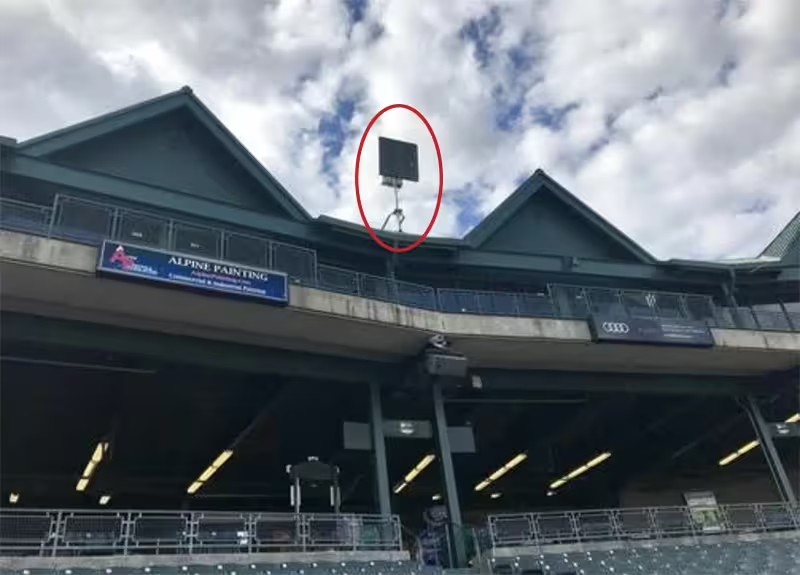
A robot umpire is a misnomer. As we said, we aren’t talking about R2D2 chilling at home plate. Nope, it’s an Automated Ball-Strike (ABS) system, and it’s a technology that uses radar or camera tracking to call pitches as balls or strikes with high precision. In practice, the system (like Hawk-Eye or TrackMan) measures a pitch’s location and relays the call to the human umpire’s earpiece instantly. The human umpire still signals the call, but they are just following the machine’s calls.
Robot umps have been tested extensively at the lower baseball tiers. The independent Atlantic League first used a full ABS in 2019, with a Doppler radar “black box” perched above home plate to call pitches. Since then, MLB has trialed ABS in affiliated minors: the Low-A Southeast League in 2021, some Triple-A games in 2022-2024, and the Arizona Fall League. The technology adapts for each batter’s height and stance, so a tall hitter’s zone is bigger than a shorter player’s, and it’s the same as the rulebook strike zone.
When could we see the majors see robot umps? MLB Commissioner Rob Manfred has indicated the earliest would be 2026 for a rollout. In Spring Training 2025, MLB used the ABS challenge system in about 60% of exhibition games as a high-profile test. Those spring games allowed each team two challenges (retaining them if successful), and about 52% of challenged calls were overturned by the ABS, implying umpires were indeed missing about half of the disputed pitches. While the full robotic strike zone won’t be part of the 2025 regular season, the writing is on the wall: the robot umps are coming, one way or another.
MLB’s experiments have evolved into a hybrid challenge system instead of total automation. In 2023-24, Triple-A leagues alternated between two modes: some games used full ABS (every pitch called by the system), and others used an ABS challenge system where the human umpire called the game, but teams could appeal a few ball/strike calls to the computer. The feedback was that players and fans strongly prefer having a human ump with limited tech assist over a completely robotic strike zone. The challenge system has been deemed a better balance between accuracy and the traditional “feel” of the game. By late 2024, MLB “pushed aside” full automation at Triple-A in favor of challenges, after observing some unintended side effects of the pure ABS (like an uptick in walks that we’ll talk about).
How Run-Line Betting Works in MLB
Ok, before we get into the betting impact, we need to do a quick refresher on run-line bets. A run-line is baseball’s version of a point spread. In a typical MLB game, the favorite is -1.5 runs (meaning they must win by 2 or more runs to cover), and the underdog is +1.5 runs (they can lose by 1 run and still cover, or, of course, win outright). This 1.5-run spread is almost always used as the default line, which is why you’ll see something like Yankees -1.5 / Red Sox +1.5 with associated odds. It adds extra complexity beyond the moneyline (which is just picking the winner) because it factors in the margin of victory.
How Run-line Bets Differ from ML and Totals
Run-line bets differ from moneyline bets in that you’re not just asking “who will win?” but “who will win, and by how much?”
If the favorite wins 3-2, a moneyline bettor on the favorite cashes in, but a run-line bettor on the favorite loses (since 3-2 is only a one-run win, not covering the -1.5 spread). Conversely, run-line underdog bettors often win bets on close losses. It’s a really popular wager type because it can turn heavy favorites into more profitable bets (if you’re confident they’ll win by 2+), and it gives underdog backers a cushion in a typically low-scoring sport where one run is huge.
Main Betting Factors
There are a lot of factors that influence run-line betting decisions.
- Pitching matchups are paramount; a great starting pitcher can suppress scoring, and that makes it harder for a favorite to pull away by 2 runs.
- Bullpen quality and late-inning tendencies matter if leads get extended or blown.
- Ballpark factors (a game at a hitter-friendly park like Coors Field vs. a pitcher-friendly park like Petco Park).
- The weather (wind blowing out vs. in) can sway expected run totals and thus the likelihood of a big margin.
Bettors also consider umpire tendencies, and we’ve now come full circle! There are umpires who have a reputation for a tight strike zone (favoring hitters and runs), and others who call a wide zone (favoring pitchers and unders).
All of these tendencies can influence scoring: If they call more balls, which results in additional walks, more runs can score. Other umpires can call fewer balls, and that could reduce the number of runs scored. Astute bettors will check who the home plate umpire is and adjust their over/under or run-line bets accordingly.
An analysis of umpire stats found that nearly half of the umps studied in a season showed a bias toward either overs or unders in total runs. For example, in 2010, Fieldin Culbreth’s games went over the betting total ~63% of the time (suggesting a smaller zone/hitter-friendly), whereas Doug Eddings’ games went over only ~33% (a big zone favoring pitchers and lower scores).
Sportsbooks are aware of these patterns and will shade totals for extreme cases, but it’s an extra variable in the betting equation.
The main point is this: human variability in calling balls and strikes is one of those factors that can change an MLB game’s run distribution. A generous strike call in a pivotal moment can kill a potential rally, and a tight zone can extend innings and boost scoring. That’s why a move to an automated strike zone stands to impact betting! It totally eradicates one source of volatility that bettors and oddsmakers have historically baked into betting lines.
Human Umpires’ Impact on Game Outcomes
Human umpires, for all of their experience and training, are not perfect or consistent. Every fan has seen a strike three call on a pitch a foot outside, or a pitcher lose a strike because the ump didn’t like the height or the catcher’s framing.
And inconsistencies aren’t anecdotal; they show up in the data.
In the 2024 MLB season, Statcast data showed that 10.9% of pitches thrown in the rulebook strike zone were called balls by umpires, and 6.3% of pitches outside the zone were erroneously called strikes. In other words, about 1 in every 10 true strikes was missed, and about 1 in 16 balls was mistakenly gifted as a strike. Over a full game with, say, 300 pitches, that’s on the order of 20+ potentially incorrect calls. Each one could change an at-bat outcome, which can snowball into changing innings and final scores.
Different Umpires, Different Calls
There’s also a big variation between different umpires. The strike zone is not actually a fixed rectangle in practice; it’s a human judgment influenced by habit and perspective. A study of umpire strike zones from 2008–2016 found that some umps consistently call many more strikes than others, especially on the edges of the zone.
Veteran ump Bill Miller was shown to call about 1,100 more strikes than the average umpire over a span of years; roughly 4 extra strikes per game, often on the fringes of the zone. He was the quintessential “pitcher’s umpire,” giving pitchers the benefit of the doubt on borderline pitches high, low, inside, and outside.
On the other end of the spectrum, there are umpires like Gerry Davis and Greg Gibson who have notably tight zones (sometimes called “hitter’s umpires”), calling fewer strikes than average, especially around the edges. The difference from one ump to another can be huge: analysis of 2017 data indicated the most pitcher-friendly ump was calling about 10 more strikes per game than the most hitter-friendly ump. That’s a huge factor in how a game might play out, as more strikes generally mean quicker outs, fewer walks, and typically lower scoring.
The tendencies impact not only totals but also how runs are distributed, which ties into run-line outcomes. An umpire with a tiny zone might contribute to more baserunners and potentially more big innings (as pitchers struggle to get strike calls and may have to throw easier pitches over the plate).
But an ump with a really generous zone could keep games tighter by suppressing offense, and teams might score less frequently, perhaps leading to more one-run games rather than blowouts. Bettors track umpire stats: historically, you could find umpire-by-umpire records against the total (over or under) and even how often favorites cover the run line under certain umps. As we said, almost half of the umpires in one sample leaned notably toward either higher or lower scoring games.
Extreme cases like Jim Reynolds (64% of his games went Over the total in 2010) or Greg Gibson (only 22% went Over, meaning 78% Under) show that an ump’s strike zone consistency (or lack thereof) can absolutely influence and change the margins of victory.
Famous (or Infamous) Examples
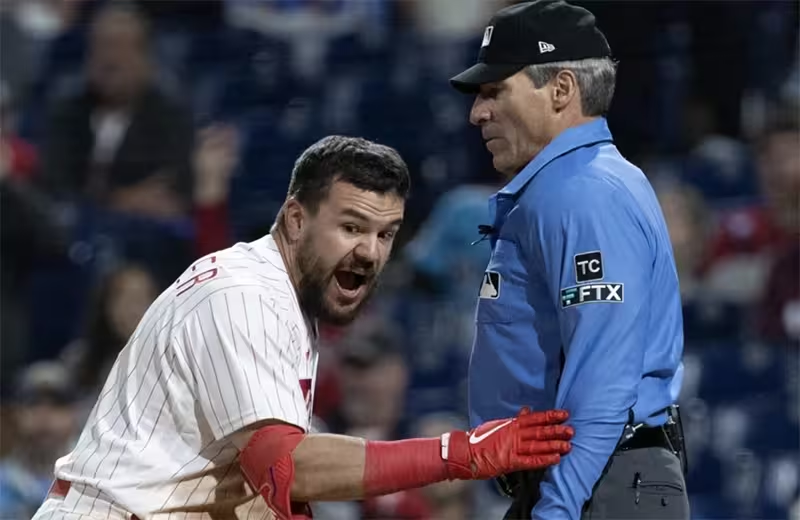
And of course, there are the headline-grabbing examples of umpire mistakes that altered baseball games. In a nationally televised game in April 2022, veteran ump Angel Hernandez had only 77% accuracy on strikes (well below the ~93% league average) and “rung up” multiple batters on pitches clearly outside the zone.
Phillies hitter Kyle Schwarber famously blew up at Hernandez after a called strike that was nowhere near the zone, and it was a demonstration of how a human umpire can inject chaos into such a crucial moment; blown calls can directly affect whether a team extends a lead or falls behind. Bettors who had the Phillies -1.5 in that game (just as an example) might feel that a missed ball four call, which should have been a walk (but became a strikeout), robbed them of a potential rally to cover the spread.
The human element in umpiring introduces variability in game outcomes, and it’s a variability that skilled bettors try to account for, but with robot umpires? That would be eliminated.
How Robot Umpires Could Change the Game
If MLB does end up changing to automated strike zones, we’d see an immediate and big shift in how games are played. The most obvious? The change is in strike zone consistency.
Why? Because a robo-ump doesn’t “expand” the zone for a pitcher on a hot streak or tighten it because a catcher is bad at framing. It calls the rulebook zone, pitch after pitch, with the same calibration for all. Human umpires call pitches probabilistically on the edges; sometimes a strike, sometimes a ball on identical pitches, whereas an automated system will make the same call every time for a pitch in a given location. Those borderline low-and-away sliders that one ump might call a ball and another a strike will have a uniform verdict.
Less Borderline Discrepancies
What could this mean in practice? For one, fewer borderline discrepancies. There will be no more “make-up calls” or individual ump decisions where a pitch is a strike in the 1st inning but not in the 9th. Over the course of a game (and season), that should decrease the variability in count outcomes.
A borderline 3-2 pitch with bases loaded will be called correctly, one way or the other. This could lead to less argument-induced drama, but more importantly for competition, it means players will adjust to a stable zone. Hitters won’t have to bother holding up their hand asking, “was that high?” because they know that the machine is precise. Pitchers could attack the exact top/bottom of the zone with more confidence, knowing they’ll get the strike if they hit it (and conversely, knowing there’s no hope of an ump giving them an inch off the plate anymore).
Player Performance
From a performance standpoint, we can only speculate on which types of players benefit or suffer. Let’s think about pitchers first. A strikeout pitcher (one with good velocity or nasty stuff that catches the zone) could see a benefit: if they can paint the real edges, they’ll get those calls consistently.
Some power pitchers throw rising fastballs at the top of the zone that occasionally get ruled balls by a human ump who perceives it as too high, but a robot will call those strikes if they nip the zone, potentially increasing high strike calls. And finesse pitchers or “nibblers” who succeed by getting hitters to chase just outside the zone or by relying on a catcher stealing strikes might lose an edge.
With ABS, a pitch that is two inches off the plate will never be called a strike (whereas a good framer and a friendly ump might have gotten that call before). An aspect that players disliked about full ABS was that it removed the art of pitch framing; catchers could no longer influence calls. Those catchers (and their pitchers) could no longer “steal” strikes on borderline pitches by presentation.
ABS Trials
There’s evidence that in the ABS trials, pitching dynamics did shift. In some early uses of full ABS, walks increased by a lot. MLB executives explained that in Triple-A games with full automation, walks became more prevalent, causing games to drag on longer despite the pitch clock.
Why more walks? Likely because pitchers couldn’t get those generous calls on borderline balls, so hitters were more often awarded walks on close pitches that a human might have called a strike. There are also reports that strikeouts actually dipped with the automated zone in certain minor league samples.
A Baseball America analysis of Triple-A data indicated the strikeout rate went down a little, but the walk rate went up, and that’s not exactly the outcome many expected, but it does suggest the zone called by the robot was tighter (or at least different) than what many umps were calling.
In the International League (Triple-A East), runs per game rose from about 4.98 to 5.50 after introducing ABS, walks increased from 4.0 to 4.8 per 9 innings, and hits ticked up as well. This aligns with the idea that a perfectly enforced zone would favor hitters in some ways, certainly in drawing walks, if not in hitting. It’s worth noting MLB adjusted the strike zone dimensions in the ABS system a few times to try to get the “right” balance, so not all ABS zones are identical. A too-big zone would favor pitchers excessively, a too-small zone vice versa. They’re looking for a happy medium that matches the intended rulebook zone without crushing offense or inflating it.
Another expected effect is a decrease in those game-altering “what if” moments that are set off by bad calls. Think about blow-up innings; sometimes a missed strike three leads directly to mayhem.
If an ump misses a strike call that would have been the third out, the at-bat continues, and the batter hits a 3-run double. With ABS, that third out is called correctly, the inning is over, and the rally is prevented. In theory, fewer big innings will be fueled by umpire mistakes, because those mistakes are gone. This could mean more predictable scoring progressions. It’s not to say that big innings won’t happen (they will, via hits and legit walks), but they won’t happen because an umpire gave a free pass or a free strike.
ABS will also prevent situations where a batter was mistakenly called out on strikes on ball four; those innings will now continue when they should have, possibly creating rallies that were unfairly halted before. The net effect is hard to quantify, but overall? The outcomes should lean more toward what the players earn, instead of what an umpire mis-sees.
Could automated zones lead to more offense or less? The early data and player feedback suggest more offense (more walks, slightly higher on-base, maybe slightly longer games) unless the zone is adjusted. MLB saw that as a negative when the pace of play suffered, which is partly why they currently favor the challenge system (let the human call it and only fix the egregious misses).
But regardless of offensive levels, the key is consistency and reduced variance. The day-to-day fluctuation caused by “which ump is behind the plate” would pretty much vanish if every game had the same calibrated zone or the ability to challenge bad calls.
Implications for Run-Line Bettors
From a betting perspective, a world with robot umpires? It’s a world with one less variable (and one less source of randomness) in each game. Below are 5 big-picture implications for run-line bettors!
Decreased Volatility in Scoring Margins
If each game’s strike zone is standardized, we could see more consistent scoring ranges. Umpires won’t be squeezing one pitcher one night and giving a wide zone the next. In theory, this could lead to results that are more in line with the team’s true talent and other factors, rather than occasionally being skewed by an umpire’s influence.
For run-line bets, reduced volatility could mean favorites cover the -1.5 spread at a more predictable rate (depending on their actual superiority), and underdogs get blown out or keep it close based more strictly on skill, not a friendly strike zone. Outcomes might cluster a little more closely around the expected values since an element of randomness is removed. But decreased volatility also means tighter betting lines. Sportsbooks will adjust their odds to the more stable environment, leaving bettors fewer soft spots to exploit. If games become easier to predict, any edge a bettor has will shrink because the bookmakers can predict them better, too!
Better Data Modeling and Handicapping
For the bettors who rely on analytical models to predict games? An automated zone is a dream come true because it’s an elimination of randomness. Currently, a model has to account for umpire tendencies, but with a uniform ABS, today’s handicap (and the sportsbook’s odds) wouldn’t need to worry about who the ump is.
As a result, bettors can put more weight on core factors like the pitchers, lineups, and weather without the wild card of umpire inconsistency. In the early days of ABS introduction, this could be an opportunity: oddsmakers will certainly update totals and run-line pricing based on any league-wide offensive shifts, but they might under- or over-estimate the impact initially. A sharp bettor who studies the minor league data might project that scoring will rise X% due to more walks, and could hammer run-line underdogs if they believe more runs = more chances for the +1.5 side to cover (since higher scoring games sometimes produce closer percentage margins, except in extremes).
But if scoring drops due to a bigger zone, a bettor could focus on favorites covering (-1.5) in lower-scoring, more one-sided games. The point is, early adopters could find an advantage before the market has figured it out. But that edge? It might not last long.
Line Movement and Odds Efficiency
Once the ABS system is established, it will incorporate all known effects (walk rate changes, etc.) into their lines. Any traditional angles like “this ump tends to produce overs, so I’ll bet the over” disappear, because that angle is gone with the ump’s influence.
What remains is more “pure” data. In a way, this levels the playing field between sharp and casual bettors on that front. Those obscure stats about how often Umpire X’s games land one run apart versus two runs apart will be obsolete. The sportsbooks will be cautious early on, and we could see slightly higher totals or slightly inflated odds on certain props until there’s enough data, but by the time robot umps are the norm? The betting market will likely be quite efficient in pricing in the effects. The days of sneaking an Over bet because you know a certain ump calls a tiny zone may be gone for good.
New Angles to Consider
That being said, the game will evolve, and bettors can look for new angles. We could start evaluating pitchers in ABS environments. Some pitchers may have a hard time adjusting, like a starter vet who got by on getting calls just off the black. If he can’t get those anymore, maybe he issues more walks or has to throw more hittable pitches, making him a fade on run-line bets, and you might bet against his team covering, or take the other team’s run line because he could be hit hard or keep games closer than before.
And a flame-throwing strike-thrower could thrive! If he was already pounding the zone, now he gets every borderline strike as well. Bettors could target such pitchers in run-line bets, expecting their team to win by a larger margin because of a pitching edge that’s fully realized with ABS.
Another angle? Patient hitting teams might very well benefit from ABS. If you have a lineup full of players with good strike-zone discipline, they will draw even more walks when the zone is robotically enforced (since borderline calls that might’ve been called strikes now become guaranteed balls if outside). Those extra baserunners would translate to more runs and more covers on the -1.5 run line if that patient team is favored. Or if two patient teams play each other, maybe you lean Over instead of the run-line, expecting a higher-scoring close game with lots of walks.
Impact on 1-run Games
A really interesting question is if robot umps will increase or decrease the frequency of 1-run games (which is directly relevant to run-line bets, because a 1-run margin is the razor’s edge between winning and losing most run-line bets).
If the offense increases (more walks, etc.), one would think that blowouts could become more common (more runs available to create large margins). But a consistent zone might actually prevent some big crooked-number innings, which could keep scores closer. It could also mean a leading team can’t rely on an ump to expand the zone to help them get out of a jam; they’ll have to earn every out, and that gives trailing teams more comeback opportunities.
Yes, it’s kind of a paradox, and we’ll need to see real data once it’s implemented to know. But run-line bettors should be super mindful: if the distribution of victory margins shifts even slightly, it changes how you should price those -1.5 or +1.5 bets. If historically road favorites win by 2+ runs, say, 45% of the time, and after ABS, they win by 2+ runs only 40% of the time, that’s a big deal in setting run-line odds.
Possible Changes in Betting Strategy
Assuming that automated strike zones do become a reality, bettors will have to adjust their strategies! Look below for some changes to think about if it does happen.
Target (or fade) High Strikeout Pitchers
As we said, pitchers who generate lots of swings-and-misses or looking strikes in the zone could become even more effective. Early on, one could bet on teams with power arms to cover the run line.
If Team A’s ace is a big strikeout guy, under ABS, he might rack up Ks and mow through lineups on the reg, making it more likely Team A wins by 2+ runs.
And you could fade finesse pitchers who lived on the edges. These are the types who see pitch counts soar and get into trouble with walks or hitters sitting on predictable strikes. If a known “edge-nibbler” is starting, a bettor could take the +1.5 on the opponent, as they’re expecting a closer game or an upset, because that pitcher can no longer get those cheap strikes and will give up more baserunners.
Monitor Walk Rates and OBP
Bettors should really pay close attention to which teams draw a lot of walks and which pitchers issue walks. Under a robo-zone, patient hitters will probably do even better.
A team that’s patient would be an excellent bet on the run line as an underdog, because they can stay in games by drawing walks and putting pressure on (preventing the favorite from pulling away easily). Or as a favorite, a patient team can blow a game open with walk-filled innings. For prop betting, things like over/under on total walks, or player walk props, could become super attractive in ABS games.
Totals and Alternate Bets
We know that a lot of bettors will initially shy away from run lines until the effects are clear, instead focusing on totals or derivative markets like team totals and props.
If ABS creates a higher baseline of walks, overs on totals might hit more often until lines adjust. If it somehow lowers scoring (due to more strikes called), then unders become the play. Instead of picking a side to win by 2, you could find value in betting a team’s total runs over or under, if you identify they are particularly helped or hurt by the new zone. Maybe there’s a team with free swingers (who currently suffer under human umps because they chase anyway) who won’t be helped by ABS; they’ll strike out or get themselves out regardless. This kind of a team will continue to not score much, so betting their team total under or even taking them -1.5 less often (if they’re the favorite) could be smart!
Consider the Umpiring System in Play
During any transition period, it’s possible that the MLB could implement the challenge system in some games (or some parks) and not others, or the postseason could differ from the regular season at first.
Bettors will need to know the rules for each game! During the Triple-A in 2023, all games switched to the challenge system mid-season, but before that, some days were full ABS and some were human. If MLB did a staggered introduction (say, ABS challenge in certain series or as an experiment), bettors should absolutely factor that in.
A game with full ABS would have a different run environment than a game with a human umpire. Even looking ahead, if MLB uses the challenge system (where only a few calls get changed), the impact is smaller than full ABS. So a bettor’s strategy can differ: under a challenge system, you might still handicap a little based on the scheduled umpire (since 90%+ of calls are still made by humans and only obvious misses get fixed). Under a full ABS, you ignore the umpire’s identity. Staying informed on how the games will be officiated will be a new part of bettors’ daily routines.
Adjust In-game Betting Decisions
In-game (live) betting could also be affected by ABS! The strike zone consistency could make it easier to predict outcomes once you see which pitcher “has it” or not on a given day. If a normally wild pitcher is pounding the zone (and getting strikes), you could bet his team to hold a lead on the run line. And if a team that’s known for patience isn’t drawing walks (maybe the opposing pitcher is exceptionally on with his control that day), you would steer clear of betting that underdog +1.5 live because their usual advantage isn’t materializing.
All of the above strategy shifts boil down to one thing: relearning the nuances of baseball betting in a landscape where one major variable, the umpire, is neutralized. It’s sort of analogous to how bettors had to adjust to the NL adopting the designated hitter or the new extra-inning rules; those changed scoring and strategy, and thus betting dynamics. Robot umps will probably have a similar learning curve.
What the Data Says So Far (Early Trends)
While we don’t have any major-league data for robot umps, the minor league trials give us some clues. We’ve already talked about the main stats: more walks, possibly fewer strikeouts, and a slight increase in runs were observed in some ABS implementations. But we can recap a few early trends from where it’s been used!
Triple-A 2022-2023
In one Triple-A league, after introducing the automated zone, walks went up around 0.8 per game (per team) and strikeouts were roughly flat or dipped slightly, resulting in about a half-run increase in scoring. This suggests that pitchers couldn’t get as many borderline strike calls, putting more men on base via walks. But it didn’t produce a massive offensive explosion, only a moderate bump. Hitters weren’t all of a sudden teeing off for 10 runs a game; they were just reaching base a little more often via the base on balls.
Atlantic League 2019
In the initial indie-league trial, qualitative reports said players were intrigued but had complaints about certain pitches being strikes that never were before (like breaking balls that clip the very bottom of the zone). Statistically, an article from The Ringer noted that the Atlantic League saw strikeout and walk rates rise slightly when ABS was first used, but overall offense (batting average, hitting) stayed almost unchanged. The shape of offense shifted (more Ks and BBs, fewer balls in play), but it didn’t dramatically alter the runs scored.
Player Reactions
Pitchers and hitters have commented on robot umps in minor league play. A common sentiment from pitchers is frustration at the “weird” strike zone.
Red Sox pitcher Nick Pivetta, after a Triple-A rehab start under ABS, said: “I hate it. It’s terrible. Hopefully it never comes [to MLB]. The strike zone is just weird, it just doesn’t match the baseball.”
Hitters have complained as well about high strikes or breaking pitches that clip the zone late, which are things umps often call balls but ABS won’t miss. This says that there will be an adjustment period for players, and it’s a window where some teams will suffer and others benefit until everyone adapts.
Challenge System Data
MLB’s spring 2025 test of the ABS challenge system revealed some interesting stats, too. Teams only challenged about 2.6% of all called pitches (so 97% of calls stood unchallenged), and about 52% of challenges resulted in overturned calls (meaning the ump was wrong on roughly half of the ones players thought were wrong). Catchers were the most successful challengers (winning 56% of their challenges) compared to pitchers (41%), likely because catchers have the best view and sense of the zone. For bettors, if the challenge system is in play, it means that some of the worst calls will be corrected, but some will still occur (you can’t challenge everything, just a few per game). So the impact on run-lines under a challenge system could be smaller, as it trims the extreme misses but doesn’t make every call perfect. Full ABS would be a bigger step-change.
Runs and Margins
It’s way too early to conclude how margins of victory change. But one could look at the distribution of scores in ABS vs non-ABS games in Triple-A for clues. If ABS games had slightly higher variance in scoring due to more walks, or maybe lower variance due to consistent zones, these are the things that data scientists are studying.
One thing we do know? With human umps, about 28-30% of MLB games historically are decided by one run. If robot umps alter that percentage even a little, it changes run-line outcomes.
Could This Actually Help Bettors?
A consistent strike zone takes one unpredictable element off the table. And for those bettors who rely on data and matchup breakdowns? That’s a very good thing. Fewer surprises behind the plate mean outcomes line up more closely with what the numbers suggest.
But that also cuts both ways! If the zone becomes easier to account for, sportsbooks will adjust quickly, and any short-term edge could dry up, so it could be a lot harder to find mispriced lines.
The shift could make things more approachable for newer bettors. Because there are fewer hidden variables in play, projections become cleaner, and the gap between casual and experienced players might shrink, at least for a little while.
The Robot Umps Are Coming: Is Your Run-Line Strategy Ready?
If we’re being honest, the only thing we love more than a bench-clearing field brawl is when a coach loses their sh*t on an umpire before they’re ejected from the game. We’ll miss that!
But robot umpires remove that human error factor that makes players get in their faces, and that’s a good thing (for the umps and the game as a whole).
Once the strike zone stops changing from night to night? Betting on the margins won’t feel quite the same. The usual ump-driven change in baseball game outcomes could be a thing of the past.
Run-line outcomes will always depend on pitching matchups and lineup strength, but plate discipline and pitcher control will matter more. If and when robot umpires happen, watch how teams adjust in those games! Seeing any trends early on will give you an advantage if this system ever does make it to the show.
Phoenix Mercury vs. Indiana Fever Prediction & Preview (July 30, 2025)
Two teams that haven’t battled it out on the hardwood this season finally meet in a matchup! The playoff hopefuls are the Phoenix Mercury, who head to Indiana to take on the Fever.
First things first, Caitlin Clark is not playing. She’s still sidelined with a groin injury and was ruled out for her fifth straight game. In spite of her absence, the Fever (14-12) is on a two-game win streak and wants to keep it going. Without Clark? Kelsey Mitchell has taken on most of the scoring duties for Indiana.
Phoenix (16-9) is coming off a win over the Washington Mystics; they’ve been killing it on the offense and rebound, and we see them as the more reliable bet because of how well they’ve defended.
Sportsbooks are calling this game pretty even, but the early action is looking like it favors the Mercury side. What else do you need to know? Keep reading to see the latest betting odds, trends, stats, players, and props, our best bets, and why we chose them!
Game Details
- Matchup: Phoenix Mercury (16–9) vs. Indiana Fever (14–12)
- Date & Time: Wednesday, July 30, at 7:00 pm ET
- Venue: Gainbridge Fieldhouse, Indianapolis, IN
- How to Watch: WNBA League Pass, Bally Sports Indiana, local broadcast
- Head-to-Head: The first of three matchups this WNBA season
Betting Odds
The oddsmakers have spoken, and here are the latest betting lines from FanDuel:
| Team | Spread | Moneyline | Total |
|---|---|---|---|
Mercury | -3.5 (-108) | -176 | Over 166 (-110) |
Fever | +3.5 (-112) | +142 | Under 166 (-110) |
Betting Trends & Stats
How have both teams performed at sportsbooks, and what can the recent trends tell us going into the game?
- Against the Spread (ATS)
- Mercury: 14–11
- Fever: 13–13
- Totals (Over/Under)
- Mercury: 12–12–1
- Fever: 13–13
- Scoring Notes
- Indiana’s games are averaging around 165.9 combined points.
- Phoenix has stayed under the total in 4 of their last 6 games.
- Situational Trends
- Indiana is 3–1 straight up at home over their last four games.
- Phoenix has won 4 of its last 5 road games.
- The underdog has covered in 6 of the last 7 meetings between these two squads.
Players & Props to Watch
Because Clark is still out, Indiana’s offense has been relying more on its vets, and Phoenix is on fire with a really balanced core. Here are the players that we are watching on the board and in the poor market!

Indiana Fever
- Kelsey Mitchell: She’s been Indiana’s go-to scorer, and she’s averaging 20.2 PPG and hitting 44% from deep. With her usage up? The Over 19.5 points at –110 is def worth a look.
- Aliyah Boston: She’s been holding it down in the paint, and she’ll have her hands full dealing with Sabally and Thomas. Staying out of early foul trouble is the priority here.
- NaLyssa Smith & Kristy Wallace: Both give spacing with their midrange and face-up games. Smith has been able to take control inside when she’s matched with undersized defenders.
Phoenix Mercury
- Alyssa Thomas: One of the most versatile players in the league, and she’s averaging around 10.5 boards a night. Her all-around impact makes her a solid double-double candidate!
- Satou Sabally: Really hard to contain; she can step outside, beat defenders off the dribble, and crash the boards, so Sabally is a matchup problem for most of the bigs.
- Kahleah Copper & Natasha Cloud: Their guard combo is a solid mix of pace and good decision-making. Copper gives Phoenix a dynamic scorer, and Cloud keeps the offense flowing when the half-court sets slow down.
Game Breakdown & Strategy Angles
Phoenix’s ball control and defensive length could overwhelm an Indiana team that’s still trying to adapt to playing without Clark!
Indiana and Phoenix both average around 77–80 possessions per game, but Phoenix is better at dictating the structure of those trips. They limit fast break chances and force opponents into set offenses. Without Clark, Indiana hasn’t looked to push the tempo much; they’ve averaged fewer than 9 fast break points per game in her absence.
Without Clark, the Fever are more static. They’ve averaged under 19 assists per game over the last four, and their spacing has tightened up. Kelsey Mitchell has had to do a lot off the dribble, which works when she’s good but turns into a liability when the defense loads up. Stretch forwards are still a problem for Indiana; opponents have shot over 40% from beyond the arc at the 4-spot in the last five games.
Mercury plays with control. They rank in the top five in assist-to-turnover ratio and in the top three in second-chance points. Alyssa Thomas is the engine on the boards and from the elbow, and she’s getting strong support from Copper and Cloud, who have combined for over 34 points per game in the last five outings.
Indiana has to hit threes in the first two quarters to space the floor and open driving lanes for Mitchell and Smith. If they go cold from outside in the first half, Phoenix will sit in the paint and dare them to shoot. The Mercury doesn’t overwhelm with scoring volume, but they’re well-coached, patient, and rarely beat themselves. That’s been enough against teams with limited creation options.
Our Best Bets
What are we looking at for value? Well, we have five angles for this matchup! Here are our best bets:
| Pick | Confidence | Why Do We Like It? |
|---|---|---|
| Moderate (3/5) | Phoenix has been steadier ATS, and their half‑court discipline fits well against Indiana without Clark. |
Mercury −3.5 (−108) | Strong (4/5) | Indiana is without Caitlin Clark; Mercury have a size/rebounding edge and are surging. |
Under 166 (-110) | Moderate (3/5) | Fever’s scoring dips without Clark; slower pace favors a total below 166. |
Kelsey Mitchell Over 19.5 PTS (−110) | Strong (4/5) | Mitchell is Indiana’s go-to scorer without Clark and has hit 20+ in multiple recent games. This prop line is available at −102. |
Alyssa Thomas Double‑Double | Moderate (3/5) | Thomas is really active on the glass and in playmaking, so this is a solid value spin. |
FYI: Make sure you check our best online sportsbooks as it gets closer to tipoff for any line movement and prop availability!
Supporting Insights & Sharp Angles
- Phoenix is 8–2 when holding a lead after three quarters; Indiana is 3–6 in the same scenario.
- The Fever have allowed the most offensive rebounds in the league, and that’s bad news against Thomas and Sabally’s inside presence.
- The Mercury has scored 80 or more in five of their last six because of spacing and good ball movement.
- Indiana ranks in the bottom five in opponent field goal percentage, making them vulnerable to Phoenix’s early shot creation.
- Market movement and bet volume are trending toward the Mercury against the spread and Over 164.5
Why We’re Backing the Mercury Over the Fever
Final Score Prediction: Phoenix Mercury 82 – Indiana Fever 74
Phoenix has the more experienced core, and it shows when games are close. Alyssa Thomas and Natasha Cloud are leading the half-court sets and controlling the tempo late; they’re better equipped to close out tight matchups than Indiana’s current rotation.
The Fever have issues limiting second-chance points, and it’s an area where the Mercury’s size and rebounding depth (Thomas, Sabally) give them an advantage. Without Caitlin Clark’s rebounding and transition presence? Indiana becomes easier to scout: it forces Kelsey Mitchell into contested looks, and the offense slows way down.
Phoenix’s frontcourt versatility has been a problem for Indiana in the past, and their scoring balance gives them more ways to win than the Mitchell-or-bust approach the Fever are using.
Underdogs have covered in six of the last seven meetings between these teams, but Phoenix fits the short road favorite role here: deeper, steadier, and way less dependent on one scorer carrying the whole team.
Best Bets Recap
- Phoenix Mercury –3.5 (–108): Confidence: 4/5
- Moneyline: Phoenix ML (–176): Confidence: 3/5
- Total Points: Under 166 (–110): Confidence: 3/5
- Player Prop: Kelsey Mitchell Over 19.5 Points (–110): Confidence: 4/5
- Alt Bet (Sprinkle): Alyssa Thomas Double-Double: Confidence: 3/5
We’re with the Mercury in this one; they have the rebounding advantage, more late-game options, and fewer lineup gaps. They’re in a much better position to close this one out in regulation!
2025 World Series Longshots: Best Value Teams Nobody’s Betting On
Time flies just like one of Aaron Judge’s homers. Yes, that was corny. But that doesn’t make it any less true, and that means the World Series will be here before we know it!
We don’t know who will end up at the biggest game in baseball, but we never count out the longshots. Who doesn’t love the underdog? And when you bet on one and they pull it off? Cha-Ching!
The truth is that a majority of casual bettors only focus on the fav teams, like, say, the Yankees or the Red Sox, but that isn’t always the smartest strategy. Why? Because the real opportunity sometimes lies with those underrated underdogs.
And that’s why we are gonna go over the top undervalued longshots to win the 2025 World Series! We’ll do so based on the latest odds, team trajectory, and good betting strategies.
Before we get into it, know this: betting on longshots is high-risk. These are not sure things, as there is no such thing in sports. But a small, calculated wager on a dark-horse team? That’s a fun part of the betting. If you manage your bankroll and expectations, longshot futures bets can kick up your season a notch with big upside potential, but don’t forget that they’re called “longshots” for a reason!)
Here are the 2025 World Series Longshots: the best value teams that nobody is betting on (yet).
What Makes a Team a ‘Longshot?’
Why is something considered a “longshot?” Well, in this case, it’s a baseball team with a low implied probability of winning, and it’s reflected by odds of roughly +3000 (30-to-1) or longer.
The market gives these teams around a 3% (or less) chance of winning it all. They are the clubs that no one expects to become the champs, and it’s because of recent performance, market size, or roster questions. Sportsbooks and the betting public will overlook them, and this means the payoff would be huge if they end up defying the odds.
The factors that can cause a team to be labeled a longshot? An absence of superstar names, a small-market fan base (and thus less betting action), or a mediocre record in the previous season. Public perception and preseason predictions heavily influence futures odds; teams with known players or a winning history get way more respect on the odds board, and up-and-comers or historically unsuccessful franchises have odds that don’t show their real potential.
What are the traits that potential “sleeper” teams have in common? The following things:
- A Youthful Core with Upside: Longshots usually have younger talent who are on the brink of breaking out. A roster full of emerging stars, like rookie phenoms or recent call-ups, can gel late in the season and overperform expectations.
- An Emerging Ace or Resurgent Bullpen: Maybe the team has a pitcher who is developing into an ace or a bullpen that’s locking teams down. Strong pitching can carry an underrated team much further than anyone is expecting them to go.
- Deadline Trade Potential: A “sleeper” team might be just one big move away from contention. If the front office has resources or prospects to trade, a midseason acquisition (like adding a power hitter or a No. 2 starter) could alter their outlook overnight.
- Over-performing on a Budget: Usually, longshots are low-payroll or mid-market teams that find ways to win in spite of a lower budget. It could be via great defense, fantastic coaching, or team chemistry; they could be winning games without attracting any media hype.
- Undervalued by Public Perception: Sometimes, a team is a longshot just because the public hasn’t caught on to their improvements. They will be flying under the radar because of a long playoff drought or a lack of marquee names, but their on-field performance is fire
A longshot is any team that the market isn’t giving much of a chance, but that doesn’t mean we should count them out. It’s the overlooked clubs that can offer value to bettors who want a little extra risk.
Why Betting Longshots Is a Smart Strategic Play
The thing about futures betting is to find the discrepancies between implied probability and actual upside.
Every set of odds contains an implied probability of winning. +3000 odds imply about a 3% chance to win the World Series. If you think a team’s actual chances are higher than that (like 5% or more), then that futures bet has value. Longshots are usually where these discrepancies exist; public bias and conservative forecasts can underrate a team’s ceiling. When you bet on a few carefully chosen longshots, you’re saying, “I think these teams have a better shot than a lot of people realize.”
Of course, you should NOT load up your whole bankroll on a 50-to-1 praying for a miracle candidate. The smart play? Balance your portfolio with one or two small bets on high-upside longshots to complement any wagers on the favorites. The beauty of this is that you only need to hit on one longshot out of many to come out ahead. If one 40-1 underdog wins it all, it can cover losses on all the others and then some. It’s this asymmetric payoff that makes longshot betting so attractive; a little can go a really long way!
Historical Longshot Examples
Baseball history has proven that longshots do sometimes win championships. The last six years have given us some great examples of why it’s wise not to just blank the underdogs!
Early in the 2019 season, the Nats were only 19–31 and given super-slim playoff odds. They caught fire in the second half and went on to win the World Series. Their preseason title odds were around +1600 (16-to-1), which is not the longest shot ever, but they were considerable underdogs after their bad start. Bettors who kept the faith in Washington reaped big rewards.
The Braves weren’t huge longshots before the season (+1000, or 10-to-1, in preseason ), but by mid-season? They’d lost their star Ronald Acuña Jr. to injury and hovered around .500. Few expected them to even contend. But after a flurry of trade deadline moves and a late surge, Atlanta went on to nab a World Series victory. It was a stark reminder that even a team that’s given about a 10% chance in spring can struggle, regroup, and still win it all.
The biggest Cinderella story is the Texas Rangers. They went into 2023 as a 50-to-1 longshot to win the World Series. After a recent history of losing seasons, they weren’t on anyone’s radar as contenders. But a combo of breakout performances and bold moves (like signing star free agents) paid off big time. Texas not only made the playoffs, but they went the distance and won the 2023 World Series, cashing out one of the most miraculous futures tickets in recent memory. A $100 preseason bet on the ’23 Rangers would have returned $5,000, and this illustrates the massive ROI that longshots can deliver.
The above examples highlight an important point: the MLB season is long and unpredictable. Wild-card teams can get hot at the right time, injuries can shuffle the hierarchy, and unsung players can transform into postseason heroes. If you had a feeling about those underdogs and put down a small wager, you would have been handsomely rewarded.
Best Practices
What’s the best way to bet on longshots? Below are the best practices if you take this wager route!
Spread Your Wagers
Instead of going all-in on one 100-to-1 miracle, it’s way smarter to sprinkle small wagers across a few longshots that you really believe in. You could bet a quarter-unit each on four teams with big odds. You only need one of them to hit for a potentially profitable payout, and diversifying increases your chances of having a live ticket late in the year.

Bet Early But Keep Monitoring
Longshot odds can change dramatically as the season progresses. If you spot an undervalued team early and bet them at, say, +4500, you can gain a huge edge if they surge (because that same team might be +1500 a few weeks later).
- We saw this happen in 2025: the Detroit Tigers opened at +4000 but were bet down to +850 by mid-summer after jumping to a first-place tie.
- The Milwaukee Brewers were around +3500 in spring and, after a big winning streak, were shortened to +1600.
Early action usually nets the best value, so watch the odds board all season long! If a team hits a slump or has injuries, their odds could drift longer again, and that can create another chance to buy low.
Use Logic, Not Love
Huge odds are always tempting, but make sure you have a rationale that goes deeper than “That would be nice.” Look at a team’s run differential, underlying stats, or second-half schedule. Is there evidence that they could turn things around or sustain their success? Longshot betting should still be grounded in analysis; you’re looking for undervalued teams, not just any team with a pulse. Don’t throw money at hopeless cases; focus on those that have a plausible path to contention.
Manage Risk & Bankroll
By their very nature, longshot bets are less likely to cash, so always treat them as a high-risk portion of your betting portfolio. Keep the wager sizes modest (relative to your standard unit). The goal is that if the bet loses (as most longshots will), it’s a tiny hit to your bankroll. But if it wins? You get an outsized boost. This way, you enjoy the upside without jeopardizing your bankroll stability.
Don’t Be Scared to Hedge
If your longshot does end up making a deep run, you’ll have options to secure profit. If your 40-1 pick reaches the World Series or League Championship Series, you could hedge by betting on the other team or via cash-out features, and that will lock in some winnings regardless of the final outcome. Hedging strategy is a whole topic in and of itself, but it’s good to plan ahead for how you might capitalize on a longshot that goes the distance.
Best 2025 World Series Longshot Picks (as of late July)
It’s only July, so we are concentrating on the five baseball teams with longer odds but have strong value relative to their World Series chances. These are by no means predictions that each will win! They’re worth a speculative wager because the payoff significantly outweighs the risk in our estimation. A common approach is to risk 0.25 to 0.5 units (a quarter or half of your usual bet size) on these types of futures. That way, if even one hits? You’ll make a profit.

Seattle Mariners (+2200 to +2500)
Seattle’s franchise is overlooked because of history; the Mariners have never reached the World Series in their 40+ year history.
They play in a smaller media market on the West Coast, so they don’t get as much national attention. Despite ending a 20-season playoff drought in 2022, the Mariners missed the postseason in 2023 and 2024 by narrow margins, so bettors wrote them off as perennial underachievers. Public perception hasn’t caught up to Seattle’s strong roster, and that’s reflected in their roughly +2200 odds (about a 4% implied chance of a title).
The current Mariners squad has a different feel. For one, their offense, which has long been a weak point, has turned into a surprise strength. Young hitters have stepped up, and power-hitting catcher Cal Raleigh has been having an amazing season, as he leads the majors with 38 home runs at the All-Star break. With Raleigh pacing the lineup and star center fielder Julio Rodríguez capable of getting hot down the stretch, Seattle can score runs more reliably than in years past.
Their pitching rotation, which was among the league’s best in 2024, has the room to improve in the second half of 2025. Injuries to key starters (like George Kirby and Logan Gilbert) hurt them early on, but as those arms return to health, the Mariners could regain a top-tier staff. If the rotation approaches its 2024 form (when Seattle had the lowest starters’ ERA in the AL), this team becomes super dangerous.
Another factor? The Mariners have a loaded farm system and could be aggressive at the trade deadline. They haven’t won a division title since 2001, and management could make a deal (or two) to bolster an already solid core. All told, Seattle has the upside of a World Series contender hidden inside a team the betting market views as a longshot.
With current futures odds in the +2200 to +2500 range, Seattle’s implied championship probability is about 4%. That feels really low given that models put their postseason odds around 69% and a championship chance near 2–3% even before any deadline moves. If you believe in their momentum and potential upgrades, a small speculative stake (about 0.25–0.5 units) on the Mariners could pay off massively. This is a high-upside flyer, and it’s the kind of bet you make now and hope to cash in October if the Northwest’s underrated stars keep cooking!

Boston Red Sox (+2900 to +3500)
The Red Sox are a famous franchise, but in 2025? They’ve been dismissed by oddsmakers and bettors. Why? A lot of it comes down to pitching uncertainty.
Boston’s rotation depth was questionable to start the year, and nagging injuries and a lack of proven aces have kept public confidence low. Their bullpen has also been wobbly at times, and that’s led to plenty of blown leads. The Sox made a curious offseason move by trading away their best hitter, Rafael Devers, as part of a mini-rebuild, which people assumed signaled a step back this year. As a result, their World Series odds drifted out to around +3000 or even +3500 at some books (~3% implied chance). In a division with powerhouses like the Yankees and Blue Jays, the Red Sox have been treated as afterthoughts.
Despite all the skepticism, Boston has hung in the playoff race. A big reason for this is their youth movement on offense. After Devers was sent to San Francisco, a trio of young players filled the void and then some. Outfielder Ceddanne Rafaela raised his batting average from .220 to the .320s and hit a dozen homers in six weeks.
Top prospects like Roman Anthony and Marcelo Mayer have come up and started contributing as well. The lineup has more power than people expected, even after they lost a superstar.
Now, consider the potential pivot at the trade deadline: Boston’s front office has money to spend and knows pitching is the glaring need. If they acquire a solid starter and a reliable reliever (or two) by the July 31 deadline, which many analysts deem likely, this team’s outlook changes drastically.
A better pitching staff behind a rock-solid offense could make the Red Sox a very tough out in September and beyond. They’ve also gotten contributions from surprise sources, and if one of their injured pitchers (or an unheralded arm) steps up as a late-season “ace,” look out. Boston is a couple of moves away from going from longshot to legit contender, and those moves could be imminent.
The Red Sox are hovering around +3000 to +3500 odds to win the World Series, implying about a 3% chance at best. That’s a swing-for-the-fences kind of bet, but it’s in no way as far-fetched as it sounds.
Their current record has them in wild-card contention, and betting models still give Boston around a 2% chance to win it all (even pre-deadline). If you wager on the Sox now, you’re betting on the come: that they’ll shore up the pitching soon and make a late push. It’s the literal definition of a high-risk, high-reward play. Worth a quarter or half-unit as a contrarian pick for the bettors who believe a key trade could be in the cards. Just know this: this is a longshot for a reason, and they’ll need all of the pieces to fall in the right place.

Milwaukee Brewers (+1500–1600 to +4500)
How can a team with one of the best records in baseball still be a “longshot”? Welcome to the small-market paradox!
The Milwaukee Brewers stormed out as one of MLB’s hottest teams with an 11-game winning streak in July that catapulted them to the best record in the majors at one point. As of late July, they’re sitting atop the NL Central with a record north of .580 and on pace for 90+ wins.
Still, most bettors (and sportsbooks) have been slow to anoint the Brewers as championship favorites. Public money still pours in on teams like Los Angeles, New York, or Philadelphia, keeping Milwaukee’s futures price relatively longer than their performance merits. Oddsmakers opened the Brewers around +3500 last fall, and even after their midseason surge, they’re roughly +1500 to +1600 now.
Part of this is legacy bias: Milwaukee has never won a World Series and last appeared in one back in 1982. And they traded away star closer Devin Williams this past winter and former ace Corbin Burnes the year before, making preseason analysts assume they were retooling. But the Brewers have defied those expectations and have assembled a young, exciting core, and the betting public hasn’t caught on.
The Brewers might be the most well-rounded team Milwaukee has fielded in a decade. After a sluggish 0–4 start, they found their footing and haven’t looked back. A wave of rookies and younger players has injected life into the lineup, and Milwaukee leads the MLB in wins above replacement from rookies this year. An infusion of talent (breakout performances from guys in their early 20s) has made them a more athletic and dynamic team than the homer-or-bust Brewers of recent years.
They’re top 5 in the league in team defense and have a deep pitching rotation that has stayed effective even when injuries happen. The return of ace Brandon Woodruff from injury was the catalyst for that 11-game win streak; his presence (1.65 ERA in his first three starts back) gave the club a jolt. If Milwaukee continues to get quality pitching and clutch hitting? There is zero reason they can’t be a force in October. They’ve shown they can beat elite teams and win close games. And because they’re not a big-market team, the Brewers relish their role as an underdog. They have a chip on their shoulder, and that attitude can make them a threat in a postseason series. In a year with no ringer team, Milwaukee has the makings of a team that could go all the way, even if most bettors haven’t clocked it.
If you grabbed the Brewers at +4500 earlier this summer, congrats on an awesome value pick! Those odds have since shrunk to around +1500 or +1600 as of late July, after their hot streak and rise to first place.
At +1500, the implied probability is about 6.25%. That’s still a respectable value given Milwaukee’s standing; remember, the model in early July saw their championship odds at roughly 5–6%. Even now, some sportsbooks and bettors are still skeptical, and that’s an opportunity.
If you believe the Brewers are “for real,” taking them at ~15-1 isn’t unreasonable, though the best window of value (back when they were 30-1 or 45-1) has passed. This could be a team to watch for dips; if they hit a rough patch and the odds drift longer again, it could be time to jump on it. Otherwise, a small token bet now can still pay off nicely. Here’s a reassuring note: sportsbooks have indicated that the Brewers winning it all would be a good outcome for them, meaning that not many people have bet on Milwaukee. That tells you just how under-the-radar this club is!

Chicago Cubs (+1400)
The Cubs’ presence on this list surprised us, too! Chicago is a big franchise with a really famous fan base. But coming into 2025? The Cubs weren’t on the short list of expected contenders. They’d been in mini-rebuild mode since their 2016 championship core was broken up, and most thought they were still a year or two away from serious contention.
That skepticism lingered even as the Cubs got off to a nice start this season. The public and oddsmakers tend to view the Cubs as a middle-of-the-pack team, not one of the elite juggernauts, and that’s why their World Series odds opened around +3000.
And even though they’re near the top of the NL Central, you can still find them at about +1400 (14-to-1) odds to win it all. In percentage terms, that’s about a 6–7% implied chance, and that shows caution from bettors who aren’t totally sold that the Cubs are “for real.”
Plus, when people think of the NL pennant, they think Dodgers, Braves, Phillies…the Cubs haven’t been in that conversation for a while, and that has kept their betting support pretty modest.
The Cubs have become a well-balanced, dangerous team, and their lineup has been a revelation. Chicago’s offense never seems to go cold for long; they are one of only two teams in baseball that haven’t been swept in a series of 3+ games this year, largely because even when the pitching falters, the hitters keep them in games. The Cubs rank second in the majors in batting percentage and third in stolen bases, which is a rare combo of power and speed that makes them a threat to score in any number of ways.
Two catalysts illustrate this new Cubs attack: Pete Crow-Armstrong and Kyle Tucker. Crow-Armstrong (a 23-year-old rookie center fielder) and Tucker (an All-Star whom the Cubs signed away from Houston) have given Chicago a pair of dynamic, five-tool talents. Both can crush a ball over the fence and steal a crucial bag. Around them, the vets and young players are contributing, and the defense is vastly improved (one of the top-ranked units in MLB).
On the mound, the Cubs aren’t as star-studded, but they have depth and a bullpen that’s better than people realize; closer Daniel Palencia has been clutch. And Chicago is likely to be active at the trade deadline. Sitting in a playoff position with a real shot at the division, the Cubs front office has signaled that they’ll be looking to add a starting pitcher and maybe a third baseman before July 31. Any notable addition could elevate this team’s ceiling further, and they’ve already shown they can go toe-to-toe with the NL’s best during the regular season. If they get into October, their combo of power, speed, and defense, and that Wrigley Field magic, could carry them on a deep run. They won’t be anyone’s favorite matchup in the playoffs, that’s for sure.
The Cubs are currently around +1400 to win the World Series, and it’s a marked improvement from the 30-1 odds they had in the preseason. That implies a 7% chance, and some advanced metrics and simulations have them in the same ballpark. ESPN’s model gave Chicago about a 15% chance to win the NL and roughly a 15.4% (+550) chance to win the World Series as of the All-Star break, which suggests the betting market might still be a little behind on the Cubs.
At 14-1, the value isn’t as big as the longer shots on this list, but Chicago is a relatively solid middle-ground bet. This is a team on the upswing that might have the consistency to do it. A half-unit play on the Cubs could be justified if you have faith in their trajectory; it’s not the lottery ticket payout of a true longshot, but it’s still a nice price for a team that’s looking like a legit contender. As always, shop around; if you can find +1500 or better, that’s even sweeter for a club with this kind of talent!

Texas Rangers (~+3100) (if still available)
The Texas Rangers hoisted the World Series trophy in 2023, but fast forward to 2025? A lot of bettors have lost faith in them. After a strong 2024 follow-up, the Rangers hit a bad stretch in the first half of 2025. Injuries to their pitching staff have been a big story. Ace Nathan Eovaldi missed a lot of time with a trip to the injured list, and other starters dealt with ailments, which cooled optimism around the defending champs.
The offense also underperformed early in the season, which was a surprise given their star power. Sportsbooks and the public reacted by drifting Texas’s odds upwards. At one point in June, when the team was sitting around .500, the Rangers were being offered at +5000 (50-1) longshot odds. And although Eovaldi is back and the team is trying to climb in the standings, their odds are still relatively inflated; around in the +3000 range at many sportsbooks (~3% implied). The market may have overreacted to Texas’s mid-season slump, and that presents value if you believe in their resurgence.
This is largely the same core that won a championship two seasons ago, so they know how to get it done in October. The Rangers’ biggest reason for optimism is the return of their pitching firepower. Nathan Eovaldi made his comeback from the IL in late June, and while his first start looked rusty, manager Bruce Bochy said, “it’s only going to get better with him” as he rebuilds his arm strength.
Other rotation pieces like Martín Pérez and Dane Dunning have been solid, and there’s hope that Tyler Mahle (who was also injured) could contribute down the stretch. A healthy Rangers rotation is a strength; remember, this was a team built on pitching depth and an explosive offense, which underachieved early but still has championship-caliber talent: Corey Seager, Marcus Semien, Adolis García, and company. There’s a sense that this lineup is too good to stay down forever. Since the All-Star break, Texas’s hitters have shown signs that they’re waking up. The Rangers also have that intangible “been there before” factor, so the moment won’t be too big for their clubhouse if they can make it into the postseason.
The Rangers are around +3100 in the futures market at the moment (give or take, depending on where you shop), which is an implied probability of around 3.1%. For a team with Texas’s pedigree, that’s really intriguing! It’s rare to get the defending World Series champions at 30-1 odds. Granted, that price reflects the uphill battle they face to make the playoffs this year; they’ll need a big finish to secure a spot. It’s a classic high-risk play: you’re betting on a talented team to overcome earlier struggles and peak at the right time. A small bet (0.25–0.5 units) on Texas could be warranted for contrarian bettors who trust the Rangers’ “championship DNA” and recent positive signs. If they catch fire in August, those 30-1 odds will disappear, so consider this one to be a speculative flyer on a battle-tested squad. It’s by no means a safe bet, but the payout could be huge if the Rangers rally for another October run.
Summary Table
| Team | Odds | Implied % | Why It’s Valuable | Suggested Stake |
|---|---|---|---|---|
Mariners | +2200–2500 | ~4–4.5% | Young stars blooming; strong offense & rotation upside | 0.25–0.5 units |
Red Sox | +3000–3500 | ~3% | Underrated lineup; potential pitching upgrades coming | 0.25–0.5 units |
Cubs | +1400 | ~7% | Revamped power-speed offense; upgraded roster & defense | ~0.5 units |
Brewers | +4500 (early) / +1600 now | ~2% → 6% | Hottest team in MLB; youth infusion but still under-bet | 0.25 units (early); small now |
Rangers | ~+3000 | ~3% | Pitching getting healthy, recent champions’ experience | 0.25–0.5 units |
The Brewers’ odds moved fast! They went from around +4500 in early July to about +1500–1600 by late July as they surged to the league’s best record!
How to Bet World Series Futures: Final Strategy Tips
Follow these tips if you’re gonna bet on World Series futures!
- Split your bets: Pair a high-payout team or two with a shorter-odds contender.
- Compare odds: Lines jump between sportsbooks, so shop around so you can lock in the best number.
- Stay plugged in: Trades, injuries, and call-ups can and do change the market quickly.
- Log your tickets: Track stakes, payouts, and teams so you know exactly where you stand.
Recommended Longshot Bets for Late July
What do we recommend in terms of longshots? Here’s what we are backing:
- Top Pick | Mariners (+2200‑2500): They have a balanced lineup, their rotation is getting better, and they are still priced like a mid-tier club!
- Top Contrarian | Red Sox (+2900‑3500): The young hitters are stepping up to the plate, pitching upgrades are likely to happen, and sportsbooks haven’t adjusted.
- Solid Value | Cubs (+1400): Chicago has a really strong combo of power and speed, a solid defense, and a lot of room to improve at the deadline.
FAQs About MLB Futures Betting
Okay, it’s the end of July, and even though October is months away, it’ll be here before we know it! Still, it is far enough off that you probably have some questions about how it all works, so here are the FAQs that we get from readers about it.
And if you’re new to betting on futures, our sports betting guide can help you understand the basics before diving into World Series odds.
What’s the Difference between Odds and Probability?
Odds show you what you’ll win, but the number is only an implied chance of it happening. +2000 suggests about a 4.8% shot; the lower the odds? The more likely a team is expected to win, according to the sportsbook. You can convert odds with our free tool into percentage terms to figure out if there’s any real value in the number you’re seeing!
Can You Cash Out World Series Futures Mid-Season?
You can at most sportsbooks! If your team’s on the upswing, you’ll usually see a mid-season cash-out offer. It won’t match the full value, but it gives you a way to lock in profit or cut your risk. If your sportsbook doesn’t offer that, you can still hedge manually by betting on other outcomes later on.
Do Sportsbooks Adjust Longshot Odds Aggressively?
They absolutely do! One hot stretch or a big trade can send a team’s odds skyrocketing up the board. The reverse is true as well; injuries or a losing skid can cause a team to fall rapidly. Once public money starts to come in, books move quickly to adjust.
What Happens if a Team Gets Eliminated before the Playoffs?
Your bet’s a bust. World Series futures only pay if your team wins the title, and there’s no refund for making a run and losing. That’s why it’s so important to treat these as long-term, high-upside plays, not as any kind of a guarantee.
The Best Futures Can Come with Doubt
As with every sport, the big-name teams hog all of the attention. But that doesn’t mean they’re the only ones worth betting on! The market isn’t always right, and that leaves a window for undervalued clubs to crash the October party. A few under-the-radar teams are still flying beneath pricing corrections, and if and when they make their move? Sportsbooks won’t even hesitate to slash their numbers.
If you see a team that checks enough of the right boxes and the odds haven’t caught up, now’s the time to take your shot. Remember to keep your wagers modest, spread them around, and keep track of where you’re exposed. Futures bets call for patience, but if one of them hits? You better believe it’s worth the wait!
Las Vegas Aces vs. Los Angeles Sparks Prediction (July 29, 2025)
Two of the WNBA’s highest-scoring talents will face off on the hardwood in a head-to-head on July 29, when the Las Vegas Aces (13–13) take on the Los Angeles Sparks (11–14) at 10 p.m. ET.
The weapons? A’ja Wilson, who ranks second in the league with 21.6 points per game, and Kelsey Plum, who’s on Wilson’s heels at fourth with 20.1.
- The Sparks have turned their season around in the span of two weeks. A five-game win streak has pulled them to 11–14, and they’ve done it by tightening up on the defensive end and finally getting consistent guard play. And with Cameron Brink returning from injury? Los Angeles gets back its best interior defender in the nick of time to try and deal with A’ja Wilson.
- At .500, The Aces still have the best player on the court in Wilson, but the supporting cast hasn’t come through when they’re on the road. Las Vegas has lost four of its last five away games, and spacing issues keep stalling out their offense when Plum or Gray can’t hit from the perimeter.
Both of them are fighting for playoff seeding, but who will fight harder? The Sparks are healthier and playing their best basketball of the season. The Aces want to stop the slide and show they’re still a top-tier force.
We’ve got all of the deets! Keep scrolling to see recent team form and trends, player matchups, X-factors, betting odds, and trends, and our picks for the three best bets!
Game Details & Stakes
- Matchup: Las Vegas Aces (13–13) at Los Angeles Sparks (11–14)
- Date & Time: Tuesday, July 29, at 10:00 pm ET
- Venue: Crypto.com Arena, Los Angeles, CA
- How to Watch: ESPN+, WNBA League Pass
- Playoff Relevance: Both teams are grouped between the 4th and 8th seeds, making each game critical for seeding positioning.
- Season Series: Tied at 1–1; May 30: Aces 84 – Sparks 69; June 12: Sparks 78 – Aces 70
Recent Form & Team Trends
First up, let’s take a look at how the Sparks and the Aces have been playing as late and any team trends!

Los Angeles Sparks
- Record: 11–14 (5th in West)
- Last 5 Games: 5–0, each win by at least 7 points
- Scoring (Last 10): 90.6 points per game
- Shooting: 49.4% from the field, 35.2% from beyond the arc
- What’s Working: Defensive intensity has improved since mid-June, and their opponents are averaging only 76.2 PPG.
- Notable Shift: Turnovers have dropped from 14.8 per game to 11.2 over their last 6 games, and that’s a big boost for their half-court sets.

Las Vegas Aces
- Record: 13–13 (4th in West)
- Last 5 Games: 2–3
- Scoring (Last 10): 82.1 points per game
- Defensive Concerns: Opponents are shooting 46% over their past 7 matchups; there are too many open looks inside and out.
- Road Woes: They’re only 6–9 in away games this season, and several of those have gotten away from them in the fourth quarter.
- Injury Watch: Kelsey Plum is dealing with a minor wrist issue but is expected to play through it.
Main Player Matchups & X-Factors
Who’s up against whom, and what are the possible X-factors? Here’s what we’re watching out for:
| Matchup | Edge | What to Watch |
|---|---|---|
A’ja Wilson vs. Dearica Hamby | Aces | Wilson puts up 21.6 PPG and leads the league in PER. Hamby handles a heavy interior load for L.A., but Wilson’s physicality and shot volume should control the lane. |
Jewell Loyd vs. Layshia Clarendon | Aces | Loyd’s perimeter scoring gives Vegas a backcourt scoring edge. Clarendon brings veteran defense, but doesn’t offer much in return as a scoring threat. |
Cameron Brink’s Return | Sparks | Brink’s return gives L.A. a legit shot-blocker and high-post passer. Even in limited minutes, she can alter shots, rebound, and force the Aces to think twice about driving. |
Other X-Factors
- Kelsey Plum’s Shot Volume: She’s been taking on more of the scoring load with defenses collapsing on Wilson. If she keeps creating off the dribble and finding clean looks beyond the arc, Vegas has a secondary scoring outlet that can shift the matchup.
- L.A.’s Bench Support: Jordin Canada brings a lot of intensity at the point of attack and can disrupt passing lanes, and Rae Burrell has been way more reliable from deep in recent games. If that group holds serve? The Sparks won’t have to lean so heavily on their starters.
- Transition Pressure: The Sparks need to push off missed shots and turnovers so they don’t get trapped in Vegas’s half-court pace. If they generate early offense and don’t let the Aces set up, they control more of the game’s direction.
Head-to-Head Breakdown
Next up? The head-to-head stats for both WNBA teams:
- May 30 – Aces 84, Sparks 69: Las Vegas shot 51% from the floor and outrebounded L.A. by 14. Wilson and Plum combined for 45 points as the Aces controlled most of the game.
- June 12 – Sparks 78, Aces 70: Back in Los Angeles, the Sparks tightened their defense, holding Vegas to 38% shooting and forcing 17 turnovers. Dearica Hamby led with 20 and 10.
Main H2H Trends
- The Aces have covered in 4 of the last 6 meetings.
- Unders have hit in 3 of the last 4.
- The home team has won and covered in both 2025 matchups.
Latest Betting Odds
Throwing a wager on this game? We’ve got the latest odds and lines courtesy of ESPN BET:
| Team | Spread | Moneyline | Total |
|---|---|---|---|
Aces | -2.5 (EVEN) | -145 | Over 174.5 (-115) |
Sparks | +2.5 (-120) | +125 | Under 174.5 (-105) |
Odds fluctuate fast, especially near game time. Make sure you’re betting with the most current lines—it might be the edge that turns a lean into a win.
Betting Market & Line Movements
- Spread
- Opening: Aces –1.5
- 7/28: Aces –2.5
- Notes: Early action has backed Vegas despite L.A. being on a win streak
- Moneyline
- Opening: Aces –145
- 7/28: Aces –160 | Sparks +135
- Notes: Vegas is seeing the edge in most projections
- Total
- Opening: 171.5
- 7/28: 172.5
- Notes: A modest bump suggests the expectations of pace and scoring
Public Betting Trends
- Spread: About 62% of bettors are backing the Aces at –2.5
- Moneyline: Around 54% of the handle is on the Sparks, and it’s likely from bettors who are after plus-money value at home
- Total: Bettors are leaning slightly toward the Over, and it’s driven by L.A.’s scoring uptick over the last few games
Our Best Bets
Where do we think the smart money is, and why do we like it? Look below for our three best bets!
| Pick | Confidence | Why Do We Like It? |
|---|---|---|
| Moderate | Las Vegas has the size edge inside and has covered 4 of the last 6 against the Sparks. |
Over 174.5 (–115) | Low–Moderate | L.A. has topped 90 points in 5 straight, and the Aces should push the pace with Plum and Wilson active. |
Jewell Loyd Over 17.5 Pts (–120) | Moderate | Loyd is getting volume looks from three and facing a defense that’s allowed multiple guards to hit 20+. |
Aces vs Sparks Prediction: Can L.A.’s Win Streak Survive the Champs?
Final Score Prediction: Aces 89 – Sparks 85
The Sparks are on a nice run, but most of those wins? They were against lower-tier teams. They haven’t faced a frontcourt presence like A’ja Wilson during that stretch, and Vegas still has the better top-end talent, so we’re backing the Aces to win.
If the Aces defend the interior and force the Sparks into tough looks outside the paint, they’re in a good position to separate down the stretch. L.A. needs a strong shooting night and a big performance from Brink or Canada to keep the score close.
Best Bets Recap
- Aces –2.5 (moderate)
- Over 172.5 (low-moderate)
- Loyd points prop (moderate)
Want to improve your betting results? Check out our expert betting strategies—and explore the top-rated sportsbooks where you can put them into action!
Toluca vs. Columbus Crew Preview | Leagues Cup Opening Match (July 29, 2025)
The Leagues Cup opening match kicks off with Toluca vs. Columbus Crew, and it could be the most exciting game of the first round!
Toluca has been ripping through Liga MX defenses all summer long, and they’ll have home altitude and the fans behind them for the opener. Sure, Columbus is the defending Leagues Cup champs, but they’ve had some bumps on the road here, and Mexico has never been nice to visiting MLS clubs.
Both of these teams are made to score, so this one is setting up to be a back-and-forth goal-fest in group play. And the club that handles the tempo better? They could set the temperature for the rest of the round! And because both are favs to make it to the semifinals, that ups the ante.
Are you ready for some serious soccer? Keep reading for a complete preview, including both teams’ recent form, head-to-head stats, players to watch, the latest betting odds, and our four best bets!
Match Details
- Matchup: Toluca vs. Columbus Crew
- Date & Time: Tuesday, July 29, 7:00 pm ET
- Location: Lower.com Field, Columbus, Ohio (MLS side home advantage)
- How to Watch: Apple TV’s MLS Season Pass in English; Spanish commentary via Fox Deportes or Univision platforms
- Weather Forecast: It’ll be in the mid-80s and humid; the heat and humidity could have an effect on late-game tempo
Recent Form & Team Context
Let’s talk recent form and what’s been going on with Toluca and the Columbus Crew!

Toluca (Liga MX)
- They won the Clausura 2025 title, beating América 2–0 on aggregate, and it was their first league title since 2010.
- Their attack has been really productive: 2+ goals in six of their last eight matches, and that includes a convincing win over Tigres.
- But there are defensive lapses; Toluca only has one clean sheet in their last seven across the league and playoffs.
- Rotated starters in their final match before the Leagues Cup, so they’re clearly prioritizing this opener.

Columbus Crew (MLS)
- As the defending Leagues Cup champions, Columbus is also pushing toward playoff positioning in the Eastern Conference.
- They held off until last weekend before losing their first home game; prior to that, they’d been unbeaten in five straight at Lower.com Field prior (4 wins, 1 draw).
- Coming into this tournament trending upward offensively, scored 13 goals in their previous five matches, and recent signee Wessam Abou Ali has made a solid impact.
- Defensively, it’s been here and there; they’ve conceded in eight of their last nine matches, giving up two or more goals in three of those five most recent outings.
Head-to-Head Trends
How do these clubs stack up head-to-head?
Toluca and Columbus Crew have faced each other only twice competitively before, in the 2010 Concacaf Champions Cup, which ended in a 2–2 draw in the first leg, and Toluca won 3–2 in the second leg to take the tie.
In both of the matches:
- Both teams scored
- Over 2.5 goals hit
- Late goals were decisive, changing the momentum and the result
Across both games, neither side ruled the midfield; the action flowed between end‑to‑end chances and wasn’t a controlled build-up by one team.
Main Players to Watch
We’ll be watching all of the players on the pitch, but there are three names from each team that we’ll be laser-focused on:
Toluca
- Alexis Vega: Toluca’s assist king (8 in Clausura); Vega nailed a hat trick and assisted in a 5–2 win over Necaxa. He’s a threat from open play and in dead-ball situations.
- Paulinho: Clausura’s top scorer (12 goals), scored in the final, and is vital to Toluca’s attack; he brings size and composure inside the box.
- Jesús Gallardo: He’s the newly awarded Liga MX Best Full-Back; Gallardo has both forward thrust from left wing-back, with experience at the back.
Columbus Crew
- Diego Rossi: He’s back to his goal-making ways and linking up really well as part of the Crew’s front line; he’s on a tear as the club’s creative focal point.
- Darlington Nagbe: This is the Crew’s midfield metronome; when Nagbe controls possession and tempo, Columbus moves super well.
- Wessam Abou Ali: He is Columbus’s new Designated Player from Al Ahly, and gives the Crew a physical edge and another goal threat; Ali just starred with a Club World Cup hat trick.
Betting Odds & Market Insights
If you’re thinking about betting on the Leagues Cup opener, here are the latest odds and lines from DraftKings:
| Odds | Implied Probability | Notes |
|---|---|---|
Columbus Crew +140 | ~41.7% | Slight home edge, but they aren’t a clear favorite. |
Draw +265 | ~27.4% | A draw remains a real possibility in a wide-open group-stage opener. |
Toluca +155 | ~39.2% | This is more dangerous than the price suggests, so there is an attacking upside. |
Over 2.5 -190 | ~65.5% | Oddsmakers strongly expect a high-scoring affair, with both teams attacking. |
Under 2.5 +150 | ~40.0% | The under is a contrarian play given both sides’ recent scoring form. |
BTTS – Yes (-220) | ~68.8% | Very likely outcome—both teams consistently score and concede. |
BTTS – No (+170) | ~37.0% | Considered unlikely, especially given defensive vulnerabilities. |
Sportsbooks are pricing this as an open matchup; the market odds show goals coming from both clubs.
Stay sharp—odds move as the match draws near, and checking the latest lines before betting could be the key to a smarter wager.
Preview Summary: What to Expect
This matchup is looking like a lot of open play with very little midfield congestion. Columbus will try to stretch the field early through Rossi’s movement and Nagbe’s short-passing game; they’ll want to keep Toluca pinned deeper than they want to be. And Toluca will clap back via quick switches and wing overloads through Vega’s service and Gallardo’s late runs.
Second-half fatigue could definitely be a factor; it’s gonna be hot and humid, and both clubs want to dictate the pace. But whoever controls the wide spaces as energy drops could come out on top.
Our Best Bets
It’s about that time! Look below for our best bets; we’ve got three solid picks and a so-so one that could be worth a look.
| Bet | Why Do We Like It? | Confidence Level |
|---|---|---|
Over 2.5 Goals (–190) | Both teams are averaging over two goals per match, and past meetings have all gone high. | 8.5/10 |
BTTS – Yes (–220) | Scored in 8 of their last 9 combined matches; clean sheets are unlikely on either side. | 8/10 |
Draw No Bet | Toluca (-110) | Even with Columbus playing at home, Toluca has been better in the buildup and more cohesive in the final third. | 6.5/10 |
Alexis Vega Anytime Assist (+400) | Vega takes corners and free kicks, and leads the team in chances created; this number could be worth a shot. | 5.5/10 |
In-Game Storylines
- Columbus’ opening tempo: They usually press early at home. If Toluca holds firm without overcommitting, they’ll have the space to exploit later in the game.
- Wing exposure: The Crew’s fullbacks push up, and that leaves pockets in behind. Toluca’s wide players (Vega and Gallardo) can turn that flaw into scoring chances.
- Second-half edge: Toluca’s attack doesn’t drop off with changes. If the game’s still even after 70? They’ve got more than enough match-winners waiting in the wings and ready to come on.
Toluca vs. Columbus Crew Final Take
Don’t expect to watch a match that’s decided by control; it’ll be won by whoever can handle pressure better in those broken phases of play.
Columbus relies on structure and spacing to build their attacks, but they’ve been exposed when play gets iffy. Toluca’s strength lies in exploiting those gaps with direct runs and quick decisions in the final third. You’re not betting on control with this game; you’re betting on execution in tense moments. That’s why the goal markets, and not the winner, are where the real value is!
Best Bets Recap
- Over 2.5 Goals (8.5/10)
- BTTS – Yes (8/10)
- Toluca DNB (+160) (6.5/10 value play)
Final Score Prediction: Columbus Crew 2 – 2 Toluca
Columbus does have the home advantage, but don’t count Toluca out; their shape and counterattack are not to be trifled with!
The over feels like the most stable route, as does the BTTS if the match stays loose defensively.
And if you’re ready to bet on the Leagues Cup opener or any other upcoming matches, make sure you’re using a trusted sportsbook that gives you great odds and fast payouts. Check out our list of the best sports betting sites to compare options.
Impact of 2025 NFL Rule Changes on Betting Lines and Player Props
Listen up, all of you slavishly devoted pigskin punters! There is a new kickoff rule coming down the pike that could affect your betting strategy.
The 2025 NFL season comes with two new rules. One of them is a revamped kickoff format, and the other? Brand new replay/challenge protocols.
Yes, these are safety measures for players, but they’ll also change up field positions and the game’s pace in every quarter. And you better believe that these rule changes will mean point totals, prop lines, and live odds could change in surprising ways.
But don’t panic! We are going to go over all of it, including how the new kickoff rules and replay changes work, and then apply that knowledge to how you should alter your over/under wagers, special-teams props, and in-play strategies. Let’s blitz this, baby!
Quick Overview of the 2025 Rule Updates
The NFL’s 2025 rulebook is recasting the opening play of each half and the referee challenge system. Under the new Dynamic Kickoff rules, kickoffs now line up like a mini-scrimmage (with players smooshed closer together and limited pre-snap movement).
Any kickoff that lands in the end zone? It will now be ruled a touchback at the 35-yard line (it was previously the 25). This change is aimed at forcing more returns and better field position. The teams that are behind can also declare an onside kick at any point in the game (not only in the 4th quarter), although they still have to be trailing to do so.

The Replay Assist program is getting stronger. On-site replay officials are now able to proactively fix certain penalties (defenseless hits, face-mask grabs, horse-collar tackles, tripping, and running-into-the-kicker).
Coaches retain red flags to challenge plays, but only if a flag was thrown on the field in the first place; they can’t challenge to draw attention to an uncalled foul. The league is locking down some fouls under replay review while discouraging needless coaches’ challenges. The rule adjustments are meant to help with game flow and decrease injury risks.
New Kickoff Rule
How does the new kickoff rule operate? Look below:
- Touchbacks at the 35: Starting in 2025, any kickoff that’s caught or downed in the end zone will be spotted at the 35-yard line, not the 25. A five-yard jump forces teams to think twice about easy touchbacks.
- Compact Alignment: The ball is kicked from midfield toward a “setup zone,” which is where return teams can have at most three players just ahead of the restraining line. By lining up like a regular play and restricting space/speed, the NFL expects more return attempts (and way less high-speed collisions).
- Onside Any Time (If Trailing): Any team that is trailing can declare an onside kick on any kickoff. This gives teams a weapon earlier in the game. The kicker still has to bounce the ball short (it will be kicked from the 34 instead of the 30-yard line per reports) to attempt a recovery.
Coach‑challenge Change
And what’s with the whole coach challenge thing? Here’s how that will work:
- New limits: The 2025 rulebook narrows the scope of how and when coaches can use the red flag. Teams are now limited to just one challenge per half, regardless of if it’s successful or not. A failed challenge still costs a timeout, but the biggest change? Coaches can only challenge plays where a penalty was already called on the field. They can’t use challenges to argue for missed calls or demand new flags after the fact.
NFL Executive VP of Football Operations Troy Vincent explained the change like this: “We’re trying to remove unnecessary delays while still allowing replay to correct egregious errors. If no flag was thrown, that’s the call; the replay booth won’t be used to manufacture one.”
So, if a pass interference or personal foul isn’t flagged live, coaches have zero recourse. That erases the gray area and cuts down on throwaway challenges, as it forces coaching staffs to be way more selective with their one shot per half.
The Replay Assist Program
The instant replay involvement is being expanded for safety calls as well, and it looks like this:
Replay Assist: The league’s system for booth-initiated reviews now has broader authority over safety-related fouls. Replay officials can step in to correct face masks, horse-collar tackles, defenseless receiver hits, tripping, and roughing the kicker, even if the on-field refs happen to miss them.
NFL Referee Committee Chair Perry Fewell told ESPN: “We’ve given replay assist a bit more authority when it comes to player safety. But that’s a booth-driven correction, not something coaches can trigger. The goal is faster, cleaner outcomes, not dragging the game down.”
The adjustment means there will be fewer interruptions from sideline challenges and more consistent pacing, particularly in moments where late-game rhythm used to be interrupted by questionable red flags. What does this mean for bettors? A smoother clock flow in halves with no replay-worthy safety fouls!
Kickoff Rule — Betting Impact Breakdown
The new kickoff rules will undoubtedly reverberate through point spreads, totals, and props. In 2024’s test run, the changes led to a historic scoring bump: the league averaged 45.8 points per game, up from 43.5 in 2023. Returns also jumped; NFL data projects a 65–75% return rate once touchbacks are at the 35. In betting terms, more returns generally mean more possessions and better starting field position! Below are the effects it will have on betting.
Over/Under Point Totals
The change in kickoff structure isn’t just a cosmetic thing; it cuts into the number of splash plays that used to sneak totals over the number. In past years, a surprise return or botched coverage could flip a slow first quarter into a 14-point swing. That volatility has been evened out. The new alignment keeps coverage teams close to the returner and limits high-speed collisions, which means most returns start around the 25–30 yard line without a lot of drama. So, while returns will be more frequent, they’ll be way less explosive.
And that creates a strange betting paradox. You’d think more returns would mean more points, and they did in theory during the 2024 test run. The league saw a modest uptick in average points per game (from 43.5 in 2023 to 45.8 in 2024), and part of that was tied to better starting field position. But it wasn’t because of long touchdown returns; it was because offenses got the ball at the 30+ instead of the 25.
Early game totals, in particular, are worth watching. First quarter and first-half over/unders usually lean conservative because coaches start out cautiously. But when a team starts a drive near the 35 instead of the 25, and doesn’t burn 30 seconds letting the kickoff bounce into the end zone? The chance of getting a field goal out of that first possession goes up. That’s where the early scoring lines can drift upward.
If you want to compare the pre- and post-rule totals, below is how it looked across sample games:
| Year | Average Starting Field Position (After Kickoff) | League-Wide PPG | Common Totals Range | |
|---|---|---|---|---|
2023 | Own 25.3-yard line | 43.5 | 42.5–44.5 | |
2024 | Own 30.1-yard line | 45.8 | 44.5–46.5 | |
2025 (Projected) | Own 33–35-yard line (due to spot on touchbacks) | ~46–47 (early projection) | 45.5–47.5 |
The expected outcome isn’t that games are all of a sudden shootouts; it’s that the bar is raised. With better field position and fewer time-draining touchbacks, the average drive becomes more productive. That can push totals upward without changing the look or feel of the game. If sportsbooks hang totals at 43.5–44.0 in the first couple of weeks, you could be looking at value on the over when two average offenses face off and field position tips them over the edge.
Player Props
Kick return props will also have a reset. In past seasons, most sportsbooks priced “longest kickoff return” or “total kick return yards” based on volatility alone; all it took was one busted lane for someone to run 60+ yards. But with the new kickoff setup? That kind of play is going to be the exception, not the rule. Returns are happening more often, but the average yardage per return is coming down. That changed how you should approach prop betting around kickoff plays.
In 2024’s trial run of the new kickoff formation, teams returned kicks on about 78% of opportunities, up from just 38% from 2023. That’s a massive increase in volume. But the average return distance hovered around 22–24 yards, compared to 26–27 in the prior format. The compressed setup, with both coverage and blocking players aligned five yards apart at the 40 and 35, makes it harder to find big seams. You get short, frequent returns. Not breakaway plays.
So what does that mean for props? For starters, “Longest Kick Return Over 35.5 Yards,” which was a common line in 2023 and 2024, will feel inflated in most matchups. That under is live unless you’re dealing with a known burner or a soft special teams unit. Sportsbooks that haven’t adjusted will get caught pricing those lines on outdated assumptions.
Where it gets really interesting is with volume props. If you’re seeing “Total Kick Returns Over 3.5” per team or “Kick Return Yards Over/Under 85.5” as an individual prop, you have some nice opportunities. Because touchbacks now give up the 35-yard line, most kickers are avoiding booming it through the end zone. That means returners are fielding the ball inside the 5 or on a short hop and taking it out. More returns equal more yardage, even if the yards-per-return stay modest. Those props are more stable and easier to handicap than they used to be.
If you’re targeting props in this new landscape, fade the splash plays and bet into the volume. Go under on the longest return. Go over the number of returns. And if a book hangs a lazy prop like “Player X Over 110.5 return yards,” know that it now takes 5+ returns to get there; it’s not one big one and done.
Live Betting Opportunities
And what about live betting? This is where the sharp bettors should be paying really close attention. The new kickoff format not only affects special teams stats; it changes the pace and tone of games in the first and fourth quarters. That’s where live betting windows used to be unpredictable; a surprise TD return, a flagged touchback, or an unexpected squib could swing lines all over the place. That kind of chaos has calmed down under the new rules.

Returns are more controlled, more repeatable, and more average. And that’s an absolute gift for live bettors. If you know that every drive is starting between the 28 and 35-yard line, and you’re not worried about a 103-yard score coming out of nowhere, it’s so much easier to time your entries.
In 2024, the average drive following a kickoff lasted 5.7 plays and covered about 32 yards, compared to just 4.8 plays and 27 yards the year before. That small change opened up live total overs in second quarters where scoring pace had dipped; the drive math made it more likely that a basic possession could generate a field goal or flip field position.
What this also means is that live lines adjust more slowly. In the first quarter, if the opening drives don’t feature big returns or turnovers, totals may drop a few points from the pregame number. That can be the moment to strike: the field position edge hasn’t gone away, but the market is reacting like it has.
Same goes for end-of-half sequences! Without kickoff penalties or touchbacks eating up time, teams are getting cleaner setups for their two-minute drills. That favors late-half overs and “next score” props when the market isn’t priced aggressively.
And don’t forget the onside scenarios. Under the 2025 rules, teams can declare an onside kick at any point in the game, as long as they’re behind. That introduces a brand new wrinkle into second- and third-quarter live betting. If a team is down 10 and just scored, you have to consider the real chance that they’ll try to steal a possession. Live ML odds might not price that possibility in until it’s too late. If you’re paying attention, you can beat the sportsbook to the number!
Challenge Rule — Betting Consequences
The new challenge restrictions change how the game is paced, and not just when the clock runs, but when it doesn’t stop. Coaches get one challenge per half. That’s it. They can’t challenge missed penalties. The replay booth can step in, but only for player safety fouls. That removes several of the most common delays that used to slow down second quarters, kill late-half drives, or give teams time to reset. And with fewer stoppages, the pace picks up, and that will change totals and in-game betting windows!
Over/Under Point Totals
Games now run with fewer breaks, and that’s good news for everyone who thinks that football games are way too long. There are more reviews of missed DPI. No more stall-outs after a third-down spot.
That means uninterrupted possessions, fewer wasted plays, and a decrease in clock drain without movement.
Totals in the 43–46 range are now vulnerable to getting passed, and not from breakaway scoring, but from time no longer being eaten up by delays. Fewer stoppages = more usable seconds = a few more plays. If a drive gets two extra snaps because the clock wasn’t frozen for a sideline flag, that’s usually enough to get into field goal range. Sportsbooks might raise numbers in high-total games, but mid-tier matchups are where these changes will be seen the most.
Live Lines & In‑Game Derivatives
Stoppages used to control a game’s momentum, but not anymore! Coaches would use challenges to break a drive’s rhythm, kill the tempo after a turnover, or burn time for a late-half clock reset. Those tools? Bye! That changes how live totals and in-play props behave.
You should be watching the following four windows:
- Third-down reviews; no more delays after spot challenges.
- End-of-half fouls; less clock manipulation via flag disputes.
- Turnover returns; the momentum won’t be stalled out by post-play reviews.
- Final drives; challenges won’t be there to bail out tired defenses.
Fewer pauses mean that live lines move faster, and there will be reduced corrections. If a team picks up tempo, there’s no timeout or challenge to slow it down, and the sportsbook won’t have time to adjust it mid-drive. Time-based props (“plays in Q2,” “next team to score”) become more reliable. You’re betting into pace, not volatility.
Combined Effects — Line Movement & Player Props
The kickoff and replay rule changes don’t only affect isolated markets; they will reshape how totals and props are built across entire slates. Fewer return touchdowns. Fewer stoppages. Drives that start closer to midfield, and way less timeouts wasted on questionable flags. Add all that together, and you get a different game, and it’s one that sportsbooks now have to account for in pregame lines and prop combos.
For totals, this creates a compression effect. Games with passive special teams and low-tempo offenses might see their over/unders drop by two to three points compared to 2024, particularly if neither team has a return specialist that’s worth watching. But in matchups where both teams are likely to return kicks and burn through clean drives without delay? You’ll see totals hold or even go up, and not because of scoring, but because the clock isn’t being stopped as much.
Props are being grouped differently as a result, too. You’ll see pairings that never used to exist, like return stats linked with officiating trends. Football betting sites are now experimenting with lines like the ones below:
- “Total Kick Return Yards + First-Half Challenges: Over/Under 88.5”
- “More: Kickoff Returns or Accepted Penalties?”
- “First Special Teams Play to Exceed 25 Yards OR First Booth Review?”
The above markets show the fact that kickoff returns are now predictable in frequency but less volatile in yardage, and reviews will happen less but will still be tied to fixed foul types.
This is how a typical adjustment could look with different matchup profiles:
| Game Type | 2024 Total | 2025 Projection | Reason for Adjustment |
|---|---|---|---|
Low-possession, soft coverage units | 42.0 | 39.9 | No big-play returners, reduced stoppages |
Balanced teams, average return rates | 44.5 | 45.5 | Extra plays added by uninterrupted drives |
Return-heavy matchup, limited flags | 46.5 | 48.5 | Frequent field-position flips, minimal reviews |
If you’re betting on pregame totals or combo props, the chasm between how sportsbooks modeled these games in 2024 and how they unfold in 2025 is where the value lives. Pay attention to which teams keep the red flag in their back pocket and which ones let kickoffs come out of the end zone; those are the games where betting lines haven’t totally caught up to what’s happening on the field!
Four Betting Strategy Tips
Want some tips for betting in this new age of the NFL? We got you!

Target Mispriced Totals in Low-Event Matchups
Early-season lines will probably still reflect last year’s return data and stoppage trends. That’s a problem, and a great opportunity. If you see two teams with limited return value, low pass volume, and coaches who rarely use challenges? Totals in the low 40s could be inflated. The games will now play quicker and produce fewer bonus possessions. Unders in the 39.5–41.5 range are in play when the matchup leans static and the new rules decrease the variance.
Take Unders on Longest Kickoff Return Props
Kickoffs are coming out of the end zone way more often, but they’re not going as far. With the condensed formation, coverage units close the gap almost instantly, and that makes long return props weaker across the board. Unless a team has a proven return threat facing a below-average special teams unit, you’re better off taking the under. It’s no longer just about if the return happens; it’s about how quickly it’s over!
Bet Overs on Return Volume Props
The number of returns is the one category that’s now much easier to project. Most kicks are coming back, and there’s less variation across teams. That makes “Returns Over/Under” props far more predictable than they were in previous NFL seasons. Four to six returns per team is a realistic baseline in any close game. In higher-scoring matchups or indoor games with shorter kicks, that number goes up. The props will reward volume, not risk.
Look for Live Opportunities When Drives Stay Uninterrupted
Without challenges breaking up momentum or officials pausing play every few series, there are longer periods where teams are moving without interference. Live totals and drive-based props during these periods are easier to time. If a team’s offense is clicking and the sportsbook hasn’t bumped the line yet? You’re buying in before the next play hits the market. The sequences don’t last very long, but when you spot one, the pricing advantage is real.
FAQs
Bet you have a lot of questions about these rule changes (do you see what we did there?). We put together a few of the most common FAQs that should cover the most important things about how they’ll impact betting lines and player props!
Will These Rule Changes Apply in Playoff Games as Well?
Yup! They were all approved and will apply to both the regular season and postseason. The only differences might come from specific playoff procedures (the overtime change actually matches regular-season OT with what was used in the 2024 playoffs). For betting, this means that playoff totals and prop bets will be influenced by the same kickoff and challenge dynamics as regular games. So don’t expect a separate “playoff kickoff” rule; the changes are league-wide.
Should I Still Bet on Kickoff Return Props?
Of course, you should, but you need to adjust your expectations. Kickoff return props (like longest return, total return yards) can still be wagered, but just know that almost every game will have multiple returns now. It won’t be a rarity to see 4–5 returns per game. If a sportsbook is slow to adapt, the under on “longest return” will probably be safer (given coverages will be better with all hands near the line). Someone who’s regularly returning kicks can rack up yards, so high-value returners are def worth watching. Lean on teams’ special-teams strengths and the new frequency of returns if and when you choose these props.
Are There Any Teams That Stand to Benefit More from These Changes?
Yep! These will be those with top-tier returners or great special teams units; they’ll get an edge. On defense, teams that were already excellent in kickoff coverage might have a slight disadvantage since opponents won’t settle for safe touchbacks. And disciplined teams will benefit from the replay assist; if they draw a flag, they know it will be scrutinized. Pay attention to how each roster is built: a team that prioritizes special-teams coaching could see a bigger shift than a team that doesn’t prioritize returns.
How Does the Onside-Kick Change Affect Late-Game Betting?
Allowing onside kicks anytime a team is behind gives trailing teams more gamble options. In practice, this could turn into surprise onside attempts in the 2nd or 3rd quarter if a coach wants to change the momentum. This adds volatility in late-game situations for bettors: a trailing team might try an onside when the game plan didn’t previously suggest it. Oddsmakers now have to weigh the increased chance of a kickoff surprise whenever a team is down. In live betting, watch for changes when an underdog is within three scores; bookmakers could adjust spreads more aggressively if an onside is declared. The main thing is that any time a team is behind by a big margin, the possible exclamation-point play exists to shake up the lines.
How Quickly Should Sportsbooks Adjust Their Lines?
It will take a few games for the sportsbooks to calibrate. They are usually super cautious with big shifts, so early-season lines might lag behind the actual stats. If Week 1 games see unexpectedly high (or low) scoring due to the new rules, smart bettors should act on the first look. After a couple of weeks, expect lines to shift; totals might climb, and prop lines on returns may move. Sharp bettors find value in the initial lag. Keep records of Week 1–3 trends; if you see regular underrating of scoring or return stats, bet accordingly before the market “catches up.” Watch movers like totals and returns props, as early market inefficiencies are likely.
What about Overtime and Other Rule Changes?
While our focus is kickoffs and challenges, owners also approved regular-season OT equality (both teams get the ball once) for 2025. That change mostly affects overtime strategy and scoring chance (making OT more fair), and that can influence late-season wager outcomes (like “total points with OT” props). But it doesn’t directly change kickoff or challenge rules. It means OT coin flips have less drastic impact on the final score, and that could slightly inflate expected point totals if games do get into OT. For special-teams betting, the big items are still the kickoffs and replay rules that we covered.
Will These New Rules Be in Effect for Preseason Games?
Yes! All officially adopted rules apply beginning with the 2025 preseason. NFL training camps and preseason games will be the first live look at the changes. Coaches and players will have to adapt from the first kickoff of summer football. If you’re looking to test out theories, the preseason is where these rules are already being used. By Week 1 of the regular season, both teams and oddsmakers should be familiar with how they play out.
Adapting Your Strategy for 2025 NFL Lines
The rules have literally changed, and the market hasn’t caught up to all of it. Some totals are still padded by last year’s assumptions. Props are being posted without accounting for how return volume or reduced stoppages recalculate the drive structure. If you’re betting 2025 lines like it’s still 2024? You’ll be left in the dust. Below, we tell you how to fix that!
Pay really close attention to opening game totals early on in the season. If sportsbooks don’t fully account for the extra plays from kickoffs and faster clock, early totals might be set too low. If actual scoring begins to track 2024’s high pace (45+ PPG), those lines will look super generous. Be ready to grab overs in games that seem underpriced given the new kickoff math. Conversely, if you notice kickoff coverage teams absolutely dominating returns, a cautious under could make the most sense. Don’t assume lines are “right” yet; they’ll likely change as new data comes in.
Return-related props will also have some new norms. Because returns are virtually guaranteed with every kick, some lines should drop. “Longest kickoff return” props could land shorter, favoring the under if teams rarely break one all the way. And props like “total return yards” should be more predictable since you can count on several returns per game. Look for out-of-the-box value: teams with known talent could push these props higher. But general “last return distance” props should be beaten to the under until we see a few games’ worth of tape.
Less disruptions mean more reliable in-game trends. If, early in a game, you see a team methodically moving the chains (and the scoreboard going up), live lines may lag behind. With a decrease in sudden stops, momentum carries longer, so you might bet on a team to keep scoring as drive after drive ticks by. Be aware of the decline in punts: 2024 saw only 7.5 punts per game (a 40-year low). Fewer punts (more fourth-down attempts) imply new live angles: backs on 4th-down conversion bets, or taking a big favorite if you expect more fourth-down tries to hang on to a late lead.
At the start of the season, watch how books tweak lines after Week 1 or 2. If a team’s home game runs up a high score on mostly returns and easy drives, oddsmakers will raise that team’s future totals. But if teams start out slower, see if books over-correct by dropping the lines too much. Sharp bettors usually find advantages when the public (and oddsmakers) overreact. Bookies will also likely reshape props: a book could lower a “returns per game” prop from 3.5 to 2.5 after seeing five games with three returns each. Track those changes! Fading lines before they move fully can lock in a lot of value.
As of now, this situation is fluid. Keep an eye on league-wide stats (return attempts, challenge usage) and news from analysts. CBS noted that coaches went for it on fourth down more than ever in 2024; if that trend continues, the rules will further amplify it. Similarly, the drop in kickoff injuries (43% fewer concussions) tells us that players will stay in games, and that’s a boon for line consistency. Join community discussions and use the first few weeks as data. The smarter you are about how teams adapt (and how lines lag)? The sooner you can angle your bets before the market fully catches on.
Tampa Bay Rays vs. New York Yankees Prediction (July 28, 2025)
The Yankees will host the Rays for a three-game series that begins on July 28 at 7:05 pm ET!
Tampa Bay is heading to the Bronx, where they’re hoping to stop their losing streak (they’ve lost 7 of their last 10 games). NY has fared a little better; they lost the first 2 games against Philly but won the third 4-3.
Drew Rasmussen will be back on the mound after nearly 14 months of recovering from elbow surgery. He’ll most likely be limited, but Tampa’s hoping he can get through the lineup once without giving up much. But the Yankees still have the deeper lineup and a bullpen that’s logged fewer innings this week. If Rasmussen can’t give length? It puts a lot of pressure on Tampa’s middle relief.
Playoff positioning is at stake, y’all! Keep reading to see starting pitcher stats, the latest betting odds and lines, main storylines, our four best bets, and our final score prediction!
Game Details
- Matchup: Tampa Bay Rays (53‑53) vs. New York Yankees (57‑48)
- Date & Time: Monday, July 28, 7:05 pm ET
- Location: Yankee Stadium, Bronx, NY
- How to Watch: YES Network (Yankees), Bally Sports Sun (Rays), MLB.tv
- Forecast: Clear with mostly sunny skies with temps in the low to mid 90s, but it’ll cool down to the 80s during the game. There’ll be light winds from the east-northeast that should have minimal influence on fly balls.
Starting Pitchers & Matchup Insights
Who’s throwing in Game 1? The Rays are sending out Drew Rasmussen, and the Yanks will have Carl Schlittler on the hill. Look below for a breakdown of each starter’s stats!

Drew Rasmussen (Rays)
- 7–5 record | 2.93 ERA | 1.09 WHIP
- Over his last 3 starts before his injury: 2.14 ERA, 20 Ks in 18.1 IP
- Rasmussen attacks the zone early, gets quick outs, limits hard contact, and he’s super effective against righty-heavy orders

Cam Schlittler (Yankees)
- 1–0 record | 4.35 ERA | He was promoted mid-July
- Debuted with 5.2 innings of 1-run ball against Seattle
- Can have a hard time when he’s working behind in counts to lefties; Tampa could load the lineup accordingly
Advantage
Rasmussen has a clear advantage in experience and command. His cutter-sinker mix keeps right-handers at bay, and he doesn’t give up a lot of base runners via walks. If the Rays let him work into the sixth? He can neutralize the top half of the Yankees’ order. Schlittler looked really composed in his debut, but he hasn’t faced a team that can stack up solid lefties like Tampa does.
If Tampa stretches Schlittler’s pitch count, the Yankees could be looking at bullpen duty by the fifth inning. Rasmussen has the advantage because of his command and track record against right-handed hitters, and if the Rays give him the support, he’s in a solid spot to work through six.
Betting Odds & Market Movement
If you’re gonna bet on this game, look below for the latest odds and lines via FanDuel:
| Bet Type | Yankees | Rays |
|---|---|---|
Run Line | –1.5 (+164) | +1.5 (-200) |
Moneyline | -120 | +102 |
Total | Over 8.5 (-114) | Under 8.5 (-106) |
Check the most recent odds before betting—lines can move as game time nears, and staying informed could be the difference between a win and a miss.
Line Movement
- The Yankees ML opened around –175 and moved to –196 and is now down to -120; sportsbooks are reacting to steady money on New York and a possible pitching advantage.
- The total dropped from 9.0 to 8.5; early bettors are likely leaning under based on the lineup form and weather.
Betting Splits
- A lot of public bets are leaning hard toward the Yankees’ moneyline because, well, they’re the Yankees.
- The Rays +1.5 and the Under have drawn extra interest from sharper bettors; the movement shows there is a split between casual and sharper action.
Storylines to Watch
What are we watching for in this one? The following factors!
- Rasmussen’s First Start Back – After a long recovery, Rasmussen returns to a tight playoff race. He doesn’t have to go deep, but how good he looks in the first few innings will say a lot about how ready he really is.
- Schlittler’s Second Test – The Yankees are throwing the rookie into the lion’s den. His debut went really well, but Tampa’s hitters work deeper counts and can expose command lapses if he gets behind early.
- Bullpen Balance – New York gave their late-inning arms a workout over the weekend, and Tampa pretty much stayed out of high-leverage spots. That disparity could come into play if this turns into a six-inning game.
- AL East Stakes – The Yankees are trying not to slip behind in the rankings, and the Rays can’t afford many more losses if they want to stay in the Wild Card chase.
- Lefties vs. the Bronx Dimensions – Josh Lowe, Brandon Lowe, and any other Tampa lefties in the lineup could benefit from that short porch in right field. One solid swing could change the game!
Our Best Bets
Who and what do we think are the best bets for the game? Here are the four angles that we feel have the most value!
| Bet | Why Do We Like It? | Confidence Level |
|---|---|---|
Under 8.5 Runs | Rasmussen keeps the base traffic light, and the Yankees are likely to cap Schlittler around five innings. Both bullpens are rested and capable of covering the second half without leaking runs. | ★★★★☆ (70%) |
Yankees Moneyline | New York has a stronger lineup top to bottom and a deeper bullpen. They’ve played really well at home and match up well against Tampa’s bottom half. | ★★★☆☆ (60%) |
Rays +1.5 Run Line | Rasmussen’s command gives Tampa a shot to keep this within a run, even if the bats don’t deliver. Their bullpen’s been holding leads and limiting big innings. | ★★★☆☆ (50%) |
First 5 Innings Under 4.5 | Both starters have been good the first time through the order. If Rasmussen keeps the ball down and Schlittler avoids walks? The scoring should stay limited through the first five frames. | ★★★★★ (75%) |
How to Bet on the Rays vs. Yankees Game
We’re backing NY, but that Moneyline? It’s inflated. Rasmussen has the pitches in his arsenal to stall the Yankees’ best hitters, and that puts the Under 8.5 in play as the better angle. If the game stays scoreless through three? Then we’re talking live totals that could give you extra value!
Best Bets Recap
- Under 8.5 Runs (–118); Confidence: ★★★★☆
- Yankees Moneyline (–196); Confidence: ★★★☆☆
- Rays +1.5 Run Line (–142); Confidence: ★★★☆☆
- First 5 Innings Under 4.5; Confidence: ★★★★★
Wanna bet smarter? You can use our sports betting strategies, and you can find out where to do it on our best sportsbooks page!
Final Score Prediction: Yankees 4, Rays 2
This game won’t be a blowout like we saw with the first two in the Yankees/Phillies series this weekend (sorry, NY fans, but the Phils whooped y’all), but the Yankees will take it over the Rays.