
How Sports Bettors Exploit Arbitrage Opportunities Across Books
When we place a sports bet, there’s an agreement between our brains and the fingers we are using to make that bet that there is a risk involved in doing so.
Obviously, we know that we either win or lose, and it all depends on the game’s outcome. But there’s a gray area where it isn’t just win or lose. And that’s called betting arbitrage (aka “arbing,” which is adorable, or sure betting).
It’s a strategy where you place bets on all possible outcomes of a sporting event using different sportsbooks in such a way that you lock in a profit no matter who wins. Why are you doing this? To exploit the price discrepancies between bookmakers. The upside is a no-brainer: the chance at a guaranteed profit with almost no risk involved (at least in theory, if it’s executed correctly). Yes, it sounds too good to be true, but bettors really do use arbing to make regular and risk-free returns from sports betting!
Why would this kind of an opportunity exist? And is it legal? Yes, it’s legal, let’s get that out of the way. As to why it exists? Sportsbooks are all different entities, and they all have different bookmaking teams setting different odds based on their own models, opinions, or customer betting patterns. The operative word here is different, as we used it three times in the same sentence.
Odds also move at varying speeds; one sportsbook will update its lines slower or later than another when new info (like an injury or a change in the weather) hits the news. And sometimes, books run promo odds boosts or just make a mistake on a less popular market, and that causes one site’s odds to diverge from the broader market. All of these factors can turn into chances where betting both sides with two (or more) books will get you a risk-free profit.
In our comprehensive guide, we’ll walk through how arbitrage betting works, why and how the opportunities pop up, how to spot and calculate arbs, real examples across the biggest U.S. sportsbooks, and the risks that are involved. And we’ll also show you how you can profit from them!
How Arbitrage Betting Works
How does arbing work? By covering all outcomes of a game with bets at different sportsbooks, so that the payouts are higher than the total stakes that are laid out.
This means that you’ll win a little money no matter what happens in the event. The fundamental principle is as follows: you are “buying” odds on one side of a bet where they are high and simultaneously “selling” (or betting against) the other side where the odds are low. When you split your stake proportionally between those bets, you guarantee that one bet’s winnings will cover the loss on the other, and there’ll be some profit left over.
Say there is a tennis match between Player A and Player B. Sportsbook 1 thinks it’s an evenly matched contest and offers Player A at +115 (2.15 in decimal odds) to win. And over at Sportsbook 2, they have a slightly different view and offer Player B at +120 (2.20 in decimal) to win.
Both players are priced as underdogs by different books, and that’s an arbitrageur’s dream scenario. If you place a bet on Player A at +115 with Book 1 and a bet on Player B at +120 with Book 2 (using carefully calculated stakes), you can guarantee a profit regardless of who wins the match.
Why does it work? Implied probability, baby! Betting odds reflect the implied probability of an outcome, after accounting for the sportsbook’s cut (the “vig” or overround). The odds of +115 imply around a 46.5% chance of winning, while +120 implies about a 45.5% chance.
If you add up those probabilities? 46.5% + 45.5% = 92%, which is under 100%. In a steady market, the odds on all outcomes should sum to over 100% (because each book builds in a profit margin). The combined implied probability is only 92%, and that means there’s an 8% “hole” where the books have underpriced the outcomes. An arbitrage bettor fills that hole by betting both sides. In formula form, an arbitrage exists whenever:

In our tennis example, 1/2.15 + 1/2.20 \approx 0.465 + 0.455 = 0.920 < 1. This confirms a profitable arb. By allocating your bets so that the payouts for each outcome are equal, you lock in a sure profit.
And suppose you want each outcome to pay out $210. For Player A at +115 (2.15), you’d bet about $97.70 to get a $210 return. For Player B at +120 (2.20), you’d bet about $95.45 to get $210 back. In total, you’d wager $193.15, and whichever player wins, you receive $210, yielding $16.85 in profit. The profit margin is about 8.7% of your total stakes, and that’s not bad for a bet that, by design, cannot lose!
Arbitrage opportunities usually have much slimmer margins (1–5% is common, and many arbs are under 2%). But the process is always the same: cover all outcomes, guarantee equal payout, and pocket the difference between what you should have had to bet and what you did bet.
Arbing is purely number crunching and line shopping. You’re leveraging discrepancies in odds, so it takes a lot of discipline and speed instead of sports knowledge. You don’t have to know who the better tennis player is; you just need to spot that Book A’s odds and Book B’s odds are out of sync in a way that favors you.
Arbitrage can work with any two (or more) opposing bets, not just two-player moneylines. The classic arb is a two-way moneyline or total (over vs. under) bet, but it can also occur in three-way markets (like soccer win-draw-lose) or even across different bet types (more on advanced arbs later). The main thing is that the combined implied probability of all covered outcomes is below 100%.
Why Arbitrage Exists in the First Place
Arbitrage chances in sports betting happen due to inefficiencies or differences in how sportsbooks set and adjust their odds. If sportsbooks were always perfectly in sync with each other and with the real probabilities, arbing wouldn’t be a thing. Let’s go over the main reasons that the price discrepancies happen!
All sportsbooks have their own team of traders or an algorithm setting the lines, and they don’t all agree on the exact probability of a given outcome. One book might rate a team or player differently from another.
Sportsbook A could offer higher odds on an underdog to attract more bets on that side, and sportsbook B (or an exchange) could have lower odds due to smarter money betting the favorite. The differing opinions? Those create gaps. In highly competitive betting markets, bookmakers will also shade the lines based on their customer base or risk tolerance. One sportsbook will cater to more casual bettors and take bigger risks with generous odds, whereas another will be more conservative. When two books’ views diverge dramatically, their odds reflect it, and that’s when arbitrageurs can make their move.
Sports odds are never static; they move as news comes out and as bettors wager on them. Some sportsbooks update their lines faster than others do. A book with slower line movement may leave an outdated price up for a short window, and a faster book has already changed the odds.
The temporary mispricings because of timing are how arbitrage openings happen. If a star player is ruled out of a game, a sportsbook might immediately adjust the odds on the opponents, but another book could take a few extra minutes, and in that window, you could bet the advantageous odds on both sides. This is super common in fast-paced markets like live (in-game) betting or in niche sports where the sportsbook’s changes aren’t as quick to happen.
In regions where sportsbooks operate, biases in the bettor base can also influence odds. A sportsbook with a lot of local bettors might get heavy action on the home team, forcing it to shift the line more towards that team. And over at another book that has a different customer base, the odds won’t move as much. The regional differences mean that the same game can have different prices in different places.
If a Pennsylvania sportsbook gets a surge of bets on the Eagles, it might make their odds less favorable (to deter more Eagles bets), and a national book may still have a standard line on the Eagles’ opponent. The differences can cause arbitrage for bettors who have accounts at both books.
Sportsbooks all run promotions like boosted odds or special bets to bring in new customers. And although a boost (like a +EV promo odds on a certain team) is great for the customer at that book, it might inadvertently create an arbitrage situation when compared to the odds at another sportsbook.
A book could boost a team from -150 to +100 for a promo, and another book still has the opposing team at +133. In this case, betting both the boosted line and the normal line on the other side yields a sure profit. Artificial arbs like this happen because one sportsbook is willingly offering an off-market price as a marketing tactic. The smartest bettors watch for these deals and hedge them for guaranteed gains!
Sports betting odds are usually set by professionals, but mistakes can and do happen, especially in less popular sports or obscure markets. A typo, a data feed error, or a bad line on an under-the-radar game (like lower-league soccer, table tennis, fringe prop bets, etc.) can put one book’s odds way out of line with others.
The mispricings might last only minutes until the bookmaker corrects them, but during that time, an arbitrageur can get the generous odds at one book and the opposing side at another. Because the smaller markets don’t attract a ton of betting volume, bookmakers might not notice the error immediately, or they might not bother adjusting until someone bets it.
Arbers concentrate on these niches, as the opportunities might be more frequent there. But be warned: If a line is too obviously wrong (like inverted favorites or a huge odds error), the book could void those bets as an “obvious error” (palpable error), and that can rain on your arb!
Identifying Arbitrage Opportunities
Ok, so how do you go about finding arbitrage bets in the wild? In the yesteryear of arbing, bettors would manually compare odds across a handful of sportsbooks, looking for mismatches.
You would literally have 10 browser tabs open for DraftKings, FanDuel, BetMGM, and Caesars, while manically refreshing lines to hunt for that rare combo of odds that will get you a profit. You can find arbs manually, but who wants to do that? It’s a time-waster, and you could make a mistake.
Odds can move in the time it takes you to check one book before hitting the next one. And by the time you spot an apparent arb and go back to place the bets, one side of the line can change and the opportunity disappears.
Luckily for arbitrage bettors, there’s now technology and tools to help you see opportunities. Below is how you can find arbs, from low-tech to high-tech:
Line Shopping by Hand
This means regularly checking and comparing odds for the same game across multiple sportsbooks. Practically, you’d focus on markets that are likely to have discrepancies, like niche sports, alternate lines, or any bet where you notice two books have significantly different prices. You can use a spreadsheet or an implied probability formula as you go. While it’s educational, doing this manually for a long time is difficult and tedious. Not to mention it’s easier to miss opportunities or make calculation mistakes under time pressure (like confusing American odds or mis-estimating how much to bet). A small arithmetic error could turn a sure profit into an unintended loss, so manual arbing takes a lot of work.

Using Arbitrage Calculators
An arbitrage calculator is your best buddy for arbing! They let you input the odds for each outcome and tell you how much to stake on each side to guarantee a profit. Just plug in “Odds for Team A = +115, Odds for Team B = -110” and a total amount you’re willing to wager, and the calculator will output the exact bet sizes for each side and the expected profit margin. This takes the guesswork out of the math and helps to avoid human error.
Arbitrage Scanning Tools and Software
The fastest way to spot arbs is to use dedicated arbitrage bet finder tools. Services like OddsJam, RebelBetting, and SureBet are scanners that monitor odds across dozens of sportsbooks in real time.
These lil beauties automatically compare every line and highlight instances where you can bet all outcomes for a profit, and they’ll alert you that “Sportsbook A has Over 5.5 goals at +130 and Sportsbook B has Under 5.5 at -120” with a 2% arb margin. The tools save bettors a ton of time and can catch opportunities that a human won’t see. overlook. Some do come with subscription fees, but for serious arbers the cost is well worth it.
Real-Time Alerts and Bots
Then we have real-time alerts and automated bots! Bettors can configure an alert to ping their phone when a specific arb threshold (like >1% profit) appears in certain sports. Some bettors with programming skills use bots connected to odds APIs that not only find arbs but can place bets automatically when a certain criterion is met.

This is the most hands-off approach, and your bot could secure a profit before you even manually see there’s an opportunity. But using bots can be risky from a sportsbook’s perspective (some explicitly forbid automated betting and will ban suspected bot users). For most of us, using an arbitrage service or software with alerts is good enough to stay on top of the fast-moving odds.
Focus on Niche Markets
The major events (NFL games, NBA playoffs, etc.) do present arbs occasionally, but the competition and bookmaker attention on those is really high. The majority of arbitrage bettors choose to concentrate on the faster-moving or less popular markets like tennis, table tennis, smaller basketball or soccer leagues, and esports.
These are the markets with less liquidity and less efficient odds, and different sportsbooks can have really different prices live for longer, and you know what that means? Arbing chances!
And in-play betting (live betting) can produce brief arbitrage windows because the odds move so fast and not all books react in unison. The downside? You have to be super quick (odds might only align favorably for a minute or seconds in live betting). But if you specialize in a niche, you could find arbs more frequently than by randomly scanning NFL Sunday lines.
No matter which method you use, timing and accuracy are everything when identifying arbs. Opportunities can vanish in seconds, and a mistaken calculation can turn a sure win into a loss. That’s why most arbers leverage software and always double-check the numbers with a calculator. It’s also why having accounts funded at multiple sportsbooks is important, because when you see an arb? You have to execute both bets immediately!
How to Calculate an Arbitrage Bet
So you’ve spotted a possible arbitrage opportunity! What’s next? You have to calculate the exact stakes to wager on each outcome. The goal is to distribute your total betting money in proportion to each outcome’s implied probability, so that the payouts are equal no matter which side wins. This will guarantee that a profit is locked in!
Below is a step-by-step example on how to calculate an arb bet!
You see a discrepancy in a basketball game between two sportsbooks. Team A is listed at +115 on Sportsbook 1, and Team B is listed at -110 on Sportsbook 2. These are two sides of the same moneyline bet (Team A vs Team B). We’ll assume these odds are the best available for each side and that no other book has Team A at better than +115, and no other has Team B at better than -110, so this pair is the arbitrage opportunity.
Convert each odd to an implied probability. For American odds:
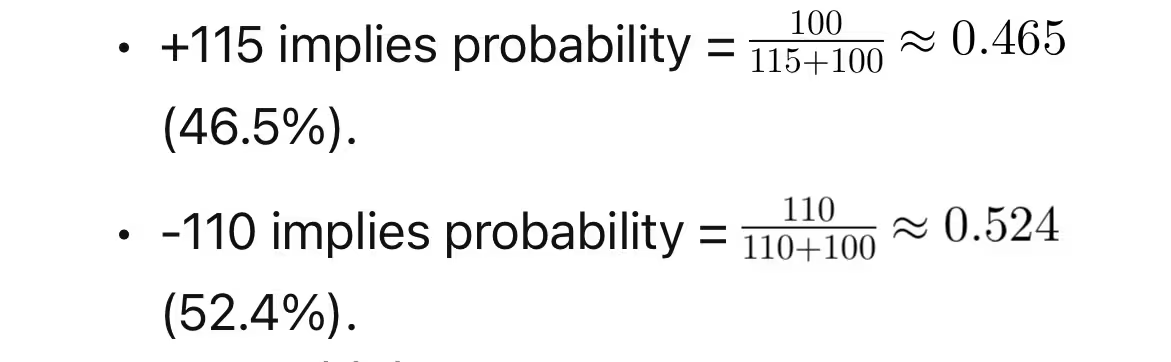
Now you add them: 46.5% + 52.4% = 98.9%. Since 98.9% < 100%, this indeed is an arbitrage situation. (In formula terms, using decimal odds: 1/2.15 + 1/1.91 = 0.989 < 1.) There is roughly a 1.1% profit margin available here.
Decide how much money in total you want to commit to this arb, or alternatively, how much you want each outcome’s payout to be. A lot of arbers choose a target payout for each side, and this makes the math easier. You could aim for each outcome to pay $100 (just as a simple baseline). You can always scale up the stakes proportionally after. For our case, we are gonna target a $100 payout on each outcome.
Using the target payout, calculate the required stake for each side:
- For Team A at +115 (which is 2.15 in decimal odds), to get $100 payout, you’d need to bet roughly $46.51 (because $46.51 * 2.15 ≈ $100). In general, Stake = Target Payout / Decimal Odds. So here: $100 / 2.15 = $46.51.
- For Team B at -110 (1.909 in decimal), to get $100 payout, you need to bet about $52.36 (because $52.36 * 1.909 ≈ $100). Calculated as $100 / 1.909 = $52.36.
If you want to target a certain total stake instead, you can use proportions: bet proportionally to the inverse of odds. But the equal payout method is intuitive!
Now, you verify the outcomes:
- If Team A wins, your Sportsbook 1 bet of $46.51 at +115 returns $100.00 (which includes $53.49 profit plus the $46.51 stake back). You lose your $52.36 bet on Team B, so after the dust settles, you have $100 from A win minus $52.36 lost on B = $47.64 net.
- If Team B wins, your Sportsbook 2 bet of $52.36 at -110 returns about $100 (specifically, it gives $47.64 profit plus $52.36 stake = $100). You lose $46.51 on Team A. You end up with $100 from B win minus $46.51 lost on A = $53.49 net.
In this calculation, the net amounts ($47.64 vs $53.49) are not exactly equal because we rounded to cents and targeted an exact $100 payout for simplicity. The difference between them (about $5.85) is the profit. To be precise, you could aim for both outcomes to net the same profit. To calculate the profit more directly: your total stake outlay was $46.51 + $52.36 = $98.87. And no matter who wins, you get around $100 back. That’s a $1.13 profit on a $98.87 investment, which is about a 1.14% return, and that matches our earlier margin calculation.
You could refine the stakes a little to even out the profit to the cent, but the principle holds: you’d make about $1.13 on ~$98.87 wagered, guaranteed.
You can scale this arb to any level that’s comfortable for you. If you wanted a higher profit, you’d increase the target payout or simply multiply all stakes by a factor. Targeting a $1000 payout on each side would mean betting $465.10 on Team A and $523.60 on Team B (10x the stakes above), yielding about $11.30 profit. Large bets like this can draw attention, so arbers usually hit lots of small arbs rather than one huge arb.
It’s always a good idea to run the numbers through an arbitrage calculator tool, especially if you’re dealing with more than two outcomes or non-standard odds. The calculator will confirm the stake split and profit. In this scenario, an arb calculator would confirm roughly a 1.1% profit and suggest the same stake proportions.
In formula terms, if we generalize for a two-outcome arbitrage:
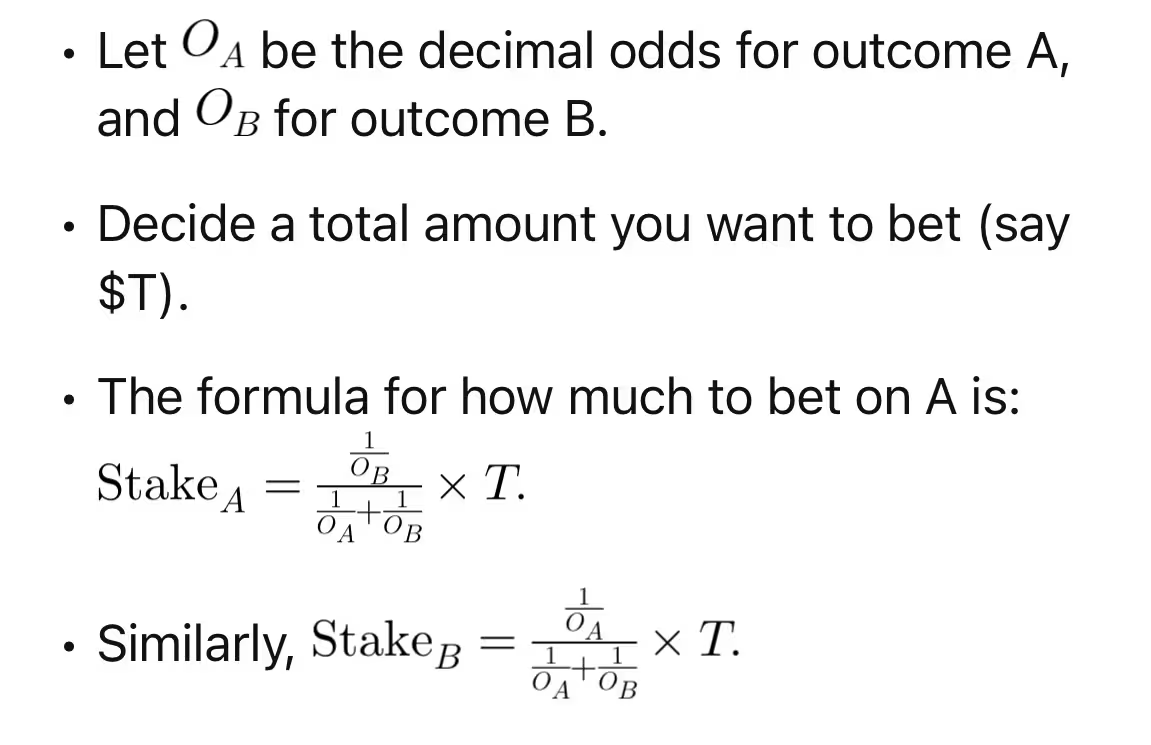
This weights your total bankroll by the inverse of the odds (which correspond to implied probabilities). In our example, O_A = 2.15, O_B = 1.909. So:
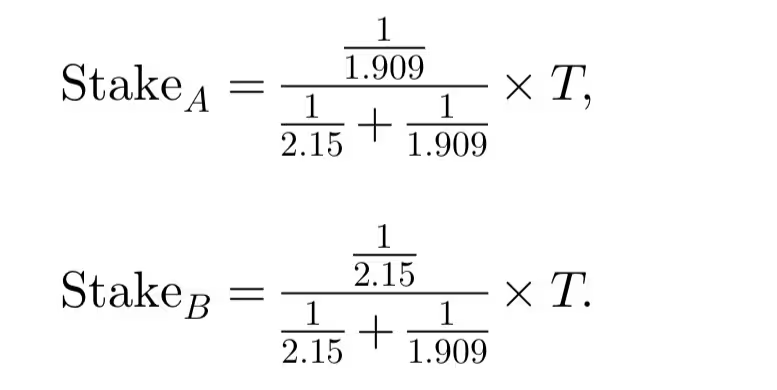
If you plug T = \$100, you’ll get the stakes we calculated manually (approximately $46.5 and $52.4). The beauty of the formula or calculator approach is that it works for any number of outcomes. For three-outcome markets (like 1X2 bets in soccer), you’d ensure 1/O1 + 1/O2 + 1/O3 < 1 and stake proportionally to each inverse odd.
You can use our free arbitrage calculator to do these computations instantly! All you do is input the odds from each book, and it will output the exact stakes for a balanced bet and show your guaranteed profit percentage.
A final tip on calculation is to always account for the possibility of different maximum bet limits or odds changing. If one sportsbook won’t accept the full amount you need to bet for an arb, you’ll have to recalculate based on what you can bet (or skip that arb). And if you place one side of an arb and the other side’s odds move before you can bet it, you must recalculate with the new odds, or you risk breaking the arb.
Real-World Examples Across Sportsbooks
Arbitrage opportunities happen in any sport, at any sportsbook; all it takes is the right circumstances. Below, we’re going to take a look at some examples to show how lines can differ across mainstream sportsbooks and how those differences translate into sure-bet profits.
NHL Total – DraftKings vs BetMGM
Not long ago, an NHL game between the Calgary Flames and Edmonton Oilers presented the perfect arbitrage scenario on the goal total.
- DraftKings had the Over 6.5 goals at -103 odds.
- While at the same time, BetMGM was offering Under 6.5 goals at +110.
The odds imply probabilities of about 50.7% (over) and 47.6% (under), adding up to only 98.3%. That leaves a 1.7% cushion for an arbitrage bettor. If you had $100 to split on this opportunity, the optimal approach was to bet roughly $51.58 on the over at DraftKings and $48.42 on the under at BetMGM. In doing so, you’d guarantee about $1.67 profit no matter if the game went over or under. No matter the outcome, one of your bets wins and returns around $101.67 while the other loses $48.42 (or $51.58), netting that $1.67. This is a small profit (1.67% return on $100), but it was free money for a minute or two until those lines changed. An arb like this is fleeting; maybe one of the books moved to -105/+105 or -110/+110 shortly after, but during that window? Quick bettors could lock in a risk-free win.
NFL Moneyline – FanDuel vs PointsBet vs BetMGM
Arbitrage usually involves only two sportsbooks, but sometimes you can involve three or more to cover all outcomes (especially in three-way markets or when using a combo of moneyline and spread). But sticking to two-book scenarios, think about an NFL game where one sportsbook has the underdog at a generous price and another has the favorite cheaper than usual.
In a past Jets vs Bills matchup, BetMGM’s moneyline on the Buffalo Bills was -300, and FanDuel’s moneyline on the New York Jets was +330. In this case, BetMGM was giving relatively favorable odds on the strong favorite (Bills) and FanDuel was giving extra on the underdog (Jets).
By betting the Bills at -300 on BetMGM and the Jets at +330 on FanDuel for proportional stakes, a bettor could secure around a 1.7% profit on their total wagered amount. About $322.50 on the Bills and $100 on the Jets would yield roughly $430 return in either scenario, netting $7.50 profit on $422.50 that was risked. The biggest-name sportsbooks have differing lines, and in this particular case, a 30-point difference on the underdog price (+300 vs +330), causing an arb.
Cross-Book Middle Turning into an Arb
Sometimes, arbitrage can be found in alternate lines or point spreads across books. An NBA game total where Caesars Sportsbook has Over 210.5 points at +100 (even money) and DraftKings has Under 211.5 points at +100 as a promotional line means that the sportsbooks not only disagree on the price, but also on the number (one offers a line a point higher).
If you bet the over 210.5 and the under 211.5, you’ve actually created a situation where two outcomes are possible:
- If the total lands exactly on 211, you win both bets (a special kind of arbitrage called a middle).
- But even if it doesn’t? You’ve bet over 210.5 and under 211.5 both at +100. The only way to lose money is if the game ends with 211 points exactly, which would push one bet and win the other, and that results in no loss (just returned stake on one side, profit on the other).
This example is a hypothetical (and a true middle rather than a pure arb), it shows how line differences can be exploited. In real arbitrage, you’re usually guaranteeing a profit on all outcomes, but experienced bettors sometimes take the smaller windows where one outcome yields a bigger win (winning both bets) and all other outcomes break even.
Consistent Small Edges Across Sportsbooks
Not all arbitrage bets are as clear-cut as plus vs. plus odds. A lot of the time, your arb will involve taking one side at a plus-odds underdog price and the other side at a slight favorite price.
DraftKings has Team X at +115 and Caesars has Team Y (the opposing team) at -105 for the same game. Team X +115 implies 46.5% and Team Y -105 implies ~51.2%, totaling 97.7%. That’s a 2.3% arbitrage margin. A bettor could put around $49 on Team X and $51 on Team Y to win $105 on either outcome, yielding a ~$5 profit on a $100 bet. The small-margin arbs (well under 3%) are way more common. They might only net a few dollars each, but over time? Even 0.5% or 1% edges can add up with enough volume.
Profitable arbing is all about volume and consistency. You could scour dozens of games to only find a handful of opportunities. But if you can reliably grab a 1-2% return on tens of thousands of dollars worth of bets (spread across many small bets), the profits turn into something tangible. This is why the most successful arbitrage bettors have accounts with as many sportsbooks as possible in their region; when one book’s line is off, you need to be ready to hit it and cover the other side elsewhere!
Risks and Challenges of Arbitrage Betting
Arbitrage betting sure sounds like the holy grail of sports wagering (free money, yay!), but it has its fair share of risks and practical challenges. It is some kind of a get-rich-quick scheme, and it’s definitely not as simple as picking up cash off the sidewalk.
Sportsbooks Don’t Like Arbers (Account Limitations)
The number one issue arbitrage bettors face is that sportsbooks actively discourage this behavior. No, arbing isn’t illegal, but it does hurt the book’s profits, and sportsbooks reserve the right to limit or ban players who consistently exploit arbitrage. If a bookmaker notices that you always beat the closing line or always make bets that guarantee profit elsewhere, they may tag you as a “sharp” or an arber. The consequences can range from reducing the amount you’re allowed to wager (your max bet on a side is $10 when it used to be $1000) to account closure. Sportsbooks see using their odds to guarantee profit as cheating the spirit of the game, and they will cut you off if they detect it.
Market Moves and Execution Risk
An arbitrage opportunity is fleeting; odds can change at any moment, and there’s always a risk that by the time you go to place both of your bets, one of the lines has moved unfavorably. The nightmare scenario for an arber is you successfully bet one side and then the other side’s odds move before you can bet it, wiping out the profit margin or even making the whole thing a loss if you still complete the bet. This execution risk is real: if you’re too slow or the market moves suddenly (maybe due to breaking injury news), you get stuck. And if one sportsbook’s bet fails to go through or is voided (like a game cancellation, or the book voided due to an obvious error), you’ll be left holding an unhedged bet on the other side.
Human Error
The pressure of fast betting means that mistakes happen. Inputting the wrong amount, betting the wrong side, or misunderstanding the odds format can turn a sure profit into a loss. If you accidentally add an extra zero and bet $1,000 instead of $100 on one side, your balance of stakes is ruined. Or if you confuse a team because of similar names or bet an alternate line that wasn’t the one you intended, you might not actually have covered all outcomes correctly. Even if you use calculators, you have to make sure that you copied the odds correctly (American vs decimal, etc.). A small oversight, like forgetting that +115 means you enter 2.15 in decimal, will throw off your math.
Capital Requirements and Bankroll Liquidity
Arbitrage betting is a low-margin, high-volume approach, which means that real profits require larger stakes spread across multiple sportsbooks. If all your money sits in one account, you can’t cover both sides of an arb, so successful bettors keep balances across several books. This ties up capital and requires being okay with funds sitting in different accounts. Constantly moving money isn’t practical; withdrawals can take time, hit limits, or raise red flags with sportsbooks. To make arbing work, you need to have enough bankroll to distribute and the patience to let it sit across platforms until opportunities present themselves.
Geolocation and Account Issues
Sportsbooks in the U.S. are licensed state by state, so you can’t bet both sides of an arb that straddles two states unless you’re physically in both (or have help). Within one state, you’ll usually have enough books to work with, but some bettors are tempted to use multiple accounts or accounts in other names to get around limits. That’s really risky, and sportsbooks run strict KYC checks, share data, and can confiscate funds if they catch duplicate accounts. For casual bettors, it’s smarter to stick to one account per book.
Limits on Promos and Markets
You might not get banned outright, but books can cut your limits where you’ve been arbing, like on niche sports or props, or lock you out of odds boosts. Some will void any bets that they decide were obvious errors, and in rare cases, post “honeypot” lines just to catch out arbers. Even without a hard ban, the more you exploit the markets, the faster a book will make your betting life harder.
Time and Mental Load
Arbing takes away some of the gambling risk but replaces it with stress. Odds change in a blink, bets have to be placed instantly, and juggling accounts across books is a lot of work. You’re not betting for fun anymore; you’re chasing small percentage gains that add up. For some? It’s worth it, but for some, it’ll get old quick.
Advanced Arbitrage Concepts
When you’re arbing, you aren’t limited to betting both sides of a moneyline! Once you’re comfy with the basics? There are some more advanced ways to exploit those mismatched lines.
- Cross-Market Arbs: Sometimes the gap isn’t between two moneylines but between related bets, like a spread on one book and a moneyline on another. If the numbers don’t line up, you can lock in profit by mixing markets.
- Middling vs. Sure Bets: A “middle” happens when you bet both sides of a spread or total at different numbers, creating a sweet spot where both bets win. Unlike classic arbs, it isn’t guaranteed a profit every time, but the payoff can be bigger if you hit the middle.
- Matched Betting: When sportsbooks hand out bonus bets or boosts, you can hedge those promos across books to turn them into real cash. It’s one of the easiest entry points into arbitrage.
- Props and Alt Lines: Books don’t always agree on player props or alternative totals. If one sportsbook prices a player at over 24.5 points and another has under 26.5, you’ve got some room to set up a profitable hedge.
Is Arbitrage Betting Worth It in 2025?
Arbitrage has been part of sports betting for a long time, but the reality in 2025 looks much different from it did when sportsbooks were slower and promos were better. The method still works, but it comes with trade-offs that make it more work than fun.
Pros
- The math guarantees profit when the numbers line up
- It’s systematic and free from the guesswork of handicapping
Cons
- It takes constant monitoring and quick execution for small margins
- Sportsbooks flag arbers and cut limits or ban accounts
- Odds across books sync faster than ever, so opportunities disappear in a moment
Verdict: Arbitrage isn’t dead and gone, but it’s by no means a long-term career either! In the present market, it works best as a side hustle; it’s a way to squeeze steady returns out of your bankroll without gambling on outcomes.
Arbing: Still Worth It or Too Risky?
Is arbing worth it? Sure, if you have the time and dedication! But it’s not gonna make you rich. All you are doing is leveraging mismatched lines here and there for value. For some bettors? It’s a worthy pursuit! But for a lot of us, the effort it demands far outweighs the rewards.
Here’s a quick recap of all things arbing:
- It does work, and the math backs this up
- Success all depends on fast execution, accuracy, and managing your bankroll across multiple sportsbooks
- Small stakes won’t move the needle; scale matters, but limits make that harder
- Think in terms of racking up small but steady returns, not big jackpot wins
- Detailed tracking is a non-negotiable; you have to be and stay organized to catch mistakes and exploit them
Inter Miami CF vs. Seattle Sounders Match Preview & Prediction (September 16, 2025)
Sixteen days after getting absolutely smoked 3-0 by Seattle in the Leagues Cup final and then getting into an all-out ugly brawl after the game, Miami will meet the Sounders again on Tuesday, Sept. 16, at 7:30 pm ET.
Inter Miami gets home pitch advantage at Chase Stadium for the regular-season MLS match and wants to redeem itself after being embarrassed by the Seattle Sounders.
There’s not a trophy at stake for this one, but Miami really needs to win this one after they lost another game 3-0 over the weekend at Charlotte FC; they’ve dropped down to eighth place in the East.
Messi has played every minute of both games and hasn’t scored, which is crazy, and he also missed a penalty kick, which is also crazy; it’s Lionel Messi!
Miami needs these three points for the MLS table and is in damage control mode, and Seattle has been killing it this summer; they’ve only lost one of their last 16 games.
Miami still relies way too heavily on Messi to carry the attack, and without Suárez? They haven’t had any kind of real flow in the final third. Seattle doesn’t force anything; they stay organized, move as a unit, and go for the jugular when their opponents get sloppy.
If Miami doesn’t break through with a lot of control and purpose, Seattle won’t have a problem making them play from behind again.
Keep scrolling for everything you need to know about the game; we’ve got team forms, recent results, head-to-head comparisons, tactical matchups, main players, betting odds, market analysis, and our picks for the four best bets!
Game Details
- Fixture: Inter Miami (13-7-6) vs Seattle Sounders (12-9-7)
- Date & Time: Tuesday, September 16, at 7:30 PM ET
- Venue: Chase Stadium, Fort Lauderdale, Florida
- How to Watch: The game is streaming on MLS Season Pass for Apple TV
Team Form & Recent Results
Miami hasn’t looked great recently, but Seattle has been pretty close to flawless. Here’s a breakdown of both teams’ form and their recent results!

Inter Miami
- Last Match: Miami lost 3-0 to Charlotte; they gave up space between the lines and failed to recover when pushed into transition.
- Recent Pattern: Since the Leagues Cup, players’ performances have lacked consistency across midfield and the back line, and the disjointed play has hurt their ability to control matches.
- Tactical Setback: Since Suárez is suspended, Miami has lost a main option for hold-up play and combo movement, which forces Messi to drop deeper without a reliable central outlet.
- Defensive Record: Miami has allowed goals in 8 of its last 10 matches, and there’s been repeated breakdowns in wide coverage and slow midfield rotation when defending the box.
- Urgency Level: Sitting in eighth place, Miami faces extra pressure at home to stay close to the playoff line before time is up.

Seattle Sounders
- Last Match: Seattle earned a draw against LA Galaxy by controlling possession spells and limiting chances in open play without overcommitting forward.
- Recent Pattern: Their form has stayed steady; they have a clear system that’s built around spacing, rotation, and compact defending through the middle third.
- System Focus: Seattle’s defensive shape is compact, which forces opponents outside and recovers numbers centrally once possession changes.
- Scoring Trends: The Sounders have scored in 9 of their last 10 matches by creating chances via off-ball movement and precise passing in the final third.
- Outlook: With the Leagues Cup in the rearview mirror, the Sounders have continued to approach league matches with structure and control; there’s been no drop in performance levels.
Head-to-Head / Psychological Edge
- Last Meeting: Seattle whooped Miami 3-0 in the Leagues Cup final and did so with a controlled, disciplined performance that exposed the gaps in Miami’s midfield and back line. That loss is no doubt still very much on the minds of Miami’s players (not to mention the fight afterwards).
- Match History: These two clubs haven’t played each other often, but when they have met? Seattle has looked like the more organized and better-prepared team.
- Mental Factor: The weight is all on Miami here. They were outplayed in the last game; they’re at home, and they need this win. Seattle can approach the game with a lot less pressure and stick to their structure.
- Betting Insight: When teams try to force a response, they can leave themselves exposed. Miami has more to prove, but that can backfire if they push too hard too early. Seattle is in the better spot to control the pace and wait for chances.
Tactical Match-Up & Key Players
In this game, the tactics will matter more than the talent on the teams!
Inter Miami
- Shifting Roles in Attack: Without Suárez? Messi is expected to take on more responsibility in both creation and finishing. That means that the midfielders like Busquets and Gressel will need to play more direct, connect lines quickly, and support the front line with better positioning.
- Defensive Concerns: The wide areas are still vulnerable. Miami’s fullbacks have been caught too high on several occasions, which leaves space for opposition wingers to isolate defenders one-on-one or get in behind.
- Player to Watch: Messi’s ability to control the pace in the attacking third and create chances under pressure will be central to Miami’s approach. Without a natural striker next to him, he’ll have to find space and combine quickly to keep Seattle from falling apart in the middle.
Seattle Sounders
- Midfield Advantage: Seattle’s strength lies in how well its midfield handles transitions. They press in coordinated waves and keep possession under pressure, and that helps to limit openings for counter-attacks.
- Wide Play and Transition Threats: Miami’s open spaces on the flanks match up with Seattle’s preferred approach of quick switches and direct runs. This plays directly into the strengths of their wide players.
- Player to Watch: Jordan Morris gives Seattle a reliable outlet in transition. His timing and acceleration on the wing could cause issues for a Miami defense that has looked really disorganized when asked to track runners across space.
Betting Markets & Live Odds
Wanna throw some money on this one? Here are the latest odds and lines via FanDuel! Don’t forget to check them closer to kickoff, as they can and do change!
Moneyline (3-way)
- Inter Miami -105
- Draw +270
- Seattle Sounders +250
Both Teams to Score
- Yes -220
- No +168
Over/Under
- Over 3.5 (+128)
- Under 3.5 (-152)
Betting on Inter Miami vs Seattle? Compare odds, spreads, and props with our top sports betting sites to maximize value.
Analysis of Each Market
- Moneyline: Inter Miami is listed as the narrow favorite, but the line leaves room for Seattle at +250. Given Miami’s recent form and absence of Suárez, the value sits with the visitors if you think that their structure can hang in there for over 90 minutes.
- Totals (Over/Under 3.5): Sportsbooks are expecting fewer goals, and the Under is priced at −152. But the Over at +128 has some appeal, especially considering Miami’s defensive issues and Seattle’s ability to convert in transition.
- BTTS (Yes/No): The Yes side is heavily favored at −220, which lines up with the data. Miami has conceded in eight of its last 10, and Seattle has scored in nine of 10. The likelihood of both sides finding the net? It’s pretty high!
Our Best Bets
We’ve looked at the market, studied the data, and come up with four angles that make the most sense. Here are what we feel are the four best bets!
| Bet | Why Do We Like It? | Confidence Level |
|---|---|---|
Inter Miami -105 | Miami has been strong at Chase Stadium all season, and with Messi back in the lineup, they should have the edge over Seattle, which hasn’t traveled well. | 4/5 (Medium-High) |
Over 3.5 (+128) | Both teams push numbers forward and leave space at the back. If either side scores early, it could turn into a shootout. | 3/5 (Medium) |
BTTS: Yes (−220) | Neither defense has been reliable, and both attacks usually find a way through. Recent matches from each team point strongly to goals both ways. | 4/5 (Medium-High) |
Seattle +0.5 Handicap (Even) | A hedge if Miami underperforms. Seattle has a decent track record of picking up results on the road when they’ve been underestimated. | 3/5 (Medium) |
Value & Risks
- Value Angles: Over 3.5 at +128 comes with a strong upside when you think about Miami’s defensive issues and Seattle’s regular movement in the final third. Seattle moneyline (+240) is a solid play for those backing the more organized side.
- Key Risks: If Seattle scores first, Miami could run into some problems maintaining control without a forward to stretch the defense or relieve pressure on the ball. Seattle has the structure to kill off momentum, slow down attacking buildup, and play the match how they want to.
Miami’s Redemption or Seattle’s Repeat?
Final Score Prediction: Inter Miami 2-1 Seattle Sounders
We are going with Miami to win this one. Why? Because there is no way that Messi will have another game like his last two, it doesn’t make sense to us as rational Messi observers.
And when you add in the last time they played Seattle and factor in the post-game melee? Yeah, Miami is not gonna mess around. Yes, Seattle has been playing really well, but they’re traveling and haven’t had much rest.
There’s a very strong case to be made for goals on both sides, and the BTTS is priced like it’s a foregone conclusion. The BTTS and Over 3.5 combo covers most outcomes if the match opens up. And for those who are fading Miami’s current form, Seattle at +240 is a live underdog that’s definitely worth considering!
Best Bets Recap
- BTTS – Yes (−215): ⭐⭐⭐⭐
- Over 3.5 Total Goals (+132): ⭐⭐⭐
- Seattle Moneyline (+240): ⭐⭐
- BTTS + Over 3.5 (Combo): ⭐⭐⭐⭐
Buccaneers vs. Texans Preview and Prediction for September 15, 2025)
Week 2 of Monday Night Football is here, and who’s on the schedule? That would be the Tampa Bay Buccaneers vs. the Houston Texans.
The Texans are playing host to the Bucs at the NRG Stadium in Houston, and kickoff is at 8:15 pm ET.
The Bucs beat the Atlanta Falcons in Week 1, and they want to bump that number up to 2-0 with a road win. The Texans are 0-1 after losing to the LA Rams in their first regular-season game.
Despite being listed as road underdogs against the defending four-time AFC South champions, the Buccaneers have gotten a lot of backing from national analysts going into the prime-time game!
The Texans want to prove that their young quarterback and defense can back it up in a primetime slot. And the Bucs are out to show the world that their Week 1 win wasn’t a one-off and that Baker Mayfield has total command of the offense.
What do we think? Keep reading for the game details, the latest betting odds, a Week 1 recap, main storylines and matchups we’re watching, team stats comparisons, our picks for the three best bets, and our final score prediction!
Game Details
- Matchup: Tampa Bay Buccaneers (1-0) vs. Houston Texans (0-1)
- Game Details: Monday, September 15 at 8:15 pm ET
- Location: NRG Stadium, Houston, Texas
- How To Watch: Monday Night Football airs on both ESPN and ABC
Betting Odds
Monday Night Football is prime betting time! Look below for the current odds and lines courtesy of DraftKings, but remember to check them closer to game time bc they could move!
| Team | Spread | Moneyline | Total |
|---|---|---|---|
Buccaneers | +2.5 (-112) | +114 | Over 42.5 (-110) |
Texans | -2.5 (-108) | -135 | Under 42.5 (-110) |
Week 1 Recap
Week 1 was good for the Bucs; they left Atlanta with a win. Houston lost what looked like it could’ve been a winnable game to the Rams.
Tampa Bay Buccaneers
- Tampa Bay beat Atlanta 23–20 on the road.
- Baker Mayfield ran a late two-minute drill super cleanly and finished the night off with the game-winning drive.
- Rookie wideout Emeka Egbuka caught two touchdowns and gave the Bucs a downfield target that Atlanta never contained.
- The offensive line allowed constant pressure, the rushing attack stalled out, and Mayfield had to get the ball out quickly to avoid getting sacked.

Houston Texans
- Houston lost 14–9 to the Rams; they didn’t score one TD.
- C.J. Stroud threw underneath most of the game, and he missed chances downfield without Christian Kirk on the field.
- Nick Chubb ripped off a couple of really strong runs, but holding calls erased first downs and killed any progress.
- The defense bottled up the Rams for most of the game, but couldn’t finish drives; they gave up third-down conversions that extended possessions.
- The Texans came away with just field goals; they were undone by penalties, red-zone failures, and a depleted wide receiver group.
Main Storylines & Matchups
Tampa Bay is 1–0 and Houston is 0–1, and this game will show us which team holds it together in certain areas and matchups!
- Baker Mayfield kept the Bucs in control against Atlanta; he relied on rookie Emeka Egbuka as a new primary target. His quick release masked some protection issues, but he’ll need more than a few short throws against a quicker defense.
- C.J. Stroud comes off a bad showing versus the Rams, and since Christian Kirk is out, he has to prove he can move the ball vertically and not let drives sputter out.
- Tampa Bay is relying solely on Egbuka because Chris Godwin is sidelined, and the rookie showed that he can stretch defenses from the get-go.
- Houston’s receiver group is really thin; Nico Collins has to perform as a solid WR1, or the Texans will be stuck again.
- Houston’s offensive line has to deal with Vita Vea collapsing the interior and a Buccaneers front that lives for pressure.
- Tampa Bay’s offensive line had a lot of issues in Week 1 and now has to hold up against Will Anderson Jr. and a Texans pass rush that comes with speed off the edge.
- Penalties cost Houston field position and progress in Week 1. Another sloppy game will set a bad precedent.
- Tampa Bay can’t just go through the motions in the opening quarters again. Forcing Mayfield into performing another late rescue job is not sustainable against better NFL teams.
- The Bucs’ secondary will challenge Stroud if he tries to force throws downfield; they’ll dare him to make tight-window completions.
- Houston’s linebackers have to bottle up Tampa Bay’s backs on checkdowns and in protection, or Mayfield will carve them up from underneath.
Team Statistical Comparisons (Early Season + Trends)
How do Tampa Bay and Houston compare when we look at the early-season stats and trends?
Offense
- Buccaneers: They scored 23 points in Week 1; Baker Mayfield threw for 268 yards and engineered the game-winning drive in the final minutes. Rookie WR Emeka Egbuka hauled in 2 TDs, which immediately changed how defenses have to play Tampa. The ground game produced only 88 yards on 3.1 YPC, leaving them dependent on quick passing.
- Texans: They managed to get 9 points in the opener against the Rams and didn’t score a touchdown. C.J. Stroud finished 19-of-33 for 174 yards with no TDs and was sacked four times. Nick Chubb posted 76 yards on the ground, but holding penalties erased any key gains and shut down drives. Houston went 0-for-3 in the red zone.
Defense
- Buccaneers: Tampa Bay allowed 20 points to Atlanta but shored up late, forcing punts on the Falcons’ last two drives. Vita Vea set the pace inside, and the pass rush produced three sacks. Coverage broke down at times on third down, but tightened up in the fourth quarter.
- Texans: Houston held the Rams to 14 points and only 2-of-11 on third down conversions. Will Anderson Jr. posted 1.5 sacks, and the front seven bottled up the run. But two long Rams drives were enough to win the game, and Houston’s offense just wasn’t able to respond.
ATS / Betting Trends
- Buccaneers: Covered as +3.5 road underdogs in Week 1. Under Todd Bowles, Tampa is 6–2 ATS in its last eight games as a road underdog.
- Texans: Closed as 2.5-point home favorites against the Rams and failed to cover the spread. Houston is now 2–7 ATS in its last nine games when favored by a field goal or less.
Totals
- Buccaneers: Their opener went over the total of 40.5; Mayfield’s late drive pushed the combined score to 43.
- Texans: Their game against the Rams stayed under the 41.5 total, finishing at 23.
- Current Line: The total is 42.5. With Houston scoring only 9 points in Week 1 and Tampa struggling to run, oddsmakers are signaling a matchup where defenses can dictate stretches unless turnovers create short fields.
Prediction Scenarios
Sure, Houston can win this game, but only if Stroud cuts way down on mistakes and Chubb sets up manageable downs. Tampa Bay’s best shot comes from Mayfield keeping the offense on schedule, with the defense and special teams dictating field position. Here are the most liked scenarios we predict will happen:
How the Buccaneers Can Win
- Mayfield has to keep the offense moving by using multiple targets instead of locking onto one receiver.
- Tampa Bay’s defensive front needs to collapse the pocket and take advantage of Houston’s penalty problems.
- Special teams could be the game-changer here if the game comes down to field position and late kicks.
How the Texans Can Win
- C.J. Stroud has to play turnover-free football and get the ball out quickly in order to avoid Tampa Bay’s pass rush.
- Nick Chubb needs to move the chains on the ground to open throwing lanes for intermediate routes.
- The defense must force Mayfield into making mistakes and turn short fields into points.
Our Best Bets & Picks
The line has Houston set as the slight favorites, but Tampa Bay looks undervalued in this spot! Here are the three best bets we’re going with:
| Bet | Why Do We Like It? | Confidence Level |
|---|---|---|
Buccaneers +2.5 (-112) | Houston’s offense looked completely out of sync and is missing a few of its main players. Tampa Bay’s defensive front is built to win up front and keep this inside a field goal. | 7/10 |
Buccaneers +114 | Mayfield is coming off a really strong opener, and Houston’s penalty issues plus receiver injuries make them the vulnerable team in this matchup. | 6/10 |
Over 42.5 (-110) | Tampa Bay has opened up its passing attack, and Houston will have to push the ball through the air with a limited backfield. That combo points toward more points than the market expects. | 6/10 |
Prediction: The Buccaneers Get a Road Win
Final Score Prediction: Tampa Bay Buccaneers 24 – Houston Texans 20
Baker Mayfield delivers more than C.J. Stroud, Tampa Bay’s defense forces two turnovers, and Houston fails to finish drives.
Take the Bucs +2.5, the Over 42.5, and a sprinkle on the ML!
The Bucs will take this one! Houston shot itself in the foot so many times against the Rams; there were penalties, missed chances, and not a reliable receiver in sight except for Nico Collins.
Tampa Bay more than proved they can bring it on the field and close out strong; Baker Mayfield ran the two-minute drill like he is a vet QB.
If Mayfield protects the ball and the Bucs’ front keeps Stroud off kilter? That’s enough of an advantage for them to win.
Taking the points with Tampa Bay at +2.5 makes the most sense, and the moneyline is definitely worth a look if you think Mayfield can outplay Stroud.
The total is 42.5, so this game has a better shot at going over than Houston’s opener. Tampa will push the ball, and the Texans will be forced to throw to keep up with them.
Best Bets Recap
- Bucs +2.5: 7/10 confidence
- Over 42.5: 6/10 confidence
- Bucs ML +114: 5/10 confidence
Betting on Buccaneers vs. Texans this Monday night? Compare spreads, totals, and props with our top sports betting sites to lock in the sharpest odds, maximize value, and bet with confidence on trusted platforms.
Top Heisman Trophy Candidates – And How to Bet Them Smart
Betting on the front-runners for the Heisman is not in the same stadium as betting on the national championship. You don’t only need to choose the right team, which is hard enough.
No, you need the right rookie to stay in the race (and not get injured), rack up a lot of highlight numbers, and win over the voters who care just as much about public narratives as they do stats. It’s part skill, part survival of the fittest, and TBH, part popularity contest. This is why the odds board moves faster here than on most other futures markets!
A quarterback nobody has ever heard of in the preseason can be at the top of the list by the time October is here. And a preseason darling can throw a single ugly pick during Monday Night Football when everyone is watching, blow up his odds.
Then you’ve got injuries, viral plays, and the strength of the schedule to contend with, and all of this is what makes Heisman futures fun: you’re not only betting on the talent, you’re betting on timing, hype, and if a player can keep playing his best football.
Who are the Heisman Trophy candidates for 2025? And how should you bet on them? We’ve got all of the details! We are gonna break down the race into tiers. There are the obvious favs, mid-range options who have a good chance, and the longshots that could surprise us all.
Then we’ll get into how to bet on them without messing up your bankroll, how the market works, why odds move the way they do, and the best strategies. Ready? Let’s go!
How the Heisman Trophy Betting Market Works
The Heisman Trophy is a futures market, aka a long-term wager on who will win the award in December. How does it all work? Look below to find out!
What Are Heisman Futures?
Heisman futures are the bets that are placed on a player to win the Heisman Trophy, and it’s months before the winner is chosen. Sportsbooks post odds for dozens of players in the offseason and update them as the season goes on.
The top favorites will usually have “plus” odds (like +300 or +800), which means a bettor wins more than their stake if the player wins. This shows how difficult it is to predict a single winner out of the entire nation. And betting on a longshot can yield a huge profit if they somehow pull off the victory; for a $100 bet at 50:1 odds returns $5,000 profit if it hits.

Because Heisman futures are long-running bets, your money is tied up for months until the award is announced. Odds can change a lot based on weekly performances, injuries, and narrative momentum. Historically, the opening favorite is never a sure thing, as only 1 of the last 10 preseason favorites ended up winning the Heisman. The unpredictability makes the Heisman futures market really challenging and exciting for bettors!
When Odds Shift
Heisman odds never remain static; they change from week to week as players either bolster or hurt their campaigns. One big performance on a national stage can cause a player’s odds to shorten overnight. In Week 1 of 2025, Utah QB Devon Dampier saw his odds improve from +5000 to +2500 after an amazing debut (293 total yards, 3 TDs). And South Carolina’s QB LaNorris Sellers went from a mid-tier outsider to near the top of the odds after looking like “a certified playmaker” in his first start.
Here are the main things that move the odds:
- Breakout games: A huge statistical game or an upset victory can vault a contender up the odds board in one game.
- Injuries: If a frontrunner gets hurt or underperforms, their odds get longer, and others’ odds improve.
- Media hype: High-profile storylines (like having a famous last name *ahem* Manning, or a two-way star) can shorten odds if the media spotlight intensifies.
- Big matchups: Performance in marquee games (rivalry games, top-25 matchups) has an outsized impact. These “Heisman moments” usually make or break candidacies.
Be ready for a lot of volatility. The early season especially allows for big jumps, as one week’s star can become next week’s betting favorite. Tracking line movement is the most important thing here.
Best Places to Bet
Now, let’s talk about where you should bet! Not all sportsbooks treat futures the same, so it definitely pays to shop around. All major online sportsbooks offer Heisman odds (from preseason through late fall), but the odds vary, so always compare lines across apps to get the best payout.
The most popular and legit sportsbooks for college football futures include FanDuel, DraftKings, BetMGM, and Caesars; each one has a Heisman Trophy market year-round. The best sportsbooks also run promotions for futures bettors, like odds boosts or bonus bet offers for signing up.
Always use a legal and trusted site that has competitive odds and features like cash-out options.
Want to place your Heisman bets? You can check out our Best College Football Betting Sites page for the latest sportsbook offers and to compare odds!
2025 Heisman Trophy Favorites & Smart Betting Tips
The 2025 season is already in motion, and there are some names that have separated themselves from the pack as early favorites in the Heisman race. The players below are a mix of elite talent with team situations that set them up for success and big seasons. Here are the three top contenders (with their current approximate odds) and how to bet on them!
Garrett Nussmeier (LSU) | +800
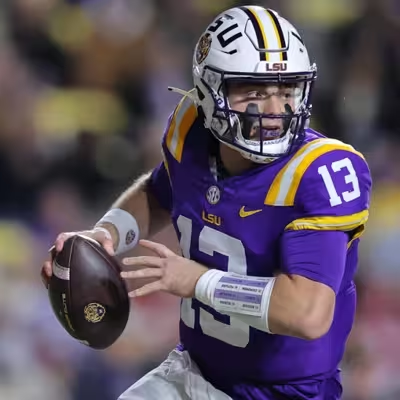
This strong-armed junior has walked into the spotlight as LSU’s new starting quarterback and looks like he’s justified the hype surrounding him.
Nussmeier operates in an explosive LSU offense that led the nation with 45.5 points per game last year, which gives him a platform to put up video-game numbers. He opened the season among the top Heisman candidates and quickly went into pole position after leading LSU to a huge Week 1 win. Bettors are bullish; at BetMGM, he’s currently around +700, making him the national favorite.
- Smart Bet: This is really good value for a preseason front-runner. If you believe in Nussmeier, strike early while his odds are still in the single digits! A strong start in SEC play will likely shrink those odds further, so locking in +700 to +800 now could pay off if he keeps making good. Watch LSU’s big games; if Nuss piles up wins and highlights, you’ll be holding a prime ticket on the favorite.
LaNorris Sellers (South Carolina) | +900
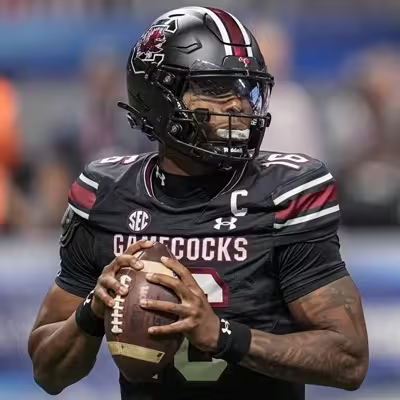
For a player who was pretty much unknown nationally a year ago, Sellers has exploded onto the scene as a dual-threat dynamo for the Gamecocks.
The sophomore’s Week 1 performance turned a lot of heads, as he looked like a certified playmaker who was leading South Carolina’s offense. With a big arm and fast feet, Sellers does his best in a system that lets him improvise and go to work. Sportsbooks noticed and slashed his odds from longshot territory to around +1000, and he’s one of the top three or four favorites now.
- Smart Bet: Consider monitoring his first few games and be ready to jump in if he continues to light it up. If Sellers posts highlight-reel plays through Weeks 1–3, his odds could shorten fast. Right now, he has excellent mid-range value; not as short as the top favorite, but with potentially similar upside. This is a case where a mid-tier preseason bet can turn golden if the hype keeps building. Just be aware that South Carolina’s schedule gets harder later on; ideally, you should grab his odds before any major showcase games that could spike his price are played.
Carson Beck (Miami, FL) | +1200
The transfer portal has given Miami a shot in the arm with Carson Beck under center. The former Georgia quarterback committed to Miami for his final season, and he comes in as a vet with big-game experience (Beck threw for over 7,400 yards as a two-year starter at Georgia, including a playoff run).
Now he has a brand new start with the Hurricanes and a bevy of playmakers at the skill positions. The transfer and Miami’s ACC title aspirations have made Beck a really popular futures pick (around +1100 odds ).
- Smart Bet: One creative approach here would be a correlated parlay, like betting Beck to win the Heisman plus Miami to win the ACC. If Beck excels to Heisman level, Miami will likely have a championship-caliber season in the conference. Parlaying those outcomes boosts your return a ton (just make sure that your sportsbook allows futures parlays). You could also take Beck straight up now if you believe in his talent; his odds could drop if Miami starts strong. But don’t forget that his Heisman case will rely on team success; any misstep in Miami’s record could hurt his chances.
Mid-Tier Heisman Contenders to Watch
Going into the mid-tier contenders, we have some players who could crash the Heisman party. The players currently have odds in the +1400 to +2000 range; they aren’t front-runners, but they are still very much in the hunt if things break right. The smartest bettors know that this tier can produce finalists (or winners) who were under the radar in August. Below are the four names to know and how to bet them!
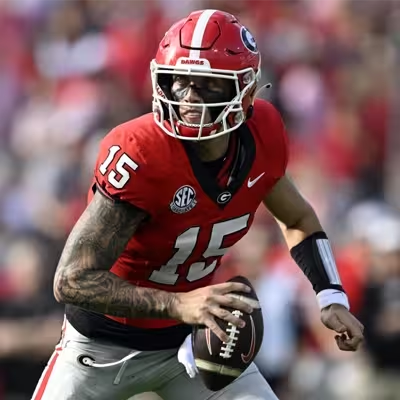
Stepping into the starting role for the back-to-back national champion Georgia Bulldogs, Stockton inherits both huge expectations and an elite supporting cast. The former blue-chip recruit has some pretty big shoes to fill, but he hasn’t wasted any time showing off his potential; in Georgia’s opener, he tallied four touchdowns (2 passing, 2 rushing), and that means he can be the next star in Athens. Georgia’s offense is loaded, and if Stockton does well, he’ll get Heisman talk playing for a top-5 team.
- Smart Bet: Bet early in the season before Georgia’s marquee matchups (like their rivalry games or SEC Championship) when his odds could shorten. Right now, at ~15:1, he’s a solid value play. The rationale for this is that if Georgia keeps winning and Stockton posts gaudy stats, oddsmakers will quickly adjust. By getting in now, you benefit from any “big-stage” bumps later. Watch Georgia’s offense; if they appear more run-heavy or if Stockton is having a hard time, you should hold off. But given the upside? An early small wager is definitely justified.
Yes, there is another Manning, and the last name comes with heaps more pressure in college football. Now at Texas, Arch Manning (the nephew of Peyton and Eli) is navigating sky-high expectations as a former No. 1 recruit.
The media magnetism around him is insane; he opened as a preseason co-favorite around +650 before he even took a snap. But there have been early missteps (like a Week 1 loss where he looked like a human instead of a Manning), which caused his odds to head into the +1300–+1600 range. The volatility shows both the risk and reward of backing Arch. He has immense talent and the Texas brand behind him, but is also inexperienced as a first-time starter.
- Smart Bet: Treat Manning as a high-variance play. One strategy is to wait and only bet after he has a statement win or monster game; sure, the odds will be shorter then, but you’ll have more certainty that he can live up to the hype. And if you bet him early at longer odds, plan a hedging strategy for the late season. If Arch is a finalist, you could hedge by betting on the other top contender to guarantee some profit. Also, given Texas’s move to the SEC, think about pairing an Arch bet with a Texas conference/title future (or playoff future) as a hedge. And if he falls short of the Heisman but the team wins, your other bet could pay off. Manning’s path here is boom-or-bust, so you have to manage your risk accordingly.
This is a name that Oklahoma fans know really well, and Mateer is emerging nationally after taking over the Sooners’ offense. The double-threat junior transferred from Washington State and has already made a big impact at OU. In an early marquee win over Michigan, Mateer showcased his versatility: 270 passing yards plus 74 rushing yards and 2 TDs on the ground. That kind of playmaking ability, when it’s combined with Oklahoma’s perennial contention, gives Mateer real Heisman upside. Sportsbooks had him near the top at +800 after Week 2 (essentially a co-favorite), and that shows his rapid ascent.
- Smart Bet: If you didn’t grab Mateer’s odds in the offseason, you might wait for a short-term dip; maybe he has a quieter game or two, and then bet before a major spotlight game. The annual Red River Rivalry (OU vs Texas) is a mid-season showdown that usually produces a Heisman moment. If Mateer is playing well going into that game, think about betting him before it, as a big performance there could catapult him to front-runner status, shrinking his odds way down. Use the schedule to your advantage: identify a window to buy in, then possibly cash out or hedge later if he’s in the finalist conversation!
A year ago, Klubnik was Clemson’s next big thing, but a turbulent 2024 season (with offensive struggles) killed his hype. Now the talented junior is looking for redemption, and we’ll see how it plays out.
Clemson has reportedly retooled its offense for 2025, and if Klubnik finds his groove, he has the pedigree to get back in the Heisman chatter. He was among the top preseason candidates before, and some sportsbooks still opened him around +900. But bettors got cold feet; after a lackluster opener this year, Klubnik’s odds moved, and he went down on the board of contenders.
- Smart Bet: Do not wager on Klubnik until you see some proof that Clemson’s offense has turned the corner. The first couple of games will be very telling, so watch Clemson’s scoring and Cade’s stat lines. If the Tigers’ new scheme sparks a return to form (like multiple 300+ yard games and big wins), then investing at his longer odds could be smart, as a turnaround narrative could pick up steam. But if the struggles continue, it’s best to steer clear. Klubnik should only be a conditional bet: pull the trigger if early results show there’s been improvement. There’s upside here, but it hinges totally on Clemson’s offensive trajectory.
Value Bets & Potential Breakout Picks
One of the best things about Heisman betting is finding that longer-odds player who could surprise everyone. They are the players outside of the top tier (usually +1800 and above) who have the talent to mount a serious campaign if things go right. They are flying under the radar for now, but a few big games? It could send their stock soaring (and make your longshot ticket super valuable). Let’s take a look at some of the value bets and dark horse candidates, and we also have tips for how to bet them!
It’s really rare for a wide receiver to be a Heisman frontrunner, but this Ohio State freshman is cut from a special cloth. Smith came to Columbus as the nation’s #1 receiver recruit, and he’s wasting no time showing why.
At 6’3″ with game-breaking speed, he’s already making highlight catches that have Buckeye fans (and bettors) talking. Sportsbooks list him around 16:1 to 18:1, which is the highest among non-QBs. Why all of the optimism? Because Ohio State’s offense is a factory for huge receiving numbers, and if Smith puts up big stats, he could follow the path of DeVonta Smith (who won in 2020 as a WR).
- Smart Bet: This is one of the best true longshot values on the board. As a receiver, Smith will need extraordinary performances (like one-handed touchdowns, multiple 200-yard games, viral highlights) to sway voters, but he has that capability. Betting him at +1800 is a bet that he could be the breakout star of 2025. A smart approach is to pair his Heisman bet with Ohio State to win the Big Ten or make the playoff; if Smith is in Heisman contention, Ohio State is probably having a great season, so a conference title bet on OSU leverages that correlation. And Smith has been attracting a lot of early betting action (a sportsbook reported he already accounts for almost 9% of Heisman tickets, which is a top-3 figure). This means that a lot of people believe he’s the rare WR that is worth the risk. If you agree, get the odds before they shorten any further!
Say hello to the freshman phenom who’s generating serious buzz in Gainesville. DJ Lagway was a five-star recruit and, after an injury to Florida’s veteran QB last year, he stepped in and showed his star potential (he set a school passing record in one outing).
Now a sophomore, Lagway is penciled in as the Gators’ starter and already making moves; he won the job with a strong fall camp and has a burgeoning NIL profile to match his talent. His skillset? A huge arm, mobility, and a fearless mentality that’s reminiscent of Tim Tebow’s early days. But since he’s still a young player, consistency is the concern here.
- Smart Bet: Caution and timing are super important with Lagway. Florida opens the season with manageable games, so wait through the first few weeks to see how Lagway performs as “the guy.” If he comes out firing (like 4 TDs, instant highlight plays), his current +2000 odds will probably drop, and you’ll want to grab whatever value is left. If he has a hard time, you should hold off entirely or look for a longer number later. Use the first few games as your litmus test. Lagway has an immense upside, and it’s enough to possibly crash the Heisman party as an underclassman, but with freshmen QBs, volatility is really high. Think about a small bet if he passes the test, and be ready for a week-to-week watch.
A prototypical pro-style quarterback with a rocket arm, Allar is entering his second year as Penn State’s starter and could be ready for a jump. He has the pedigree (he’s a former 5-star recruit) and has shown moments of brilliance as a sophomore.
Now in his junior year, he also benefits from playing behind an elite defense, which means more wins (a 10-2 or 11-1 PSU team would bolster his resume). Through the first few weeks of 2025, Allar has put up good numbers, keeping him in the middle of the Heisman odds pack. The big opportunities for him are ahead on the schedule: showdowns with Michigan and Ohio State.
- Smart Bet: If you like Allar, the strategy is to bet before Penn State’s marquee games. His current 20:1 odds could go up (shrink) if he were to knock off a powerhouse like Ohio State while having a big day. If Allar throws 4 TDs in a win over Michigan, he’d be among the top candidates overnight. When you bet beforehand, you are grabbing the value before the odds react. But if PSU loses those games, Allar’s Heisman hopes likely go away. So this is a boom-or-bust wager that’s tied to a couple of key dates. You could take a wait-and-see approach and only bet Allar if Penn State wins one of those big games and he breaks out, but the odds won’t be as generous. Allar is a calculated gamble, and he’s one that could pay off big if Penn State finally breaks through. If you bet him now, think about hedging later against other top contenders, especially if PSU is still in the hunt late in the season.
Next up, we have a trio of talented quarterbacks in the +2200 range, and each has the potential to post eye-popping stats in 2025. Dampier, Moore, and Arnold are all former highly rated recruits who are now running explosive offenses, which makes them prime “stat monster” candidates!
Devon Dampier (Utah)
A junior who transferred from New Mexico, Dampier has taken the reins of Utah’s offense and immediately impressed. In his first start, he completed 21 of 25 passes and totaled 3 TDs, showing his accuracy and running ability. Utah’s move to the Big 12 has put them in a lot of high-scoring games, and Dampier is capitalizing on it. His Week 1 performance was so good that oddsmakers halved his odds from 50/1 to 25/1, so he could be the most slept-on QB in the country.
Dante Moore (Oregon)
Dante Moore is a former five-star who transferred in and has Oregon’s high-octane offense at his fingertips. Early returns are great; through two weeks, he’s tossed multiple touchdowns and energized the Ducks. Playing in the Pac-12 (which has produced recent Heisman QBs), Moore has more than enough chances for huge stat lines. If Oregon contends for the Pac-12 title and Moore lights up defenses, he’ll get a lot of national love.
Jackson Arnold (Auburn)
Previously an Oklahoma backup, Arnold transferred to Auburn and brought new hope to the Plains. Under coach Hugh Freeze’s quarterback-friendly system, Arnold’s strong arm and mobility are doing really well. In his first start for Auburn, he threw for 300+ yards with a couple of scores, and that validated the offseason hype. Auburn might not be a top SEC team yet, but it will build the offense around Arnold’s skills. If he racks up numbers against SEC defenses, he’ll make his way into the conversation.
- Smart Bet: These three players are in similar boats odds-wise, so the best move is to “sprinkle” small units on each rather than a big bet on one. At ~22:1 odds, a modest bet can give you a nice payout. If you invest a little in all three, you’re diversifying your longshot portfolio and increasing the chance that one of them hits it big. All players have a strong upside: Dampier has the dual-threat wow factor, Moore has the brand-name program and stats, and Arnold has the SEC stage and talent. Hitting on even one of them would more than make up for misses on the others. Or you could pick your favorite of the trio if one situation looks better. But from a value perspective? Spreading out your bets among the high-ceiling longshots is a sound approach. The odds are strong, and you don’t need to wager much to possibly win a lot!
Deep Sleepers Worth a Look
Now it’s time to venture into the real dark horse territory; these are the players with odds in the +2500 to +5000 range (25/1 to 50/1 or more). The names are long shots for a reason, but all of them have a scenario where they could at least enter the Heisman talk. Look at these as the lottery tickets that have a plausible chance of hitting. If you’re the type of bettor who loves to chase after big paydays, here are some deep sleepers that are worth a look!
Julian Sayin (Ohio State): The former five-star who transferred from Alabama. If he wins the Buckeyes’ job and delivers in primetime games against Notre Dame, Penn State, or Michigan? His odds could be cut in half.
CJ Carr (Notre Dame): A redshirt freshman with the name recognition. If Notre Dame opens hot and Carr looks the part, the media attention will follow.
Thomas Castellanos (Florida State): A transfer from Boston College who has FSU’s roster around him, so an early undefeated run would move him from longshot to contender.
- Smart Bet: Small-unit bets only! Each has a shot to surge if September goes their way, but the variance is huge.
Jeremiyah Love (RB, Notre Dame): PFF graded him as one of the top backs in the country last season, and he’s now the Irish feature runner. Running backs hardly ever win, but if ND is a playoff team and Love posts 2,000+ scrimmage yards, he’ll be in the conversation.
Joey Aguilar (QB, Tennessee): The sixth-year senior who transferred through JUCO, App State, and UCLA before landing in Knoxville. Tennessee’s system churns out QB stats; if Aguilar does well and knocks off Georgia or Alabama, his number collapses.
- Smart Bet: Love has the talent to be the rare RB in the race; Aguilar has the system and schedule. Both belong in the “fun flier” category, so don’t overextend on either one of them.
Bryce Underwood (Michigan): The No. 1 recruit in the 2025 class. If Michigan hands him the job and he delivers right away? His price won’t last. Freshman QBs almost never win, but the talent cannot be denied.
Ty Simpson (Alabama): A former five-star who’s waited behind Bryce Young and Jalen Milroe. If he finally starts and Alabama is in contention, the exposure alone gives him a shot.
- Smart Bet: These are all pure hedges. If you’ve already bet a favorite, tossing a small wager here can cover the “what if” scenario of a Michigan freshman or an Alabama starter heating up.
Longshot Lottery Tickets
And now for the ultra-long odds plays. None of them are serious contenders today, but a hot start or a viral moment? They could gain some traction!
- Ryan Williams (WR, Alabama) | +5500: A freshman receiver with huge expectations, but he would need a DeVonta Smith-type season to even get near the ballot.
- Jalon Daniels (QB, Kansas) | +6000: Amazing when he’s healthy, so if he can stay on the field, his numbers could pop, but the team’s record will hold him back.
- Beau Pribula (QB, Missouri) / Josh Hoover (QB, TCU) | +7500: Both quarterbacks play in high-volume passing systems, and the odds show that they get limited national spotlight.
- Demond Williams Jr. (QB, Washington) | +9000: The athletic sophomore is taking over at Washington and will need team success and big stats to be in contention.
- Kaidon Salter (QB, Colorado) | +10000: Salter is a transfer with proven production at Liberty. He’s now under Deion Sanders, but Colorado has to go above and by one expectations.
Smart Bet Tip: Keep these wagers small; they’re best used for parlays or as hedges if you already have a ticket on a front-runner!
Betting Strategy: Maximize Your Heisman ROI
Getting a Heisman pick is a rare thing, but you can make better bets with knowledge about timing, coverage, and using the tools that the sportsbooks already give you!
- Start Early, Cash In Late: Preseason and early-season odds are where the biggest prices live. If your player goes up the board, look at cash-out options or partial hedges before the field narrows.
- Hedge in November: By the last few weeks, the race is usually down to two or three names. If your ticket is still alive, add small bets on the closest challengers so you end December with a profit, no matter who wins!
- Tie Player to Team Futures: Heisman winners almost always come from teams in playoff contention. Pair your bet with a conference title or CFP ticket from the same program to multiply your returns.
- Use Sportsbook Features: Don’t settle for just one sportsbook! Compare odds, take odds boosts when they are offered, and use early cashout or profit-boost promos to squeeze all of the extra value you can from your positions.
The Heisman Hopefuls You Need to Bet On Now
The 2025 Heisman Trophy race has a lot of names on the board, but only a handful of them are worth taking seriously when it comes to betting!
Some players already have odds that show their position, the others are hovering in a no-man’s land middle area where one game can change it all, and then there are the longshots that are only worth pocket-change wagers.
Here’s a quick recap of the names that are either already in the conversation or could be a part of it soon:
- Garrett Nussmeier and LaNorris Sellers are headlining the early Heisman futures board.
- Arch Manning and Carson Beck are priced in the middle tier with upside that is tied to team success.
- Jeremiah Smith and select double-threat QBs have value at longer numbers.
- Time your wagers around marquee games and use hedging if your pick is still alive in November.
- Shop around for the best prices at sportsbooks and take advantage of boosts or cash-out features when they are available!
Philadelphia Eagles vs. Kansas City Chiefs Picks & Prediction (September 14, 2025)
Are you ready for a Super Bowl rematch in Week 2? That’s what you’re getting on Sunday at 4:24 pm ET!
The Philadelphia Eagles are the visiting team at Arrowhead Stadium, and they’ll play what should’ve been Sunday Night Football since they’re playing the Kansas City Chiefs.
The last time they saw each other, Philly annihilated Kansas City’s dreams for a three-peat Super Bowl run. Philly’s record is 1–0, and the Chiefs are in a foreign (to them) place of starting the season 0–1.
What are the books and oddsmakers saying? The general consensus is that Philly has a slight edge in Sunday afternoon’s game.
We’ll get into all of it below, with the latest betting odds, recent form, team momentum, injuries, rosters, matchups to watch, tactical and trend insights, a market breakdown, and our picks for the three best bets!
Game Details
- Matchup: Philadelphia Eagles (1-0) vs. Kansas City Chiefs (0-1)
- Game Details: Sunday, September 14 at 4:25 pm ET
- Location: GEHA Field at Arrowhead Stadium, Kansas City, MO
- How To Watch: Airing on FOX; streaming on NFL+ + or NFL Sunday Ticket for out-of-market fans
- Weather Forecast: Both teams head into Week 2 after contrasting Week 1 performances (the Eagles won, and the Chiefs lost).
Betting Odds
Feeling this one out? Here’s what the odds and lines are according to FanDuel:
| Team | Spread | Moneyline | Total |
|---|---|---|---|
Eagles | -1.5 (-105) | -118 | Over 46.5 (-112) |
Chiefs | +1.5 (-115) | +100 | Under 46.5 (-108) |
Recent Form & Momentum
The Eagles came out of Week 1 looking like the defending champions; Kansas City? Not so much. They lost their first game (unlike them) and are short on receivers this week.

Philadelphia Eagles
- The Eagles beat the Dallas Cowboys 31–10 in Week 1 and were in control of both lines of scrimmage during the game.
- Jalen Hurts completed 19 of 23 passes, rushed for 62 yards, and scored two touchdowns on designed runs.
- The offensive line gave solid and consistent protection so that A.J. Brown and DeVonta Smith had the time and space to win against coverage.
- Jalen Carter pressured the interior while the edge rush collapsed the pocket, and that forced hurried throws and resulted in a turnover from Prescott.
- Philly looked really organized and physical in all three phases; they looked fit and ready.

Kansas City Chiefs
- Kansas City lost 27–24 to the Chargers in Brazil, which marks an unheard-of season-opening defeat in the Mahomes era.
- Patrick Mahomes moved the ball, but he relied heavily on Travis Kelce because Xavier Worthy and Jalen Royals were not available.
- Isiah Pacheco could not establish regular production on the ground, which left the offense one-dimensional and totally reliant on Mahomes to extend plays.
- The defense gave up repeated completions outside the numbers and committed penalties that changed field position at important moments.
- The Chiefs go into Week 2 undermanned at receiver and needing to correct a lot of mistakes against this Eagles roster.
Injuries & Roster Notes
Who’s sitting out and who’s playing? We’ve got it all below:
Eagles
- Tight end Dallas Goedert is out with a knee injury, and that takes out one of Jalen Hurts’ most trusted red-zone targets.
- The defensive backfield is fully available, which gives Philadelphia a chance to load coverage toward Kelce and force Kansas City’s backup receivers to win one-on-one.
Chiefs
- Wideout Rashee Rice is suspended, and rookie Xavier Worthy is out with a shoulder injury, and that leaves Mahomes without two of his top pass-catching threats.
- Travis Kelce is still the focal point of the passing game, but Philadelphia’s defense will bracket him whenever they can.
- The defensive unit is largely intact, but the cornerback group is really vulnerable against size and speed, and that’s a tough ask against A.J. Brown and DeVonta Smith.
Matchups to Watch
We think this game will come down to certain one-on-one battles. Philly’s roster is built to exploit Kansas City’s roster gaps, and Mahomes and Kelce try to fill them in.
- Philadelphia’s corners are super physical and disciplined, and they’ll be up against a Kansas City receiver group that’s without Rashee Rice and Xavier Worthy.
- The Chiefs are stuck with role players who struggled to separate against the Chargers.
- Mahomes will have to create off-script throws to keep drives going, because straight dropbacks? They give their wideouts very little in the way of chances against Slay and Bradberry.
- The Eagles finished third in sacks last season and generated a ton of pressure on 36% of dropbacks in Week 1.
- Kansas City’s tackles allowed multiple hurries against the Chargers, and that forced Mahomes into quick releases.
- If Philadelphia collapses the pocket at a similar rate? Kansas City’s passing attack gets predictable, and Mahomes will be forced into constant second-reaction plays.
Kelce is the one true matchup nightmare left. Expect double teams, bracket coverage, and physical play at the line.
- Kansas City surrendered 4.7 yards per carry to the Chargers in Week 1, especially on inside zone runs.
- Philadelphia’s offensive line created push for 156 rushing yards against Dallas, setting up Hurts on play-action for A.J. Brown and DeVonta Smith.
- Sustaining that ground production at Arrowhead? It shortens the game and cuts Mahomes’ possessions down to eight or nine drives.
Tactical & Trend Insights
- Eagles’ Game Plan: Philly has been at its best when the run game and quick-hitting passes set the pace. Against Kansas City’s depleted receiver corps, the Eagles can push the Chiefs into long-yardage situations and make Mahomes work without reliable wideouts.
- Chiefs’ Bounce-Back Spot: Mahomes is 9–2 ATS coming off a loss, and Andy Reid usually adjusts pretty well after setbacks. We think they’ll be more designed touches for Isiah Pacheco and heavier usage of Kelce in order to stabilize the offense.
- Total Trends: The number sits at 46.5, and recent meetings have leaned toward scoring. But both defenses ranked top 10 in 2024, and Week 2 timing can still favor defenses, and that makes the Under worth a look.
- Arrowhead Impact: Kansas City has covered in 6 of its last 8 prime-time home games. Noise from the crowd regularly pushes false starts and blown protections, and that factor could put a strain on Philadelphia’s line communication.
Betting Market Breakdown
When the lines are this tight, it usually comes down to quarterback play; oddsmakers have given Philadelphia just the teensiest cushion against Mahomes at home!
Point Spread: Eagles -1.5 (-105) / Chiefs +1.5 (-115)
The spread is set just past a pick’em, which signals that sportsbooks expect a one-possession finish. Philadelphia has been given the narrow edge based on roster health and its recent form.
Moneyline: Eagles -116 / Chiefs -102
The prices show very little separation, and Philadelphia has a slight lean. Bettors who are backing Kansas City are essentially betting on Mahomes’ ability to overcome missing wideouts.
Total Points: 46.5 (Over -112 / Under -108)
The number reflects two capable offenses, but also shows a respect for both teams’ defenses. With 46.5 as the midpoint, bettors have to weigh Philadelphia’s ability to generate explosive plays against Kansas City’s history of slowing down games when it plays at home.
Our Best Bets & Predictions
As we said, the market has this game at nearly even, so picking spots is more important than siding with a clear favorite. We narrowed it down to three bets that we have the most faith in based on the matchup and history!
Best Bet #1: Under 46.5 (-108)
Our Confidence Level: High
Why Do We Like It?
Kansas City’s passing attack is missing key receivers, and that forces Mahomes into shorter completions and longer drives. Philadelphia’s defense is built to limit explosive plays, and the Chiefs’ front can slow Philly’s rushing attack in the red zone. That combo points to fewer touchdowns and a scoreline that stays under the posted total.
Best Bet #2: Chiefs +1.5 (-115)
Our Confidence Level: Medium
Why Do We Like It?
Mahomes almost never drops consecutive games, and Andy Reid is known for pivoting after a loss. Arrowhead does tilt games in the Chiefs’ favor, particularly when the crowd noise disrupts protection. Even if Philadelphia controls parts of the matchup? Historically, Kansas City has covered this short number when they play at home.
Best Bet #3 (Prop Angle): Travis Kelce Anytime TD
Our Confidence Level: Medium-High
Why Do We Like It?
Because Rashee Rice is suspended and Xavier Worthy is sidelined, Mahomes’ most dependable option is still Kelce. He owned red-zone looks in Week 1 and will be the go-to target again when Kansas City gets inside the 20. Even against bracket coverage, Mahomes totally trusts him in close spaces, which makes this prop probably one of the safer scoring plays!
What Could Change the Game
There are some scenarios that could change the outcome of this one:
- If one of Kansas City’s backup receivers wins vertically, it forces Philadelphia to adjust its coverage and prevents them from doubling Kelce on every down.
- Arrowhead crowd impact combined with Chris Jones collapsing the interior could possibly disrupt the Eagles’ protections and put Hurts into long-yardage downs.
- Hurts has a history of fumbling when he’s under pressure; if Kansas City creates a turnover in Eagles’ territory, it changes the entire scoring outlook.
- A special teams breakdown or defensive touchdown could decide this game, since both defenses are capable of turning a mistake into points.
A Sorta Super Bowl Rematch: Who Takes It?
Final Score Prediction: Eagles 23 – Chiefs 20
This one belongs to the Eagles! It won’t be a blowout by any means, but Philly has a lot more ways to move the ball, even sans Dallas Goedert, and their front seven is built to push Mahomes off track. Kansas City still runs through Mahomes and Kelce, but its receiver group? They don’t scare anyone.
Both defenses can hold the line, and that’s what makes the total one of the better betting angles for this game. Arrowhead won’t save a team that’s down two wideouts and puts the entire load on Mahomes and Kelce. The Eagles have the stronger lineup across the board, and that’s why they leave KC with the win!
Best Bets Recap
- Under 46.5 (–108): High Confidence
- Chiefs +1.5 (–115): Medium Confidence
- Travis Kelce Anytime TD: Medium-High Confidence
Ready to bet on Eagles vs. Chiefs? Stay ahead by comparing spreads, totals, and props with our top-rated sports betting sites to lock in the best value and boost your edge.
Vanderbilt vs. South Carolina NCAAF Preview & Prediction (September 13, 2025)
Vanderbilt and South Carolina meet again in Columbia for what would be an intriguing encounter, as each team will try to prove its legitimacy. For Vanderbilt, it will be a time to flip the script on South Carolina, and a win here will break South Carolina’s dominance in their previous 5 head-to-head encounters. However, South Carolina’s defense and home crowd energy won’t be a walk in the park, as they are quite capable of keeping Vanderbilt in check.
The game will kick off Saturday, September 13, 2025, at Williams-Brice Stadium in Columbia, SC. Vanderbilt comes into the game after a road win against Virginia Tech and will hope to extend its road dominance in the series. On the other hand, South Carolina hasn’t had any trouble winning at home this year and will push to keep that record on Saturday.
Game Details
- Matchup: Vanderbilt (2-0) vs. South Carolina (2-0)
- Date & Time: Saturday, September 13, at 7:45 p.m. ET
- Venue: Williams-Brice Stadium in Columbia, SC
- How to Watch: SEC Network
The Odds & What They Tell Us (via DraftKings)
| Team | Spread | Moneyline | Total |
|---|---|---|---|
Vanderbilt | +3 (-108) | +124 | Over 48.5 (-110) |
South Carolina | -3 (-112) | -148 | Under 48.5 (-110) |
Ensure you review the odds, as they might get updated.
Interpretation
The odds project a one-possession game, with South Carolina receiving a modest home-field edge. When it comes to the implied win probability, the moneyline pricing suggests that Vanderbilt has about 42%, while South Carolina hovers around 61%. Then, we have the total of 48.5, which indicates that books expect moderate scoring with little to no chance for a shootout or a grind-fest.
We recommend you weigh whether Vanderbilt’s offensive explosiveness outweighs South Carolina’s defensive reliability. This will be a major deciding factor in the game.
Team Overviews

South Carolina Gamecocks
The team goes into week 3 unbeaten. It also handled its first two opponents with balance on both sides of the ball, with the key strengths being its run defense and an experienced offensive line that keeps Sellers upright.
Opponents have struggled to get past 100 rushing yards/game when facing the South Carolina defense. It gets even better with QB LaNorris Sellers’ dual-threat capability, which forces opponents’ defenses to respect both the pass and the run.
While the run defense and QB have been impressive for the team, their inconsistency in the vertical passing game leaves loopholes for opponents to exploit. This inconsistency has made the team rely more on short and intermediate throws. And with a history of letting weaker opponents hang around, Vanderbilt may just flip the game.

Vanderbilt Commodores
Vanderbilt is riding on one of its best starts in recent memory after grabbing a big win against Virginia Tech. The team also defeated Charleston SO a few days before that.
QB Diego Pavia is one player to watch, as he has been dynamic, averaging over 250 passing yards and multiple touchdowns per game. Add that to an offensive lineup that thrives on tempo and creative play-calling, and the Vanderbilt Commodores might just cause an upset in this game.
The Vanderbilt Commodores haven’t been all-stars, though. Their leaky defense gave up chunk plays on the ground early in the season, a weakness South Carolina will likely exploit in this game. The team also had depth and stamina concerns when it faced physical SEC teams on the road.
Head-to-Head & Trends
South Carolina remains the clear favorite when it comes to the head-to-head stats. The team has dominated the series, winning 15 straight meetings against Vanderbilt. It also has a total of 23 victories in its last 25 clashes.
Vanderbilt is 1-1 ATS in 2025, while South Carolina has covered against the spread (ATS) in both games so far this year. As for totals, Vanderbilt’s offensive pace has made its games lean slightly to the “over,” while South Carolina’s games have trended “under,” with the defense setting the tone.
Both teams have conflicting trends, which makes the “total” especially interesting.
Key Players & Matchups to Watch
- LaNorris Sellers (QB, South Carolina): He needs efficiency and ball security to thrive in this game. His team will also have to avoid turnovers when facing Vanderbilt’s opportunistic defense.
- Diego Pavia (QB, Vanderbilt): The Commodores’ success hinges on his ability to hit big plays against SC’s secondary.
- SC Defensive Front vs. Vandy O-Line: Vanderbilt could struggle to sustain drives if South Carolina controls the trenches.
- Explosiveness Factor: The team that creates chunk plays (20+ yard gains) could decide this game.
- Special Teams: Watch out for South Carolina’s reliable kicker as it compares to Vanderbilt’s inconsistency in the kicking game.
What the Numbers Say
- Offense:
- Vanderbilt averages ~34 points per game.
- South Carolina averages ~28 points per game.
- Defense:
- South Carolina allows ~17 points per game, one of the lowest in the SEC so far.
- Vanderbilt has given up ~24 points per game.
- Efficiency:
- SC ranks top-20 nationally in 3rd-down defense.
- Vanderbilt ranks top-25 in passing yards per game but bottom-half in rush defense.
- The current metrics highlight SC’s ability to slow games down while Vanderbilt pushes pace.
Game Flow Predictions
- We expect the game to start slowly as both teams adjust to the loud South Carolina crowd.
- As for the South Carolina team, we expect them to lean on the run game and defense while aiming for the time of possession edge in the game.
- Vanderbilt will try to break the slow pace for a fast tempo and also test SC’s secondary with deep shots.
- Swing factors
- Vanderbilt can push late in the game if Pavia avoids turnovers.
- The South Carolina team can grind out a cover if it establishes ground dominance.
Best Bets & Confidence Levels
| Bet | Why It Makes Sense | Confidence Level |
|---|---|---|
South Carolina −3 (-112) | Small number at home, defensive edge, historical dominance in series. | Medium-High |
Vanderbilt +124 | The bet has a strong value if Pavia’s offense catches fire. SC is also vulnerable to explosive plays. | Medium |
Under 48.5 (-110) | Both teams’ defenses are solid, and their historical matchups have been lower scoring. But note that the public will likely lean over. | Medium |
Can Vanderbilt Break the Streak?
South Carolina has the defensive strength and the home-field advantage that tilts the spread slightly in their favor. However, Vanderbilt’s offense carries upset potential, with turnovers being its major risk.
Our best value is to go with South Carolina -3 and Under 48.5. But if you want to chase plus-money, you can consider the Vanderbilt moneyline for a live dog play.
Overall, we expect a defensive-driven game from both teams. But there’s potential for one or two explosive plays to be the game’s decider.
Final Score Prediction: South Carolina 24, Vanderbilt 20
The game will be a tight contest, but SC’s defense and home edge get them the win and cover.
Betting on Vanderbilt vs. South Carolina? Don’t just settle for the first line you see—compare odds, find the sharpest value, and bet smarter with our football betting guide, where we highlight trusted sportsbooks and strategies for every matchup.
Canelo Alvarez vs. Terence Crawford Betting Preview (Sept 13, 2025)
Vegas is primed for the fight of the year. Maybe even the decade! On Saturday night (Sept. 13), Saul “Canelo” Alvarez and Terence Crawford will get into the ring and fight it out. Literally.
We’re only a couple of days out from one of boxing’s biggest and most touted dates that boxing fans have been waiting for, and they’ll be jabbing it out while the world watches on Netflix.
Alvarez is putting his undisputed super middleweight titles on the line against Crawford for this one, and that’s no small potatoes.
Alvarez (63-2-2, 39 KOs) is a two-time undisputed champ at 168, the man who’s collected the WBA, WBC, WBO, and IBF more than once. At 35, he is still the sport’s biggest draw, with belts in four weight classes and a No. 8 pound-for-pound spot in Uncrowned’s latest rankings.
38-year-old Crawford is taking a huge gamble by moving up three whole weight divisions, which is nuts and something that most fighters wouldn’t even consider.
Will Canelo defend his undisputed legacy, or could Crawford take him down? If he does, he’d be the GOAT, at least for the night.
Keep scrolling to see the fight details, both boxers’ profiles and recent form, the latest betting odds, a tactical breakdown, our picks for the three best bets, and a bonus value play!
Fight Overview
- Fight Date & Venue:Saturday, Sept. 13 at Allegiant Stadium in Las Vegas. There is a huge crowd expected to attend; the house will be full to capacity.
- Main Card Start Time: 9 p.m. ET / 6 p.m. PT.
- How to Watch: Streaming live worldwide on Netflix (it’s included with a membership; there’s no PPV fee).
- Titles at Stake: Canelo’s undisputed super middleweight titles; WBA, WBC, IBF, WBO, plus The Ring and TBRB.
- Crawford’s Shot at History: He’s trying to become the first male boxer to be undisputed in three different weight divisions.
- Cultural & Historical Stakes: Mexico’s biggest current fighter against America’s unbeaten technician; it’s being billed as a “passing of the torch” fight, with echoes of Mayweather–Pacquiao and Leonard–Hagler.
- Financial Stakes: A custom $200,000 Ring Magazine belt and projected nine-figure paydays for both fighters.
Fighters’ Profiles & Recent Form
Alvarez enters the ring as the established power at super middleweight, and Crawford has the timing, versatility, and an unbeaten record. One relies on physical strength and body work; the other on precision and adjustments. That contrast in styles? It’s why this fight has been on our calendars for months!
Canelo Alvarez
Record: 63-2-2 (39 KOs)

Strengths
Alvarez is a pressure fighter who builds his game from the body up. His left hook downstairs is a fight-changer, and he mixes it with uppercuts when opponents duck to protect the midsection. He doesn’t smother his work; no, he steps into range deliberately, with short combinations that are meant to sap energy over rounds instead of overwhelming in quick bursts. His ability to absorb hits means he is able to take calculated risks and stay in the pocket longer than most. Against big punchers, slick movers, or brawlers, he’s logged enough rounds to know what works and when.
Concerns
Where Canelo can be touched is against opponents who stick behind a jab and just won’t stand still. Bivol exposed that by keeping him outside, and Mayweather did it years earlier by forcing him to reach. At 35, he isn’t closing distance quite as well, and that could leave him running around after a quicker opponent like Crawford and eating counters on the way in.
Terence Crawford
Record: 41-0 (31 KOs)
Strengths
Crawford’s biggest edge is his uncanny ability to adapt. He goes from orthodox to southpaw, and it’s not for show; it’s to force his opponents into making mistakes that they don’t ever see coming. His counters are precise; he draws a lead, then cracks back with timing instead of with raw speed. He’s really patient in the opening rounds; he’s collecting reads. Then he ramps up the pressure once he has the pace. His balance between power and accuracy makes him a threat at any and all distances. It doesn’t matter if he’s stepping back with a check hook or walking an opponent onto a straight shot.
Concerns
The real unknown here is how Crawford’s power will translate. At welterweight, his shots forced opponents to reset and think twice. At 168? He’s up against a fighter who’s proven he can take punches from natural super middleweights. If Canelo gets through those counters unfazed, Crawford will need to win rounds with accuracy, footwork, and ring generalship instead of stopping power. That’s an entirely different type of fight, and it’s one that plays into Canelo’s experience over 12 rounds.
Betting Market & Odds
Betting on fight night? We’ve got the latest odds and lines courtesy of DraftKings:
- Moneyline
- Canelo -175 (he’s the sportsbooks’ favorite)
- Crawford +140 (the underdog with pull from late bettors)
- Total Rounds
- Over 10.5: -475 (the market expects it to go the full distance)
- Under 10.5: +300 (the stoppage angle is priced long)
- Method of Victory
- Canelo by Decision: +125
- Canelo by KO/TKO: +380
- Crawford by Decision: +210
- Crawford by KO/TKO: +850
- Draw: +1200
Line Movement Insight
- Early money has gone toward Canelo
- Public action late has tightened Crawford’s number
- The heavy protection on Over 10.5 signals there’s a high expectation of a 12-round fight
Tactical Breakdown
The proven size and strength of Alvarez against the precision and adaptability of Crawford? How the differences hit over 12 rounds will obviously matter for who’s arm is lifted at the end (or who’s still standing). Let’s do a tactical breakdown of both fighters:
- Alvarez is a natural super middleweight, proven at 168.
- Crawford is moving up from 147, so he’s an unknown entity at this weight.
- Alvarez will press forward, look to the body early, and try to tire out Crawford’s legs.
- Crawford will circle, change up his stances, and look for windows to counter.
- Alvarez has shown signs of slowing if he’s forced to walk down his opponents in the later rounds.
- Crawford tends to build as fights go long, and a lot of his stoppages come after round seven.
- Vegas judges usually reward forward momentum and aggression.
- That scoring tendency? It could favor Alvarez in any close rounds.
- No one knows if Crawford’s durability carries against a natural 168-pound puncher, but we’ll find out!
- Alvarez’s ability to cut the ring against one of boxing’s best movers could decide it all.
Our Best Bets
This matchup is priced like it’ll be a twelve-rounder, but the props still leave some room for plays on style and judging trends! Here’s where we think the best value is:
| Bet | Confidence Level | Why Do We Like It? |
|---|---|---|
Crawford by Decision | 7/10 | This is hands-down the best value play. His style is built for winning rounds; he has sharp counters, ring control, and a steady output across 12 rounds. |
Over 10.5 Rounds | 8/10 | Both men are hard to crack and really skilled at limiting their mistakes. Everything we’ve seen so far points to the judges deciding it. |
Canelo by Decision +125 | 6/10 | In close rounds, Vegas judges have a track record of favoring pressure. That’ll lean toward Canelo if the fight is close. |
Sprinkle: Canelo by KO/TKO | 4/10 | This is a long-shot angle. If his body work wears Crawford down, there’s a chance he forces a stoppage in a late round. |
What to Bet Before the Bell Rings
Our Final Prediction: Crawford wins by split decision (115-113, 114-114, 115-113).
The judges may give the winner a belt, but not everyone will buy it. There are always a ton of hot and controversial takes when the decision-makers sitting ringside call it!
Alvarez ducks under the ropes with the belts, the size, and the track record at 168. Crawford is the mystery factor; he has no losses, no blueprint at this level, but he also has zero experience at this weight division. Oddsmakers have made Alvarez the safer side, but bettors seem like they’re willing to test Crawford’s number as the week goes on. The only thing most everyone agrees on? The fight is destined to go long, and the judges will probably have the final say!
- Canelo: He has the size, body work, and a possible judging advantage.
- Crawford: He has the skill, adaptability, and he hasn’t been beaten yet.
- The odds have favored Alvarez, but late betting has pulled some action to Crawford’s side.
- Most likely scenario: A 12-round tactical fight that’s settled on the cards.
- Best angle: Decision markets tied with Over 10.5 rounds.
Best Bets Recap
- Crawford by Decision +200: (7/10)
- Over 10.5 Rounds -475: (8/10)
- Canelo by Decision +125: (6/10)
- Sprinkle: Canelo by KO/TKO +380: (4/10)
Don’t miss the action! Bet smarter on Canelo vs. Crawford with the best boxing betting apps offering sharp odds and exclusive features.
Seattle Sounders vs. LA Galaxy Prediction & Match Preview (September 13, 2025)
The MLS season is heating up, and Saturday night brings us one of the league’s classic matchups as the Seattle Sounders host the LA Galaxy at Lumen Field. On the surface, this looks like a straightforward contest — Seattle enter as heavy −230 favorites on ESPN BET, while the Galaxy sit at +550 as massive underdogs. But as any sharp bettor knows, big lines always deserve a closer look.
Seattle have made their home stadium a fortress once again, combining efficient attack with one of the league’s stingiest home defenses. Meanwhile, the Galaxy have endured a nightmare road campaign, still searching for their first away win of the season. History hasn’t been kind to LA in the Pacific Northwest either, as victories in Seattle have been rare.
The oddsmakers may be leaning hard toward the Sounders, but the real betting value comes in the secondary markets — spreads, totals, and both-teams-to-score props. Let’s break this matchup down and find the best angles for your bankroll.
Match Details & Betting Odds
- Match: Seattle Sounders vs. LA Galaxy
- Date: Saturday, September 13, 2025
- Venue: Lumen Field, Seattle, WA
- Kickoff: 8:30 PM EDT
- Odds via ESPN BET:
- Moneyline: Seattle −230 | Draw +400 | LA Galaxy +550
- Both Teams to Score (BTTS): Yes (−135) | No (+105)
- Total Goals (O/U 3.5): Over +120 | Under −160
- Spread: Seattle −1.5 (+105) | LA Galaxy +1.5 (+140)
These numbers tell us oddsmakers like ESPN BET give Seattle around a 69% implied chance of winning, while the Galaxy are given just a 15% shot of pulling off the upset. The question for us as bettors is whether the value lies in the obvious Seattle play, or in secondary markets where the edge might be sharper.
Seattle Sounders: Fortress at Home
The Seattle Sounders have built their reputation on being one of the most reliable home sides in MLS, and 2025 has only strengthened that narrative. Lumen Field continues to function as a true fortress, where opponents rarely leave with points and often struggle just to create quality chances.
Seattle’s home dominance comes down to a mix of tactical discipline, attacking depth, and crowd energy that fuels their intensity for a full 90 minutes. The Sounders average over two goals per game at home while conceding fewer than one on average, a combination that makes them one of the league’s most balanced clubs.
For bettors, the Sounders’ ability to consistently handle business at home is key. They don’t just win outright; they often cover spreads and deliver value across multiple markets. Consider these patterns at Lumen Field this season:
- High scoring: Seattle have scored multiple goals in the majority of home games.
- Spread success: When they win, they often do so by 2+ goals, cashing −1.5 tickets.
- Tight defense: Few teams manage more than a single goal against them in Seattle.
- Consistent tempo control: They dictate possession, limiting opponents’ ability to counter.
This combination of offensive firepower and defensive discipline is why betting against Seattle at home feels like throwing money away. They don’t just win at Lumen Field — they do it in a way that consistently rewards bettors who back them.
LA Galaxy: Road Woes Continue

If the Seattle Sounders’ dominance at home is one of MLS’s sure things, the LA Galaxy’s road struggles are the other. Their 2025 campaign has been defined by an inability to pick up points away from Dignity Health Sports Park, and the numbers paint an ugly picture. The Galaxy remain winless on the road (0-9-6) this season — one of the worst away records in the league.
The issues start at the back. Defensive lapses have plagued them all year, with the Galaxy conceding nearly two goals per game when playing away from home. Their back line often struggles with organization, particularly under pressure from set pieces or quick counter-attacks.
Offensively, it hasn’t been much better. While their Designated Players provide occasional moments of brilliance, the Galaxy are averaging under one goal per away match, rarely stringing together enough consistent attacking phases to threaten for 90 minutes.
For bettors, these trends matter because they highlight just how unreliable the Galaxy are on the road. Key patterns include:
- Winless streak: Zero road victories all season.
- Leaky defense: Averaging ~2 goals conceded per away game.
- Lack of firepower: Fewer than 1 goal scored per away match.
- Poor spread record: Struggle to cover +1.5 against strong opponents.
Simply put, the Galaxy don’t just lose on the road — they lose in ways that regularly cash tickets for those betting against them.
Head-to-Head / Historical Context
The Seattle Sounders and LA Galaxy are two of MLS’s most storied franchises, and their clashes have always carried extra weight. These are clubs with championship pedigrees and large fanbases, and whenever they meet, it feels like more than just another regular season match. But while the rivalry has seen its share of back-and-forth battles over the years, recent history has tilted strongly in Seattle’s favor.
Over the last few seasons, the Sounders have asserted themselves as the more consistent side, particularly at Lumen Field where the Galaxy’s struggles have been glaring. When evaluating this fixture from a betting standpoint, the head-to-head numbers underline why oddsmakers lean so heavily toward Seattle.
Key trends to note in this matchup:
- Recent Form: Seattle have won 3 of the last 5 meetings; LA Galaxy have managed just 1 win in that span.
- Scoring Trends: Over 2.5 goals has hit in 3 of the last 5 head-to-head clashes.
- Home Advantage: Galaxy haven’t beaten the Sounders at Lumen Field in several seasons.
- Margins of Victory: Seattle’s home wins over LA often come by multiple goals, reflecting the betting value in the spread.
- BTTS Patterns: Both teams have scored in 4 of the last 6 meetings, a trend bettors should consider.
History suggests Seattle’s home edge isn’t just narrative — it’s a consistent, profitable angle.
Tactical Breakdown / Players to Watch
When two clubs with as much history as Seattle and LA meet, the game isn’t just about star names — it’s about tactical execution. From a betting standpoint, understanding how each side approaches matches helps us gauge the likelihood of spreads, totals, and props hitting.
Seattle Sounders
Seattle’s tactical identity revolves around balance: they’re structured defensively but sharp in transition, with enough attacking depth to hurt teams in different ways. Playing at Lumen Field, they usually dictate possession and force opponents into uncomfortable defensive shapes.
Key tactical strengths and players to watch:
- High Press & Possession Control: Seattle pressure early to force mistakes and dominate the midfield battle.
- Star Forward: Their leading striker is in form, providing pace and finishing that stretches defenses.
- Creative Midfield Engine: The playmaker orchestrates tempo, ranking near the top of MLS in key passes and chance creation.
- Set-Piece Execution: Seattle regularly capitalize on corners and free kicks, giving them multiple scoring avenues.
LA Galaxy
The Galaxy’s tactics shift significantly away from home. Instead of controlling games, they’re often reactive, sitting deeper and looking to counter. While their Designated Players can provide flashes of quality, their overall system often breaks down defensively under pressure.
Key tactical factors and players to watch:
- Counter-Attacking Threats: Quick winger play offers their best route to goal.
- DP Striker: Dangerous in isolation, capable of finishing half-chances.
- Creative Winger: Inconsistent but able to create moments of magic.
- Defensive Weakness: Organization in the back line is poor, leaving gaps that disciplined sides like Seattle exploit.
This tactical matchup strongly favors Seattle, but bettors should note that Galaxy’s counter-attacks and individual talent could still influence BTTS and Over/Under markets.
Key Betting Angles & Insights
The raw moneyline odds tell the story: Seattle are overwhelming favorites at −230, while the Galaxy are priced as a longshot at +550. But for sharp bettors, the moneyline is often just the starting point. The real value comes from digging into alternative markets like spreads, totals, and BTTS (both teams to score). Here’s how this matchup breaks down:
1. Seattle Moneyline (−230)
- A safe play but steep juice — not much standalone value.
- Best used as a parlay anchor if tying together multiple MLS or weekend bets.
- Backed by Seattle’s near-perfect home record and LA’s road futility.
2. Spread: Seattle −1.5 (+105)
- Solid plus-money value given the Sounders’ tendency to win comfortably at home.
- Galaxy have lost by 2+ goals in several away matches this season.
- A riskier play but higher payout potential than the straight moneyline.
3. Total Goals (O/U 3.5)
- Under 3.5 (−160) looks sharp: Seattle often manage games once ahead.
- Galaxy’s lack of firepower away makes a 2-0 or 2-1 type game more realistic.
- Over 3.5 (+120) is only worth a small sprinkle if expecting Galaxy to open up.
4. Both Teams to Score (BTTS)
- Yes (−135): Galaxy have scored in 5 of their last 7 games despite losing.
- No (+105): If Seattle clamp down early, a clean sheet is very possible.
These angles show that while the moneyline is almost a lock, the spread and totals markets are where bettors can find real edges.
Best Bets & Predictions
This matchup sets up beautifully for bettors because the odds reflect not just current form, but season-long trends that have been extremely consistent. Here’s how the top betting opportunities line up:
1. Seattle to Win (−230)
This is the foundation bet for this matchup. The Sounders haven’t just been good at home this year — they’ve been dominant. They’ve dropped points at Lumen Field only a handful of times, and against a Galaxy side that hasn’t won on the road all season, the probability of a Seattle win shoots even higher than the implied 69%. In betting terms, you’re laying juice, but you’re also buying reliability. The Galaxy don’t travel well, and Seattle feed off their home crowd, making this as close to a “banker” as MLS offers.
- Confidence Level: 9/10
- Best Use: As a parlay anchor tied with another MLS or NFL play to trim the juice.
2. Seattle −1.5 (+105)
This is where the value lies. The Galaxy rarely lose by just one on the road — their defensive frailties mean once they concede, the floodgates tend to open. Seattle’s balanced attack also makes this spread attractive: they don’t rely on one scorer, so even if the Galaxy key in on their striker, the Sounders have midfielders and wingers who can step up. Historically, when these teams meet in Seattle, the Sounders often win by multiple goals. With plus money attached, this is the sharpest straight bet on the board.
- Confidence Level: 7/10
- Why It Matters: If you’re backing the Sounders, betting the spread pays you more for the same logic.
3. Under 3.5 Goals (−160)
At first glance, Seattle’s strong home attack might suggest goals galore. But here’s the nuance: once the Sounders get ahead, they manage games pragmatically. They don’t chase style points — they shut the door, rotate possession, and see the match out. Add in the Galaxy’s lack of consistent scoring on the road (under 1 goal per away game), and it’s hard to see this turning into a 4–2 shootout. The most realistic paths are 2–0, 2–1, or 3–0. The under isn’t flashy, but it aligns with both teams’ trends.
- Confidence Level: 6.5/10
- Key Angle: This is a play for bettors who prefer lower-risk, grind-it-out wins.
4. Both Teams to Score – Yes (−135)
This is the trickiest market, but it deserves attention. Despite their dreadful road record, the Galaxy have scored in 5 of their last 7 matches. Their DP striker has a knack for finding half-chances, and if Seattle push their line high, a quick counter could burn them. That said, betting BTTS is more about trusting patterns than trusting the Galaxy’s form. Seattle do occasionally concede soft goals at home — especially once they’re up by two and their defensive intensity drops. If you’re playing BTTS, the handicapper’s angle is betting on a “consolation goal” for LA rather than them truly competing.
- Confidence Level: 6/10
- Best Scenario: Galaxy sneak one late after Seattle already lead comfortably.
Whether you’re looking to just place a bet on this game or combine one of these bets into a parlay with others, we would suggest doing it at one of the recommended soccer betting apps. This will ensure you get the best odds and that you get paid our your winnings quickly.
Best Bets by Tier
🟩 Safe Plays (Bankroll Builders)
These are bets with high reliability, perfect for cautious bettors or for anchoring parlays.
- Seattle to Win (−230)
- Home dominance + LA’s winless road record = one of the most dependable spots on the MLS board.
- Not much payout as a solo wager, but rock solid for parlays with NFL/college football this weekend.
- Under 3.5 Goals (−160)
- Matches involving the Galaxy away from home rarely turn into shootouts.
- Most likely scorelines: 2–0, 2–1, 3–0.
🟨 Value Plays (Sharper Angles)
These carry slightly more risk but align with statistical and tactical trends that suggest plus-money opportunity.
- Seattle −1.5 (+105)
- Seattle’s home wins often come by multiple goals.
- The Galaxy have lost by 2+ goals in several away fixtures.
- The plus price adds real betting value.
🟥 Risk-Reward Plays (For Action Bettors)
High-variance bets that can cash if the match script tilts a certain way.
- Both Teams to Score – Yes (−135)
- Galaxy may not be winning, but they’ve still managed to score in 5 of their last 7.
- Most realistic path: Seattle go up 2–0, and LA find a late goal.
- Over 3.5 Goals (+120)(sprinkle only)
- Contrarian play if you expect Seattle to blow the doors off and Galaxy to grab one.
- Only worth a small bet since both teams’ trends lean under.
✅ Handicapper’s Final Card
- Safe Bankroll Plays: Seattle ML, Under 3.5
- Best Value Bet: Seattle −1.5
- Fun Action Bet: BTTS Yes
Final Whistle: Seattle Keeps Lumen Locked Down
Seattle vs. LA Galaxy is one of MLS’s most storied matchups, but at this stage of the 2025 season, the gap between these clubs couldn’t be clearer. Seattle’s fortress at Lumen Field, paired with the Galaxy’s dreadful 0-9-6 road record, makes the Sounders the right side from every angle.
For bettors, though, the moneyline alone isn’t where the best value lies. The spread and totals markets offer sharper plays that match recent trends and season-long performance. Seattle’s balance in attack and control at home should see them win comfortably, while LA’s only realistic path to scoring is through a late counter or set piece.
Key Takeaways:
- Seattle ML is safe, but best used in parlays.
- Seattle −1.5 is the top value play.
- Under 3.5 fits the most likely score script.
- BTTS Yes is live if LA find a consolation goal.
Final Score Prediction: Seattle Sounders 2 – 1 LA Galaxy
Colorado Buffaloes vs. Houston Cougars NCAAF Prediction (September 12, 2025)
The Colorado Buffaloes are currently 1-1 on the year, after rebounding from an initial loss to Georgia Tech to secure a win against Delaware. For this match, they’ll be on the road to face the Houston Cougars, who are 2-0 on the year after their first two games. The Houston Cougars will hope to solidify their strong start and defend their home turf. For Colorado, it will be a test to prove how capable they are on the road.
Popular betting lines put the Houston Cougars as the favorites with -3.5, and the total is set at 44.5. We expect both teams to rely heavily on their defenses. As such, it will likely be a low-scoring game, but expect a few notable momentum swings along the way.
It’s up to the Colorado Buffaloes to pull the upset on this one. On the other hand, Houston’s run game and defense have been impressive, indicating a tough time for Colorado. Let’s explore further to see how the teams’ strengths and weaknesses match up against each other.
Game Details
- Matchup: Colorado Buffaloes (1-1) vs. Houston Cougars (2-0)
- Date: Friday, September 12, 2025
- Location: TDECU Stadium, Houston, TX
- Kickoff Time: 7:30 PM EST
- Broadcast: ESPN / ESPN+
- Matchup Note: This game will be the first non-conference meeting in several years. As such, bettors will have a rare cross-conference clash.
Odds Snapshots (FanDuel)
- Spread: Colorado +4.5 (-110) | Houston -4.5 (-110)
- Moneyline: Colorado +162 | Houston -196
- Total (O/U): Over 44.5 (-115) | Under 44.5 (-105)
Note that odds may shift before the kickoff. Hence, we recommend you check the sportsbook links for the latest odds betting.
Team Overviews
Colorado Buffaloes

While the team has an established reputation for explosive plays, it sometimes fails to sustain drives. They’ll have to come with their A game if they want to bust Houston’s strong run defense.
The offense also relies heavily on the quarterback play to open up its passing game. Any lapses on his end will likely be a swing factor in this game. Add that to an offensive line that hasn’t fared well against strong defensive fronts, and the Colorado Buffaloes have their work cut out for them in this game.
On the defensive front, the Buffaloes have an opportunistic secondary that thrives on interceptions. However, they show visible struggles in the trenches when faced with strong rushing attacks. The Red Zone defense is also middle of the pack.
When it comes to trends, Colorado has shown impressive performance when they are the underdogs. Their road performance recently has also been poor, a key hurdle that might haunt them in this game.
Houston Cougars

The Cougars have an offense that has perfected the art of wearing down opponents with time-of-possession dominance. We should see this play out with the struggling defense on the Colorado side.
Houston’s quarterback has improved his efficiency, but the passing game is still secondary. You also have the ground-and-pound running behind a sturdy O-line. These will likely give Houston the upper hand.
The Houston defense has a better reputation than Colorado. It typically forces opponents to beat them through the air, and the tackling team limits yards after contact. Nonetheless, Colorado has a weakness to explore from the team’s susceptibility to give up the occasional deep ball. If they do, they can steal momentum from the Houston Cougars.
As for the trends, the Houston Cougars have covered spreads at home more than on the road. The Unders have also cashed in several recent home games with low totals.
Match-Up Analysis & Key Factors
- Colorado’s Path to Victory: The team will likely win through explosive passing while limiting turnovers. It may also force Houston’s defense out of its comfort zone if the quarterback connects on a couple of big plays early.
- Houston’s Path to Victory: We expect the team to do what it does best, which is to control the scrimmage and tempo. It can go even further to keep Colorado’s playmakers off the field if it sustains long drives.
- Turnover Battle: Both teams have average performances (mid-pack ranking) when it comes to turnover margins. As such, a single big defensive play could swing the turnover battle.
- Pace & Possessions: A faster pace will give Colorado more chances for big plays. On the other hand, fewer possessions favor Houston’s grind-it-out style.
Betting Angles & Trends
- Spread Trends:
- Houston is 6-2 ATS in their last 8 home games.
- Colorado is 3-7 ATS in their last 10 road contests.
- Totals Trends:
- Houston unders have hit in 5 of their last 7.
- Colorado overs have cashed in 4 of their last 6 against non-conference foes.
- Public Betting Note: With Houston as a short home favorite, expect the betting public to lean toward Cougars ML. Sharps may see value on Colorado +4.5 if the line inflates.
Best Bets & Confidence Levels
| Bet Type | Pick | Rationale | Confidence |
|---|---|---|---|
Spread | Houston -4.5 (-118) | Stronger defense at home, better run game control. Colorado’s road struggles loom large | 7/10 |
Moneyline | Colorado +162 (value play) | If betting ML, the Buffaloes are worth a sprinkle—a volatile team that can pull an upset with explosive plays. | 4/10 |
Total | Under 44.5 (-105) | Both defenses are stingy in the red zone. Houston controls tempo, limiting drives. Low total still has wiggle room. | 6/10 |
Risk Factors & Contrarian Angles
- The game could tilt towards the Colorado Buffaloes if they force multiple turnovers.
- A shootout will favor Colorado, and “Over” bettors could benefit if Houston’s defense gives up a few chunk plays.
- Blocked and long returns (special teams mishaps) could change the game’s momentum.
Takeaways & What to Watch Live
- Colorado’s passing attack vs. Houston’s secondary: Watch out for the big plays and if they connect or get shut down.
- Houston’s offensive line vs. Colorado’s defensive front: We can expect a battle of attrition that will likely decide the game.
- First quarter pace: The “unders” betting line will look great if Houston slows down the pace. But if Colorado forces the tempo, then the “Overs” betting line will come alive
Buffaloes vs. Cougars: Where the Value Lies
The Houston Cougars have the home-field edge in this game. It also has the better defense, making it the safer pick. Nonetheless, you will still find value on Colorado ML if you are willing to chase an upset.
We expect the total to lean under, as both teams’ playing styles point to a slower pace. For our best bet, we’ll go with Houston -4.5, with a confidence level of 7/10.
Final Score Prediction: Houston 24, Colorado 17
Why: We expect Houston’s defense to contain Colorado’s big-play ability, while their run game will wear down the Buffaloes in the 2nd half.
Introducing PickGenius – The AI Sports-Betting Tool Built for Serious Bettors
Human Bias is Obsolete.
Sports betting isn’t about gut feelings anymore—it’s about speed, precision, and predictive power. That’s why we’re excited to introduce PickGenius—the AI‐powered picker that blends live stats, player data, and betting market insight into confident, actionable picks.
Supported Sports
PickGenius launches, covering all your favorites:
- NFL
- NCAAF
- NBA
- MLB
- MLS
- NHL
How PickGenius Works
PickGenius transforms complexity into clarity—digesting real-time stats, historical performance, and market shifts to generate:
- Daily AI picks across supported sports
- Confidence scores that show how much the AI trusts each pick
- AI personalities—a unique set of models, each specialized in different betting strategies
Behind the AI
Wondering what makes PickGenius more than just another bot?
We use a dynamic, continuously learning AI system that updates in real time with live data and shifts in betting markets. It doesn’t just spit out predictions—it learns, adapts, and evolves, meaning your Edge improves as PickGenius does.
This isn’t static logic—it’s a live, beating brain for bettors who want consistency and precision.
Meet the AI Personalities
PickGenius isn’t one-size-fits-all. Here’s your AI betting advisory team—each persona brings a different flavor of strategy:

The Professor – Scholarly, low-medium risk. Focuses on long-term value (EV+) through statistical modeling. Ideal for bettors seeking slow, steady gains in MLB, soccer, and tennis.

Action Ace – High-risk, high-speed. Tracks momentum and real-time shifts to target in-game opportunities (NBA, NFL, UFC).

Mad Dog – All about those high-risk, high-reward plays. Finds contrarian underdog bets in college football and March Madness.

The Grinder – Methodical, ultra low-risk. Emphasizes disciplined bankroll management through volume, incremental wins (flat bets on NHL/MLB totals or spreads).
What Makes PickGenius Different
We say it again: Human Bias is Obsolete. Here’s where PickGenius stands apart:
| Feature | PickGenius | Other Pick Services |
|---|---|---|
AI-Powered Intelligence | Cutting-edge ML models | Mostly human “expert” picks |
Confidence Scores | Always included | Rarely provided |
Multiple AI Personalities | Tailored to styles and risk profiles | One-size-fits-all |
Transparency | Avg. win rate: 60%+ | Vague or unverified claims |
Free Access | 3 daily free picks | Paywall from day one |
Why 60% Win Rate Matters
An average win rate north of 60% may sound modest—but in the world of betting, that edge is massive. Being just a few points above break-even consistently can shift your season from loss to profit. With PickGenius, your aspiring ROI isn’t luck—it’s data, AI, and discipline in motion.
Pricing & Early Access
PickGenius keeps things simple and fair:
- Free Plan: 3 picks every day, no cost.
- Premium Plan: Unlimited picks, available monthly or annually (annual option saves 60%).
- Early Adopter Offer: Sign up now and lock in that 60%-off annual discount for LIFE with a guarantee of no future increase in price for that plan

The Future of Sports Betting
AI isn’t just a trend—it is the transformation point for sports betting. PickGenius takes the science of betting, removes bias, and gives serious bettors a tool that beats instinct. Human Bias is Obsolete, but sharp data-driven decisions are forever.
Join the Waitlist
PickGenius is flipping the betting script with smarter, bias-free AI strategies. Be among the first to harness its power:

👉 [Join the PickGenius Waitlist Today]
The future is here—Human Bias is Obsolete.