
How Sports Bettors Exploit Arbitrage Opportunities Across Books

When we place a sports bet, there’s an agreement between our brains and the fingers we are using to make that bet that there is a risk involved in doing so.
Obviously, we know that we either win or lose, and it all depends on the game’s outcome. But there’s a gray area where it isn’t just win or lose. And that’s called betting arbitrage (aka “arbing,” which is adorable, or sure betting).
It’s a strategy where you place bets on all possible outcomes of a sporting event using different sportsbooks in such a way that you lock in a profit no matter who wins. Why are you doing this? To exploit the price discrepancies between bookmakers. The upside is a no-brainer: the chance at a guaranteed profit with almost no risk involved (at least in theory, if it’s executed correctly). Yes, it sounds too good to be true, but bettors really do use arbing to make regular and risk-free returns from sports betting!
Why would this kind of an opportunity exist? And is it legal? Yes, it’s legal, let’s get that out of the way. As to why it exists? Sportsbooks are all different entities, and they all have different bookmaking teams setting different odds based on their own models, opinions, or customer betting patterns. The operative word here is different, as we used it three times in the same sentence.
Odds also move at varying speeds; one sportsbook will update its lines slower or later than another when new info (like an injury or a change in the weather) hits the news. And sometimes, books run promo odds boosts or just make a mistake on a less popular market, and that causes one site’s odds to diverge from the broader market. All of these factors can turn into chances where betting both sides with two (or more) books will get you a risk-free profit.
In our comprehensive guide, we’ll walk through how arbitrage betting works, why and how the opportunities pop up, how to spot and calculate arbs, real examples across the biggest U.S. sportsbooks, and the risks that are involved. And we’ll also show you how you can profit from them!
How Arbitrage Betting Works
How does arbing work? By covering all outcomes of a game with bets at different sportsbooks, so that the payouts are higher than the total stakes that are laid out.
This means that you’ll win a little money no matter what happens in the event. The fundamental principle is as follows: you are “buying” odds on one side of a bet where they are high and simultaneously “selling” (or betting against) the other side where the odds are low. When you split your stake proportionally between those bets, you guarantee that one bet’s winnings will cover the loss on the other, and there’ll be some profit left over.
Say there is a tennis match between Player A and Player B. Sportsbook 1 thinks it’s an evenly matched contest and offers Player A at +115 (2.15 in decimal odds) to win. And over at Sportsbook 2, they have a slightly different view and offer Player B at +120 (2.20 in decimal) to win.
Both players are priced as underdogs by different books, and that’s an arbitrageur’s dream scenario. If you place a bet on Player A at +115 with Book 1 and a bet on Player B at +120 with Book 2 (using carefully calculated stakes), you can guarantee a profit regardless of who wins the match.
Why does it work? Implied probability, baby! Betting odds reflect the implied probability of an outcome, after accounting for the sportsbook’s cut (the “vig” or overround). The odds of +115 imply around a 46.5% chance of winning, while +120 implies about a 45.5% chance.
If you add up those probabilities? 46.5% + 45.5% = 92%, which is under 100%. In a steady market, the odds on all outcomes should sum to over 100% (because each book builds in a profit margin). The combined implied probability is only 92%, and that means there’s an 8% “hole” where the books have underpriced the outcomes. An arbitrage bettor fills that hole by betting both sides. In formula form, an arbitrage exists whenever:

In our tennis example, 1/2.15 + 1/2.20 \approx 0.465 + 0.455 = 0.920 < 1. This confirms a profitable arb. By allocating your bets so that the payouts for each outcome are equal, you lock in a sure profit.
And suppose you want each outcome to pay out $210. For Player A at +115 (2.15), you’d bet about $97.70 to get a $210 return. For Player B at +120 (2.20), you’d bet about $95.45 to get $210 back. In total, you’d wager $193.15, and whichever player wins, you receive $210, yielding $16.85 in profit. The profit margin is about 8.7% of your total stakes, and that’s not bad for a bet that, by design, cannot lose!
Arbitrage opportunities usually have much slimmer margins (1–5% is common, and many arbs are under 2%). But the process is always the same: cover all outcomes, guarantee equal payout, and pocket the difference between what you should have had to bet and what you did bet.
Arbing is purely number crunching and line shopping. You’re leveraging discrepancies in odds, so it takes a lot of discipline and speed instead of sports knowledge. You don’t have to know who the better tennis player is; you just need to spot that Book A’s odds and Book B’s odds are out of sync in a way that favors you.
Arbitrage can work with any two (or more) opposing bets, not just two-player moneylines. The classic arb is a two-way moneyline or total (over vs. under) bet, but it can also occur in three-way markets (like soccer win-draw-lose) or even across different bet types (more on advanced arbs later). The main thing is that the combined implied probability of all covered outcomes is below 100%.
Why Arbitrage Exists in the First Place
Arbitrage chances in sports betting happen due to inefficiencies or differences in how sportsbooks set and adjust their odds. If sportsbooks were always perfectly in sync with each other and with the real probabilities, arbing wouldn’t be a thing. Let’s go over the main reasons that the price discrepancies happen!
All sportsbooks have their own team of traders or an algorithm setting the lines, and they don’t all agree on the exact probability of a given outcome. One book might rate a team or player differently from another.
Sportsbook A could offer higher odds on an underdog to attract more bets on that side, and sportsbook B (or an exchange) could have lower odds due to smarter money betting the favorite. The differing opinions? Those create gaps. In highly competitive betting markets, bookmakers will also shade the lines based on their customer base or risk tolerance. One sportsbook will cater to more casual bettors and take bigger risks with generous odds, whereas another will be more conservative. When two books’ views diverge dramatically, their odds reflect it, and that’s when arbitrageurs can make their move.
Sports odds are never static; they move as news comes out and as bettors wager on them. Some sportsbooks update their lines faster than others do. A book with slower line movement may leave an outdated price up for a short window, and a faster book has already changed the odds.
The temporary mispricings because of timing are how arbitrage openings happen. If a star player is ruled out of a game, a sportsbook might immediately adjust the odds on the opponents, but another book could take a few extra minutes, and in that window, you could bet the advantageous odds on both sides. This is super common in fast-paced markets like live (in-game) betting or in niche sports where the sportsbook’s changes aren’t as quick to happen.
In regions where sportsbooks operate, biases in the bettor base can also influence odds. A sportsbook with a lot of local bettors might get heavy action on the home team, forcing it to shift the line more towards that team. And over at another book that has a different customer base, the odds won’t move as much. The regional differences mean that the same game can have different prices in different places.
If a Pennsylvania sportsbook gets a surge of bets on the Eagles, it might make their odds less favorable (to deter more Eagles bets), and a national book may still have a standard line on the Eagles’ opponent. The differences can cause arbitrage for bettors who have accounts at both books.
Sportsbooks all run promotions like boosted odds or special bets to bring in new customers. And although a boost (like a +EV promo odds on a certain team) is great for the customer at that book, it might inadvertently create an arbitrage situation when compared to the odds at another sportsbook.
A book could boost a team from -150 to +100 for a promo, and another book still has the opposing team at +133. In this case, betting both the boosted line and the normal line on the other side yields a sure profit. Artificial arbs like this happen because one sportsbook is willingly offering an off-market price as a marketing tactic. The smartest bettors watch for these deals and hedge them for guaranteed gains!
Sports betting odds are usually set by professionals, but mistakes can and do happen, especially in less popular sports or obscure markets. A typo, a data feed error, or a bad line on an under-the-radar game (like lower-league soccer, table tennis, fringe prop bets, etc.) can put one book’s odds way out of line with others.
The mispricings might last only minutes until the bookmaker corrects them, but during that time, an arbitrageur can get the generous odds at one book and the opposing side at another. Because the smaller markets don’t attract a ton of betting volume, bookmakers might not notice the error immediately, or they might not bother adjusting until someone bets it.
Arbers concentrate on these niches, as the opportunities might be more frequent there. But be warned: If a line is too obviously wrong (like inverted favorites or a huge odds error), the book could void those bets as an “obvious error” (palpable error), and that can rain on your arb!
Identifying Arbitrage Opportunities
Ok, so how do you go about finding arbitrage bets in the wild? In the yesteryear of arbing, bettors would manually compare odds across a handful of sportsbooks, looking for mismatches.
You would literally have 10 browser tabs open for DraftKings, FanDuel, BetMGM, and Caesars, while manically refreshing lines to hunt for that rare combo of odds that will get you a profit. You can find arbs manually, but who wants to do that? It’s a time-waster, and you could make a mistake.
Odds can move in the time it takes you to check one book before hitting the next one. And by the time you spot an apparent arb and go back to place the bets, one side of the line can change and the opportunity disappears.
Luckily for arbitrage bettors, there’s now technology and tools to help you see opportunities. Below is how you can find arbs, from low-tech to high-tech:
Line Shopping by Hand
This means regularly checking and comparing odds for the same game across multiple sportsbooks. Practically, you’d focus on markets that are likely to have discrepancies, like niche sports, alternate lines, or any bet where you notice two books have significantly different prices. You can use a spreadsheet or an implied probability formula as you go. While it’s educational, doing this manually for a long time is difficult and tedious. Not to mention it’s easier to miss opportunities or make calculation mistakes under time pressure (like confusing American odds or mis-estimating how much to bet). A small arithmetic error could turn a sure profit into an unintended loss, so manual arbing takes a lot of work.

Using Arbitrage Calculators
An arbitrage calculator is your best buddy for arbing! They let you input the odds for each outcome and tell you how much to stake on each side to guarantee a profit. Just plug in “Odds for Team A = +115, Odds for Team B = -110” and a total amount you’re willing to wager, and the calculator will output the exact bet sizes for each side and the expected profit margin. This takes the guesswork out of the math and helps to avoid human error.
Arbitrage Scanning Tools and Software
The fastest way to spot arbs is to use dedicated arbitrage bet finder tools. Services like OddsJam, RebelBetting, and SureBet are scanners that monitor odds across dozens of sportsbooks in real time.
These lil beauties automatically compare every line and highlight instances where you can bet all outcomes for a profit, and they’ll alert you that “Sportsbook A has Over 5.5 goals at +130 and Sportsbook B has Under 5.5 at -120” with a 2% arb margin. The tools save bettors a ton of time and can catch opportunities that a human won’t see. overlook. Some do come with subscription fees, but for serious arbers the cost is well worth it.
Real-Time Alerts and Bots
Then we have real-time alerts and automated bots! Bettors can configure an alert to ping their phone when a specific arb threshold (like >1% profit) appears in certain sports. Some bettors with programming skills use bots connected to odds APIs that not only find arbs but can place bets automatically when a certain criterion is met.

This is the most hands-off approach, and your bot could secure a profit before you even manually see there’s an opportunity. But using bots can be risky from a sportsbook’s perspective (some explicitly forbid automated betting and will ban suspected bot users). For most of us, using an arbitrage service or software with alerts is good enough to stay on top of the fast-moving odds.
Focus on Niche Markets
The major events (NFL games, NBA playoffs, etc.) do present arbs occasionally, but the competition and bookmaker attention on those is really high. The majority of arbitrage bettors choose to concentrate on the faster-moving or less popular markets like tennis, table tennis, smaller basketball or soccer leagues, and esports.
These are the markets with less liquidity and less efficient odds, and different sportsbooks can have really different prices live for longer, and you know what that means? Arbing chances!
And in-play betting (live betting) can produce brief arbitrage windows because the odds move so fast and not all books react in unison. The downside? You have to be super quick (odds might only align favorably for a minute or seconds in live betting). But if you specialize in a niche, you could find arbs more frequently than by randomly scanning NFL Sunday lines.
No matter which method you use, timing and accuracy are everything when identifying arbs. Opportunities can vanish in seconds, and a mistaken calculation can turn a sure win into a loss. That’s why most arbers leverage software and always double-check the numbers with a calculator. It’s also why having accounts funded at multiple sportsbooks is important, because when you see an arb? You have to execute both bets immediately!
How to Calculate an Arbitrage Bet
So you’ve spotted a possible arbitrage opportunity! What’s next? You have to calculate the exact stakes to wager on each outcome. The goal is to distribute your total betting money in proportion to each outcome’s implied probability, so that the payouts are equal no matter which side wins. This will guarantee that a profit is locked in!
Below is a step-by-step example on how to calculate an arb bet!
You see a discrepancy in a basketball game between two sportsbooks. Team A is listed at +115 on Sportsbook 1, and Team B is listed at -110 on Sportsbook 2. These are two sides of the same moneyline bet (Team A vs Team B). We’ll assume these odds are the best available for each side and that no other book has Team A at better than +115, and no other has Team B at better than -110, so this pair is the arbitrage opportunity.
Convert each odd to an implied probability. For American odds:
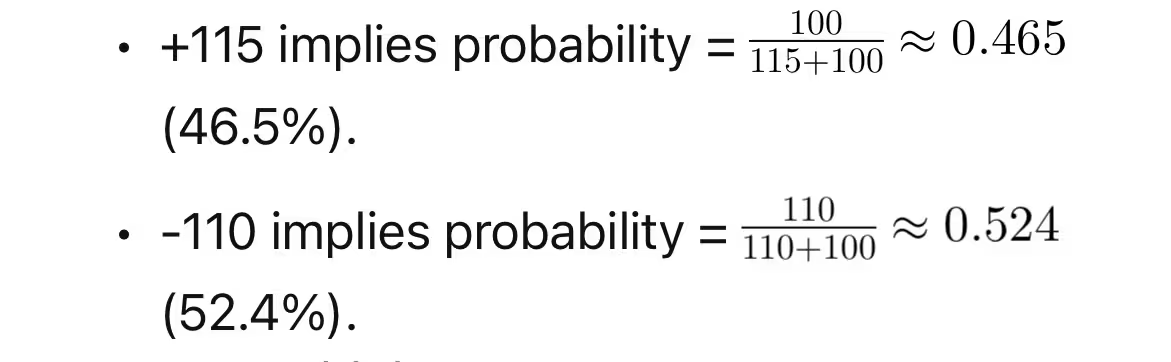
Now you add them: 46.5% + 52.4% = 98.9%. Since 98.9% < 100%, this indeed is an arbitrage situation. (In formula terms, using decimal odds: 1/2.15 + 1/1.91 = 0.989 < 1.) There is roughly a 1.1% profit margin available here.
Decide how much money in total you want to commit to this arb, or alternatively, how much you want each outcome’s payout to be. A lot of arbers choose a target payout for each side, and this makes the math easier. You could aim for each outcome to pay $100 (just as a simple baseline). You can always scale up the stakes proportionally after. For our case, we are gonna target a $100 payout on each outcome.
Using the target payout, calculate the required stake for each side:
- For Team A at +115 (which is 2.15 in decimal odds), to get $100 payout, you’d need to bet roughly $46.51 (because $46.51 * 2.15 ≈ $100). In general, Stake = Target Payout / Decimal Odds. So here: $100 / 2.15 = $46.51.
- For Team B at -110 (1.909 in decimal), to get $100 payout, you need to bet about $52.36 (because $52.36 * 1.909 ≈ $100). Calculated as $100 / 1.909 = $52.36.
If you want to target a certain total stake instead, you can use proportions: bet proportionally to the inverse of odds. But the equal payout method is intuitive!
Now, you verify the outcomes:
- If Team A wins, your Sportsbook 1 bet of $46.51 at +115 returns $100.00 (which includes $53.49 profit plus the $46.51 stake back). You lose your $52.36 bet on Team B, so after the dust settles, you have $100 from A win minus $52.36 lost on B = $47.64 net.
- If Team B wins, your Sportsbook 2 bet of $52.36 at -110 returns about $100 (specifically, it gives $47.64 profit plus $52.36 stake = $100). You lose $46.51 on Team A. You end up with $100 from B win minus $46.51 lost on A = $53.49 net.
In this calculation, the net amounts ($47.64 vs $53.49) are not exactly equal because we rounded to cents and targeted an exact $100 payout for simplicity. The difference between them (about $5.85) is the profit. To be precise, you could aim for both outcomes to net the same profit. To calculate the profit more directly: your total stake outlay was $46.51 + $52.36 = $98.87. And no matter who wins, you get around $100 back. That’s a $1.13 profit on a $98.87 investment, which is about a 1.14% return, and that matches our earlier margin calculation.
You could refine the stakes a little to even out the profit to the cent, but the principle holds: you’d make about $1.13 on ~$98.87 wagered, guaranteed.
You can scale this arb to any level that’s comfortable for you. If you wanted a higher profit, you’d increase the target payout or simply multiply all stakes by a factor. Targeting a $1000 payout on each side would mean betting $465.10 on Team A and $523.60 on Team B (10x the stakes above), yielding about $11.30 profit. Large bets like this can draw attention, so arbers usually hit lots of small arbs rather than one huge arb.
It’s always a good idea to run the numbers through an arbitrage calculator tool, especially if you’re dealing with more than two outcomes or non-standard odds. The calculator will confirm the stake split and profit. In this scenario, an arb calculator would confirm roughly a 1.1% profit and suggest the same stake proportions.
In formula terms, if we generalize for a two-outcome arbitrage:
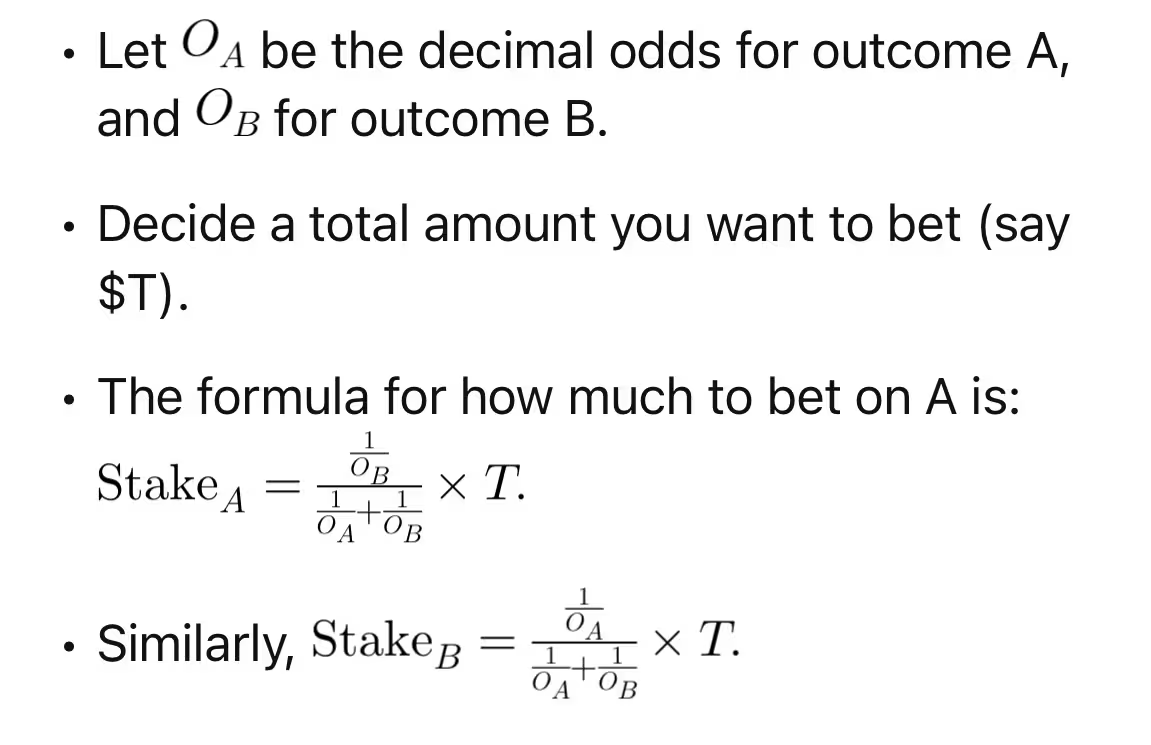
This weights your total bankroll by the inverse of the odds (which correspond to implied probabilities). In our example, O_A = 2.15, O_B = 1.909. So:
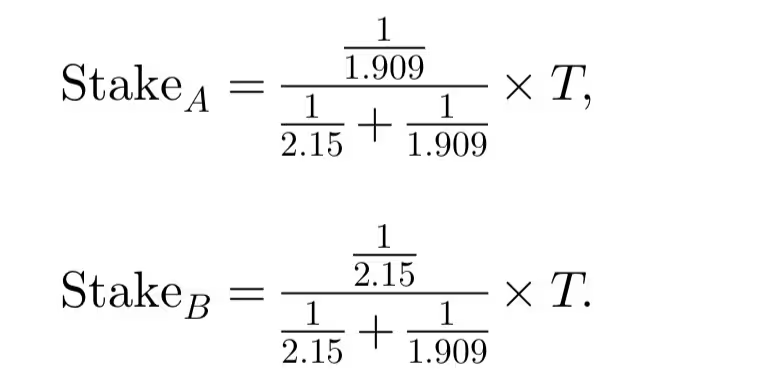
If you plug T = \$100, you’ll get the stakes we calculated manually (approximately $46.5 and $52.4). The beauty of the formula or calculator approach is that it works for any number of outcomes. For three-outcome markets (like 1X2 bets in soccer), you’d ensure 1/O1 + 1/O2 + 1/O3 < 1 and stake proportionally to each inverse odd.
You can use our free arbitrage calculator to do these computations instantly! All you do is input the odds from each book, and it will output the exact stakes for a balanced bet and show your guaranteed profit percentage.
A final tip on calculation is to always account for the possibility of different maximum bet limits or odds changing. If one sportsbook won’t accept the full amount you need to bet for an arb, you’ll have to recalculate based on what you can bet (or skip that arb). And if you place one side of an arb and the other side’s odds move before you can bet it, you must recalculate with the new odds, or you risk breaking the arb.
Real-World Examples Across Sportsbooks
Arbitrage opportunities happen in any sport, at any sportsbook; all it takes is the right circumstances. Below, we’re going to take a look at some examples to show how lines can differ across mainstream sportsbooks and how those differences translate into sure-bet profits.
NHL Total – DraftKings vs BetMGM
Not long ago, an NHL game between the Calgary Flames and Edmonton Oilers presented the perfect arbitrage scenario on the goal total.
- DraftKings had the Over 6.5 goals at -103 odds.
- While at the same time, BetMGM was offering Under 6.5 goals at +110.
The odds imply probabilities of about 50.7% (over) and 47.6% (under), adding up to only 98.3%. That leaves a 1.7% cushion for an arbitrage bettor. If you had $100 to split on this opportunity, the optimal approach was to bet roughly $51.58 on the over at DraftKings and $48.42 on the under at BetMGM. In doing so, you’d guarantee about $1.67 profit no matter if the game went over or under. No matter the outcome, one of your bets wins and returns around $101.67 while the other loses $48.42 (or $51.58), netting that $1.67. This is a small profit (1.67% return on $100), but it was free money for a minute or two until those lines changed. An arb like this is fleeting; maybe one of the books moved to -105/+105 or -110/+110 shortly after, but during that window? Quick bettors could lock in a risk-free win.
NFL Moneyline – FanDuel vs PointsBet vs BetMGM
Arbitrage usually involves only two sportsbooks, but sometimes you can involve three or more to cover all outcomes (especially in three-way markets or when using a combo of moneyline and spread). But sticking to two-book scenarios, think about an NFL game where one sportsbook has the underdog at a generous price and another has the favorite cheaper than usual.
In a past Jets vs Bills matchup, BetMGM’s moneyline on the Buffalo Bills was -300, and FanDuel’s moneyline on the New York Jets was +330. In this case, BetMGM was giving relatively favorable odds on the strong favorite (Bills) and FanDuel was giving extra on the underdog (Jets).
By betting the Bills at -300 on BetMGM and the Jets at +330 on FanDuel for proportional stakes, a bettor could secure around a 1.7% profit on their total wagered amount. About $322.50 on the Bills and $100 on the Jets would yield roughly $430 return in either scenario, netting $7.50 profit on $422.50 that was risked. The biggest-name sportsbooks have differing lines, and in this particular case, a 30-point difference on the underdog price (+300 vs +330), causing an arb.
Cross-Book Middle Turning into an Arb
Sometimes, arbitrage can be found in alternate lines or point spreads across books. An NBA game total where Caesars Sportsbook has Over 210.5 points at +100 (even money) and DraftKings has Under 211.5 points at +100 as a promotional line means that the sportsbooks not only disagree on the price, but also on the number (one offers a line a point higher).
If you bet the over 210.5 and the under 211.5, you’ve actually created a situation where two outcomes are possible:
- If the total lands exactly on 211, you win both bets (a special kind of arbitrage called a middle).
- But even if it doesn’t? You’ve bet over 210.5 and under 211.5 both at +100. The only way to lose money is if the game ends with 211 points exactly, which would push one bet and win the other, and that results in no loss (just returned stake on one side, profit on the other).
This example is a hypothetical (and a true middle rather than a pure arb), it shows how line differences can be exploited. In real arbitrage, you’re usually guaranteeing a profit on all outcomes, but experienced bettors sometimes take the smaller windows where one outcome yields a bigger win (winning both bets) and all other outcomes break even.
Consistent Small Edges Across Sportsbooks
Not all arbitrage bets are as clear-cut as plus vs. plus odds. A lot of the time, your arb will involve taking one side at a plus-odds underdog price and the other side at a slight favorite price.
DraftKings has Team X at +115 and Caesars has Team Y (the opposing team) at -105 for the same game. Team X +115 implies 46.5% and Team Y -105 implies ~51.2%, totaling 97.7%. That’s a 2.3% arbitrage margin. A bettor could put around $49 on Team X and $51 on Team Y to win $105 on either outcome, yielding a ~$5 profit on a $100 bet. The small-margin arbs (well under 3%) are way more common. They might only net a few dollars each, but over time? Even 0.5% or 1% edges can add up with enough volume.
Profitable arbing is all about volume and consistency. You could scour dozens of games to only find a handful of opportunities. But if you can reliably grab a 1-2% return on tens of thousands of dollars worth of bets (spread across many small bets), the profits turn into something tangible. This is why the most successful arbitrage bettors have accounts with as many sportsbooks as possible in their region; when one book’s line is off, you need to be ready to hit it and cover the other side elsewhere!
Risks and Challenges of Arbitrage Betting
Arbitrage betting sure sounds like the holy grail of sports wagering (free money, yay!), but it has its fair share of risks and practical challenges. It is some kind of a get-rich-quick scheme, and it’s definitely not as simple as picking up cash off the sidewalk.
Sportsbooks Don’t Like Arbers (Account Limitations)
The number one issue arbitrage bettors face is that sportsbooks actively discourage this behavior. No, arbing isn’t illegal, but it does hurt the book’s profits, and sportsbooks reserve the right to limit or ban players who consistently exploit arbitrage. If a bookmaker notices that you always beat the closing line or always make bets that guarantee profit elsewhere, they may tag you as a “sharp” or an arber. The consequences can range from reducing the amount you’re allowed to wager (your max bet on a side is $10 when it used to be $1000) to account closure. Sportsbooks see using their odds to guarantee profit as cheating the spirit of the game, and they will cut you off if they detect it.
Market Moves and Execution Risk
An arbitrage opportunity is fleeting; odds can change at any moment, and there’s always a risk that by the time you go to place both of your bets, one of the lines has moved unfavorably. The nightmare scenario for an arber is you successfully bet one side and then the other side’s odds move before you can bet it, wiping out the profit margin or even making the whole thing a loss if you still complete the bet. This execution risk is real: if you’re too slow or the market moves suddenly (maybe due to breaking injury news), you get stuck. And if one sportsbook’s bet fails to go through or is voided (like a game cancellation, or the book voided due to an obvious error), you’ll be left holding an unhedged bet on the other side.
Human Error
The pressure of fast betting means that mistakes happen. Inputting the wrong amount, betting the wrong side, or misunderstanding the odds format can turn a sure profit into a loss. If you accidentally add an extra zero and bet $1,000 instead of $100 on one side, your balance of stakes is ruined. Or if you confuse a team because of similar names or bet an alternate line that wasn’t the one you intended, you might not actually have covered all outcomes correctly. Even if you use calculators, you have to make sure that you copied the odds correctly (American vs decimal, etc.). A small oversight, like forgetting that +115 means you enter 2.15 in decimal, will throw off your math.
Capital Requirements and Bankroll Liquidity
Arbitrage betting is a low-margin, high-volume approach, which means that real profits require larger stakes spread across multiple sportsbooks. If all your money sits in one account, you can’t cover both sides of an arb, so successful bettors keep balances across several books. This ties up capital and requires being okay with funds sitting in different accounts. Constantly moving money isn’t practical; withdrawals can take time, hit limits, or raise red flags with sportsbooks. To make arbing work, you need to have enough bankroll to distribute and the patience to let it sit across platforms until opportunities present themselves.
Geolocation and Account Issues
Sportsbooks in the U.S. are licensed state by state, so you can’t bet both sides of an arb that straddles two states unless you’re physically in both (or have help). Within one state, you’ll usually have enough books to work with, but some bettors are tempted to use multiple accounts or accounts in other names to get around limits. That’s really risky, and sportsbooks run strict KYC checks, share data, and can confiscate funds if they catch duplicate accounts. For casual bettors, it’s smarter to stick to one account per book.
Limits on Promos and Markets
You might not get banned outright, but books can cut your limits where you’ve been arbing, like on niche sports or props, or lock you out of odds boosts. Some will void any bets that they decide were obvious errors, and in rare cases, post “honeypot” lines just to catch out arbers. Even without a hard ban, the more you exploit the markets, the faster a book will make your betting life harder.
Time and Mental Load
Arbing takes away some of the gambling risk but replaces it with stress. Odds change in a blink, bets have to be placed instantly, and juggling accounts across books is a lot of work. You’re not betting for fun anymore; you’re chasing small percentage gains that add up. For some? It’s worth it, but for some, it’ll get old quick.
Advanced Arbitrage Concepts
When you’re arbing, you aren’t limited to betting both sides of a moneyline! Once you’re comfy with the basics? There are some more advanced ways to exploit those mismatched lines.
- Cross-Market Arbs: Sometimes the gap isn’t between two moneylines but between related bets, like a spread on one book and a moneyline on another. If the numbers don’t line up, you can lock in profit by mixing markets.
- Middling vs. Sure Bets: A “middle” happens when you bet both sides of a spread or total at different numbers, creating a sweet spot where both bets win. Unlike classic arbs, it isn’t guaranteed a profit every time, but the payoff can be bigger if you hit the middle.
- Matched Betting: When sportsbooks hand out bonus bets or boosts, you can hedge those promos across books to turn them into real cash. It’s one of the easiest entry points into arbitrage.
- Props and Alt Lines: Books don’t always agree on player props or alternative totals. If one sportsbook prices a player at over 24.5 points and another has under 26.5, you’ve got some room to set up a profitable hedge.
Is Arbitrage Betting Worth It in 2025?
Arbitrage has been part of sports betting for a long time, but the reality in 2025 looks much different from it did when sportsbooks were slower and promos were better. The method still works, but it comes with trade-offs that make it more work than fun.
Pros
- The math guarantees profit when the numbers line up
- It’s systematic and free from the guesswork of handicapping
Cons
- It takes constant monitoring and quick execution for small margins
- Sportsbooks flag arbers and cut limits or ban accounts
- Odds across books sync faster than ever, so opportunities disappear in a moment
Verdict: Arbitrage isn’t dead and gone, but it’s by no means a long-term career either! In the present market, it works best as a side hustle; it’s a way to squeeze steady returns out of your bankroll without gambling on outcomes.
Arbing: Still Worth It or Too Risky?
Is arbing worth it? Sure, if you have the time and dedication! But it’s not gonna make you rich. All you are doing is leveraging mismatched lines here and there for value. For some bettors? It’s a worthy pursuit! But for a lot of us, the effort it demands far outweighs the rewards.
Here’s a quick recap of all things arbing:
- It does work, and the math backs this up
- Success all depends on fast execution, accuracy, and managing your bankroll across multiple sportsbooks
- Small stakes won’t move the needle; scale matters, but limits make that harder
- Think in terms of racking up small but steady returns, not big jackpot wins
- Detailed tracking is a non-negotiable; you have to be and stay organized to catch mistakes and exploit them