
Risk-Free Bets Aren’t Risk-Free: What Bonus Language Really Means
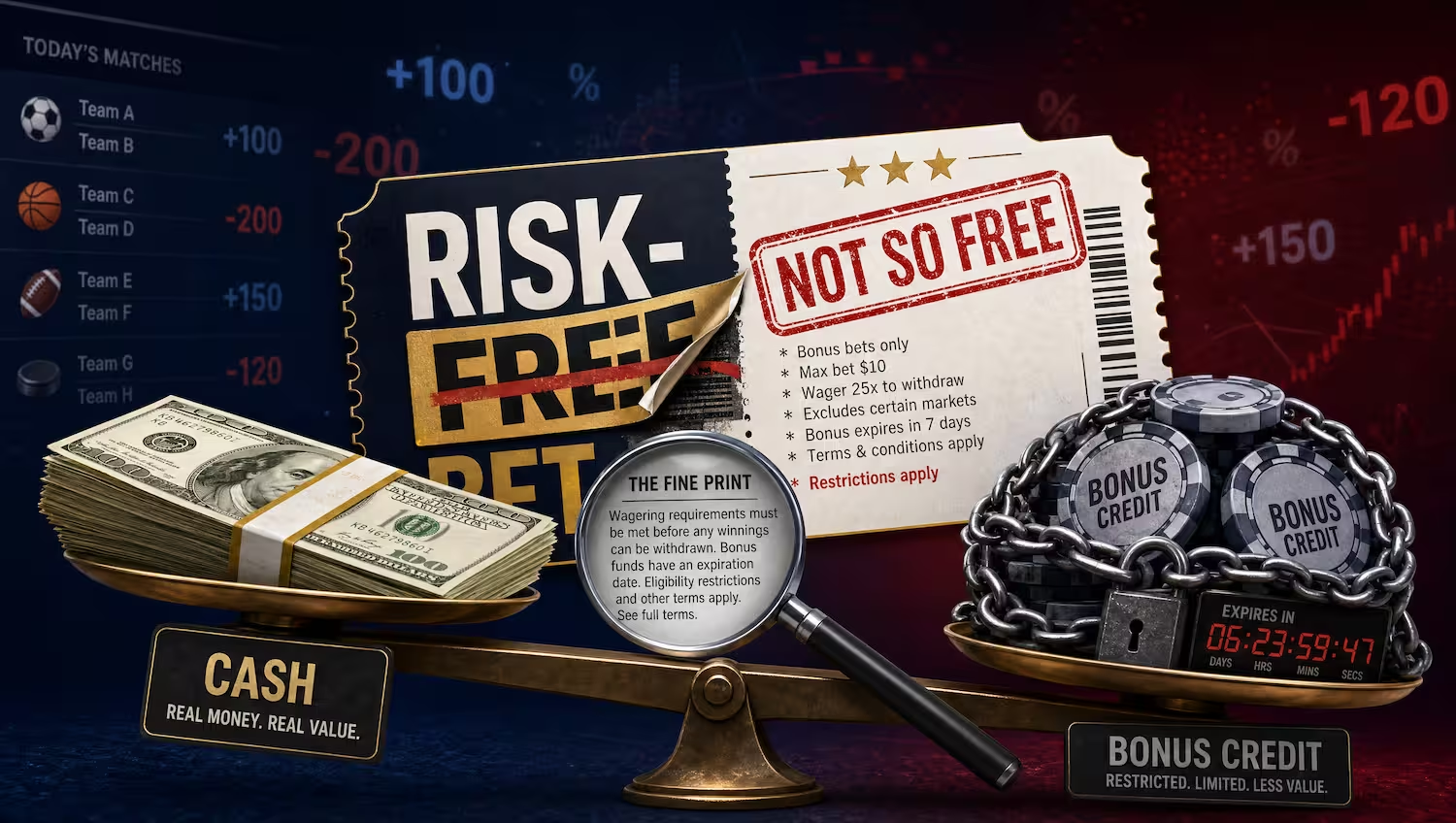
Risk-free bets are not risk-free, and that isn’t an opinion — it’s the reason the phrase got scrubbed out of nearly every legal U.S. sportsbook ad. A “risk-free bet” always meant you put up your own cash first. If the wager lost, you got that money back as a bonus bet or site credit, never as withdrawable dollars. You were never risking nothing. You were risking the time, the opportunity, and the very real gap between cash and a restricted credit you still have to gamble with.
The wording is mostly gone now, but the offers behind it are everywhere — rebranded as bonus bets, first-bet offers, no-sweat bets, second-chance bets, and deposit matches. Here’s what each one actually does to your money, why the industry’s own marketing code and a string of state regulators forced the language to change, and how to read a promo before you tap “opt in.”
What Is a “Risk-Free Bet,” Exactly?
A risk-free bet is a promotion where you place a real-money wager and, if it loses, the sportsbook refunds your stake — but the refund arrives as a bonus bet or site credit, not cash, usually capped at a set amount and limited to your very first bet. If the bet wins, you collect your normal winnings and the promo never triggers. The offer only ever does anything for someone who loses.
That’s the sleight of hand baked into the name. “Free” and “risk-free” make it sound like the house is covering your downside out of generosity. What’s really happening is closer to a store coupon: lose your $100 first bet and you don’t get $100 back to spend on groceries — you get $100 you can only spend back inside the same store, on more bets, under more rules.
So before we go further, here’s what a “risk-free” first bet actually puts on the line:
- Your cash, upfront. The first wager is real money out of your account. There is no version where you bet nothing.
- The cash-to-credit gap. A refund in bonus bets is worth meaningfully less than the dollars you lost (more on the math below).
- A second forced gamble. To realize any value from the refund, you have to bet again — and likely lose some of that, too.
So Why Isn’t It Actually Risk-Free?
It isn’t risk-free because a bonus bet is worth less than the cash it “replaces,” and you have to gamble again to see any of it. The single most important rule of bonus bets: when a bonus bet wins, you keep the profit but not the stake. A regular $100 cash bet at +100 returns $200 (your $100 back plus $100 profit). A $100 bonus bet at the same +100 returns just $100 — the stake evaporates.
Run it at longer odds and the gap is the same idea: a $25 bonus bet at +400 pays $100 in profit, where a $25 cash bet would pay $125. Industry estimates generally peg a bonus bet’s real cash value at roughly 60–70 cents on the dollar, depending on the odds you play it at. So a “$1,000 risk-free bet” that loses doesn’t hand you $1,000 — it hands you a credit realistically worth somewhere in the $600–$700 range, and only if you bet it well.
Bonus bets are single-use, non-withdrawable, and usually expire in 7 days (some run 14). You typically can’t split one across multiple wagers, there’s often a minimum-odds requirement (commonly around -200 or longer), and a max-cashout cap may apply. Lose the bonus bet and it’s simply gone.
Here’s the same idea as a side-by-side, because seeing it usually lands harder than reading it:
| $100 wager at +100, it wins | Real cash bet | Bonus bet |
|---|---|---|
| Stake returned | $100 | $0 |
| Profit paid | $100 | $100 |
| Total back in your account | $200 | $100 |
None of this means the sportsbook is breaking a rule. The terms are posted and the math is fixed. It just means a “risk-free” bet is a marketing frame, not a financial reality — and that’s exactly the conclusion regulators reached.
Why Sportsbooks Stopped Saying “Risk-Free”
Sportsbooks stopped saying “risk-free” because regulators and the industry’s own trade group decided the phrase was misleading and made them stop. In March 2023, the American Gaming Association — the casino and sportsbook industry’s main lobbying body — amended its Responsible Marketing Code for Sports Wagering to prohibit the words “risk free” outright, calling it one of the most significant changes to the code since its creation. AGA member operators were given a grace period until July 1, 2023, to pull existing “risk-free” creative.
State regulators got there first, and they had actual fines, not just a code. When Ohio launched legal sports betting on January 1, 2023, the Ohio Casino Control Commission moved almost immediately on promos that called something “free” or “risk-free” while still requiring bettors to put up their own money. On February 15, 2023, the commission approved penalties including a $500,000 fine for DraftKings and $250,000 for Penn Entertainment’s Barstool Sportsbook; another major operator settled a related matter for $150,000, and BetMGM was cited in the same enforcement wave.
The DraftKings case is the cleanest example of why “free” was a problem: the company advertised “$200 in free bet credits” that a customer could only get after wagering at least $5 of their own money. Under Ohio’s rules, you cannot call something “free” if the player has to spend to obtain it. Massachusetts and Colorado regulators pushed on the same language around the same period. You can read the Ohio rules and enforcement record straight from the regulator at the Ohio Casino Control Commission.
Ohio’s regulator approved roughly three-quarters of a million dollars in advertising penalties in a single February 2023 session — $500,000 for one operator and $250,000 for another — largely over “free” and “risk-free” promo language that required bettors to risk real money first.
Bonus Bets, No-Sweat Bets, Deposit Matches: A Plain-English Glossary
Same offers, new names — the “risk-free” structure didn’t disappear, it just got relabeled into compliant language. Today the major books, including FanDuel, mostly say “bonus bets,” and the welcome offer usually shows up as a “first-bet offer” or a “bet-and-get.” Here’s what each label actually means and where the cost hides:
| Term | What it really means |
|---|---|
| Bonus bet | A single-use wager where a win pays profit only — the stake is not returned. The modern replacement for “free bet.” |
| First-bet offer / first-bet insurance | Lose your first real-money bet and get it refunded as bonus bets, up to a cap. The old “risk-free bet,” renamed. |
| No-sweat bet | Same loss-refund structure as a first-bet offer, usually a smaller cap and tied to a specific game or day. |
| Second-chance bet | Another name for a no-sweat bet — only pays out if your qualifying wager loses. |
| Bet & get | Bet a qualifying amount and receive bonus bets regardless of result — the bonus bets still don’t return their stake. |
| Deposit match | A casino-side bonus that matches a percentage of your deposit — and attaches a wagering requirement before you can withdraw. |
Notice the pattern: every label that survived the “risk-free” purge still routes value through a restricted credit, not cash. The honest one-line translation of all of them is “a discount on betting you were already going to do,” which is fine — as long as you price it that way and not as found money.
The Casino Side: Deposit Matches and Wagering Requirements
On the online casino side, the catch hides in a single number called the wagering requirement — also called playthrough or rollover — which is how many times you must bet the bonus (often the deposit plus the bonus) before any of it becomes withdrawable. It’s the casino equivalent of “risk-free” fine print: the headline number is generous, the term that governs it is where the value actually lives or dies.
The math is brutal once you write it out. Deposit $100, get a $100 match at a 25x wagering requirement, and you typically have to place $2,500 in bets before a cent is cashable. Requirements run anywhere from a friendly 1x to an ugly 50x or higher; as a rough guide, 10x–25x is reasonable and anything north of 40x deserves a hard look at whether it’s worth your time at all.
Not every game clears the requirement at the same rate. Slots usually count 100%, but blackjack and video poker often count just 10%, and live dealer games sometimes count 0%. A “5x” requirement played entirely on a 10%-weighted table game is effectively a 50x requirement. Always read the contribution table, not just the headline multiplier.
This is the same lesson as the sportsbook side, wearing a different hat: the number that sells the promo isn’t the number that decides whether it’s worth taking. We break down how to actually extract value (and when to skip an offer entirely) in our guide to online casino bonuses, and there’s a longer walkthrough on turning credits into withdrawable money in free bets and casino bonuses into real cash.
How to Read a Bonus Offer Before You Opt In
Before you opt into any offer, find five things in the terms — and if you can’t find them quickly, treat that as the answer. Reputable books disclose all of this; the question is whether you read it before or after you’ve committed your deposit.
- Form of the reward. Cash, withdrawable balance, or bonus bets/site credit? If it’s a credit, mentally discount it by 30–40%.
- Expiry window. Most bonus bets die in 7 days. A credit you forget to use is a 100% loss.
- Minimum odds. Many offers require the qualifying or bonus wager to be at roughly -200 or longer, which limits how safely you can play it.
- Wagering requirement. Casino-side especially — find the multiplier and the game-weighting table before depositing, not after.
- Maximum cashout. Some offers cap how much bonus-derived winnings you can ever withdraw, no matter how well the bet does.
Ask: “If this offer didn’t exist, would I make this exact bet with my own cash?” If yes, the promo is a genuine discount. If you’re only making the bet because of the promo, the sportsbook just used the word “free” to change your behavior — which is the entire point of the offer.
Are These Offers Going Away?
Not soon, but they’re under real and growing pressure. The “risk-free” language is already gone; the offers themselves are now the target. Maine enacted a law in 2023 restricting how sportsbooks can advertise promotional bonus offers in public forums, and several bigger swings are pending — note that these are proposals, not current law:
- Federal SAFE Bet Act. The Tonko–Blumenthal bill would, among other things, ban advertising during live events and prohibit promoting “bonus bets,” “no-sweat bets,” and similar inducements nationwide. It remains a proposed federal bill, not law.
- New York A7962. Would bar advertising “odds boost,” “bonus bet,” or similar inducements, while still allowing the offers to exist inside the apps.
- New Jersey AB4003. Advanced out of committee; would make bettors who use responsible-gaming tools ineligible for promotions.
Here’s the honest bottom line. A bonus offer is not a gift — it’s customer-acquisition spending, and it works because “free” and “risk-free” move people who would otherwise keep their cash in their pocket. None of that makes the offers a scam; used clear-eyed, a first-bet offer or a deposit match can be a legitimate discount on entertainment you were buying anyway. The trap is the framing, not the promo. Read the credit as what it is — restricted, expiring, worth less than cash — and the marketing loses its grip on your bankroll.
Play Safe: Gambling should be fun, not stressful. Set limits, stick to your budget, and never chase losses. If you or someone you know has a gambling problem, call 1-800-MY-RESET or visit ncpgambling.org. For more resources, see our Responsible Gambling page.
Frequently Asked Questions
Bonus offers come wrapped in language that’s designed to move quickly past the parts that matter — the stake rules, the expiry windows, the wagering math. The questions below cover the ones that come up most often when readers actually sit down to read a promo’s terms: what you’re really risking, what a bonus bet is worth compared to cash, why the “risk-free” label got pulled, and how to tell a genuine discount from a marketing frame. If you only have a minute, start here before you opt in.
If a bet is advertised as “risk-free,” am I actually risking any of my own money?
Yes. A risk-free bet always requires you to place a real-money wager first. If it loses, you’re refunded in bonus bets or site credit — not withdrawable cash — usually up to a cap and only on your first bet. You risk your stake, the gap between cash and credit, and the time it takes to bet the credit back. That’s why U.S. regulators and the industry’s own marketing code pushed the phrase out of advertising in 2023.
Do I get my original stake back when I win with a bonus bet?
No. A winning bonus bet pays profit only, not the stake. A $100 bonus bet at +100 returns $100, while a $100 cash bet at +100 returns $200 (your stake plus profit). That single difference is why a bonus bet is worth roughly 60–70 cents on the dollar compared to real money.
Why did sportsbooks stop calling them “risk-free bets”?
Because regulators and the American Gaming Association decided the term was misleading. The AGA amended its Responsible Marketing Code in March 2023 to ban “risk free,” with members required to comply by July 1, 2023. State regulators acted too — Ohio approved fines including $500,000 for DraftKings and $250,000 for Penn’s Barstool Sportsbook in February 2023 over “free” and “risk-free” promos that still required bettors to risk their own money.
What’s the difference between a no-sweat bet and a casino deposit match?
A no-sweat bet is a sportsbook offer that refunds a losing qualifying wager as bonus bets, usually with a smaller cap tied to a specific game or day. A deposit match is a casino offer that matches a percentage of your deposit but attaches a wagering requirement — you must bet the bonus (often deposit plus bonus) a set number of times before withdrawing. Both route value through restricted credit rather than cash.
How do I tell if a casino bonus is actually worth claiming?
Find the wagering requirement and the game-weighting table before you deposit. A $100 deposit with a $100 match at 25x means roughly $2,500 in bets before any withdrawal. Then check weighting: slots usually count 100%, but table games may count only 10%, which can quietly turn a 5x requirement into an effective 50x. If the requirement is above about 40x or the weighting is poor for the games you play, it’s often not worth the time.