




Carlos Alcaraz’s U.S. Open Title Defense: Should Bettors Back Him Again?
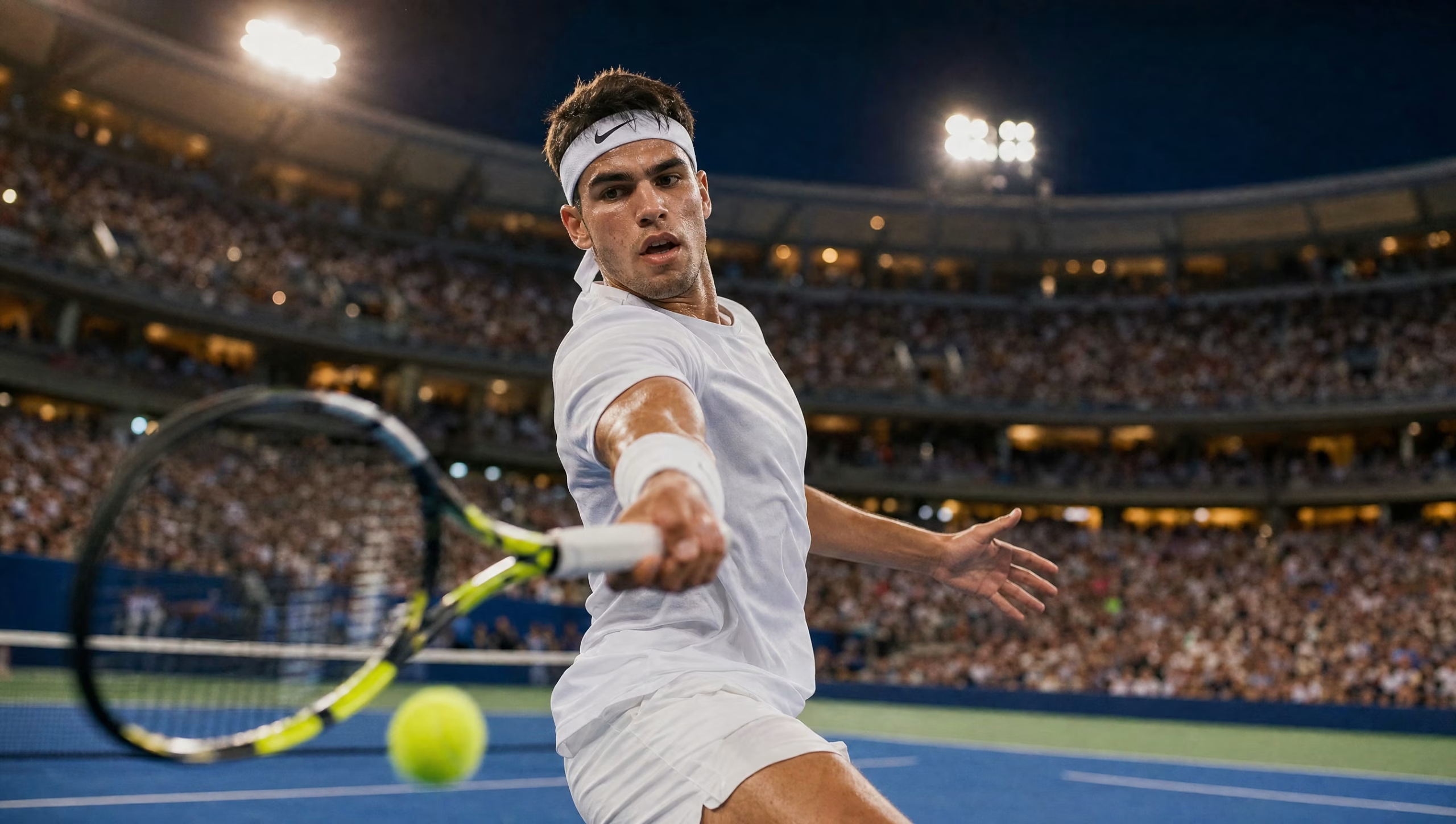
Seventeen men have walked into Flushing Meadows as the defending US Open champion since Roger Federer’s 2008 repeat, and all seventeen left without the trophy. Carlos Alcaraz is attempt number eighteen, and the market has already decided he is different: two matches into his first tournament since April, the Alcaraz US Open odds sit at 44 to 45 cents on Kalshi and Polymarket, and six regulated sportsbooks priced him between -2000 and -2400 to win Friday’s third-round match.
Our read on the title defense is a split decision: the player is worth backing, but the outright price, after two weeks of shortening and with a wrist that has logged seven competitive sets since April, is not. The better money is round by round, and the rest of this piece shows you where.
Where the Alcaraz US Open Odds Stand Right Now
As of Friday morning, September 4, Alcaraz trades at 44 cents bid and 45 cents ask on Kalshi, 43 to 44 cents on Polymarket and 53 cents on DraftKings Predictions, and the sportsbooks that opened him at +195 (FanDuel, August 29) and +250 (DraftKings, August 27) now make him roughly a 95% favorite to beat Wu Yibing in the third round. Every venue moved the same direction this week, and they got there in two distinct steps.
| Market | Alcaraz Price | As Of |
|---|---|---|
| FanDuel outright (pre-tournament) | +195 | Aug. 29 |
| DraftKings outright (pre-tournament) | +250 | Aug. 27 |
| Kalshi winner contract | 44c bid / 45c ask | Sept. 4, 9:30 a.m. ET |
| Polymarket winner contract | 43c bid / 44c ask | Sept. 4, 9:30 a.m. ET |
| DraftKings Predictions | 53c | Sept. 4 (Yahoo Sports tracker) |
| Third-round moneyline vs. Wu Yibing | -2000 to -2400 (six books) | Sept. 4, 9:30 a.m. ET |
The first step was Jannik Sinner’s withdrawal on August 21. Kalshi’s contract on Alcaraz jumped to 38 cents on the news, then drifted back to 27 cents by August 28 as traders weighed a defending champion who had not played a singles match in four months.
The second step was the tournament itself. DraftKings Predictions had him at 47 cents on Thursday and 53 by Friday after the four-set win over Jaime Faria, and Kalshi added 17 cents in a week. A price that nearly doubles in ten days is not a market that has found its level. It is a market that stopped worrying.
ℹ️
Why 53 Cents Is Not a 53% Chance
The ten names Yahoo Sports listed from DraftKings Predictions on Friday add up to 128 cents, not 100, so Alcaraz’s 53 cents is about 41% of that book once you normalize it. Polymarket’s 48-runner book summed to 100.4 cents at our pull, which makes its 43.5-cent price a genuine 43% share, and Kalshi’s 44 to 45 cents lands in the same neighborhood once its penny legs are stripped out. Three venues, one answer: a little better than a two-in-five shot. Every one of those figures is the market’s implied number, not a prediction of ours.
Why the Market Keeps Shortening Him
Three things happened inside one week: Alcaraz won twice without a wrist scare, Sinner never arrived, and seven of the top 16 seeds were gone before the third round, Novak Djokovic among them. Any one of those shortens a favorite. All three together turned a +250 outright into a 45-cent contract.
Sinner’s absence is the biggest single factor. The world No. 1 pulled out on August 21 with the right knee problem that had already cost him Toronto and Cincinnati, the first major he has missed since his 2019 debut in New York. He made that decision 44-3 on the season with six titles, including the first five Masters 1000 events of the year and a second straight Wimbledon.
He is also the man who beat Alcaraz in the 2025 Wimbledon final and then lost last September’s US Open final to him in four sets. Remove him and the field loses its only proven Alcaraz problem.
Djokovic’s exit came on Sunday night, August 30, a five-set loss to unseeded Argentine Mariano Navone over four hours and 36 minutes, through cramps and bouts of vomiting on court. It was his first opening-round defeat at the US Open and his earliest exit at any major since 2006, and it removed the man who beat Sinner in Melbourne in January before losing the Australian Open final to Alcaraz. The 39-year-old was +700 on FanDuel’s pre-tournament board, the third-shortest price on it.
The rest of the carnage came from further down the seedings, and the names matter because their implied probability had to go somewhere:
- No. 3 Félix Auger-Aliassime: lost in the second round to Karen Khachanov.
- No. 6 Alex de Minaur: lost in the second round to Botic van de Zandschulp, the man who knocked Alcaraz out of this event in 2024.
- No. 10 Arthur Fils: lost in the first round to Stefanos Tsitsipas, 4-6, 7-6(3), 6-1, 6-4, a week after winning the Cincinnati Masters.
- No. 12 Rafael Jódar: lost in the first round to lucky loser Bu Yunchaokete.
- No. 13 Lorenzo Musetti: lost in the second round to wild card Dane Sweeny.
- No. 16 Brandon Nakashima: lost in the second round to Alex Michelsen.
Add Djokovic to those six and roughly 36 points of raw implied probability on FanDuel’s August 29 board, more than a quarter of the whole book, have already been eliminated. That money did not vanish. It was repriced onto the survivors, and Alcaraz, the shortest of them, absorbed the largest share. Ben Shelton at 13 cents and Taylor Fritz at 12 on DraftKings Predictions took most of the rest.
No Man Has Defended the US Open Title Since 2008
Federer’s 2008 title, the last of five straight, is the most recent successful defense in New York, and the 17 champions since have combined for five lost finals, three semifinal exits, four earlier defeats and five years in which the champion never took the court. Seven men have defended this title in the Open Era. Nobody has done it in the last 17 attempts.
| Year | Defending Champion | How the Defense Ended |
|---|---|---|
| 2009 | Roger Federer | Lost the final to Juan Martín del Potro |
| 2010 | Juan Martín del Potro | Did not play (wrist surgery) |
| 2011 | Rafael Nadal | Lost the final to Novak Djokovic |
| 2012 | Novak Djokovic | Lost the final to Andy Murray |
| 2013 | Andy Murray | Lost the quarterfinal to Stan Wawrinka |
| 2014 | Rafael Nadal | Withdrew before the event (right wrist) |
| 2015 | Marin Čilić | Lost the semifinal to Djokovic |
| 2016 | Novak Djokovic | Lost the final to Wawrinka |
| 2017 | Stan Wawrinka | Did not play (knee) |
| 2018 | Rafael Nadal | Retired in the semifinal against del Potro |
| 2019 | Novak Djokovic | Retired in the fourth round against Wawrinka (shoulder) |
| 2020 | Rafael Nadal | Did not play (COVID-19 concerns and the compressed schedule) |
| 2021 | Dominic Thiem | Did not play (wrist) |
| 2022 | Daniil Medvedev | Lost the fourth round to Nick Kyrgios |
| 2023 | Carlos Alcaraz | Lost the semifinal to Medvedev |
| 2024 | Novak Djokovic | Lost the third round to Alexei Popyrin |
| 2025 | Jannik Sinner | Lost the final to Alcaraz |
Read the right-hand column again and the pattern is not upsets. It is bodies. Three of the five no-shows were wrist injuries (del Potro in 2010, Nadal in 2014, Thiem in 2021), two more defenses ended with the champion retiring mid-match, and two weeks of best-of-five tennis in New York’s late-summer humidity has broken down more defenders than any single opponent has.
Alcaraz already knows the feeling. He was the defending champion in 2023 and lost the semifinal to Daniil Medvedev, who sits in his half of the draw again this year.
One honest caveat before you build a bet on a streak: 17 straight failures says a lot about how hard this tournament is and nothing mathematical about Alcaraz’s chances on Friday. Markets price players, not curses. What the list does tell you is where the risk to a defending champion has actually lived, and that brings us to the wrist.
The Wrist Is the Whole Bet
Alcaraz has not lost a match at a major in 2026, and until Monday he had not played one since Melbourne either, which is why his right wrist is the single variable that decides this ticket. The tenosynovitis that flared at the Barcelona Open on April 15 cost him Madrid, Rome, a French Open he had won the previous two years, Queen’s, Wimbledon, Toronto and Cincinnati. He announced his return on August 20, 11 days before his first match, with a 22-3 record, an Australian Open title and the career Grand Slam (at 22 years and 272 days, the youngest man to complete it) already banked before the injury.
His first competitive points back came in mixed doubles alongside Serena Williams, a first-round win followed by a quarterfinal loss to Flavio Cobolli and Belinda Bencic on August 26. Then the singles: a 6-4, 6-4, 6-4 win over Roman Safiullin on Monday, August 31, after which he said the wrist was “pain-free right now,” and a 4-6, 6-0, 6-3, 6-2 win over Jaime Faria on Wednesday that took two hours and 40 minutes and included 43 winners and a 33-minute second set. He is 26-3 for his career in New York and 9-0 at the majors this year.
What the two matches have not shown is the serve. He dropped the first set to Faria, ranked No. 72, and Sports Illustrated’s betting preview for Friday noted that he “isn’t serving as well as we’re used to.” Alcaraz’s own verdict after the Faria match was blunter: “I have to hit like I was hitting before the injury.” A defending champion who is pain-free but a half-step short on serve is exactly the profile that wins comfortably in week one and gets asked hard questions in week two.
⚠️
Best-of-Five Is the Real Test
Alcaraz has played seven singles sets since April, both matches against opponents ranked outside the top 70. From the quarterfinals on, the likely opposition is Shelton, Medvedev and Zverev, and those matches run long. For an outright ticket a mid-match retirement is simply an elimination, and four of the last 17 defending champions never took the court because of injury while two more retired during the tournament. Price that in before you price in the draw.
Alcaraz’s Path to a Third US Open Title
Alcaraz’s route runs through Wu Yibing on Friday, Alexander Bublik or Tommy Paul on Sunday, Ben Shelton’s section in a Tuesday, September 8 quarterfinal, then the survivor of Medvedev’s quarter in Friday’s semifinal, before a September 13 final that the top half is lining up to hand to Alexander Zverev. The draw has been kind. The schedule, a best-of-five match every other day for two weeks, is the part a returning wrist has to survive.
Third round, Friday, September 4: Wu Yibing, ranked outside the top 100, has not dropped a set through two rounds, beating Adam Walton and James Duckworth. Alcaraz won their only previous meeting, 7-6, 6-3 in Shanghai in 2024. Six regulated books priced Alcaraz between -2000 and -2400 on Friday morning in The Odds API feed, with DraftKings the shortest at -2400 and BetMGM among the books at -2000, which works out to roughly a 91% shot once the vig comes out of DraftKings’ two-way price. DraftKings also posted the match total at 31.5 games, per Sports Illustrated’s Thursday preview.
Fourth round, Sunday, September 6: the winner of 15th seed Alexander Bublik against 20th seed Tommy Paul, the two highest seeds left in Alcaraz’s section. Bublik’s serve and Paul’s court coverage are different problems, and either is a step up from anything the wrist has faced so far.
Quarterfinal, Tuesday, September 8: eighth seed Shelton is the obvious opponent, with Denis Shapovalov, 18th seed Jiří Lehečka and a resurgent Stefanos Tsitsipas the alternatives from the section beside Alcaraz’s. Shelton’s 13 cents on DraftKings Predictions is the third-shortest price in the field on that venue.
Semifinal, Friday, September 11: someone from the quarter Djokovic vacated: seventh seed Medvedev, the man who ended Alcaraz’s last title defense here in 2023, 11th seed Frances Tiafoe, Valentin Vacherot, Arthur Rinderknech, or one of Navone, Tomás Martín Etcheverry, Alex Michelsen and Daniel Mérida.
Final, Sunday, September 13: top seed Zverev, the French Open champion and Wimbledon runner-up, is priced at 20 to 23 cents across the three prediction venues to come through the top half, with fifth seed Cobolli, ninth seed Fritz, 14th seed Learner Tien and 17th seed Jakub Menšík the live alternatives. Van de Zandschulp, who beat Alcaraz here two years ago, is also in that half. For how the grass-court version of this field was priced in June, see our Wimbledon 2026 betting preview.
Is the Outright Price Worth Backing Now?
At 44 to 45 cents on the exchanges, a fair sportsbook price for Alcaraz is roughly +125 to +130, and once all three venues are normalized to the 40 to 43% share they actually imply, it is closer to +133 to +150. If your app is shorter than that, you are paying more than the market thinks he is worth. If it is longer, you have found the one place the outright still makes sense. The pre-tournament +195 at FanDuel looked like a 34% chance on paper, but the 19 names on that board summed to about 130 cents, so it was really a 26% share of the book, and anyone who took it is holding a position the market has since repriced to 44 cents.
Here is what 44 cents asks of him. Give him Friday at the books’ 91% and assume Sunday is just as safe (it will not be), and the contract still only breaks even if Alcaraz is about an 81% favorite in each of the quarterfinal, the semifinal and the final. That is a -425 moneyline against Shelton, Medvedev and Zverev in succession.
Those are the exchange’s numbers, not ours; we are only doing the division. Alcaraz may well be that good. A wrist with seven sets on it since April has not yet proved it.
Our lean: back the player, not this price. We would not add to an Alcaraz outright at 44 cents, or at anything shorter than about +130 on a sportsbook. The time to buy was August 28, when Kalshi had him at 27 cents with the wrist unproven, and the next window is likely the first set he drops in week two, when the live outright and the match price both breathe. Until then the better use of a bankroll is the markets below, and an existing futures ticket is a hold, not a reason to add.
Smarter Ways to Bet Alcaraz Than the Outright
The markets that reward what Alcaraz actually does well this fortnight are set handicaps, live betting after a slow start and the game totals in his early rounds; the outright is the market that rewards him least. None of these is a free lunch. They are simply places where the price still reflects a question instead of an answer.
Set handicaps over moneylines: a -2400 favorite returns about $4 on a $100 bet. Alcaraz -1.5 sets asks whether he wins in straight sets or drops one, which is the live question after Faria took a set off him, and it carries a real price in every round.
Live betting the slow start: he lost the first set to Faria and then won 18 of the next 23 games. If the pattern repeats against Bublik, Paul or Shelton, the in-play price on Alcaraz will sit longer than his pre-match number for a set, and that is the only time this week his price has been longer than it started.
Game totals: DraftKings’ 31.5 for the Wu match leans on Alcaraz closing in straight sets. A returning player who is not yet serving at full pitch is an argument for the over in the early rounds, and for tighter sets, not blowouts, later on.
Hedging a pre-tournament ticket: if you hold Alcaraz at +195 or +250, the cheapest insurance is Zverev outright at 20 to 23 cents, or the top half of the draw to produce the champion, with the stake sized so that either outcome returns your money. Our futures betting guide walks through the arithmetic.
Cross-venue shopping: the same Alcaraz contract traded at 43 to 45 cents on the exchanges and 53 cents on DraftKings Predictions on the same morning. Where you can access both, that gap is the whole difference between a fair bet and an expensive one; our Kalshi vs. Polymarket comparison covers how the two venues price and settle.
The Bottom Line for Bettors
Alcaraz is the best player left in the draw, the most likely champion by every market’s reckoning, and still not a bet we would make at 44 cents. Two clean matches from a player who spent four months on the sidelines is not a lot of evidence, and the 17 failed defenses since Federer are mostly a list of bodies that gave out in week two.
Back him a round at a time, buy the outright only if your book is longer than the exchanges, and if you already own a ticket from August, hedge it rather than doubling down. The trophy may well go back to Murcia on September 13. Getting there at a fair price is the only part of this you control.
Play Safe: Gambling should be fun, not stressful. Set limits, stick to your budget, and never chase losses. If you or someone you know has a gambling problem, call 1-800-MY-RESET or visit ncpgambling.org. For more resources, see our Responsible Gambling page.
Frequently Asked Questions
Quick answers to what US Open bettors are asking about Alcaraz’s repeat bid this week, with every number as of Friday, September 4.
Is Carlos Alcaraz still the favorite to win the 2026 US Open after his wrist injury?
Yes. As of September 4 he trades at 44 to 45 cents on Kalshi, 43 to 44 cents on Polymarket and 53 cents on DraftKings Predictions, well clear of top seed Alexander Zverev at 20 to 23 cents. The sportsbooks opened him at +195 (FanDuel) and +250 (DraftKings) before the tournament, and he shortened after Jannik Sinner withdrew and Novak Djokovic lost in the first round.
What do Alcaraz’s US Open odds actually mean once the vig is removed?
About a 40 to 43% share of the winner market. DraftKings Predictions’ 53 cents looks like 53% until you add up the listed legs, which came to 128 cents on Friday, so normalized he is about 41%. Polymarket’s book summed to almost exactly 100 cents, which makes its 43.5-cent price a real 43%, and a fair sportsbook equivalent sits around +130 to +150.
When was the last time a man successfully defended his US Open title?
Roger Federer in 2008, the last of his five straight titles. Every defending champion since has failed: five lost the final, three went out in the semifinals, four lost earlier, and five (del Potro in 2010, Nadal in 2014 and 2020, Wawrinka in 2017, Thiem in 2021) never played. Alcaraz himself lost the 2023 semifinal to Daniil Medvedev as defending champion.
Why isn’t Jannik Sinner playing the 2026 US Open?
Sinner withdrew on August 21 with a right knee injury that had already kept him out of Toronto and Cincinnati. It is the first major he has missed since his debut at the 2019 US Open. He came into the summer 44-3 with six titles, including Wimbledon and the first five Masters 1000 events of 2026, and he has said he is targeting the Asian swing in Beijing and Shanghai for his return.
Who does Alcaraz have to beat to win the 2026 US Open?
Wu Yibing in Friday’s third round, then Alexander Bublik or Tommy Paul on Sunday, September 6. The likely quarterfinal on September 8 is eighth seed Ben Shelton, the semifinal on September 11 comes from Daniil Medvedev’s quarter, and the September 13 final would most likely be against top seed Alexander Zverev, the reigning French Open champion.
Is it too late to bet on Alcaraz to win the US Open, or should I wait?
It is late, not too late, but the price has roughly doubled since August 28, when Kalshi had him at 27 cents. Our view is to back him round by round with set handicaps and live bets rather than pay 44 cents for the outright, and to treat any book still offering better than about +130 as the exception worth considering. Bet only what you can afford to lose: a defending champion coming off a four-month injury layoff is a real risk, not a formality.

Latest Blog Posts